
How Many Calories Are in Injera?
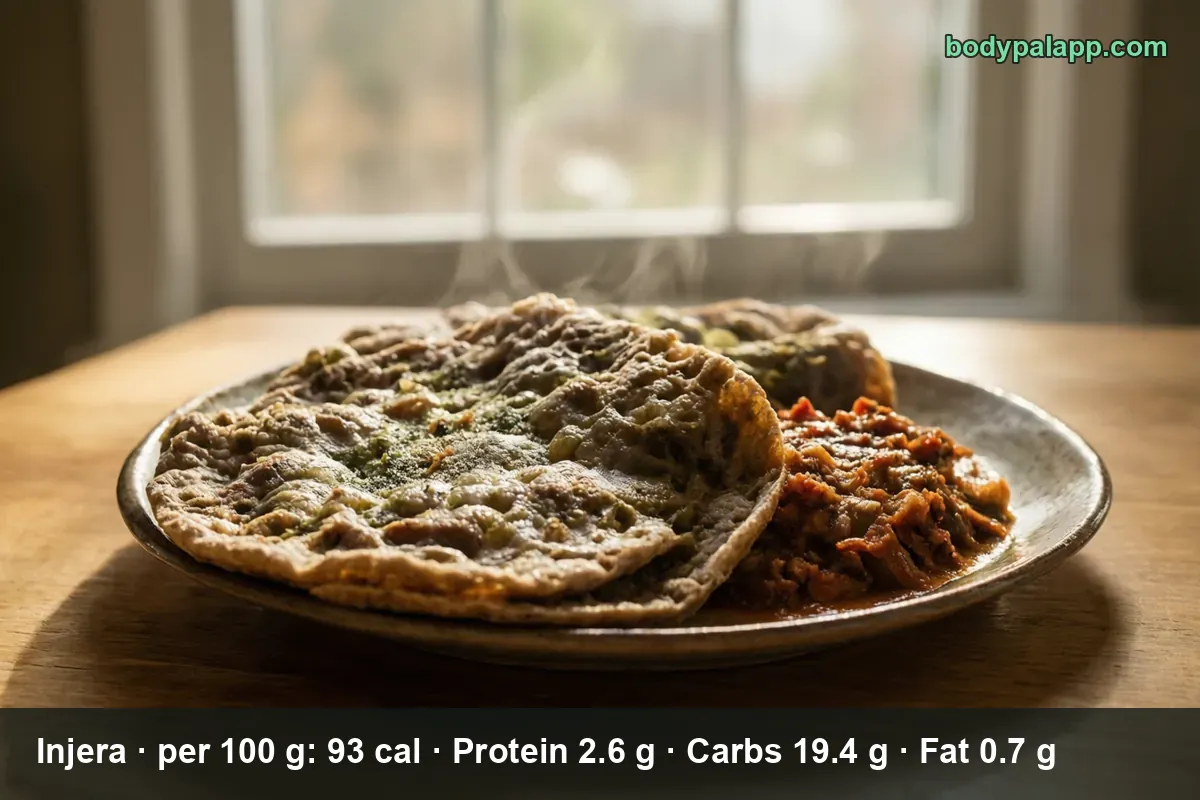
One whole injera — the 12-inch fermented sheet a restaurant lays under the stew — is 118 calories, or 93 calories per 100 g. That is the lowest per-gram figure of any bread in the USDA database. The calories in injera stay low for the same reason the sheet stays floppy: most of what you are holding is water.
On this page
- Injera quick facts
- Why injera is the lightest bread USDA lists
- One sheet, half a sheet, a cup and an ounce
- Sodium moves faster than the calories
- Teff, the grain the sheet is made of
- Injera against the other flatbreads
- FAQ
Injera quick facts
The reference below is the sheet on its own, nothing spooned onto it. USDA files it as Injera, Ethiopian bread (FDC 2707796) in its survey data, and weighs one 12-inch injera at 127 g.
| Nutrient | Per 100 g | Per 1 injera (127 g) | % Daily Value |
|---|---|---|---|
| Calories | 93 kcal | 118 kcal | — |
| Total fat | 0.68 g | 0.9 g | 1% |
| Saturated fat | 0.18 g | 0.2 g | 1% |
| Carbohydrate | 19.39 g | 24.6 g | 9% |
| Dietary fiber | 2.8 g | 3.6 g | 13% |
| Total sugars | 1.03 g | 1.3 g | — |
| Protein | 2.55 g | 3.2 g | 6% |
| Sodium | 226 mg | 287 mg | 12% |
% Daily Value is based on a 2,000-calorie diet.
Verified nutrition data
Numbers on this page come from USDA FoodData Central, the U.S. Department of Agriculture’s food composition database, and from manufacturer labels where a branded product is named. Last verified September 2026. How we verify our data →
Read the last two columns against each other and the table stops being boring. The 118 calories are 5.9% of a 2,000-calorie day. The fiber is 13% of the day and the sodium 12% — both roughly double the share the calories take. For a bread, that is an unusual shape.
Total sugars carry no percentage because the FDA sets a Daily Value for added sugars only, and the 1.3 g here is what the batter came with. Two rows you will not find above are added sugars and trans fat: the survey edition simply does not publish those two nutrients for this record, so showing them as blanks would be worse than leaving them out. Cholesterol is a straight zero.
Why injera is the lightest bread USDA lists
Ninety-three calories per 100 g sounds like a typo next to the rest of the bread basket. It is not.
| Flatbread | Calories per 100 g |
|---|---|
| Injera | 93 |
| Corn tortilla | 218 |
| Pita | 275 |
| Naan | 311 |
Injera is roughly a third of pita per gram and a little under a third of naan. The gap is not the recipe, it is the physics of how the thing is cooked. Teff batter ferments for a day or three, then goes onto a flat clay mitad as a pourable liquid and sets as a sheet. It never bakes down. Pita and naan are doughs that lose water in the oven and finish dense; injera finishes as a sponge that is still mostly the water it started with.
That has a second consequence worth knowing. On most foods, a light per-100 g number and a heavy portion pull in opposite directions — the item looks cheap by density and expensive on the plate. Injera does not do that. A whole sheet weighs 127 g, more than twice a medium pita's 57 g, and still lands at 118 calories against the pita's 157. It wins per gram and it wins per piece.
Where the calories do come from is straightforward: about 83% of them are carbohydrate, at 19.39 g per 100 g. Fat is 0.68 g per 100 g, which is 1% of the Daily Value in a full sheet, and 0.18 g of that is saturated.
One sheet, half a sheet, a cup and an ounce
| Serving | Weight | Calories |
|---|---|---|
| 1 oz | 28 g | 26 |
| Half an injera (12 in) | 63.5 g | 59 |
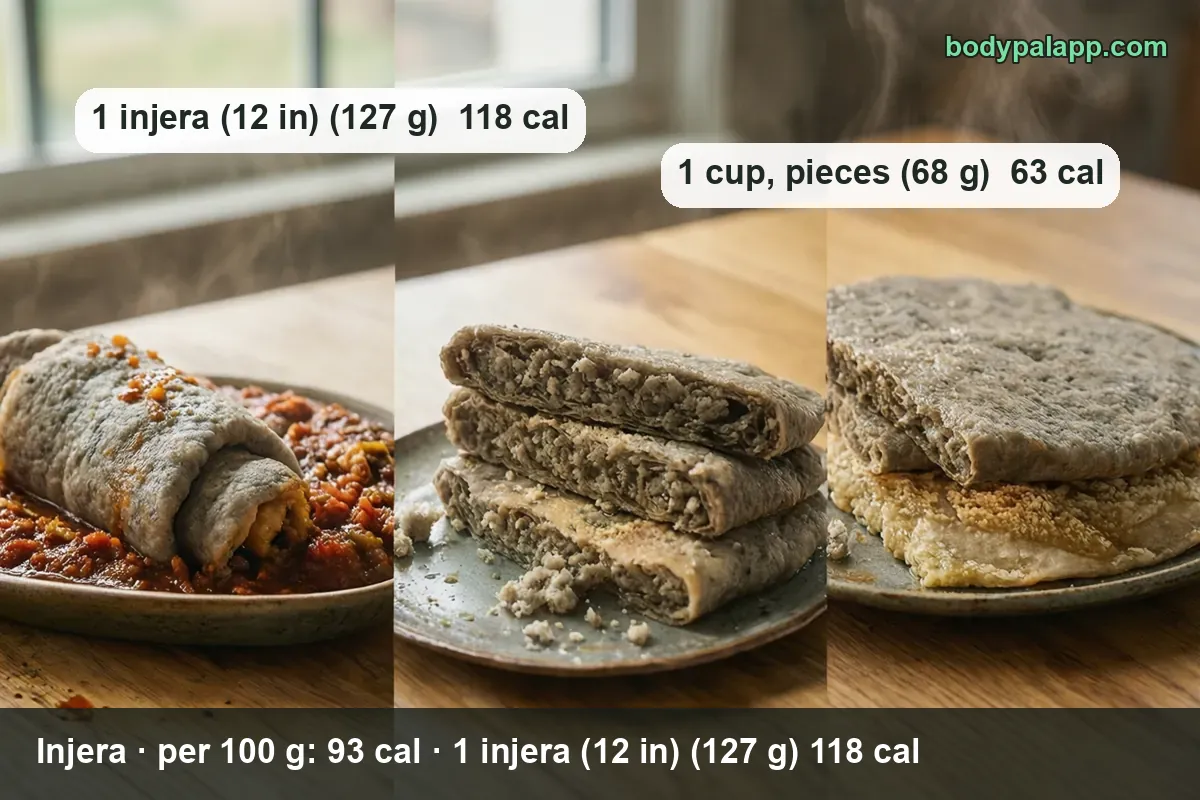
| 1 cup, torn pieces | 68 g | 63 |
| 100 g | 100 g | 93 |
| 1 injera (12 in) | 127 g | 118 |
The cup row is the one that costs people accuracy, and it costs them in the direction nobody expects. A cup of torn injera is 68 g — not 100, and not one sheet. Torn pieces are air and holes, so a packed cup is closer to half a sheet than a whole one: 63 calories, with 13.2 g of carbohydrate, 1.7 g of protein, 1.9 g of fiber and 154 mg of sodium.
Tear a whole sheet, eat all of it, log "1 cup of injera," and you have logged a little over half of what went down. The fix is to log the sheet, because the sheet is the unit that arrives at the table. Nobody serves injera by the cup.
USDA does offer one more measure, and it is a curiosity rather than a tool: 1 surface inch of injera weighs 1.1 g and comes to a single calorie. It is left out of the table above because no one has ever measured their dinner in square inches. Two rows in that table are ours rather than USDA's: the half sheet is the 127 g sheet halved, and the 1 oz row is our own conversion at 93 calories per 100 g.
Sodium moves faster than the calories
If you are going to watch one number on this page, watch this one instead of the calories.
- One 12-inch injera, 127 g: 287 mg of sodium, 12% of the Daily Value
- Two sheets under a stew, 254 g: 574 mg, 25% of the day
- One cup of torn pieces, 68 g: 154 mg, 7%
The CDC puts the adult ceiling at 2,300 mg a day, the same figure the FDA prints on the label. A single sheet spends about an eighth of a teaspoon of table salt's worth of that, and the two-sheet serving most Ethiopian restaurants build a platter on spends a quarter of the day — before the doro wat, the lentils or anything else lands on top.
The grain is not the source. Cooked teff carries 8 mg of sodium per 100 g and the uncooked grain 12 mg, both close enough to nothing. The 226 mg per 100 g in a finished injera arrives during the making of the bread, not with the flour. That matters because it is the one number in the table you cannot cook away by taking less stew.
Set against it, the fiber is genuinely good value: 3.6 g in a sheet, 13% of the Daily Value, for 118 calories. Pita gives about 2.2 g per 100 g and costs 275 calories to deliver it.
Teff, the grain the sheet is made of
Teff is the smallest cultivated grain in the world and the only thing traditional injera is made of. Watching what happens to it explains the whole page.
| Form | Per 100 g | Fiber per 100 g | US serving | Calories |
|---|---|---|---|---|
| Teff, uncooked (FDC 169747) | 367 | 8.0 g | — | — |
| Teff, cooked (FDC 168918) | 101 | 2.8 g | 1 cup (252 g) | 255 |
| Injera, finished sheet | 93 | 2.8 g | 1 injera (127 g) | 118 |
Dry teff flour is 367 calories per 100 g. The same grain, cooked as porridge, is 101. Poured out as batter and set on a mitad, it is 93. That fourfold drop is water, and it is the reason a plate-sized sheet of bread costs less than a small pita.
Teff is a whole grain, and both MyPlate and the Dietary Guidelines for Americans count whole grains toward the daily grain target. Cooked teff also has protein worth noting on its own: 9.8 g in a 252 g cup, against 3.2 g in a sheet of injera.
One thing USDA cannot tell you is what flour is actually in the sheet in front of you. The FNDDS record for injera carries no ingredient list, and plenty of American bakeries and restaurants stretch teff with wheat, barley or sorghum flour because pure teff is expensive and difficult to work. If gluten is the reason you are asking, the bakery is the only place that can answer, not a database.
Injera against the other flatbreads
| Bread | Per 100 g | US serving | Per serving |
|---|---|---|---|
| Injera | 93 cal · P 2.6 g · C 19.4 g · F 0.7 g | 1 injera (12 in), 127 g | 118 cal · P 3.2 g · C 24.6 g · F 0.9 g |
| Pita | 275 cal · P 9.1 g · C 55.7 g · F 1.2 g | 1 medium pita, 57 g | 157 cal · P 5.2 g · C 31.7 g · F 0.7 g |
| Naan | 311 cal · P 11.1 g · C 50.2 g · F 7.3 g | 1 piece (1/4 of 10 in), 44 g | 137 cal · P 4.9 g · C 22.1 g · F 3.2 g |
| Corn tortilla | 218 cal · P 5.7 g · C 44.6 g · F 2.9 g | 1 medium, 28 g | 61 cal · P 1.6 g · C 12.5 g · F 0.8 g |
| Teff, cooked | 101 cal · P 3.9 g · C 19.9 g · F 0.7 g | 1 cup, 252 g | 255 cal · P 9.8 g · C 50.0 g · F 1.6 g |
Our take: if the question is how to get a full plate's worth of bread for the fewest calories, injera wins outright and it is not close — 127 g of bread for 118 calories, where the same 127 g of naan would be 395 by our own scaling of its 311-per-100 g figure. The corn tortilla is the only thing here that beats it per serving, and only because a tortilla is a 28 g disc, a quarter the size of a sheet.
Where injera loses is protein. A sheet gives 3.2 g, against 5.2 g in a smaller pita and 4.9 g in a quarter of a naan. Injera is the bread you want when something substantial is going on top of it and you would rather the bread stayed out of the way. It is not the bread that carries a meal on its own — that is what the stew is for. And if you are watching sodium rather than calories, note that a two-sheet platter is 574 mg before anything is served onto it.
Injera FAQs
How many calories are in injera?
118 calories in one whole 12-inch injera, which USDA weighs at 127 g, or 93 calories per 100 g. That is the lowest per-gram figure of any bread in the database — pita is 275 per 100 g and naan 311. A cup of torn pieces, 68 g, is 63 calories.
How many calories are in one whole injera?
118 calories for a single 12-inch sheet weighing 127 g. That sheet carries 24.6 g of carbohydrate, 3.2 g of protein, 3.6 g of fiber and 0.9 g of fat. Half a sheet, 63.5 g, comes to 59 calories.
How many calories are in a cup of torn injera?
63 calories for 1 cup of torn pieces, which USDA weighs at 68 g rather than 100. Torn injera is mostly air, so a cup is closer to half a sheet than a whole one. It carries 13.2 g of carbohydrate, 1.7 g of protein, 1.9 g of fiber and 154 mg of sodium.
How many carbs are in injera?
24.6 g in one 12-inch sheet of 127 g, which is 9% of the Daily Value, and 19.39 g per 100 g. About 83% of injera's calories come from carbohydrate. Of that total, 3.6 g is dietary fiber and only 1.3 g is sugar.
Is injera healthy?
A sheet is 118 calories with 3.6 g of fiber, 13% of the Daily Value, and almost no fat at 0.9 g and zero cholesterol. The number that runs ahead of the calories is sodium: 287 mg, or 12% of the day in one sheet, and 574 mg in the two sheets a restaurant platter is usually built on.
Injera or pita: which has fewer calories?
Injera, both ways. Per 100 g it is 93 calories against 275 for pita, and a full 127 g sheet is 118 calories against 157 for a 57 g medium pita. Pita wins on protein, 5.2 g per pita against 3.2 g per sheet, in a piece less than half the weight.
Is injera gluten free?
USDA's record for injera, FDC 2707796, carries no ingredient list, so the database cannot answer it. Teff itself is not a gluten grain, but many American bakeries blend it with wheat, barley or sorghum flour. The kitchen that made the sheet is the only reliable source on what went into it.
How much does one injera weigh?
127 g for a 12-inch sheet in the USDA portion data, which works out to 118 calories. A cup of torn pieces is 68 g and 63 calories, and 1 oz is 28 g and 26 calories. USDA also lists a single surface inch at 1.1 g, or one calorie.
Similar foods
- Tuna Roll — 175 cal per roll, 6 pieces
- Shrimp Avocado Roll — 120 cal for 4 pieces
- Shrimp Roll — 80 cal per roll
- Corn Grits — 182 cal per cup
- Chicken Tempura Roll — 278 cal per roll, 8 pieces
- Instant Rice — 205 cal per cup
Count it without the math
Point your camera at the platter and BodyPal counts the sheets under the stew along with everything spooned on top.


How long does it take to burn off injera?
One 12-inch injera (127 g) is 118 kcal. Enter your weight and the amount you ate to see how long it takes you to burn that off:
lb
| Activity | Time to burn 118 kcal |
|---|---|
| Walking, brisk | 24 min |
| Cycling, moderate | 15 min |
| Swimming, moderate | 17 min |
| Jogging | 14 min |
| Weight training, moderate | 26 min |
Times are for a 155 lb adult at a steady pace; change the weight to see yours. The amount is set to the portion in the text (127 g); change it to what you actually ate. BodyPal works this out from your steps automatically.
One food is easy to picture; a whole day is harder. See how many calories you need a day and what a deficit actually looks like.