
How many calories are in a shrimp avocado roll?
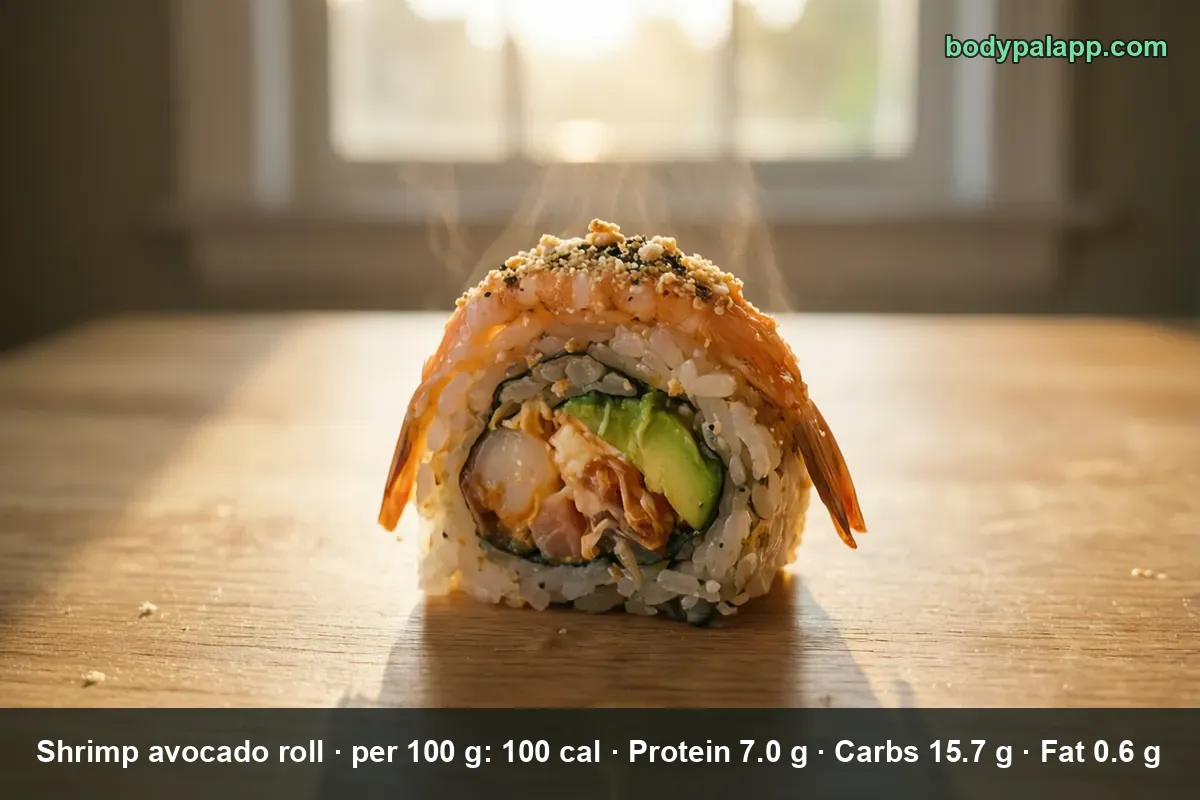
Four pieces on a plate weigh 120 g and come to 120 calories. Per 100 g the roll runs 100 calories flat, one of the tidiest numbers in the sushi case. Eight grams of protein ride along with it, and almost no fat at all.
On this page
- Shrimp avocado roll quick facts
- US servings, from one piece to a full roll
- Avocado roll, California roll and the rest of the sushi case
- Sodium and cholesterol are the rows to watch
- How does a shrimp avocado roll compare?
- Most popular shrimp avocado roll brands
- Shrimp avocado roll FAQs
Shrimp avocado roll quick facts
USDA does not publish a combined "shrimp and avocado" record. The closest match is FNDDS 2708964, "Sushi roll, shrimp", the only maki record built on cooked shrimp, and it is the one used through this page. Adding avocado to that roll is worth roughly a gram of fat per 100 g, which you can see by comparing it with the plain avocado record further down. The calorie total barely moves, because the rice dominates either way.
The numbers below are for a four-piece plate, two-thirds of the six-piece roll USDA describes.
| Nutrient | Per 100 g | Per 4 pieces (120 g) | % Daily Value |
|---|---|---|---|
| Calories | 100 | 120 | — |
| Total fat | 0.55 g | 0.66 g | 1% |
| Saturated fat | 0.15 g | 0.18 g | 1% |
| Carbohydrate | 15.67 g | 18.8 g | 7% |
| Dietary fiber | 0.7 g | 0.84 g | 3% |
| Total sugars | 0.92 g | 1.1 g | — |
| Protein | 7.01 g | 8.4 g | 17% |
| Sodium | 358 mg | 430 mg | 19% |
| Cholesterol | 51 mg | 61 mg | 20% |
| Potassium | 53 mg | 64 mg | 1% |
% Daily Value is based on a 2,000-calorie diet.
Verified nutrition data
Numbers on this page come from USDA FoodData Central, the U.S. Department of Agriculture’s food composition database, and from manufacturer labels where a branded product is named. Last verified September 2026. How we verify our data →
Two rows are missing on purpose. USDA does not publish added sugars or trans fat for this record, so guessing at them would be worse than leaving them out. The 1.1 g of total sugars in four pieces comes from the sweetened rice vinegar, not from anything added at the table.
The four-piece plate is our own arithmetic from the USDA 100 g figure, not a USDA serving. Everything scales cleanly, though, because the record lands on exactly 100 calories per 100 g: grams and calories are the same number.
US servings, from one piece to a full roll
| Serving | Weight | Calories |
|---|---|---|
| 1 oz | 28 g | 28 kcal |
| 1 piece | 30 g | 30 kcal |
| 4 pieces, as plated | 120 g | 120 kcal |
| 1 cup | 150 g | 150 kcal |
| 6-piece roll | 180 g | 180 kcal |
| Per 100 g | 100 g | 100 kcal |
The single piece, the cup and the six-piece roll are USDA household measures. The ounce and the four-piece plate are our own arithmetic from the same 100 g figure.
One caution on the piece. USDA treats a piece as 30 g, which is a fair average, but restaurant cuts run anywhere from 25 g to 40 g depending on how thick the roll is and how many pieces the chef gets out of it. A generous eight-cut roll can push a piece to 40 calories. If the menu tells you how many pieces come in the roll, log the whole roll and divide; that beats guessing at each piece.
The cup measure trips people up more than the ounce does. A cup of cut sushi is 150 g, which is more roll than most people think they are eating, and it drags 537 mg of sodium along with it.
Avocado roll, California roll and the rest of the sushi case
| Version | Per 100 g | Typical serving | Calories |
|---|---|---|---|
| Shrimp roll, whole roll | 100 kcal | 6 pieces (180 g) | 180 kcal |
| Avocado roll | 93 kcal | 4 pieces (120 g) | 112 kcal |
| California roll | 94 kcal | 4 pieces (120 g) | 113 kcal |
| Salmon roll | 103 kcal | 4 pieces (120 g) | 124 kcal |
| Tuna roll | 97 kcal | 4 pieces (120 g) | 116 kcal |
| Mixed sushi, NFS | 94 kcal | 4 pieces (120 g) | 113 kcal |
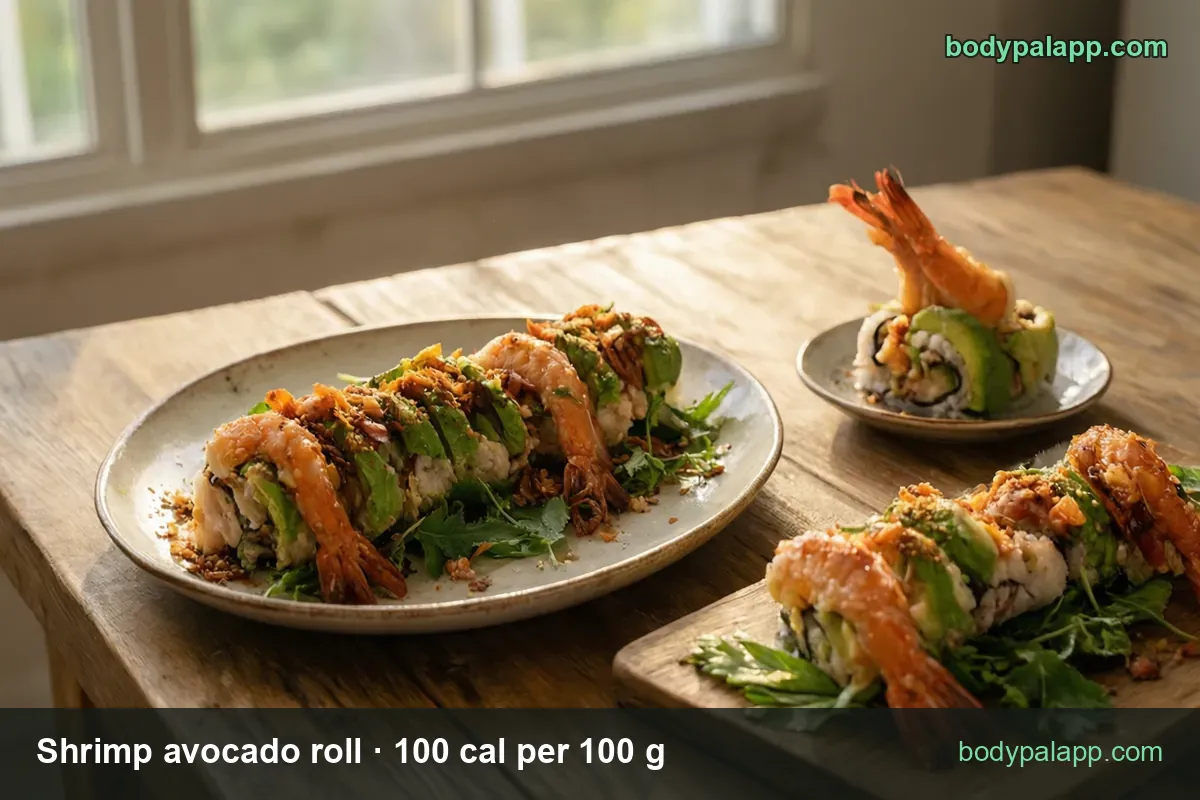
Take the shrimp out and you lose most of the point. The avocado roll is 93 calories per 100 g, so four pieces come to 112 rather than 120, but protein falls from 8.4 g to 2.2 g. That is a saving of eight calories in exchange for 6.2 g of protein. Fat moves the other way: the avocado roll carries 1.8 g per four pieces against 0.66 g, and it doubles the fiber, from 0.84 g to 1.7 g.
The salmon roll is the heaviest of the six at 103 calories per 100 g, because raw salmon brings fat that cooked shrimp does not. The tuna roll is the leanest filling on the fat line, 0.26 g per 100 g, and it comes closest to matching the shrimp roll on protein at 8.9 g per four pieces.
Restaurant and grocery rolls are a different animal. Packaged labels in the USDA branded database run from 141 to 229 calories per 100 g for rolls with shrimp or avocado, because they are built with mayonnaise, tempura batter or a heavier rice-to-filling ratio. A tempura shrimp roll at 182 calories per 100 g works out to 360 calories for a 198 g pack, nearly double the USDA roll at the same weight. If your roll was fried or dressed with spicy mayo, the generic number here is too low for it.
Sodium and cholesterol are the rows to watch
Fat and sugar are non-events on this page. Four pieces are 1% of the Daily Value for total fat and 1% for saturated fat. The rows that actually move are sodium and cholesterol.
Sodium first: 430 mg in four pieces, 19% of the FDA Daily Value of 2,300 mg. A whole six-piece roll is 644 mg, or 28% of a day, which is about a quarter teaspoon of table salt. None of that is soy sauce. The salt is inside the rice, seasoned with vinegar and salt before the roll is assembled, so you cannot dodge it by skipping the dipping bowl. You can only avoid making it worse, and a single tablespoon of soy sauce would.
Among the six sushi records here, only the tuna roll at 342 mg per 100 g and the salmon roll at 350 mg come in below the shrimp roll's 358 mg. The California roll is the outlier at 428 mg per 100 g, 514 mg for four pieces, thanks to imitation crab and mayonnaise. If sodium is what you are managing, that gap is bigger than any calorie gap on this page.
Cholesterol is the other number worth a glance: 61 mg in four pieces, 20% of the Daily Value, against 0 mg in the avocado roll. Shellfish is where it comes from. Current Dietary Guidelines no longer set a numeric cap on dietary cholesterol, so for most people this is a footnote rather than a red flag, though at 20% it is the largest percentage on the label, just ahead of sodium.
On the positive side, 8.4 g of protein for 120 calories is a good ratio for something built mostly of rice. MyPlate counts shrimp in the protein foods group, and a six-piece roll delivers 12.6 g, a quarter of the 50 g Daily Value.
How does a shrimp avocado roll compare?
| Roll | Per 100 g | US serving | Calories |
|---|---|---|---|
| Shrimp avocado roll | 100 kcal | 4 pieces, 120 g | 120 kcal |
| Avocado roll | 93 kcal | 4 pieces, 120 g | 112 kcal |
| California roll | 94 kcal | 4 pieces, 120 g | 113 kcal |
| Tuna roll | 97 kcal | 4 pieces, 120 g | 116 kcal |
Our take: the calorie spread across these four is eight calories per four pieces, which is inside the noise of how thick your chef cuts the roll. Choose on protein and sodium instead. For weight loss with the least food regret, the shrimp roll and the tuna roll are the picks, because they give 8.4 g and 8.9 g of protein for the same rice. For fullness across a longer afternoon, order two shrimp servings rather than one shrimp and one California; the calorie difference is eight, but the second plate gives 8.4 g of protein instead of 3.5 g and 430 mg of sodium instead of 514 mg. The avocado roll only makes sense as a side, not as the meal.
Most popular shrimp avocado roll brands in the United States
Ranked by how widely each product appears among foods sold in the United States, from the BodyPal food database of over 3.3 million products. Calories are the figures printed on each Nutrition Facts label, checked against USDA FoodData Central.
| Product | Calories (per 100 g) |
|---|---|
| Pada Sushi Salmon & Avocado Roll | 152 cal |
| Bento Sushi Spicy Shrimp Roll | 229 cal |
| Asian Avenue Salmoncado Salmon & Avocado Roll | 141 cal |
| Yummi Sushi Avocado Roll | 155 cal |
| Fusion Sushi Tempura Shrimp Roll | 182 cal |
Brand popularity: BodyPal food database. Nutrition: manufacturer labels / USDA FoodData Central.
Shrimp avocado roll FAQs
How many calories are in a shrimp avocado roll?
A four-piece plate weighs 120 g and carries 120 calories, because the USDA shrimp sushi record runs exactly 100 calories per 100 g. A full six-piece roll of 180 g comes to 180 calories. Along with that you get 8.4 g of protein and well under a gram of fat.
How many calories are in one piece of shrimp avocado roll?
One 30 g piece is about 30 calories, with 2.1 g of protein and 107 mg of sodium. Restaurant cuts run from 25 g to 40 g, so a thick piece can reach 40 calories. When the menu names the piece count, log the whole roll and divide rather than eyeballing each piece.
How much protein is in a shrimp avocado roll?
Four pieces give 8.4 g of protein, 17% of the Daily Value, and a six-piece roll gives 12.6 g. Almost all of it comes from the shrimp: the plain avocado roll falls to 2.2 g for the same 120 g. That 6.2 g gap is the real difference between the two rolls.
How much sodium is in a shrimp avocado roll?
Four pieces carry 430 mg of sodium, 19% of the 2,300 mg Daily Value, and a six-piece roll carries 644 mg, or 28%. That is before any soy sauce. The rice is seasoned with salt and vinegar during assembly, so the sodium is inside the roll rather than sitting on top of it.
Shrimp avocado roll vs California roll: which is lighter?
The California roll is lighter by eight calories, 113 per four pieces against 120. It also carries 514 mg of sodium against 430 and only 3.5 g of protein against 8.4. Eight calories is noise next to that. On the two numbers that matter, the shrimp roll wins comfortably.
How many carbs are in a shrimp avocado roll?
Four pieces hold 18.8 g of carbohydrate, 7% of the Daily Value, and a six-piece roll holds 28.2 g. Nearly all of it is white sushi rice. Fiber is only 0.84 g per four pieces and total sugars are 1.1 g, which come from the sweetened vinegar in the rice.
Is a shrimp avocado roll healthy?
By the numbers it is a lean plate: 120 calories per four pieces, 8.4 g of protein and 0.66 g of fat. Sodium is the weak spot at 430 mg, 19% of a day. If you are watching salt, keep the soy sauce off and treat one roll as the whole serving.
How many calories are in a 6-piece shrimp avocado roll?
A 180 g six-piece roll is 180 calories, with 12.6 g of protein, 28.2 g of carbohydrate and about 1 g of fat. Sodium reaches 644 mg, 28% of a day. Two rolls make a 360-calorie lunch, lighter than most deli sandwiches and with more protein than a bagel.
Similar foods
- Tuna Roll — 175 cal per roll, 6 pieces
- Injera — 118 cal per injera (12 in)
- Shrimp Roll — 80 cal per roll
- Chicken Tempura Roll — 278 cal per roll, 8 pieces
- Instant Rice — 205 cal per cup
- Shrimp Summer Roll — 229 cal per package
Count it without the math
Point the camera at the plate and BodyPal counts the pieces for you, shrimp tails and all.


How long does it take to burn off 120 kcal of shrimp avocado roll?
A 4-piece serving (120 g) is 120 kcal. Enter your weight and the amount you ate to see how long it takes you to burn that off:
lb
| Activity | Time to burn 120 kcal |
|---|---|
| Walking, brisk | 24 min |
| Cycling, moderate | 15 min |
| Swimming, moderate | 17 min |
| Jogging | 14 min |
| Weight training, moderate | 27 min |
Times are for a 155 lb adult at a steady pace; change the weight to see yours. The amount is set to the portion in the text (120 g); change it to what you actually ate. BodyPal works this out from your steps automatically.
Burning it off is one side of it. The other is knowing your number: work out how many calories you need a day, with macros and a goal date.