
How many calories are in a shrimp summer roll?
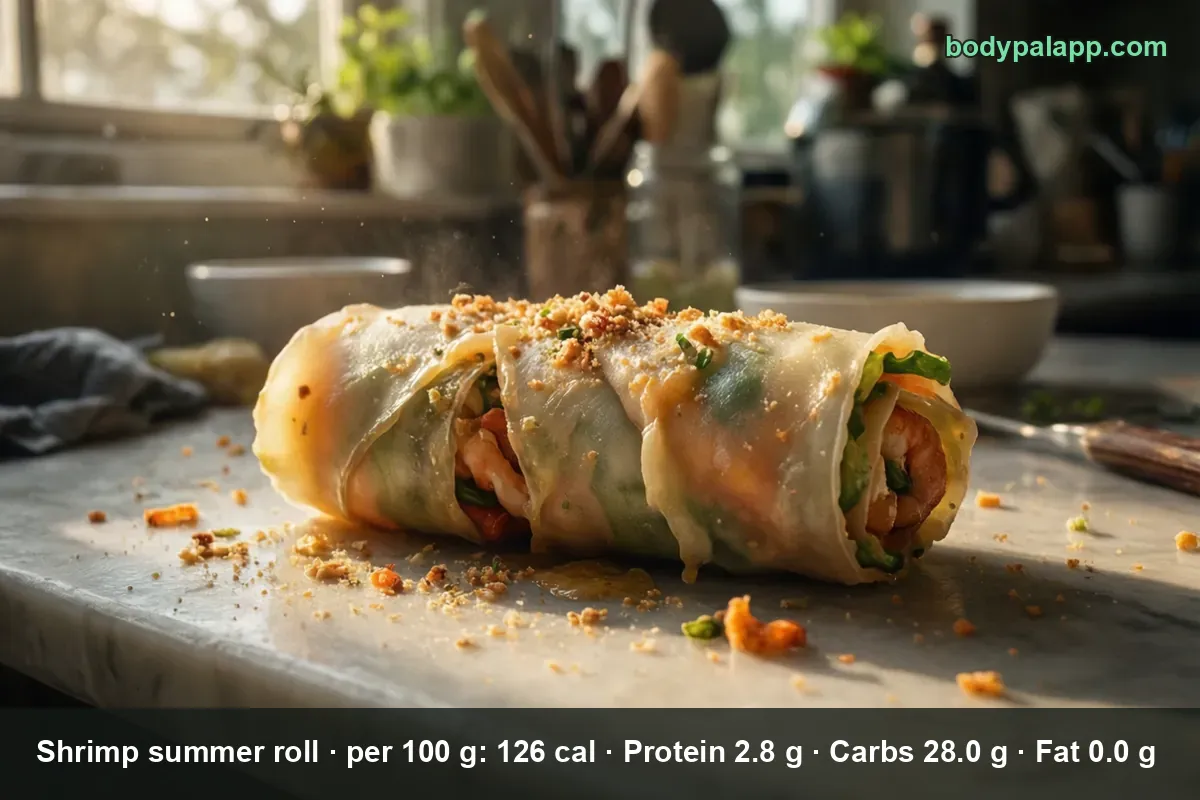
A refrigerated package of two shrimp summer rolls with its sweet chili cup weighs 182 g and carries 229 calories. Per 100 g the roll runs 126 calories, which makes a single roll about 115. Rice paper, glass noodles, lettuce and a few poached shrimp add up gently.
On this page
- Shrimp summer roll quick facts
- US servings from one ounce to a two-roll pack
- Fresh rolls mango rolls and the fried egg roll
- The sodium row beats the fat row
- How does a shrimp summer roll compare?
- Most popular shrimp summer roll brands
- FAQ
Shrimp summer roll quick facts
The record on this page is the one you actually pick up in a US grab-and-go case: USDA Branded 1968798, "Shrimp summer roll with sweet chili sauce", a Genji MAI pack of two rolls with a sealed cup of dipping sauce. It is the only USDA entry that is literally called a shrimp summer roll, and its label serving is the whole package rather than a single roll. That matters, because the sauce is counted in the numbers below.
One thing to read carefully: the fat row is 0.0 g. That is the manufacturer's Nutrition Facts panel rounding to zero, and USDA carries the label figure through. Poached shrimp, rice paper, rice noodles and vegetables genuinely bring very little fat, so the zero is close to the truth rather than an error.
| Nutrient | Per 100 g | Per 1 package (182 g) | % Daily Value |
|---|---|---|---|
| Calories | 126 | 229 | — |
| Total fat | 0.0 g | 0.0 g | 0% |
| Saturated fat | 0.0 g | 0.0 g | 0% |
| Carbohydrate | 28.02 g | 51.0 g | 19% |
| Dietary fiber | 0.5 g | 0.9 g | 3% |
| Total sugars | 7.69 g | 14.0 g | — |
| Protein | 2.75 g | 5.0 g | 10% |
| Sodium | 242 mg | 440 mg | 19% |
| Cholesterol | 19 mg | 35 mg | 12% |
% Daily Value is based on a 2,000-calorie diet.
Verified nutrition data
Numbers on this page come from USDA FoodData Central, the U.S. Department of Agriculture’s food composition database, and from manufacturer labels where a branded product is named. Last verified September 2026. How we verify our data →
Two rows you would normally expect are missing. Added sugars are not broken out in this Branded record even though the sweet chili cup is sweetened, and potassium is not reported either, so neither line appears above rather than being guessed. Total sugars have no Daily Value under the FDA labeling rules, which is why that cell stays empty.
US servings from one ounce to a two-roll pack
| Serving | Weight | Calories |
|---|---|---|
| 1 oz | 28 g | 36 kcal |
| One roll, half a pack | 91 g | 115 kcal |
| 4 oz | 113 g | 142 kcal |
| One package, two rolls with sauce | 182 g | 229 kcal |
| Per 100 g | 100 g | 126 kcal |
Only the 182 g package is a USDA serving. The single roll at 91 g, the 4 oz portion and the 1 oz line are our own arithmetic from the USDA 100 g figure, not USDA servings, because the label counts both rolls together and there is no half-pack entry to quote.
That split is the trap when you log this food. People eat one roll, see "shrimp summer roll" in a database, tap it, and take on the whole package including a sauce they may not have opened. Half the pack is 115 calories. The full pack is 229. If you left the dipping cup sealed, you are somewhere below the pack figure, and the fresh roll section further down gives you a sauce-free reference point.
Fresh rolls mango rolls and the fried egg roll
| Version | Per 100 g | Typical package | Calories |
|---|---|---|---|
| Shrimp summer roll, sweet chili sauce | 126 kcal | 182 g | 229 kcal |
| Shrimp fresh roll, no dipping sauce | 111 kcal | 209 g | 232 kcal |
| Vegetable-forward summer roll | 89 kcal | 112 g | 100 kcal |
| Shrimp mango fresh roll | 102 kcal | 305 g | 311 kcal |
| Shrimp California roll, sushi rice | 116 kcal | 172 g | 200 kcal |
| Frozen shrimp egg roll | 120 kcal | 92 g | 110 kcal |
| Restaurant Chinese egg roll, fried | 250 kcal | 113 g | 283 kcal |
The sauce-free shrimp fresh roll from the same brand is the cleanest comparison in the whole table: 111 calories per 100 g against 126, and 18.66 g of carbohydrate per 100 g against 28.02 g. Same rice paper, same shrimp, no sweet chili cup. That gap is the sauce.
The vegetable-forward summer roll is the lightest per gram at 89 calories per 100 g, mostly because it leans on herbs and lettuce instead of noodles. A three-piece 112 g tray comes to 100 calories, which is a genuinely small snack. The mango version goes the other way, not because mango is heavy but because the pack is 305 g of food.
Then there is the fried side of the family, where the wrapper changes everything. A California roll is a sushi item, rice rather than rice paper, and it sits at 116 calories per 100 g. A restaurant Chinese egg roll is wheat pastry dropped in oil: 250 calories per 100 g, double the summer roll at the same weight. Frozen retail egg rolls are smaller pieces, so a 92 g portion reads as 110 calories, but that is portion size doing the work rather than the cooking method.
The sodium row beats the fat row
The interesting number on this label is not calories at all. One package delivers 440 mg of sodium, 19% of the 2,300 mg Daily Value, for 229 calories. That is about a fifth of a teaspoon of table salt inside a lunch most people would describe as light. The Dietary Guidelines for Americans put 2,300 mg as the daily ceiling for adults, so a two-roll pack takes a fifth of it before the rest of lunch arrives.
Protein moves the other way. Five grams per package is 10% of the Daily Value, and shrimp is the only real protein source in there. Compare that with the carbohydrate row at 51.0 g and 19% DV, and the shape of the food is obvious: this is a starch-and-vegetable item with a garnish of seafood, not a protein plate.
Practically, that means the roll works better as a side than as a whole meal. If you are eating it as lunch, MyPlate style, pair it with something that carries protein, such as extra shrimp, edamame or a boiled egg. If you are watching sodium, the sauce-free fresh roll at 235 mg per 100 g is barely lower per gram, so the smarter lever is portion size rather than brand switching.
How does a shrimp summer roll compare?
| Roll | Per 100 g | US serving | Calories |
|---|---|---|---|
| Shrimp summer roll, sweet chili | 126 kcal | one package, 182 g | 229 kcal |
| Shrimp fresh roll, no sauce | 111 kcal | one package, 209 g | 232 kcal |
| Summer roll, vegetable-forward | 89 kcal | 3 pieces, 112 g | 100 kcal |
| Restaurant Chinese egg roll, fried | 250 kcal | one roll, 113 g | 283 kcal |
Our take: for weight loss, the vegetable-forward tray wins outright at 100 calories for the whole 112 g box. For a real lunch, the summer roll pack beats the fried egg roll by a wide margin, 229 against 283 for a smaller amount of food. Notice that the two shrimp packs land within 3 calories of each other, 229 and 232, even though one has sauce and the other does not, because the sauce-free pack is simply bigger. Per gram the sauce-free roll is the lighter food.
Most popular shrimp summer roll brands in the United States
Ranked by how widely each product appears among foods sold in the United States, from the BodyPal food database of over 3.3 million products. Calories are the figures printed on each Nutrition Facts label, checked against USDA FoodData Central.
| Product | Calories (per 100 g) |
|---|---|
| Genji MAI Shrimp Summer Roll w/ Sweet Chili Sauce | 126 cal |
| Genji MAI Shrimp Fresh Roll | 111 cal |
| Sushi House Summer Roll | 89 cal |
| Genji MAI Shrimp Mango Fresh Roll | 102 cal |
| Genji MAI Shrimp Mango Fresh Roll (298 g pack) | 114 cal |
Brand popularity: BodyPal food database. Nutrition: manufacturer labels / USDA FoodData Central.
Shrimp summer roll FAQs
How many calories are in one shrimp summer roll?
One roll is about 115 calories, half of the 229 in the 182 g two-roll pack. That is our own arithmetic from the USDA 100 g figure of 126 calories, since the label serving covers both rolls. Rolls rolled fatter at a restaurant will land higher.
How many calories in two shrimp summer rolls?
Two rolls, the full 182 g package with its sweet chili cup, come to 229 calories. That pack also carries 51.0 g of carbohydrate, 5.0 g of protein and 440 mg of sodium. It reads light for a lunch box, but the sodium is 19% of a day.
Are summer rolls healthier than spring rolls?
By calories, yes: 126 per 100 g for the fresh rice paper roll against 250 per 100 g for restaurant Chinese egg rolls, which are fried. The fresh roll also shows 0.0 g of fat on its label. Fried rolls bring 11.94 g of fat per 100 g.
How much protein is in a shrimp summer roll?
Not much: 5.0 g in the 182 g package, or 10% of the Daily Value, which works out to 2.75 g per 100 g. A single roll is about 2.5 g. Shrimp is lean protein, but there are only a few pieces per roll and the rest is rice paper, noodles and lettuce.
Are shrimp summer rolls high in sodium?
One package carries 440 mg of sodium, 19% of the 2,300 mg Daily Value, for only 229 calories. That is a lot of salt per calorie, about a fifth of a teaspoon of table salt. Most of it sits in the dipping sauce and the seasoned noodles.
How many carbs are in rice paper rolls?
The sweet chili pack runs 28.02 g of carbohydrate per 100 g, or 51.0 g for the whole 182 g serving, 19% of the Daily Value. The same brand's fresh roll without dipping sauce is 18.66 g per 100 g. Rice paper and glass noodles are both starch.
How many calories in a shrimp summer roll with peanut sauce?
There is no USDA record for a peanut sauce version, so the honest number is the sweet chili one: 229 calories for the 182 g pack, 115 for a roll. Peanut sauce is fattier than sweet chili, so a peanut version lands higher; log the sauce as its own line.
Are summer rolls good for weight loss?
At 115 calories a roll and 126 per 100 g, they are light for a grab-and-go lunch, and two of them with the sauce still land at 229. The catch is 5.0 g of protein per pack, so they do not hold hunger long. Pair them with a protein.
Similar foods
- Summer Roll — 229 cal per pack
- Idli — 97 cal for 2 idlis
- Instant Rice — 205 cal per cup
- Cooked White Rice — 205 cal per cup
- Sushi Rice — 242 cal per cup
- White Rice — 242 cal per cup
Count it without the math
Point the camera at the tray and BodyPal counts the rolls for you, dipping sauce included.


How long does it take to burn off 229 kcal of shrimp summer roll?
One package of two rolls (182 g) is 229 kcal. Enter your weight and the amount you ate to see how long it takes you to burn that off:
lb
| Activity | Time to burn 229 kcal |
|---|---|
| Walking, brisk | 46 min |
| Cycling, moderate | 29 min |
| Swimming, moderate | 33 min |
| Jogging | 27 min |
| Weight training, moderate | 51 min |
Times are for a 155 lb adult at a steady pace; change the weight to see yours. The amount is set to the portion in the text (182 g); change it to what you actually ate. BodyPal works this out from your steps automatically.
Burning it off is one side of it. The other is knowing your number: work out how many calories you need a day, with macros and a goal date.