
How many calories are in idli?
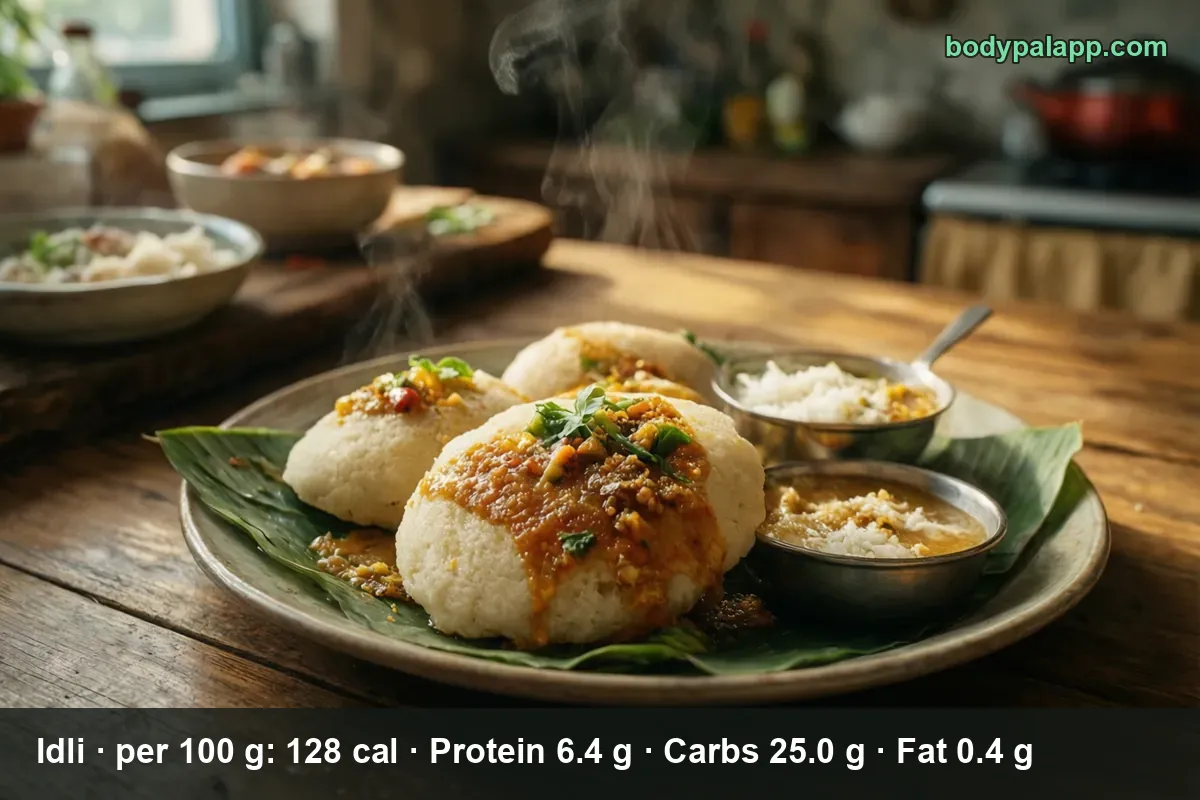
Two idli, the plate that usually comes out of the steamer, weigh 76 g and carry 97 calories. Per 100 g the steamed cake runs 128 calories, which puts a single idli at 49. That figure is for the idli alone, before the sambar and the coconut chutney land next to it.
On this page
- Idli quick facts
- US servings, from one idli to a plate of three
- Plain idli, single pieces and boxed idli mix
- Fiber beats protein on this plate
- How does idli compare?
- Most popular idli brands
- FAQ
Idli quick facts
The record behind every number here is FNDDS 2708346, "Idli", filed under rice mixed dishes. It describes the finished food: fermented rice and urad dal batter, steamed, nothing added at the table. That is the version a person actually holds, so it drives the whole page rather than a dry batter mix.
USDA gives the record two household portions, one piece and the standard two-piece serving. We build the table around the two-piece plate because that is what shows up on a breakfast tray.
| Nutrient | Per 100 g | Per 2 idlis (76 g) | % Daily Value |
|---|---|---|---|
| Calories | 128 | 97 | — |
| Total fat | 0.35 g | 0.3 g | 0% |
| Saturated fat | 0.06 g | 0.0 g | 0% |
| Carbohydrate | 24.98 g | 19.0 g | 7% |
| Dietary fiber | 5.8 g | 4.4 g | 16% |
| Total sugars | 1.85 g | 1.4 g | — |
| Protein | 6.36 g | 4.8 g | 10% |
| Sodium | 252 mg | 192 mg | 8% |
% Daily Value is based on a 2,000-calorie diet.
Verified nutrition data
Numbers on this page come from USDA FoodData Central, the U.S. Department of Agriculture’s food composition database, and from manufacturer labels where a branded product is named. Last verified September 2026. How we verify our data →
There is no added sugars row and no trans fat row because this FNDDS edition does not publish either value for the record. Nothing is lost in practice: idli is a savory batter of rice and fermented urad dal, with no sugar stirred in. Cholesterol is 0 mg in both columns, and potassium comes to 177 mg on the two-piece plate, 4% of the Daily Value.
US servings, from one idli to a plate of three
| Serving | Weight | Calories |
|---|---|---|
| 1 oz | 28 g | 36 kcal |
| One idli | 38 g | 49 kcal |
| Two idlis, the standard plate | 76 g | 97 kcal |
| Three idlis | 114 g | 146 kcal |
| Per 100 g | 100 g | 128 kcal |
The one-piece and two-piece lines are USDA household measures on the record itself. The 1 oz row, the three-piece plate and the 100 g line are our own arithmetic from the USDA 100 g figure, not USDA servings, which is why they land on such tidy multiples.
Idli is one of the few breakfasts where counting by the piece works cleanly. Each cake comes out of a fixed steamer mold, so weight barely drifts: a restaurant idli and a home idli both land near 38 g. Compare that to a pancake or a slice of bread, where the same name covers a 30 g and an 80 g object. If you log three idli instead of two, you are adding 49 calories, not guessing.
Plain idli, single pieces and boxed idli mix
| Version | Per 100 g | Typical serving | Calories |
|---|---|---|---|
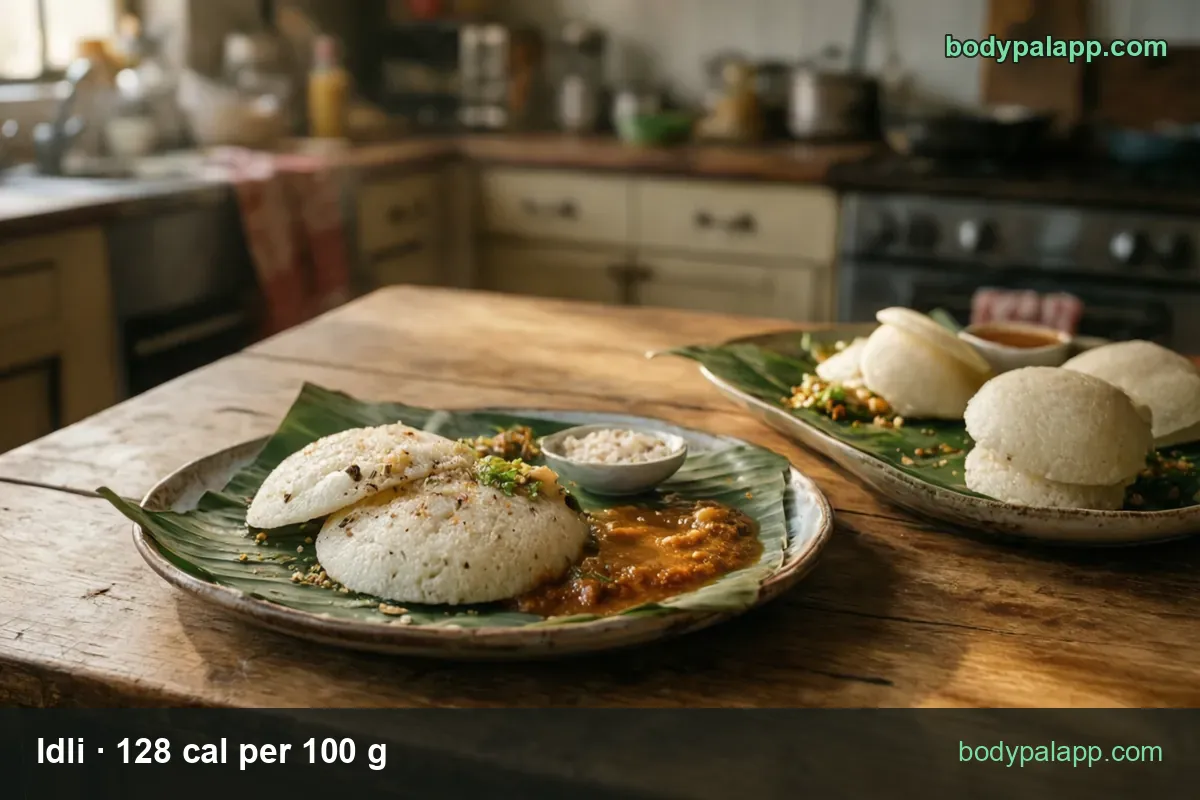
| Idli, steamed, plain | 128 kcal | 2 idlis (76 g) | 97 kcal |
| Idli, single piece | 128 kcal | 1 idli (38 g) | 49 kcal |
| Deep Idli Mix, dry mix as packaged | 360 kcal | 25 g (0.25 cup) | 90 kcal |
| Deep Rava Idli Mix, dry mix as packaged | 440 kcal | 25 g (0.25 cup) | 110 kcal |
The two mix rows are the trap. At 360 and 440 calories per 100 g, the boxes look roughly three times heavier than idli, and they are, because those numbers describe dry powder. Steamed idli is 128 calories per 100 g mostly because water has gone into it. This is the rice-and-pasta problem in another costume: dry weight and cooked weight are not interchangeable, and a scale reading of 100 g means two different things depending on which side of the steamer you are standing on.
Run it the other way and the mixes stop looking scary. A quarter cup of Deep Idli Mix, 25 g, is 90 calories, close to the 97 in two finished idli. The powder becomes batter, the batter becomes cakes, and the calories barely move. Only the water does.
Rava idli, the semolina version, is where the two diverge. The rava box is 440 calories per 100 g against 360 for the plain mix, or 110 calories per quarter cup against 90. USDA has no record for a finished rava idli, only the packaged mix, so the honest answer to "calories in rava idli" is the dry mix number plus whatever oil and cashews go in at home. In the US, idli is sold as a mix, not as a ready-made product on a shelf.
Fiber beats protein on this plate
Here is the number nobody expects on a rice breakfast. Two idli deliver 4.4 g of fiber, 16% of the FDA Daily Value of 28 g. Their protein, 4.8 g, is 10% of the 50 g Daily Value. Fiber wins, and it wins on a food most people file under plain white carbs. The fermented urad dal in the batter is doing that work, and it is the reason idli is a whole-grain-adjacent choice worth counting toward the daily grains target on MyPlate.
Fat is the other surprise: 0.35 g per 100 g, 0.3 g on the two-piece plate, 0% of the Daily Value in both columns. Saturated fat rounds to 0.0 g. Almost nothing on a South Indian breakfast tray is that lean. Which means the calories at that table are not coming from the idli. They come from the ghee, the coconut chutney and the oil in the sambar, and if you are trying to hold the meal down, those are the levers, not the cakes.
Sodium is the one row that quietly climbs. Two idli carry 192 mg before a spoonful of sambar touches them, 8% of the 2,300 mg Daily Value, or roughly a tenth of a teaspoon of table salt. Three idli put you near 288 mg. That is modest on its own, but sambar is a salted lentil stew, and the Dietary Guidelines for Americans treat sodium as one of the components most people overshoot. If you are watching sodium, the sides deserve more attention than the plate.
How does idli compare?
| Rice dish | Per 100 g | US serving | Calories |
|---|---|---|---|
| Idli | 128 kcal | 2 idlis (76 g) | 97 kcal |
| Rice, brown, with corn, fat added | 128 kcal | 1 cup (191 g) | 244 kcal |
| Rice, white, with peas and carrots, fat added | 128 kcal | 1 cup (160 g) | 205 kcal |
| Flavored rice mixture | 127 kcal | 1 cup (218 g) | 277 kcal |
All four sit within one calorie of each other per 100 g, and that is the whole point. Per gram, idli is indistinguishable from a buttered rice side dish. What separates them is how much of it lands in front of you: a cup of flavored rice mixture is 218 g and 277 calories, while two idli are 76 g and 97 calories. The mold does the portion control that a serving spoon does not.
Our take: idli is the pick when the goal is weight loss, because the format caps the portion and the fat is effectively zero, so two cakes cost 180 calories less than the cup of flavored rice mixture. If you want the meal to hold you until lunch, three idli at 146 calories plus a protein-carrying side beats any of the rice dishes here, which give you 1.9 to 2.7 g of protein per 100 g against idli's 6.36 g. The cakes are the cheap part of the tray either way.
Most popular idli brands in the United States
Ranked by how widely each product appears among foods sold in the United States, from the BodyPal food database of over 3.3 million products. Calories are the figures printed on each Nutrition Facts label, checked against USDA FoodData Central.
| Product | Calories (per 100 g) |
|---|---|
| Deep Idli Mix (dry) | 360 cal |
| Deep Rava Idli Mix (dry) | 440 cal |
Brand popularity: BodyPal food database. Nutrition: manufacturer labels / USDA FoodData Central.
Idli FAQs
How many calories are in 1 idli?
One idli is 49 calories at a typical 38 g steamed piece, based on USDA's figure of 128 calories per 100 g. Because idli comes out of a fixed mold, that weight barely varies between a home kitchen and a restaurant, so counting by the piece is unusually reliable here.
How many calories are in 2 idlis with sambar?
The two idli themselves are 97 calories for 76 g. USDA's record covers the steamed cakes only, not the sambar ladled beside them, so we will not print a combined number we cannot source. Log the idli at 97 and add your sambar separately, since oil and lentil amounts vary widely.
How much protein is in idli?
Two idli give 4.8 g of protein, 10% of the Daily Value, from 6.36 g per 100 g. That beats the buttered rice dishes in USDA's same category, which run 2.6 to 2.7 g per 100 g, because fermented urad dal is part of the batter rather than rice alone.
Is idli good for weight loss?
Two idli cost 97 calories and 0.3 g of fat, which is about as light as a filling breakfast gets. They also carry 4.4 g of fiber, 16% of the Daily Value. The calories that derail the meal come from ghee, coconut chutney and oily sambar, not the cakes.
How many carbs are in idli?
Two idli hold 19.0 g of carbohydrate, 7% of the Daily Value, from 24.98 g per 100 g. Of that, 5.8 g per 100 g is fiber, unusually high for a rice food. Total sugars are only 1.85 g per 100 g, since nothing sweet goes into a savory fermented batter.
How many calories in rava idli?
Deep Rava Idli Mix is 440 calories per 100 g of dry powder, or 110 calories per quarter-cup 25 g scoop. USDA publishes no record for a finished rava idli, only the packaged mix, so add whatever oil, cashews or yogurt your recipe calls for on top of that 110.
Is idli gluten free?
The 128-calorie USDA record is built from rice and urad dal, with no wheat in the batter. Rava idli is the exception, since rava is semolina, a wheat product. If gluten matters to you, the plain steamed version is the one to order and the rava box is the one to skip.
Can I eat idli every day?
A daily plate of two runs 97 calories and 192 mg of sodium, 8% of the Daily Value, before sides. Nothing in those numbers argues against a regular breakfast. Watch the accompaniments instead: sambar and chutney carry most of the sodium and nearly all of the fat.
Similar foods
- Cooked White Rice — 205 cal per cup
- Shrimp Summer Roll — 229 cal per package
- Summer Roll — 229 cal per pack
- Sushi Rice — 242 cal per cup
- White Rice — 242 cal per cup
- Instant Rice — 205 cal per cup
Count it without the math
Point the camera at the plate and BodyPal counts the idli for you, sambar bowl and all.


How long does it take to burn off idli?
Two idlis (76 g) is 97 kcal. Enter your weight and the amount you ate to see how long it takes you to burn that off:
lb
| Activity | Time to burn 97 kcal |
|---|---|
| Walking, brisk | 19 min |
| Cycling, moderate | 12 min |
| Swimming, moderate | 14 min |
| Jogging | 11 min |
| Weight training, moderate | 22 min |
Times are for a 155 lb adult at a steady pace; change the weight to see yours. The amount is set to the portion in the text (76 g); change it to what you actually ate. BodyPal works this out from your steps automatically.
Want the bigger picture? Calculate your daily calorie needs — your maintenance figure, a target for losing or gaining, and the date you get there.