
How many calories are in a summer roll?
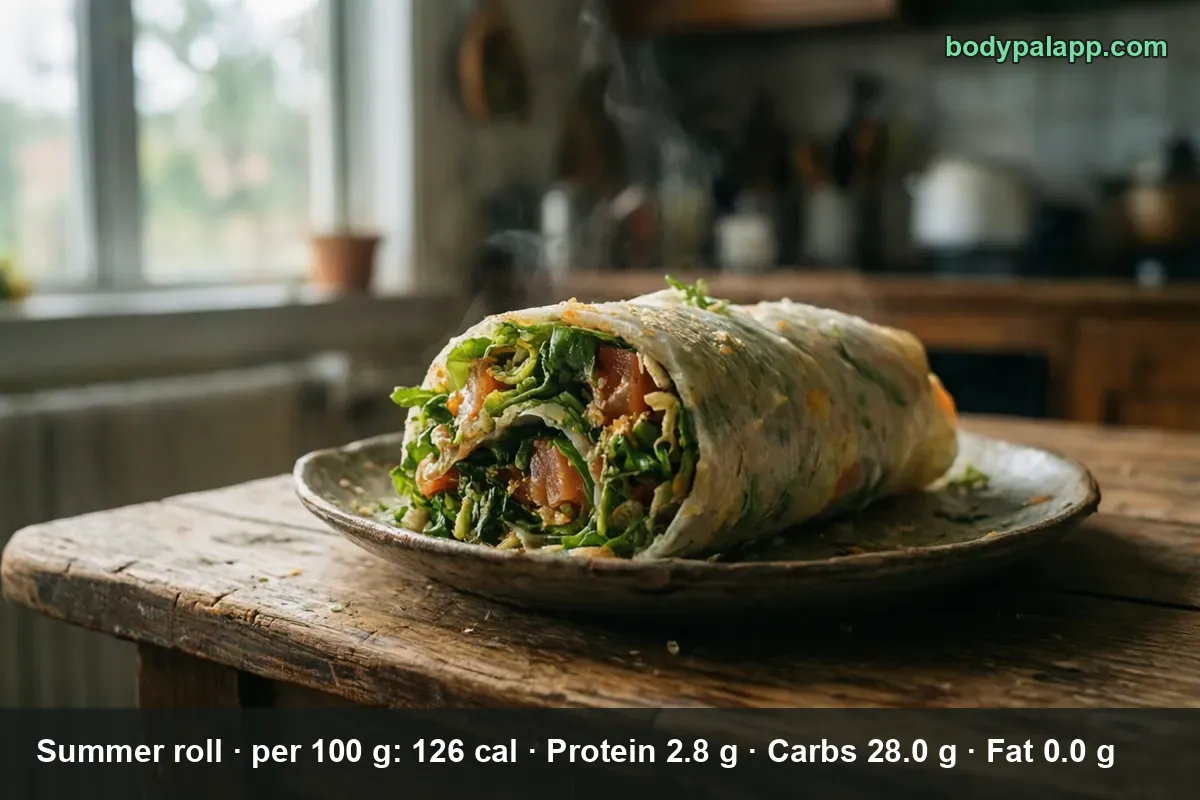
One store-bought shrimp summer roll pack weighs 182 g with its sweet chili cup and carries 229 calories. Per 100 g the roll is 126 calories, and the fat line on the label reads 0 g. Nearly all of the energy is carbohydrate — rice paper, rice noodles and the sugar in the sauce.
On this page
- Summer roll quick facts
- US servings from one ounce to the whole pack
- What the filling changes
- Sodium and carbs are the rows to watch
- How does a summer roll compare
- Most popular summer roll brands
- FAQ
Summer roll quick facts
There is no Foundation, SR Legacy or FNDDS entry for a summer roll — USDA has never analyzed one in a lab. What it does have is the deli case. The row below is FDC 1968798, "Shrimp summer roll with sweet chili sauce", the Genji MAI grab-and-go pack sold in supermarket refrigerators across the country, and it is the thing most people actually have in their hand when they look this up. Its 126 calories per 100 g also sit in the middle of the brand cloud, which runs from 89 to 186; the outliers at each end are a sauceless three-piece tray and a denser single-serve package.
| Nutrient | Per 100 g | Per 1 pack (182 g) | % Daily Value |
|---|---|---|---|
| Calories | 126 | 229 | — |
| Total fat | 0 g | 0 g | 0% |
| Carbohydrate | 28.02 g | 51.0 g | 19% |
| Protein | 2.75 g | 5.0 g | 10% |
| Sodium | 242 mg | 440 mg | 19% |
% Daily Value is based on a 2,000-calorie diet.
Verified nutrition data
Numbers on this page come from USDA FoodData Central, the U.S. Department of Agriculture’s food composition database, and from manufacturer labels where a branded product is named. Last verified September 2026. How we verify our data →
Four rows you would expect are missing: saturated fat, dietary fiber, total sugars and added sugars are not carried for this label record, so guessing them would be inventing numbers. Cholesterol and potassium are absent for the same reason. With fat at 0 g, saturated fat can only be 0 g anyway, which makes the gap harmless here; the sugar line is the one worth wanting, because the sweet chili cup is where most of it hides.
US servings from one ounce to the whole pack
| Serving | Weight | Calories |
|---|---|---|
| 1 oz | 28 g | 35 kcal |
| Half a pack | 91 g | 115 kcal |
| 4 oz | 113 g | 142 kcal |
| One pack with sauce, label serving | 182 g | 229 kcal |
| Per 100 g | 100 g | 126 kcal |
Only one of those is a USDA serving: the 182 g pack, which is what the label declares. The 1 oz, 4 oz and half-pack lines are our own arithmetic from the USDA 100 g figure, not USDA servings — useful if you eat one roll out of a two-roll pack and want a number that is not a guess.
This is where the per-100-g habit bites. Logging "a summer roll" as 126 calories because that is the number printed largest is a 45 percent undercount, since the pack is 182 g. The gap is bigger than for most deli foods precisely because the roll is heavy and watery: 100 g of it is barely more than half a roll.
What the filling changes
| Version | Per 100 g | Typical pack | Calories |
|---|---|---|---|
| Shrimp with sweet chili sauce | 126 kcal | 1 pack, 182 g | 229 kcal |
| Grilled chicken | 132 kcal | 1 pack, 190 g | 251 kcal |
| Avocado | 139 kcal | 1 pack, 180 g | 250 kcal |
| Three-piece tray, no sauce | 89 kcal | 3 pieces, 112 g | 100 kcal |
| Single package, denser fill | 186 kcal | 1 package, 113 g | 210 kcal |
| Spring roll, three-piece tray | 159 kcal | 3 pieces, 63 g | 100 kcal |
Shrimp, chicken and avocado land within 22 calories of each other per pack, so the filling is close to a wash on energy. It is not a wash on protein. The grilled chicken roll carries 5.26 g of protein per 100 g against 2.75 g for shrimp — 10.0 g in its 190 g pack, exactly double the shrimp pack's 5.0 g, for 22 extra calories. Avocado goes the other way: 1.11 g of protein and 2.22 g of fat per 100 g, the fattiest of the three Genji MAI rolls and the weakest on protein.
The two trays are the interesting pair. A three-piece summer roll tray sold without sauce is 89 calories per 100 g, the only row in the table lighter per gram than the shrimp pack, and 100 calories for the whole 112 g tray. A three-piece spring roll tray is 159 per 100 g — much denser — but the pieces are small, 63 g for all three, so it also totals 100 calories. Same total, from opposite directions.
The widest spread is between two packs with the same two words on the front: 89 versus 186 calories per 100 g. That is more than double, store to store, for a product nobody thinks of as variable. Weigh yours or read its own label rather than borrowing a number.
Brands are consistent enough to name: the Genji MAI packs (shrimp, grilled chicken, avocado) sit at 126 to 139 calories per 100 g, the Sushi House tray at 89, and the Wasabi single package at 186. Rice paper on its own, before soaking, is 343 calories per 100 g as a dry sheet; it soaks up water in the bowl, which is why the finished roll is nowhere near that.
Sodium and carbs are the rows to watch
Carbohydrate is doing almost all the work here. The pack holds 51.0 g, 19% of the FDA Daily Value of 275 g, against 0 g of fat and 5.0 g of protein. Rice paper, rice noodles and the sugar in the dipping cup make up that number, which is why a food that feels like a salad logs like a small sandwich.
Sodium is the second line to check: 440 mg per pack, also 19% of the 2,300 mg Daily Value, or roughly a fifth of a teaspoon of table salt. Across store rolls the range is 106 to 305 mg per 100 g, so the sauce cup and the seasoning of the filling move it far more than the size of the roll does.
Protein is the honest weak spot. At 5.0 g, one pack covers 10% of the Daily Value, well short of what MyPlate treats as a protein-carrying meal, and the Dietary Guidelines put most adults nearer 5 to 6.5 ounce-equivalents of protein foods a day. If you are eating a summer roll as lunch, the chicken version or something protein-heavy alongside is the difference between full at 2 p.m. and hungry at 1.
How does a summer roll compare
| Roll | Per 100 g | US serving | Calories |
|---|---|---|---|
| Shrimp summer roll with sweet chili sauce | 126 kcal | 1 pack, 182 g | 229 kcal |
| Grilled chicken summer roll | 132 kcal | 1 pack, 190 g | 251 kcal |
| Avocado summer roll | 139 kcal | 1 pack, 180 g | 250 kcal |
| Spring roll, three-piece tray | 159 kcal | 3 pieces, 63 g | 100 kcal |
Our take: for weight loss the sauceless three-piece tray at 100 calories is the cheapest thing in the case, and the shrimp pack at 229 is a reasonable light lunch if you add protein to it. For fullness the grilled chicken pack wins outright — 251 calories for double the protein of the shrimp version, 22 calories more. The fresh-versus-fried line matters more than any of this: a fried spring roll off the same shelf is 225 calories per 100 g with 11.25 g of fat, nearly double the summer roll per gram, and the rice paper is the only reason the fresh one is light.
Most popular summer roll brands in the United States
Ranked by how widely each product appears among foods sold in the United States, from the BodyPal food database of over 3.3 million products. Calories are the figures printed on each Nutrition Facts label, checked against USDA FoodData Central.
| Product | Calories (per 100 g) |
|---|---|
| Genji MAI Shrimp Summer Roll w/ Sweet Chili Sauce | 126 cal |
| Genji MAI Grilled Chicken Summer Roll | 132 cal |
| Genji MAI Avocado Summer Roll w/ Sweet Chili Sauce | 139 cal |
| Sushi House Summer Roll | 89 cal |
| Wasabi Summer Roll | 186 cal |
Brand popularity: BodyPal food database. Nutrition: manufacturer labels / USDA FoodData Central.
Summer roll FAQs
How many calories are in a summer roll?
A single-serve pack runs 100 to 251 calories depending on size and filling. The shrimp roll with sweet chili sauce used on this page is 229 calories for its 182 g pack, or 126 per 100 g. A three-piece tray sold without sauce is only 100 calories for 112 g.
How many calories in a shrimp summer roll?
229 calories for a 182 g pack of shrimp summer roll with a cup of sweet chili sauce, which works out to 126 calories per 100 g. The same pack carries 51.0 g of carbohydrate, 5.0 g of protein, 440 mg of sodium and no fat at all on the label.
Is a summer roll healthier than a spring roll?
Fresh beats fried: a summer roll is 126 calories per 100 g, while a fried spring roll from the same chilled case is 225 per 100 g with 11.25 g of fat. Unfried spring rolls sit in between at 137 to 159 per 100 g, so it is the frying that separates them.
Are summer rolls good for weight loss?
A 229-calorie pack fits most lunch budgets, and the sauceless three-piece tray is only 100 calories. The catch is protein: 5.0 g per pack is 10% of the Daily Value, so the roll rarely holds you. The grilled chicken version doubles that to 10.0 g for 251 calories.
How much protein is in a summer roll?
5.0 g in the 182 g shrimp pack, which is 10% of the Daily Value. The grilled chicken roll nearly doubles the concentration at 5.26 g per 100 g against 2.75 g, giving 10.0 g in its 190 g pack. For a food sold as lunch, protein is the weakest line on the label.
How many carbs are in a summer roll?
51.0 g of carbohydrate in the 182 g pack, 19% of the Daily Value, from 28.02 g per 100 g. Rice paper, rice noodles and the sugar in the sweet chili cup account for most of it. With 0 g of fat on the label, carbohydrate carries nearly all of the 229 calories.
How much sodium is in a store-bought summer roll?
440 mg in the 182 g shrimp pack, 19% of the 2,300 mg Daily Value and roughly a fifth of a teaspoon of table salt. Across store rolls the range is 106 to 305 mg per 100 g, so the dipping cup and the seasoning of the filling matter more than the size.
Do summer rolls have any fat?
The shrimp pack lists 0 g of fat, so all 229 of its calories come from carbohydrate and protein. Other rolls are not fat-free: the avocado version is 2.22 g per 100 g and the grilled chicken 1.84 g. A fried spring roll, by contrast, runs 11.25 g per 100 g.
Similar foods
- Shrimp Summer Roll — 229 cal per package
- Idli — 97 cal for 2 idlis
- Instant Rice — 205 cal per cup
- Cooked White Rice — 205 cal per cup
- Sushi Rice — 242 cal per cup
- White Rice — 242 cal per cup
Count it without the math
Point the camera at the pack and BodyPal counts the roll and the sauce cup for you.


How long does it take to burn off a summer roll?
One pack (182 g) is 229 kcal. Enter your weight and the amount you ate to see how long it takes you to burn that off:
lb
| Activity | Time to burn 229 kcal |
|---|---|
| Walking, brisk | 46 min |
| Cycling, moderate | 29 min |
| Swimming, moderate | 33 min |
| Jogging | 27 min |
| Weight training, moderate | 51 min |
Times are for a 155 lb adult at a steady pace; change the weight to see yours. The amount is set to the portion in the text (182 g); change it to what you actually ate. BodyPal works this out from your steps automatically.
Want the bigger picture? Calculate your daily calorie needs — your maintenance figure, a target for losing or gaining, and the date you get there.