
How many calories are in a poached egg?
One large poached egg weighs 50 g and carries 72 calories. Per 100 g the number is 143 calories, and 100 g is almost exactly two eggs, so a two-egg breakfast lands at 143. Nothing is added in the pan: the egg cooks in water, and water has no calories.
On this page
- Poached egg quick facts
- US servings from one egg to a cup
- Two eggs and the other ways to cook one
- Cholesterol is the row to watch not calories
- The sodium gap between two USDA records
- How does a poached egg compare
- Poached egg FAQs
Poached egg quick facts
The numbers below come from USDA SR Legacy 172186, "Egg, whole, cooked, poached". It is the only USDA row that describes a poached egg on its own, which makes it the right one for the food you actually have on the plate. The alternative, FNDDS 2707154, merges boiled and poached into a single entry, so it answers a broader question than the one you typed. That row still shows up further down, because the two records disagree about one nutrient in an interesting way.
A large egg is 50 g of edible egg once the shell is off. That is the standard American large size, and every portion figure on this page is built on it.
| Nutrient | Per 100 g | Per one large egg (50 g) | % Daily Value |
|---|---|---|---|
| Calories | 143 | 72 | — |
| Total fat | 9.47 g | 4.7 g | 6% |
| Saturated fat | 3.11 g | 1.6 g | 8% |
| Carbohydrate | 0.71 g | 0.4 g | 0% |
| Dietary fiber | 0 g | 0 g | 0% |
| Total sugars | 0.37 g | 0.2 g | — |
| Protein | 12.51 g | 6.3 g | 13% |
| Sodium | 297 mg | 149 mg | 6% |
| Cholesterol | 370 mg | 185 mg | 62% |
| Potassium | 138 mg | 69 mg | 1% |
% Daily Value is based on a 2,000-calorie diet.
Verified nutrition data
Numbers on this page come from USDA FoodData Central, the U.S. Department of Agriculture’s food composition database, and from manufacturer labels where a branded product is named. Last verified September 2026. How we verify our data →
There is no added sugars row here on purpose. The SR Legacy release for 172186 does not publish added sugars at all, and an egg boiled in water has none to publish. The 0.37 g of total sugars per 100 g is what the egg itself contains, which is why that cell shows a dash in the Daily Value column: the FDA sets a Daily Value for added sugars, not for total sugars.
Two things in that table are worth a second look before you scroll past. Carbohydrate is functionally zero, which is why eggs sit outside almost every carb budget. And cholesterol, at 62% of a Daily Value for a 72-calorie food, is the single largest percentage on the label.
US servings from one egg to a cup
| Serving | Weight | Calories |
|---|---|---|
| 1 oz | 28 g | 40 kcal |
| One large egg | 50 g | 72 kcal |
| Two large eggs | 100 g | 143 kcal |
| One cup, chopped | 135 g | 193 kcal |
| Per 100 g | 100 g | 143 kcal |
The 50 g egg is the USDA household measure, and the 100 g figure is the record's own reference amount. Everything else in that table is our own arithmetic from the USDA 100 g figure rather than a USDA serving: one ounce, two eggs, and the chopped cup are all scaled from 143 calories per 100 g, with the 135 g cup weight borrowed from the FNDDS egg record.
The chopped cup is the one that catches people. If you poach eggs, chop them, and pile them into a measuring cup for a salad or a grain bowl, you are looking at roughly 193 calories, not the 72 you had in your head from the single egg. Just under three eggs fit in that cup. Volume measures are unforgiving with foods that pack tightly, and chopped egg packs tightly.
The 1 oz line is mostly useful in reverse: it tells you that poached egg costs about 40 calories per ounce, which is a slow number by breakfast standards. An ounce of granola or an ounce of bacon is a very different transaction.
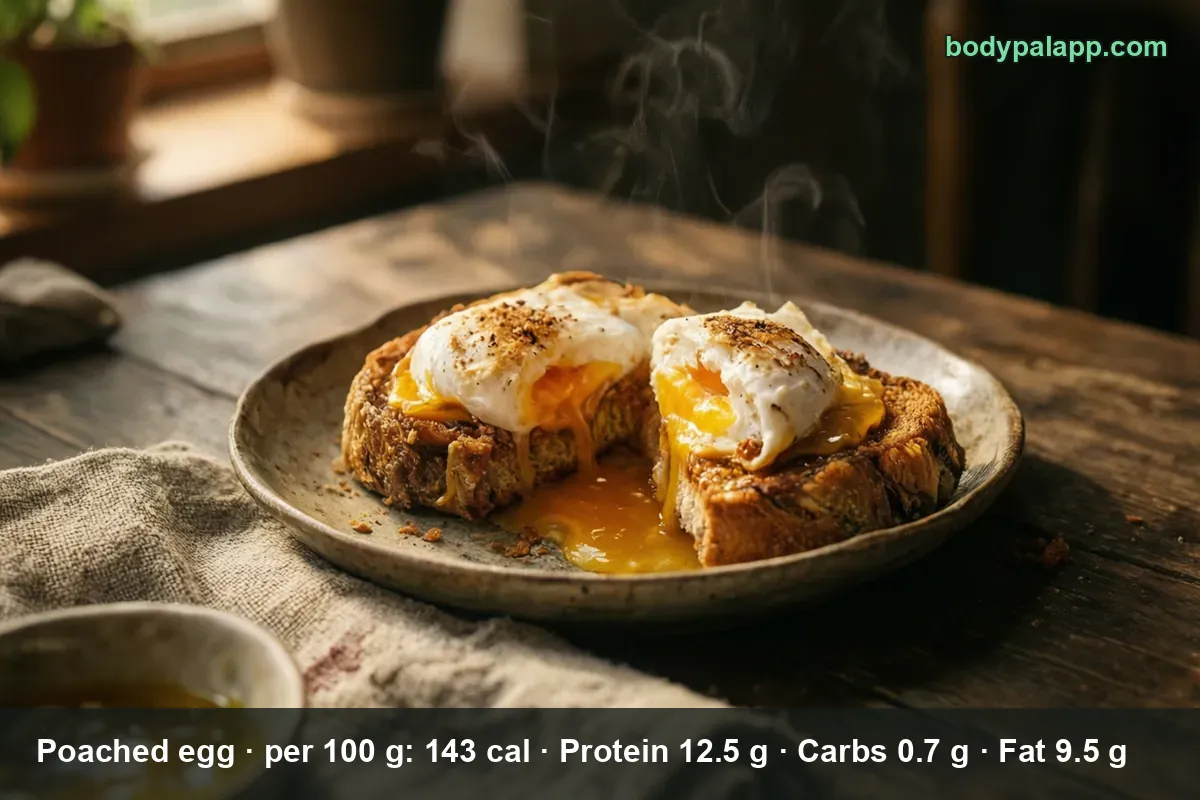
One thing the table does not include is the bread. In the photo at the top of this page, the eggs are sitting on toast, and the toast is a separate food with its own count. The USDA record for poached egg covers the egg only.
Two eggs and the other ways to cook one
| Version | Per 100 g | Typical piece | Calories |
|---|---|---|---|
| Poached egg, one large | 143 kcal | 1 large egg, 50 g | 72 kcal |
| Two poached eggs | 143 kcal | 2 large eggs, 100 g | 143 kcal |
| Boiled or poached egg, FNDDS row | 143 kcal | 1 egg, 50 g | 72 kcal |
| Raw egg | 143 kcal | 1 egg, 50 g | 72 kcal |
| Fried egg, no added fat | 143 kcal | 1 egg, 50 g | 72 kcal |
| Scrambled egg, no added fat | 143 kcal | 1 egg, 50 g | 72 kcal |
Every row in that table reads 143 calories per 100 g. That is not a copy-paste error, and it is the most useful fact on this page: raw, poached, boiled, dry-fried, dry-scrambled, an egg is an egg. USDA gives the raw egg and the fried egg cooked with no added fat the same energy figure as the poached one.
Cooking method only moves the number when something else joins the egg. Butter in the skillet, oil in the pan, cream in the scramble, cheese folded into the omelet: those are the calories people attribute to "fried eggs," and they belong to the fat, not the frying. Poaching is simply the method that makes it impossible to add any.
That also means the arithmetic for a two-egg plate is trivial. Two large eggs are 100 g, so the plate is 143 calories and 12.5 g of protein. Three eggs would be 150 g, or 215 calories by the same scaling from the USDA 100 g figure. No packaged version of this food exists to complicate it: USDA's Branded database returns nothing for poached egg, because nobody sells one in a wrapper.
Cholesterol is the row to watch not calories
A poached egg is a 72-calorie food that delivers 62% of a Daily Value. Not the calorie kind. One large egg carries 185 mg of cholesterol against the FDA Daily Value of 300 mg, and two eggs put 370 mg on the plate, which is 123% of that reference figure before anything else in the day.
Set that next to the rest of the label and the imbalance is obvious. The same egg is 6% of the fat Daily Value, 8% of saturated fat, 6% of sodium, and 1% of potassium. Cholesterol is the only line that runs away from the calorie count, and it is roughly ten times the fat percentage.
Whether that matters to you is a conversation for your doctor, and the Dietary Guidelines no longer set a hard numeric cap. But if you have been told to keep an eye on dietary cholesterol, the practical takeaway is that the number scales with yolks, not with cooking method. A poached egg and a fried egg carry the same 185 mg.
On the other side of the ledger, 6.3 g of protein for 72 calories is a genuinely efficient trade. That is 13% of the protein Daily Value from about 3.6% of a 2,000-calorie day, which is why eggs sit in the MyPlate protein foods group rather than anywhere near the treats.
The sodium gap between two USDA records
Here is where the two poached-egg records disagree. SR Legacy 172186 lists 297 mg of sodium per 100 g. FNDDS 2707154, the boiled-or-poached row, lists 129 mg. Per egg, that is 149 mg against roughly 65 mg, and the calories are identical in both.
The difference is the water. Poaching liquid is usually salted, and the SR Legacy figure reflects an egg cooked that way; the FNDDS entry assumes plain water and is closer to the sodium already inside a raw egg. Salting the pot roughly doubles the sodium of the finished egg without touching its energy.
For most people 149 mg is a rounding error in a 2,300 mg day, about one-sixteenth of a teaspoon of table salt. If you are tracking sodium closely, though, it is a lever you control: unsalted poaching water costs you nothing and saves you about 84 mg per egg. That is one of the few times a cooking decision changes a nutrient without changing the calorie count at all.
How does a poached egg compare
| Preparation | Per 100 g | US serving | Calories |
|---|---|---|---|
| Poached egg | 143 kcal | one large egg, 50 g | 72 kcal |
| Raw egg | 143 kcal | one egg, 50 g | 72 kcal |
| Fried egg, no added fat | 143 kcal | one egg, 50 g | 72 kcal |
| Scrambled egg, no added fat | 143 kcal | one egg, 50 g | 72 kcal |
Our take: four USDA records, one number. If you are logging eggs and wondering which preparation to pick from the list, the honest answer is that it does not matter as long as the pan was dry. Choose poached because you like the runny yolk, or because it saves you the decision about how much butter to use, not because it saves calories it does not save. The place to spend your attention is the rest of the plate: the toast, the butter on the toast, the bacon next to it. Those move a breakfast by hundreds of calories while the egg sits patiently at 72.
Poached egg FAQs
How many calories are in a poached egg?
A large poached egg is 72 calories at 50 g, which works out to 143 calories per 100 g. That figure comes from USDA SR Legacy record 172186 for whole egg, cooked, poached. Poaching in plain water adds no fat and no calories, so the egg is the whole number.
How many calories in 2 poached eggs?
Two large poached eggs are 143 calories, since two 50 g eggs come to 100 g and the USDA record runs 143 calories per 100 g. They also bring 12.5 g of protein and 370 mg of cholesterol, which is 123% of the FDA Daily Value.
How many calories in a poached egg on toast?
The eggs are the easy half: 72 calories for one, 143 for two. The bread is a separate food and the USDA poached-egg record does not include it, so we do not publish a toast number here. Weigh or scan your own slice and add it to the 72.
Poached vs boiled egg: which has fewer calories?
Neither: USDA files boiled and poached eggs in one FNDDS record, 2707154, at 143 calories per 100 g, the same as the poached-only SR Legacy row. One egg is 72 calories either way. The difference between the two records is sodium, not energy: 297 mg per 100 g against 129 mg.
Is a poached egg healthier than a fried egg?
On calories they tie when nothing goes in the pan: fried with no added fat is 143 calories per 100 g, the same as poached. Add a tablespoon of butter or oil and the fat comes from the pan, not the egg. Poaching simply removes that step.
How much protein is in a poached egg?
One large poached egg has 6.3 g of protein, 13% of the 50 g Daily Value, for 72 calories. Per 100 g the egg runs 12.51 g. Two eggs put 12.5 g on the plate for 143 calories, which is 25% of the day's protein for about 7% of a 2,000-calorie budget.
How much cholesterol is in a poached egg?
One large poached egg carries 185 mg of cholesterol, 62% of the FDA Daily Value of 300 mg, and 370 mg per 100 g. It is the biggest percentage on the label by a wide margin: the same egg is only 6% of the fat Daily Value and 6% of sodium.
Are poached eggs good for weight loss?
At 72 calories and 6.3 g of protein, a poached egg is one of the lower-calorie ways to put protein on a plate, and poaching keeps the pan fat at zero. Two eggs are 143 calories. What you serve them on usually matters more than the eggs themselves.
Similar foods
- Egg — 72 cal per large egg
- Soft Boiled Egg — 72 cal per large egg
- Egg Noodles — 221 cal per cup cooked
- Boiled Egg — 78 cal per egg
- Hard-Boiled Egg — 78 cal per egg
- Egg Foo Young — 219 cal per cup
Count it without the math
Point the camera at the plate and BodyPal counts the eggs, the toast under them and the butter on top.


How long does it take to burn off a poached egg?
One large egg (50 g) is 72 kcal. Enter your weight and the amount you ate to see how long it takes you to burn that off:
lb
| Activity | Time to burn 72 kcal |
|---|---|
| Walking, brisk | 14 min |
| Cycling, moderate | 9 min |
| Swimming, moderate | 10 min |
| Jogging | 8 min |
| Weight training, moderate | 16 min |
Times are for a 155 lb adult at a steady pace; change the weight to see yours. The amount is set to the portion in the text (50 g); change it to what you actually ate. BodyPal works this out from your steps automatically.
Burning it off is one side of it. The other is knowing your number: work out how many calories you need a day, with macros and a goal date.