
How many calories are in a soft boiled egg?
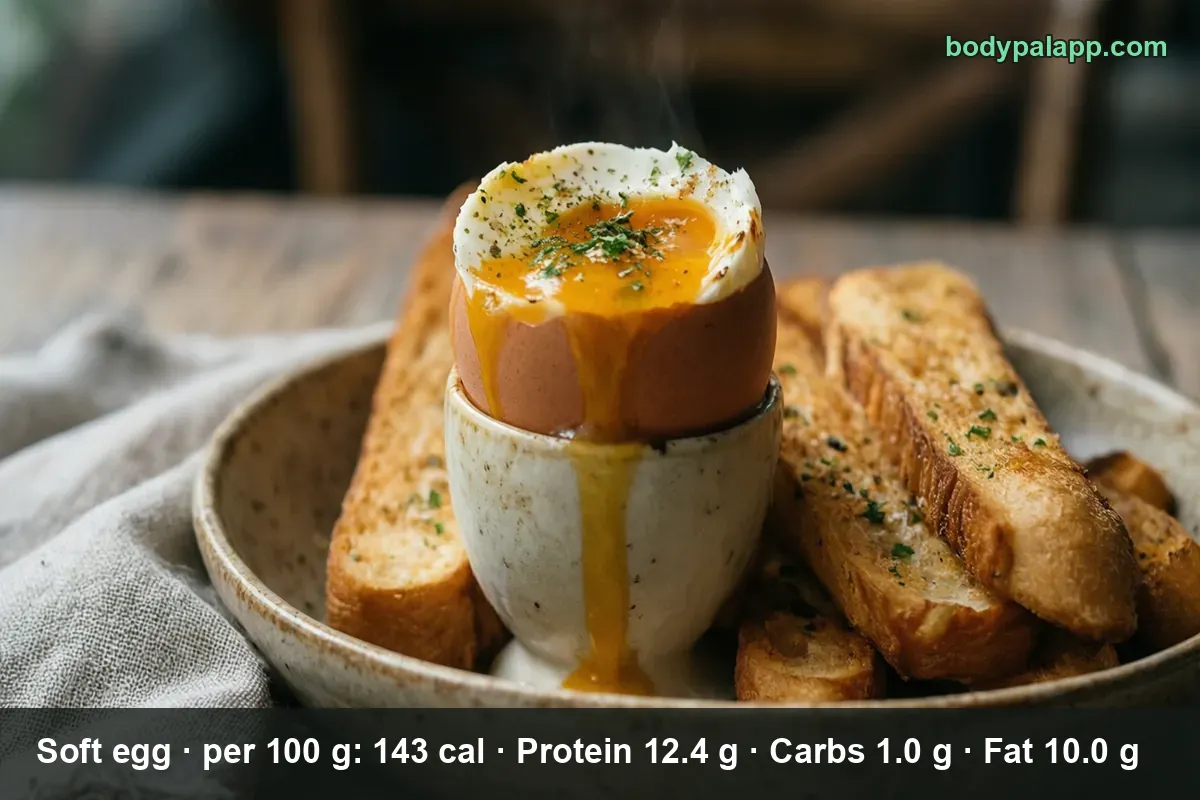
One large soft boiled egg is 72 calories. Per 100 g, egg cooked in the shell runs 143 calories, so the two eggs most people crack for breakfast come to 143. Protein is 6.2 g per egg, fat 5.0 g, carbohydrate close to nothing at 0.5 g.
On this page
- Soft egg quick facts
- US servings from one ounce to a cup of chopped egg
- Soft boiled versus poached raw and frozen egg
- Cholesterol is the row to watch
- How does a soft egg compare?
- Most popular soft egg brands
- FAQ
Soft egg quick facts
A soft egg is a whole egg cooked in its shell until the white sets and the yolk still runs. USDA does not keep a separate file for doneness, so the record that matches the egg in the cup is FNDDS 2707154, "Egg, whole, boiled or poached" from the 2021-2023 survey release. Nothing is added to the pan and nothing drains away, which is exactly what a three-minute egg is.
The older SR Legacy poached entry exists too, but it carries the salt of the poaching water and is a poor stand-in for an egg still in its shell. It gets its own row further down instead.
| Nutrient | Per 100 g | Per 1 large egg (50 g) | % Daily Value |
|---|---|---|---|
| Calories | 143 | 72 | — |
| Total fat | 9.96 g | 5.0 g | 6% |
| Saturated fat | 3.2 g | 1.6 g | 8% |
| Carbohydrate | 0.96 g | 0.5 g | 0% |
| Dietary fiber | 0 g | 0 g | 0% |
| Total sugars | 0.2 g | 0.1 g | — |
| Protein | 12.4 g | 6.2 g | 12% |
| Sodium | 129 mg | 65 mg | 3% |
| Cholesterol | 411 mg | 206 mg | 68% |
% Daily Value is based on a 2,000-calorie diet.
Verified nutrition data
Numbers on this page come from USDA FoodData Central, the U.S. Department of Agriculture’s food composition database, and from manufacturer labels where a branded product is named. Last verified September 2026. How we verify our data →
Two rows you will see on a carton label are missing here on purpose. Added sugars and trans fat are not measured in this FNDDS release, so publishing a figure for either would mean inventing one. Potassium is 132 mg per 100 g, or 66 mg in a large egg, which is 1% of the Daily Value. The Daily Values used in that last column are the FDA reference amounts for a 2,000-calorie diet.
US servings from one ounce to a cup of chopped egg
Egg sizes are sold by carton weight, not by the piece, so a large egg out of the shell is the useful unit. It lands at 50 g. A medium egg is 44 g, which is where store-brand hard-cooked packs set their label serving as well.
| Serving | Weight | Calories |
|---|---|---|
| 1 oz | 28.4 g | 41 kcal |
| One medium egg | 44 g | 63 kcal |
| One large egg | 50 g | 72 kcal |
| Two large eggs | 100 g | 143 kcal |
| One cup, chopped | 135 g | 193 kcal |
| Per 100 g | 100 g | 143 kcal |
The large egg and the cup of chopped egg are USDA household measures. The ounce, the medium egg and the two-egg plate are our own arithmetic from the USDA 100 g figure, not USDA servings.
Two large eggs weigh 100 g almost exactly, which makes this one of the rare foods where the per-100-g number and a real plate of food are the same thing. If you log two eggs, you are logging 143 calories. That coincidence does not survive the cup measure: a cup of chopped egg is 135 g and 193 calories, close to three eggs, and people underestimate it badly because chopped egg packs loosely and looks like far less than three shells' worth.
Soft boiled versus poached raw and frozen egg
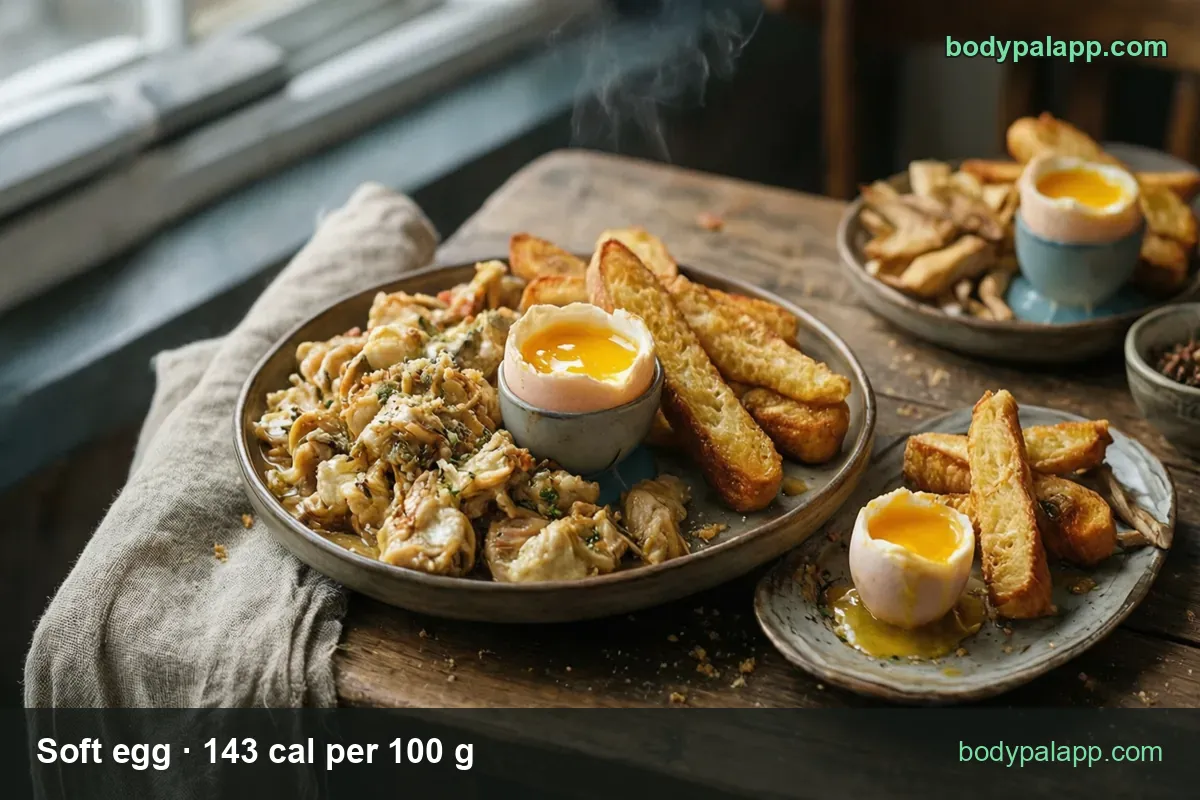
Here is the finding that surprises most people who ask about a runny yolk: doneness is free. Soft boiled, hard boiled and raw all sit at 143 calories per 100 g. Heat firms the proteins in the yolk; it does not add or remove energy. Of the five USDA whole-egg records below, only the frozen pasteurized one runs above 143, and only the frozen salted one runs below.
| Version | Per 100 g | Typical serving | Calories |
|---|---|---|---|
| Soft boiled in the shell (FNDDS 2707154) | 143 kcal | one large egg, 50 g | 72 kcal |
| Poached (SR Legacy 172186) | 143 kcal | one large egg, 50 g | 72 kcal |
| Raw, fresh (SR Legacy 171287) | 143 kcal | one large egg, 50 g | 72 kcal |
| Frozen whole egg, pasteurized (SR Legacy 172202) | 147 kcal | 1 oz, 28.4 g | 42 kcal |
| Frozen whole egg, salted (SR Legacy 170893) | 138 kcal | 1 oz, 28.4 g | 39 kcal |
The two frozen rows are industrial liquid egg, not something you cook in a shell, and the salted one is a different product with salt already in the mix. They are here because they show the outer edges of what whole egg can measure, 138 to 147 calories per 100 g. Everything you would actually eat with a spoon sits at 143.
Poaching is where the difference shows up, and it is not in calories. The poached record carries 297 mg of sodium per 100 g against 129 mg for an egg boiled in its shell. On a large egg that is about 149 mg versus 65 mg, a gap of roughly 84 mg from the salted water alone.
One more thing worth knowing if you buy eggs already cooked: US shelves have no packaged soft-cooked egg. The peeled packs are all hard-cooked, and their labels round to a 44 or 45 g egg, landing between 114 and 159 calories per 100 g depending on the brand. Eggland's Best lists 50 calories per 44 g egg, ShopRite's cage-free medium pack 70. Those are label figures on cooked shell eggs, rounded the way labels are; the USDA record is the cleaner number to log against.
Cholesterol is the row to watch
Calories are not the interesting column on an egg. One large soft egg is 72 calories and 6.2 g of protein, which is 12% of the Daily Value for protein against 4% of a 2,000-calorie day. That ratio is why eggs sit in the protein foods group on MyPlate.
Cholesterol is the row that moves. A single large egg carries 206 mg, or 68% of the 300 mg Daily Value. Two eggs put 411 mg on the plate, 137% of it. That is the biggest percentage anywhere on this page, and it does not change with the yolk's texture. The current Dietary Guidelines treat dietary cholesterol as something to keep low within a healthy eating pattern rather than setting a hard cap, so if that is a number you track, two eggs is the point where it starts to matter.
Sodium runs the other way. An unsalted soft egg is 65 mg, 3% of the Daily Value, which is a rounding error next to most breakfast meats. Salt the egg at the table and you are adding to that; the shell keeps the cooking water out.
How does a soft egg compare?
| Egg record | Per 100 g | US serving | Calories | Protein |
|---|---|---|---|---|
| Soft boiled in the shell | 143 kcal | one large egg, 50 g | 72 kcal | 6.2 g |
| Poached | 143 kcal | one large egg, 50 g | 72 kcal | 6.3 g |
| Raw, fresh | 143 kcal | one large egg, 50 g | 72 kcal | 6.3 g |
| Frozen whole egg, pasteurized | 147 kcal | 1 oz, 28.4 g | 42 kcal | 3.5 g |
Our take: stop shopping for the lower-calorie egg, because there is not one. All three ways you would eat a whole egg come to 72 calories for a large one, and the only records that move off 143 per 100 g are liquid products you would not soft-boil. Cook it the way you like it. If you are watching sodium, boil in the shell rather than poach and save yourself about 84 mg per egg; if you are watching cholesterol, the lever is how many eggs, not how long they sit in the water.
Most popular soft egg brands in the United States
Ranked by how widely each product appears among foods sold in the United States, from the BodyPal food database of over 3.3 million products. Calories are the figures printed on each Nutrition Facts label, checked against USDA FoodData Central.
| Product | Calories (per 100 g) |
|---|---|
| Eggland's Best Hard Cooked Peeled Eggs | 114 cal |
| Hillandale Farms Eggs2Go Hard-Boiled Peeled Eggs | 140 cal |
| O Organics Cage Free Hard-Cooked Peeled Eggs | 136 cal |
| ShopRite Cage Free Hard-Cooked Peeled Medium Eggs | 159 cal |
| Abbotsford Farms Cage Free Peeled Hard Boiled Eggs | 156 cal |
Brand popularity: BodyPal food database. Nutrition: manufacturer labels / USDA FoodData Central.
Soft egg FAQs
How many calories are in a soft boiled egg?
A soft boiled large egg is 72 calories, or 143 calories per 100 g, using the USDA record for whole egg boiled or poached. That covers a 50 g egg out of the shell. Doneness does not change the count, so a runny yolk and a firm one land on the same number.
How much protein is in a soft boiled egg?
6.2 g of protein in one large soft boiled egg, which is 12% of the Daily Value. Two eggs bring 12.4 g, or 25%. Per 100 g the egg runs 12.4 g of protein against 143 calories, which is why eggs sit in the protein foods group on MyPlate.
How many calories are in 2 soft boiled eggs?
143 calories for two large eggs, because two of them weigh 100 g and the USDA figure is 143 calories per 100 g. That plate also carries 12.4 g of protein, 10.0 g of fat and 411 mg of cholesterol, which is 137% of the Daily Value for cholesterol.
Is a soft boiled egg lower in calories than a hard boiled egg?
No, both are 72 calories for a large egg. USDA files boiled and poached whole egg under one record at 143 calories per 100 g, because nothing is added or drained during cooking. The extra minute in the water firms the yolk and leaves the energy exactly where it was.
Does a runny yolk have more cholesterol?
No, one large egg carries 206 mg of cholesterol, 68% of the Daily Value, whether the yolk runs or sets. Cooking time moves texture, not the number. That single egg is the biggest percentage on the label, well past the 12% of the Daily Value it gives you in protein.
How many calories are in a soft boiled egg with toast soldiers?
The egg is 72 calories; the toast has to be counted separately, because the USDA record covers the egg alone and publishes no figure for bread. Weigh the slice or read the label on the loaf, then add it to the 72. Butter on the soldiers is another line again.
Is a soft boiled egg good for weight loss?
At 72 calories with 6.2 g of protein, one egg is among the cheapest protein servings on a breakfast plate. Two eggs are 143 calories and 12.4 g of protein, a quarter of the Daily Value. If you are watching cholesterol, the 411 mg in that pair is the figure to weigh.
Poached or soft boiled: which has more sodium?
Poached, by a wide margin: the USDA poached record shows 297 mg of sodium per 100 g against 129 mg for egg boiled in the shell, so a large poached egg carries about 149 mg versus 65 mg. The salt in the poaching water accounts for the gap of roughly 84 mg per egg.
Similar foods
- Egg — 72 cal per large egg
- Poached Egg — 72 cal per large egg
- Egg Noodles — 221 cal per cup cooked
- Boiled Egg — 78 cal per egg
- Hard-Boiled Egg — 78 cal per egg
- Egg Foo Young — 219 cal per cup
Count it without the math
Point the camera at the egg cup and BodyPal counts it for you, yolk and all.


How long does it take to burn off soft egg?
One large egg (50 g) is 72 kcal. Enter your weight and the amount you ate to see how long it takes you to burn that off:
lb
| Activity | Time to burn 72 kcal |
|---|---|
| Walking, brisk | 14 min |
| Cycling, moderate | 9 min |
| Swimming, moderate | 10 min |
| Jogging | 8 min |
| Weight training, moderate | 16 min |
Times are for a 155 lb adult at a steady pace; change the weight to see yours. The amount is set to the portion in the text (50 g); change it to what you actually ate. BodyPal works this out from your steps automatically.
Want the bigger picture? Calculate your daily calorie needs — your maintenance figure, a target for losing or gaining, and the date you get there.