
How Many Calories Are in Egg Foo Yung?
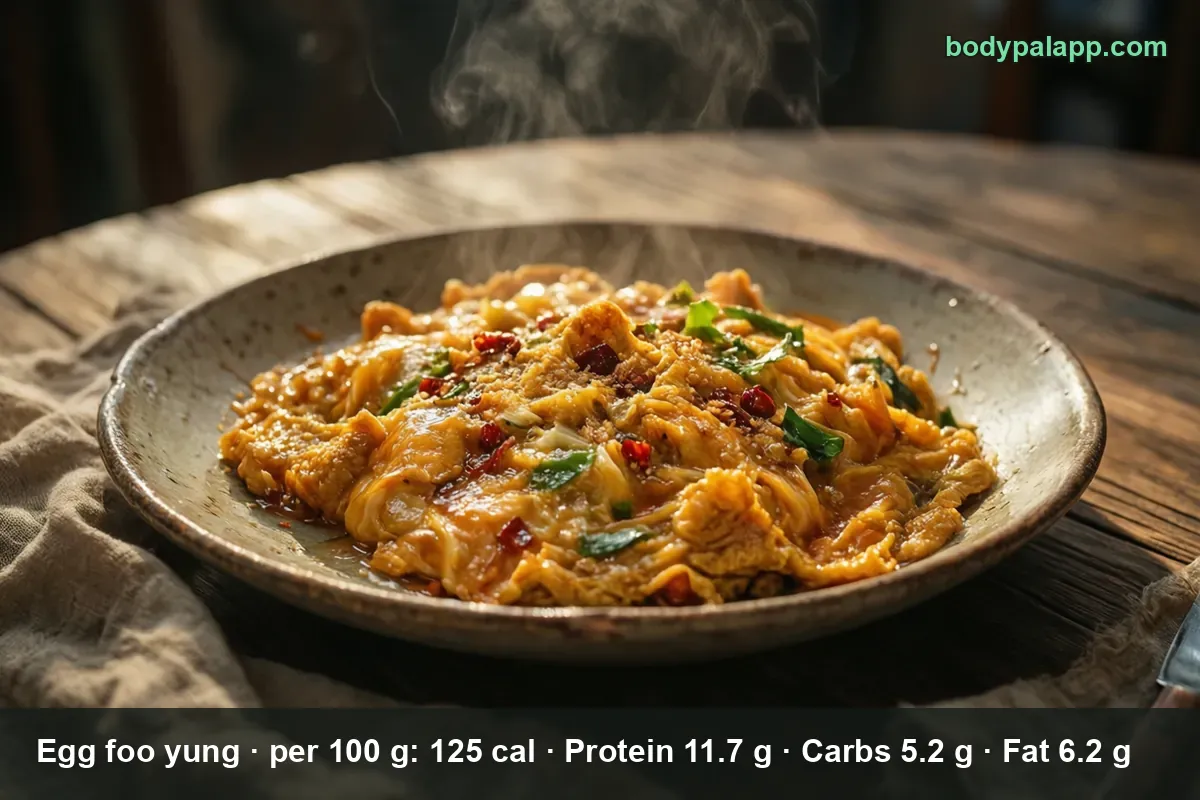
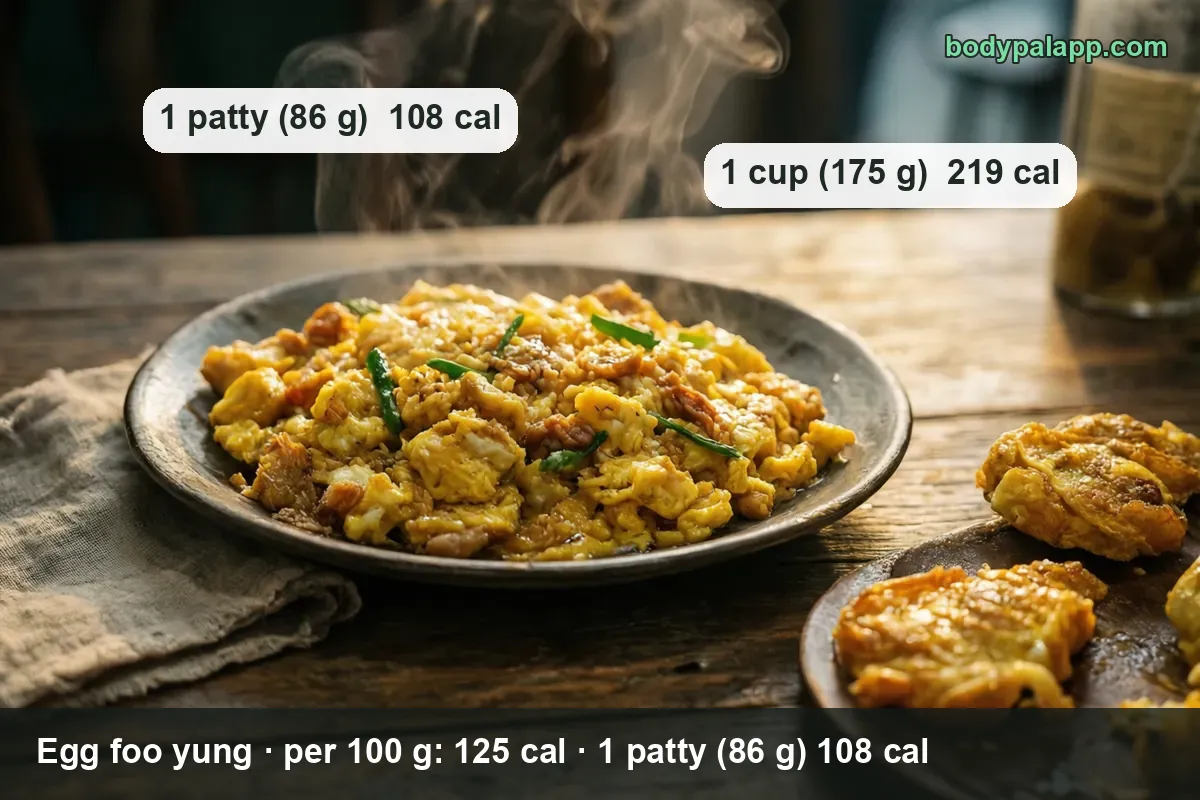
One egg foo yung patty is 108 calories at 86 g, and a full cup of it — 175 g — comes to 219. Per 100 g the dish runs 125 calories, which keeps the calories in egg foo yung modest for a fried entree. The number that actually deserves your attention on this plate is not the calorie count.
On this page
- Egg foo yung quick facts
- One patty or one cup
- What a serving actually weighs
- Pork, beef, chicken or shrimp
- The cholesterol is the binding number
- Sodium, and the gravy that never got measured
- How egg foo yung compares
- FAQ
Egg foo yung quick facts
The reference on this page is the version a menu simply calls egg foo yung, with no meat named: USDA FNDDS 2707193, "Egg foo yung, NFS." Beaten eggs, chopped vegetables, a little meat, fried flat. Every figure below is the patty itself, without the brown gravy that a restaurant pours over it.
| Nutrient | Per 100 g | Per 1 patty (86 g) | % Daily Value |
|---|---|---|---|
| Calories | 125 | 108 | — |
| Total fat | 6.16 g | 5.3 g | 7% |
| Saturated fat | 1.71 g | 1.5 g | 7% |
| Carbohydrate | 5.2 g | 4.5 g | 2% |
| Dietary fiber | 0.3 g | 0.3 g | 1% |
| Total sugars | 3.07 g | 2.6 g | — |
| Protein | 11.69 g | 10.1 g | 20% |
| Sodium | 340 mg | 292 mg | 13% |
| Cholesterol | 234 mg | 201 mg | 67% |
| Potassium | 143 mg | 123 mg | 3% |
% Daily Value is based on a 2,000-calorie diet.
Verified nutrition data
Numbers on this page come from USDA FoodData Central, the U.S. Department of Agriculture’s food composition database, and from manufacturer labels where a branded product is named. Last verified September 2026. How we verify our data →
Read the panel from the bottom up and it stops looking like an ordinary side dish. One patty of 108 calories delivers 10.1 g of protein, a fifth of the day, for about 5% of a 2,000-calorie day. That is a better protein-to-calorie trade than most things that come out of a wok.
Then there is the cholesterol line: 201 mg in one patty, 67% of the FDA Daily Value, from an item that weighs just 86 g. Eggs are the whole dish, and eggs are where that comes from.
Two rows that belong on an American label are missing, and the absence is on purpose. This FNDDS edition carries no added-sugars value and no trans fat value for any egg foo yung record, so printing a zero would invent a measurement nobody took. The total sugars line stays because it was measured; it has no percentage because FDA sets no Daily Value for total sugars.
One patty or one cup
Here is where the logging goes wrong, and it goes wrong by a factor of two.
USDA lists two household servings for this dish. One patty weighs 86 g. One cup weighs 175 g. A cup is not a patty in a round container — it is slightly more than two patties, because the pieces break up and pack down when they go into a measuring cup.
So the calorie spread on the same food is 108 against 219. Tap "1 cup" when you ate a single patty and you have added 111 calories that never existed. Tap "1 patty" when the takeout container held a cup and a half, and you are short by roughly 220 — that last figure is our own arithmetic on the USDA cup weight, not a portion USDA lists.
The tell is shape. If the eggs came to the table as distinct fried discs, count discs. If they arrived loose, scrambled into sauce and spooned over rice, count cups. A standard Chinese takeout entree container holds well over one cup, which is why the honest answer for a restaurant portion is usually two patties or more.
What a serving actually weighs
| Serving | Weight | Calories |
|---|---|---|
| One patty | 86 g | 108 |
| One cup | 175 g | 219 |
| Typical serving, size unstated | 131 g | 164 |
| 1 oz | 28 g | 35 |
| 100 g | 100 g | 125 |
That third row is the one to memorize if you eat this at a restaurant. When USDA records the dish without a stated quantity — the way people actually report eating it — the average lands at 131 g, or 164 calories. It sits neatly between one patty and one cup, and it is the closest single figure to a real plate.
There is no raw entry to worry about here, and that is a small mercy. Egg foo yung exists only cooked, so the weight you see is the weight you log. Meat and rice pages force you to track shrink and water loss; this one does not.
Pork, beef, chicken or shrimp
| Version | Per 100 g | One patty (86 g) | One cup (175 g) | Protein /100 g | Fat /100 g | Sodium /100 g |
|---|---|---|---|---|---|---|
| Plain, no meat named | 125 | 108 | 219 | 11.69 g | 6.16 g | 340 mg |
| Pork | 149 | 128 | 261 | 13.29 g | 8.25 g | 325 mg |
| Beef | 147 | 126 | 257 | 13.82 g | 8.08 g | 321 mg |
| Chicken | 137 | 118 | 240 | 12.79 g | 7.38 g | 401 mg |
| Shrimp | 125 | 108 | 219 | 11.69 g | 6.16 g | 340 mg |
The whole spread from the lightest version to the heaviest is 42 calories per cup. Choose pork over chicken and you have spent 21 calories. This is a rare dish where the meat question is close to irrelevant to the calorie total.
What the meat does change is the composition. Look at the fat column: 6.16 g plain, 8.25 g with pork. Now look for a carbohydrate column that moves, and there is not one — every version sits between 4.78 g and 5.2 g per 100 g. The meat buys fat, not starch. A low-carb eater has nothing to choose between these five rows; a low-fat eater has 2 g per 100 g on the table.
One honest note on the shrimp row. Its numbers are identical to the plain version down to the decimal, because that is what the database holds for it — not because someone weighed shrimp egg foo yung and found it matched. Treat the shrimp figure as the generic figure until USDA separates them.
The cholesterol is the binding number
Calories are why people search for this dish. Cholesterol is the reason to read further.
- One patty, 86 g: 201 mg, or 67% of the Daily Value
- Typical serving, 131 g: 307 mg, just over the full Daily Value
- One cup, 175 g: 410 mg, or 136%
FDA sets the Daily Value for cholesterol at 300 mg. A single cup of egg foo yung clears it while costing you only 219 calories. Very few foods push past a Daily Value that fast and stay that light on the calorie side.
None of that makes the dish a poor choice, and there is no verdict here about what cholesterol in food does inside a body; that is a live scientific question, not something a calorie page settles. What is worth knowing is the arithmetic: if you have already eaten eggs at breakfast, a cup of egg foo yung at dinner is a second full day of the same nutrient.
The flip side is the protein. Egg protein is the reason MyPlate counts eggs in the protein foods group, and a cup here delivers 20.5 g of it — a genuine main course of protein for 219 calories.
Sodium, and the gravy that never got measured
Sodium runs 340 mg per 100 g, which works out to 292 mg in a patty (13% DV) and 595 mg in a cup (26% DV). That cup is roughly a quarter teaspoon of table salt, and a quarter of the 2,300 mg daily limit FDA uses on the label.
The chicken version is the outlier and nobody would guess it from the menu. At 401 mg per 100 g it carries the most sodium of the five, so a cup reaches 702 mg, or 31% of the day, against 26% for the plain version. Same dish, same size, 107 mg apart.
Now the part most calorie charts quietly skip. Restaurant egg foo yung usually arrives under a ladle of brown gravy, and none of the numbers on this page include it. USDA has five records for this dish and not one of them is a gravy-topped version; there is also no separate record for that specific sauce that could be added with any confidence. So no gravy figure appears here. A soy-and-stock gravy is mostly salt and starch, which means the sodium column is the one it would move most — but a number we have not verified is worse than no number, so we have left it out.
If you want the practical rule: log the patties from this page, then log the gravy separately as its own item.
How egg foo yung compares
Five dishes from the same section of the USDA survey database, each measured as one cup with its own real cup weight.
| Dish | Per 100 g | Cup weight | Calories | Protein | Carbs | Fat |
|---|---|---|---|---|---|---|
| Egg foo yung | 125 | 175 g | 219 | 20.5 g | 9.1 g | 10.8 g |
| Kung pao chicken | 129 | 162 g | 209 | 15.8 g | 11.1 g | 11.3 g |
| Shrimp teriyaki | 120 | 201 g | 241 | 43.5 g | 6.7 g | 3.1 g |
| Chicken, rice and vegetables in soy sauce | 131 | 217 g | 284 | 20.3 g | 17.3 g | 15.0 g |
| Pork, tofu and vegetables in soy sauce | 118 | 217 g | 256 | 15.6 g | 9.7 g | 17.5 g |
Per 100 g these are all within 13 calories of each other, which tells you something useful: the calorie density of a soy-sauce entree barely varies. What varies is how much of it fills a cup, and what the protein costs.
Our take: if protein per calorie is the goal, shrimp teriyaki wins the table outright and it is not close — 43.5 g for 241 calories. Egg foo yung takes second place and beats every meat-and-vegetable dish here, delivering 4.7 g more protein than kung pao chicken for 10 more calories. The row to skip is the combination plate with rice folded in at 284 calories a cup; it is the heaviest thing on the list and the protein is no better than the eggs.
Egg foo yung FAQs
How many calories are in egg foo yung?
108 calories in one 86 g patty and 219 in a full cup (175 g), which is 125 calories per 100 g. A typical restaurant serving of unstated size averages 131 g, or 164 calories. Those figures are for the patties alone, without brown gravy.
How many calories in one egg foo yung patty?
108 calories for one patty weighing 86 g. It carries 10.1 g of protein, 5.3 g of fat and 4.5 g of carbohydrate. A pork patty of the same size is 128 calories and a chicken one is 118, so the meat adds at most 20 calories per patty.
How many carbs are in egg foo yung?
4.5 g of carbohydrate in one patty and 9.1 g in a cup, from 5.2 g per 100 g. Fiber is negligible at 0.3 g per 100 g. Carbs stay between 4.78 g and 5.2 g per 100 g across all five USDA versions, so the meat you pick does not change them.
How much protein is in egg foo yung?
10.1 g in one patty and 20.5 g in a cup, which is 20% and 41% of the Daily Value. At 11.69 g per 100 g against 125 calories, this is one of the denser protein sources on a Chinese takeout menu, beaten mainly by plain shrimp dishes.
Is egg foo yung healthy?
It is light for a fried entree at 219 calories a cup, with 20.5 g of protein and only 3.0 g of saturated fat. The two figures to weigh are cholesterol, at 410 mg per cup or 136% of the Daily Value, and sodium at 595 mg before any gravy.
Which egg foo yung has the fewest calories?
The plain version, at 125 calories per 100 g, tied with shrimp. Chicken is 137, beef 147 and pork 149. Across a full cup that is a spread of just 42 calories, from 219 for plain to 261 for pork, so the meat choice matters less than the serving size.
How many calories does egg foo yung gravy add?
No verified figure exists, so the 108-calorie patty and the 219-calorie cup on this page are the dish without it. All five USDA records for egg foo yung describe it ungravied, and there is no separate database entry for that specific brown sauce. Log the gravy as its own item rather than guessing at a combined total.
How much cholesterol is in egg foo yung?
201 mg in one patty, which is 67% of the 300 mg Daily Value, and 410 mg in a cup, or 136%. The eggs supply almost all of it. A 131 g restaurant-style serving lands at 307 mg, just past a full day's value, for 164 calories.
Similar foods
- Snow Cone — 256 cal per snow cone
- Shrimp Lo Mein — 242 cal per cup
- Chicken Chow Mein — 288 cal per cup
- Half And Half — 20 cal per tbsp
- Olive — 26 cal for 5 large olives
- Masoor Dal — 207 cal per cup cooked
Count it without the math
Point the camera at the plate and BodyPal counts the patties for you, so a cup never gets logged as one.


How long does it take to burn off egg foo yung?
One 86 g patty is 108 kcal. Enter your weight and the amount you ate to see how long it takes you to burn that off:
lb
| Activity | Time to burn 108 kcal |
|---|---|
| Walking, brisk | 22 min |
| Cycling, moderate | 14 min |
| Swimming, moderate | 15 min |
| Jogging | 13 min |
| Weight training, moderate | 24 min |
Times are for a 155 lb adult at a steady pace; change the weight to see yours. The amount is set to the portion in the text (86 g); change it to what you actually ate. BodyPal works this out from your steps automatically.
One food is easy to picture; a whole day is harder. See how many calories you need a day and what a deficit actually looks like.