
How many calories are in chicken chow mein?
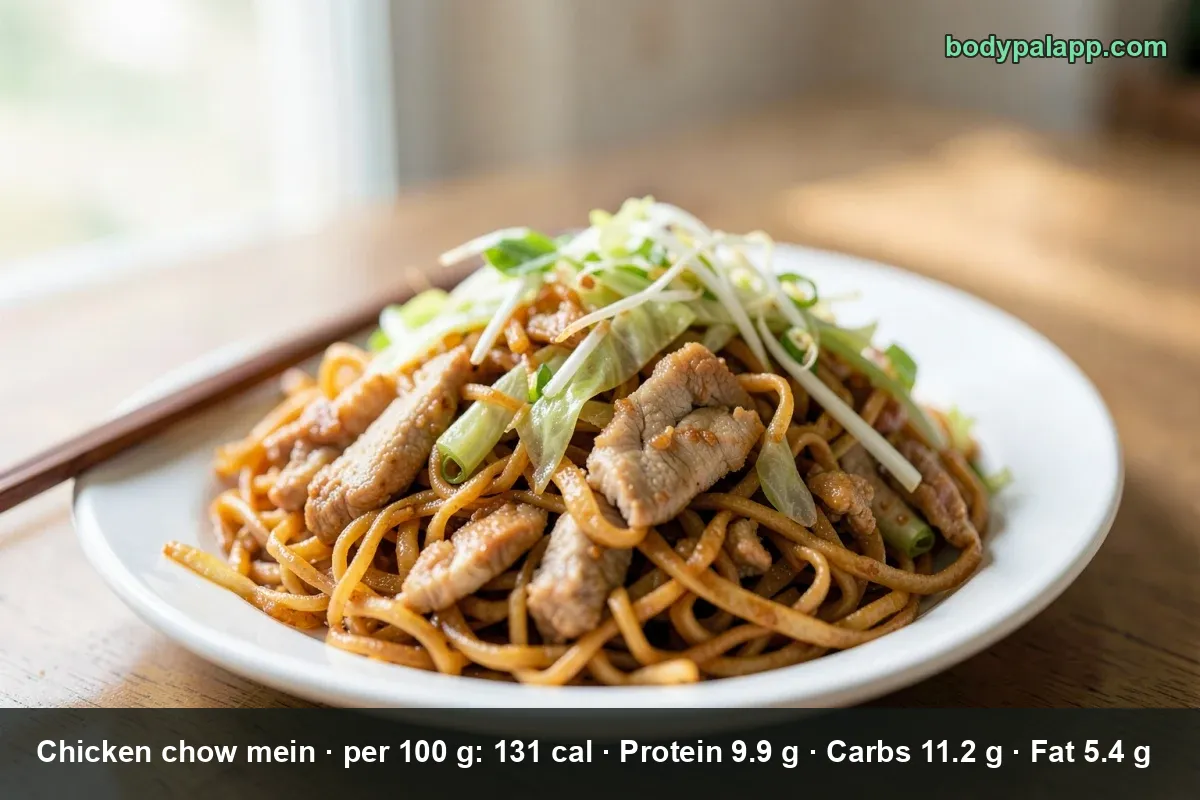
A 1-cup serving of chicken chow mein — chicken, vegetables and noodles all stir-fried together — weighs 220 g and carries 288 calories. Per 100 g it runs 131 calories, light for a noodle dish. The noodles are what move the number: the same cup made without them lands at 183.
On this page
- Chicken chow mein quick facts
- US servings, from one ounce to a takeout box
- Noodles, no noodles, takeout and the freezer aisle
- Sodium is the row to watch, not calories
- How does chicken chow mein compare?
- Most popular chicken chow mein brands
- FAQ
Chicken chow mein quick facts
The number below comes from the USDA FNDDS record 2706687, "Chicken or turkey chow mein or chop suey with noodles". That is the dish an American actually orders under the name chow mein: soft or crisp noodles tossed through the chicken and vegetables, not served next to them. USDA gives it a household measure of 1 cup, 220 g, which is what most people scoop onto a plate.
There is a second, much older USDA record for restaurant chicken chow mein that reads 85 calories per 100 g. It is not a different data source or a stricter measurement — it describes a preparation where the noodles sit on the side and the wet vegetable mixture is weighed on its own. Two ways of building the same plate, two different numbers per gram.
| Nutrient | Per 100 g | Per 1 cup (220 g) | % Daily Value |
|---|---|---|---|
| Calories | 131 | 288 | — |
| Total fat | 5.43 g | 11.9 g | 15% |
| Saturated fat | 1.46 g | 3.2 g | 16% |
| Carbohydrate | 11.15 g | 24.5 g | 9% |
| Dietary fiber | 1.5 g | 3.3 g | 12% |
| Total sugars | 1.54 g | 3.4 g | — |
| Protein | 9.91 g | 21.8 g | 44% |
| Sodium | 408 mg | 898 mg | 39% |
| Cholesterol | 33 mg | 73 mg | 24% |
| Potassium | 174 mg | 383 mg | 8% |
% Daily Value is based on a 2,000-calorie diet.
Verified nutrition data
Numbers on this page come from USDA FoodData Central, the U.S. Department of Agriculture’s food composition database, and from manufacturer labels where a branded product is named. Last verified September 2026. How we verify our data →
Two label rows are missing on purpose. This FNDDS edition does not publish added sugars or trans fat for the dish, so rather than guess at them the rows are left out. Total sugars at 3.4 g a cup are close to nothing anyway, most of it from the vegetables and the sauce.
The row that jumps out is protein: 21.8 g in one cup, 44% of the Daily Value — close to half a day's protein target in a single bowl. For a bowl that reads as a carbohydrate dish, that is a lot of it doing the work.
US servings, from one ounce to a takeout box
| Serving | Weight | Calories |
|---|---|---|
| 1 oz | 28 g | 37 kcal |
| Half a cup | 110 g | 144 kcal |
| 1 cup | 220 g | 288 kcal |
| 2 cups, a filled takeout box | 440 g | 576 kcal |
| Per 100 g | 100 g | 131 kcal |
Only the 1-cup line is a USDA household measure. The half cup, the 2-cup box and the ounce are our own arithmetic from the USDA 100 g figure, not USDA servings.
The 2-cup line is the one that catches people. A white takeout container holds close to a quart, and a portion of chow mein filling half of it is already two cups, 576 calories, before an egg roll or a scoop of rice joins the plate. Eating straight from the box instead of a bowl is the single easiest way to double the number you meant to log.
Noodles, no noodles, takeout and the freezer aisle
| Version | Per 100 g | Typical serving | Calories |
|---|---|---|---|
| With noodles, home or counter style | 131 kcal | 1 cup, 220 g | 288 kcal |
| Without noodles, chow mein or chop suey style | 83 kcal | 1 cup, 220 g | 183 kcal |
| Restaurant order, noodles on the side | 85 kcal | 1 order, 604 g | 513 kcal |
| Frozen entree, Tai Pei | 106 kcal | 1 container, 283 g | 300 kcal |
| Canned, La Choy | 37 kcal | 1 cup, 242 g | 90 kcal |
| Skillet meal, Publix GreenWise | 118 kcal | 1 cup, 203 g | 240 kcal |
Pull the noodles out and a cup drops from 288 to 183 calories. That is 105 calories of pure noodle, and carbohydrate falls with it, from 24.5 g to 8.4 g, while protein barely moves — 21.8 g becomes about 21.5 g. If you are trying to spend fewer calories on the same amount of food, that swap does more than any sauce change.
The restaurant record is the outlier in both directions. One order weighs 604 g, about 2.7 cups, so even at a lower 85 calories per 100 g it comes to 513 calories — 78% more than a home-style cup, because the plate is simply bigger.
Supermarket versions read lower per gram than either, and the canned aisle is the extreme: La Choy runs 37 calories per 100 g, so a 242 g cup is 90 calories. That is a thin, mostly-broth product rather than a stir-fry. Two more freezer options sit in between, Healthy Choice at 141 calories for a 227 g cup and Captain Ken's at 140 for a 234 g cup.
Sodium is the row to watch, not calories
One cup carries 898 mg of sodium, 39% of the FDA Daily Value of 2,300 mg — a bit more than a third of a teaspoon of table salt in a 288-calorie bowl. Take the full restaurant order and it reaches 1,878 mg, 82% of the day's allowance, for 513 calories. The CDC notes that most people in the US already take in more sodium than recommended, and a single takeout container gets you most of the way there on its own.
Losing the noodles helps here too, though less than you would expect: a no-noodle cup still holds 757 mg, because the salt lives in the soy sauce and the stock, not the pasta.
On the other side of the label, the protein is genuinely good value. At 21.8 g a cup, chow mein covers a big share of a meal's protein target, and MyPlate counts stir-fried chicken toward the protein foods group like any other cooked poultry. If you are watching sodium, ask for sauce on the side and split the container; if you are chasing protein per calorie, this is one of the better takeout picks on the menu.
How does chicken chow mein compare?
| Dish | Per 100 g | US serving | Calories |
|---|---|---|---|
| Chicken chow mein with noodles | 131 kcal | 1 cup, 220 g | 288 kcal |
| Chow mein or chop suey, no noodles | 83 kcal | 1 cup, 220 g | 183 kcal |
| Restaurant chicken chow mein | 85 kcal | 1 order, 604 g | 513 kcal |
| Restaurant chicken and vegetables | 95 kcal | — | — |
The last row has no serving figure because USDA does not publish a portion weight for that record, so there is nothing honest to put in the calories column. Judged per gram it still tells you something: a plain chicken-and-vegetable stir-fry sits at 95 calories per 100 g, above both noodle-free chow mein records and below the version with noodles.
One question we cannot settle with numbers: chow mein against chicken lo mein. USDA's index returns chow mein and chop suey records but no separate lo mein entry, so any calorie gap between the two would be invented rather than measured.
Our take: chow mein with the noodles mixed in is the densest of these four per gram, and it is still only 131 calories per 100 g — this is not a heavy dish by takeout standards. Portion size beats recipe here. A measured cup at 288 calories with 21.8 g of protein is a solid lunch; the same food eaten out of a 604 g container is 513 calories and 82% of a day's sodium. Measure the cup, and chow mein is one of the easier Chinese dishes to fit into a day.
Most popular chicken chow mein brands in the United States
Ranked by how widely each product appears among foods sold in the United States, from the BodyPal food database of over 3.3 million products. Calories are the figures printed on each Nutrition Facts label, checked against USDA FoodData Central.
| Product | Calories (per 100 g) |
|---|---|
| Tai Pei Chicken Chow Mein | 106 cal |
| Healthy Choice Chicken Chow Mein | 62 cal |
| La Choy Chicken Chow Mein | 37 cal |
| Captain Ken's Chicken Chow Mein with Pork | 60 cal |
| Publix GreenWise Chicken Chow Mein Skillet Meal | 118 cal |
Brand popularity: BodyPal food database. Nutrition: manufacturer labels / USDA FoodData Central.
Chicken chow mein FAQs
How many calories are in 1 cup of chicken chow mein?
A 1-cup serving weighs 220 g and holds 288 calories, based on the USDA FNDDS record for chow mein made with noodles. That cup also brings 21.8 g of protein, 24.5 g of carbohydrate and 898 mg of sodium. Half a cup, 110 g, is 144 calories.
How many calories are in a takeout order of chicken chow mein?
USDA's restaurant record puts one order at 604 g and 513 calories, which is about 2.7 cups of food. The catch is not the calorie count but the salt: that single order carries 1,878 mg of sodium, 82% of the Daily Value, before rice or an appetizer is added.
How much protein is in chicken chow mein?
A 1-cup serving gives 21.8 g of protein, 44% of the Daily Value, from 9.91 g per 100 g. That is high for a noodle dish, because the chicken is stir-fried through the whole bowl rather than served alongside it. Without noodles, the same cup still gives about 21.5 g.
How much sodium is in chicken chow mein?
One cup carries 898 mg of sodium, 39% of the 2,300 mg Daily Value, or a bit more than a third of a teaspoon of table salt. A 604 g restaurant order reaches 1,878 mg, 82% of the day. Even the no-noodle version holds 757 mg per cup.
How many carbs are in chicken chow mein?
A 1-cup serving has 24.5 g of carbohydrate, 9% of the Daily Value, of which 3.3 g is fiber and 3.4 g is total sugars. Nearly all of it comes from the noodles: the same cup made without them drops to about 8.4 g of carbohydrate.
How many calories are in chicken chow mein without noodles?
A 1-cup serving of chicken chow mein or chop suey made without noodles is 183 calories, from 83 calories per 100 g. That is 105 calories less than the same cup with noodles, and carbohydrate falls from 24.5 g to about 8.4 g while the protein stays around 21.5 g.
Is chicken chow mein healthy?
At 131 calories per 100 g with 9.91 g of protein, it is one of the leaner Chinese takeout dishes by weight, and a cup covers 12% of the Daily Value for fiber. Sodium is the weak spot at 898 mg a cup, which the CDC would count against an already high national average.
Is chicken chow mein good for weight loss?
At 288 calories a cup with 21.8 g of protein, it competes well with most takeout for the same money in calories. To make it lighter, take it without noodles at 183 calories a cup, or measure one cup instead of eating from a 440 g box, which is 576 calories.
Similar foods
- Half And Half — 20 cal per tbsp
- Snow Cone — 256 cal per snow cone
- Egg Foo Yung — 108 cal per patty
- Lasagna — 286 cal per piece
- Shrimp Lo Mein — 242 cal per cup
- Toor Dal — 348 cal per cup
Count it without the math
Point the camera at the container and BodyPal counts the chow mein for you, noodles and all.


How long does it take to burn off 288 kcal of chicken chow mein?
A 1-cup (220 g) serving is 288 kcal. Enter your weight and the amount you ate to see how long it takes you to burn that off:
lb
| Activity | Time to burn 288 kcal |
|---|---|
| Walking, brisk | 58 min |
| Cycling, moderate | 36 min |
| Swimming, moderate | 41 min |
| Jogging | 34 min |
| Weight training, moderate | 1 hr 4 min |
Times are for a 155 lb adult at a steady pace; change the weight to see yours. The amount is set to the portion in the text (220 g); change it to what you actually ate. BodyPal works this out from your steps automatically.
One food is easy to picture; a whole day is harder. See how many calories you need a day and what a deficit actually looks like.