
How many calories are in a cup of toor dal?
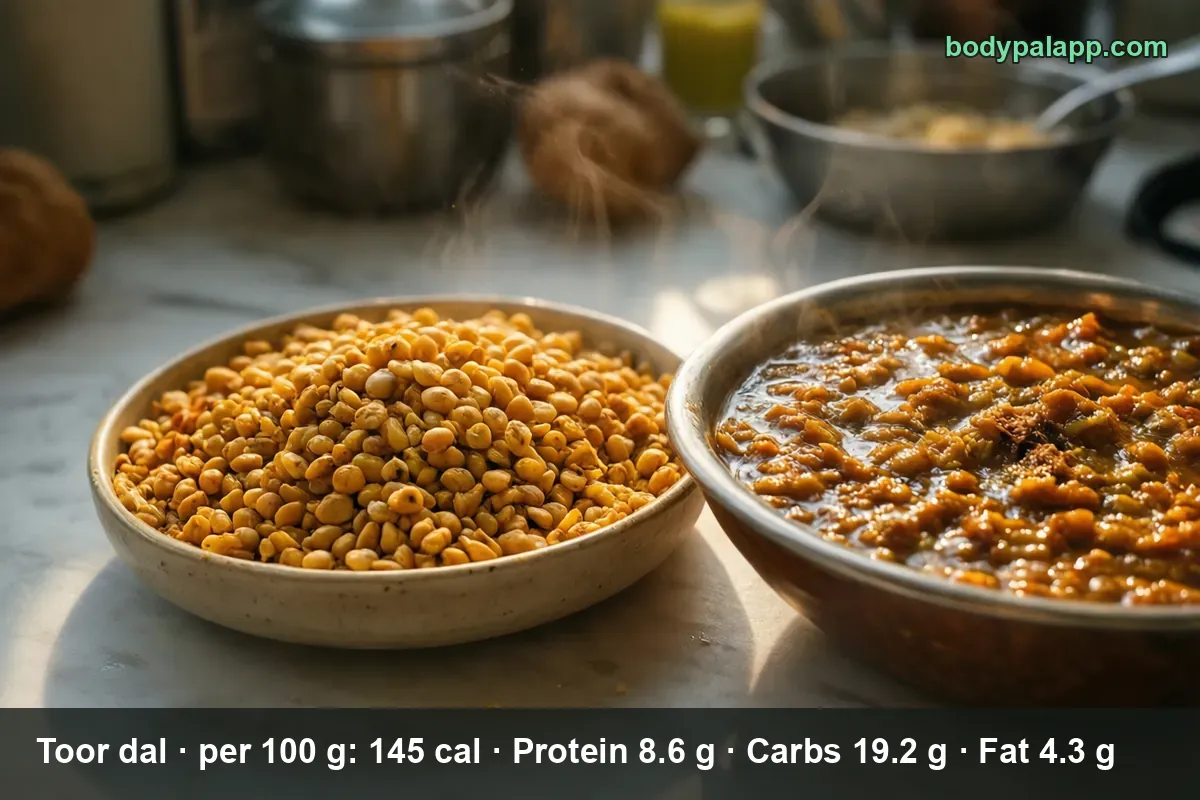
A 1-cup serving of tempered toor dal, the yellow dal that lands in front of you at dinner, weighs 240 g and carries 348 calories. Per 100 g it runs 145 calories. The dry split peas in the bag are a different number entirely: 343 per 100 g, before a drop of water.
On this page
- Toor dal quick facts
- US servings from one ounce to a restaurant bowl
- Dry versus cooked toor dal
- What the tadka adds
- Fresh green pigeon peas are a different food
- Fiber and sodium are the rows to watch
- How does toor dal compare?
- Most popular toor dal brands
- FAQ
Toor dal quick facts
Toor dal and split pigeon peas are the same legume under two names, and USDA files them in two different places. The row used here is FNDDS 2707427, "Dal", the finished dish: peas simmered soft, seasoned, and finished with a tempering of fat and spices. That is what a person holding a bowl is actually eating, and it comes with a household measure of 1 cup.
The dry bag on the shelf and the plain boiled pot are separate records, and both appear further down. They differ from this one because of what happens in the kitchen, not because of where the numbers come from.
| Nutrient | Per 100 g | Per 1 cup (240 g) | % Daily Value |
|---|---|---|---|
| Calories | 145 | 348 | — |
| Total fat | 4.31 g | 10.3 g | 13% |
| Saturated fat | 2.51 g | 6.0 g | 30% |
| Carbohydrate | 19.17 g | 46.0 g | 17% |
| Dietary fiber | 7.5 g | 18.0 g | 64% |
| Total sugars | 1.71 g | 4.1 g | — |
| Protein | 8.6 g | 20.6 g | 41% |
| Sodium | 309 mg | 742 mg | 32% |
% Daily Value is based on a 2,000-calorie diet.
Verified nutrition data
Numbers on this page come from USDA FoodData Central, the U.S. Department of Agriculture’s food composition database, and from manufacturer labels where a branded product is named. Last verified September 2026. How we verify our data →
Two rows you will not find above: added sugars and trans fat, because USDA does not publish either value for this FNDDS record. Cholesterol is 10 mg per 100 g, or 24 mg in a cup, 8% of the Daily Value, which tells you the tempering fat here includes some dairy. Potassium is generous at 352 mg per 100 g, 845 mg a cup, 18% of the Daily Value.
US servings from one ounce to a restaurant bowl
| Serving | Weight | Calories |
|---|---|---|
| 1 oz | 28 g | 41 kcal |
| Half a cup | 120 g | 174 kcal |
| Three quarters of a cup | 180 g | 261 kcal |
| 1 cup | 240 g | 348 kcal |
| 1 1/2 cups, restaurant bowl | 360 g | 522 kcal |
| Per 100 g | 100 g | 145 kcal |
Only the 1-cup line is a USDA household serving. The half cup, the three-quarter cup, the ounce and the restaurant bowl are our own arithmetic from the USDA 100 g figure, not USDA servings. They are here because nobody serves dal in hundred-gram units.
The restaurant bowl is worth pausing on. A cup of dal looks modest in a wide steel katori, and the serving that arrives with rice or roti is usually closer to a cup and a half. At 522 calories that is a full meal on its own, before the bread.
Dry versus cooked toor dal
This is the single biggest source of confusion, and it is worth getting straight before you log anything. Dry toor dal is 343 calories per 100 g. Boiled plain, it is 121. The peas did not lose anything; they absorbed water and roughly tripled in weight.
| Version | Per 100 g | Typical serving | Calories |
|---|---|---|---|
| Dry, uncooked | 343 kcal | 1 cup dry, 205 g | 703 kcal |
| Boiled, no salt | 121 kcal | 1 cup cooked, 168 g | 203 kcal |
| Boiled, salted water | 121 kcal | 1 cup cooked, 168 g | 203 kcal |
| Dal, tempered as eaten | 145 kcal | 1 cup, 240 g | 348 kcal |
A quarter cup of dry dal, about 51 g by our own arithmetic from the 205 g cup, is 175 calories and swells to nearly a full cup on the plate. That is why "a cup of dal" is never 703 calories. If you weigh the bag, use the dry row. If you weigh the bowl, use the cooked one. Mixing them is a several-hundred-calorie mistake in either direction.
US bags agree with the dry number. Laxmi and Royal both label a quarter cup at 47 to 48 g and 160 calories, Swad calls a quarter cup 35 g and 120 calories, and Jack Rabbit pigeon peas run 333 per 100 g. The spread is measuring-cup variation, not a difference in the peas.
Salting the cooking water changes exactly one row. Boiled without salt, toor dal carries 5 mg of sodium per 100 g, or 8 mg in a cooked cup. Boiled in salted water, the same peas read 241 mg per 100 g, about 405 mg a cup. Calories, protein and fiber do not move at all.
What the tadka adds
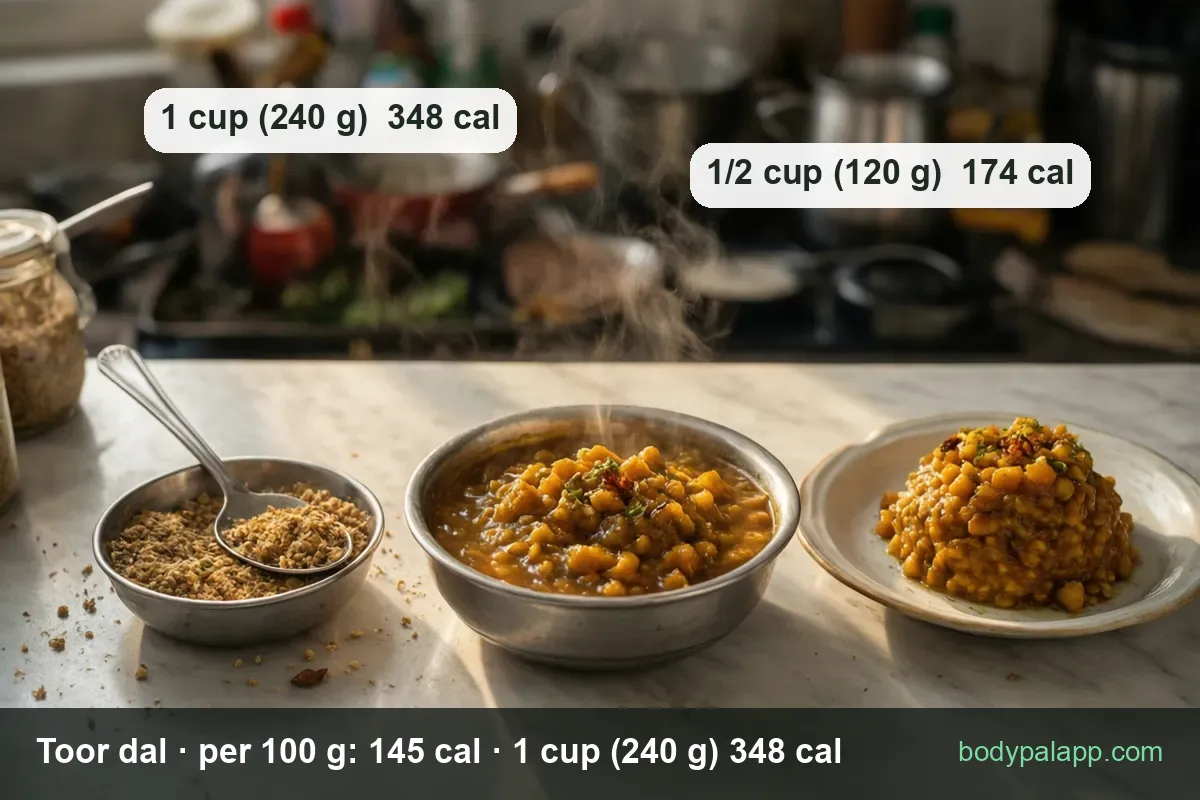
Tempering is the whole difference between a plain pot of pigeon peas and dal as anyone actually eats it. Compare the two per 100 g: 145 calories against 121, and fat of 4.31 g against 0.38 g. More than ten times the fat, for one ladle of hot ghee or oil with cumin, garlic and chili.
Where that shows up hardest is saturated fat. The tempered cup carries 6.0 g, 30% of the Daily Value in one bowl. The plain boiled cup carries about 0.1 g. If you are tracking saturated fat rather than calories, the tadka is the row that matters, not the legume.
None of this makes tempering a mistake. It is 24 calories per 100 g for the flavor that makes people eat lentils in the first place, and the fat helps with the fat-soluble vitamins riding along in the spices. It just needs to be logged.
Fresh green pigeon peas are a different food
Green pigeon peas, sold fresh or frozen and known as gandules in a lot of American grocery stores, are the same plant harvested young. They are not toor dal and the numbers are not interchangeable.
| Version | Per 100 g | Typical serving | Calories |
|---|---|---|---|
| Fresh green, raw | 136 kcal | 1 cup, 154 g | 209 kcal |
| Fresh green, boiled and drained | 111 kcal | 1 cup, 153 g | 170 kcal |
Note that raw green pigeon peas are 136 calories per 100 g while raw dry toor dal is 343. Same species, and the only difference is water. Raw green peas also carry 3 g of total sugars per 100 g, which the mature dry seeds do not have listed at all.
Fiber and sodium are the rows to watch
Fiber is where toor dal quietly wins. A 1-cup serving delivers 18.0 g, which is 64% of the FDA Daily Value of 28 g. Very few single servings of anything get you two thirds of a day's fiber, and the Dietary Guidelines flag fiber as a nutrient most Americans fall short on.
Protein comes in at 20.6 g a cup, 41% of the Daily Value. MyPlate counts beans, peas and lentils in the protein group as well as the vegetable group, and a cup of dal is doing roughly the work of three eggs on that row.
Sodium is the trade. That same cup carries 742 mg, 32% of the Daily Value and about a third of a teaspoon of table salt. Two cups over a meal put you at nearly two thirds of the day's sodium before anything else on the table is counted. If you are watching sodium, the home pot without salt at 8 mg a cup is the better pick, and you can bring the flavor back with acid and spice instead.
How does toor dal compare?
| Version | Per 100 g | US serving | Calories |
|---|---|---|---|
| Toor dal, tempered as eaten | 145 kcal | 1 cup, 240 g | 348 kcal |
| Toor dal, dry | 343 kcal | 1 cup dry, 205 g | 703 kcal |
| Toor dal, boiled plain | 121 kcal | 1 cup cooked, 168 g | 203 kcal |
| Fresh green pigeon peas, raw | 136 kcal | 1 cup, 154 g | 209 kcal |
Two of the three comparison rows are lighter per gram than the tempered bowl, and both of them are lighter for the same reason: no added fat. The dry row is the outlier in the other direction, and it is the one people misread.
Our take: for weight loss, cook toor dal at home and go easy on the tadka. Plain boiled comes to 203 calories a cup with 11.4 g of protein and 11.3 g of fiber, which is a lot of food for the calories. For fullness on a long afternoon, take the tempered version and eat half a cup, 174 calories, alongside vegetables rather than a full cup alongside rice. The dal is not the problem in a heavy Indian meal. The rice, the bread and the second ladle of ghee are.
Most popular toor dal brands in the United States
Ranked by how widely each product appears among foods sold in the United States, from the BodyPal food database of over 3.3 million products. Calories are the figures printed on each Nutrition Facts label, checked against USDA FoodData Central.
| Product | Calories (per 100 g) |
|---|---|
| Jack Rabbit Pigeon Peas | 333 cal |
| Madame Gougousse Dried Pigeon Peas | 350 cal |
| Laxmi Toor Dal | 340 cal |
| Royal Toor Dal Split Pigeon Peas | 333 cal |
| Swad Toor Dal (Split Pigeon Peas) | 343 cal |
| Diya Toor Dal Plain Split Pigeon Peas | 340 cal |
Brand popularity: BodyPal food database. Nutrition: manufacturer labels / USDA FoodData Central.
Toor dal FAQs
How many calories are in 1 cup of toor dal?
One cup of tempered toor dal, 240 g as it reaches the table, is 348 calories. That includes the tadka fat cooked into it. The same cup carries 20.6 g of protein, 18.0 g of fiber and 742 mg of sodium, so it eats like a main course rather than a side dish.
How many calories in 100 g of toor dal?
Cooked and tempered toor dal is 145 calories per 100 g, with 8.6 g of protein, 7.5 g of fiber and 4.31 g of fat. A 100 g scoop is a little under half a cup, so most people are logging two or three of them in a single bowl at dinner.
How many calories in dry vs cooked toor dal?
Dry toor dal is 343 calories per 100 g and plain boiled toor dal is 121. Nothing is lost or gained; the peas take on water and roughly triple in weight. A quarter cup of dry dal, 51 g by our own arithmetic, is 175 calories and cooks up to close to a full cup.
Is toor dal high in protein?
Yes: a cup of tempered dal carries 20.6 g of protein, 41% of the Daily Value, and dry toor dal is 21.7 g per 100 g before cooking. It is not an exact swap for meat on amino acid profile, but MyPlate counts beans, peas and lentils in the protein group.
How much fiber is in a cup of toor dal?
A 1-cup serving carries 18.0 g of fiber, 64% of the 28 g Daily Value, from 7.5 g per 100 g. Boiled plain toor dal still holds 6.7 g per 100 g, so the fiber survives the pot. Very few single servings of anything deliver two thirds of a day's fiber.
Does tadka add a lot of calories to dal?
It adds about 24 calories per 100 g. Tempered dal is 145 calories per 100 g against 121 for plain boiled pigeon peas, and fat jumps from 0.38 g to 4.31 g. The bigger change is saturated fat: 6.0 g in a tempered cup, 30% of the Daily Value, against roughly 0.1 g plain.
How much sodium is in restaurant dal?
A 1-cup restaurant-style bowl runs 742 mg of sodium, 32% of the 2,300 mg Daily Value and about a third of a teaspoon of table salt. Cook the same peas at home without salt and the row reads 8 mg a cup. The legume is not salty; the seasoning is.
Is toor dal good for weight loss?
Half a cup, 120 g, is 174 calories with 9.0 g of fiber and 10.3 g of protein, which is a strong ratio for a hot dish. If you are cutting calories, cook it plain: boiled toor dal is 203 calories a cup. If you want to stay full, keep the tadka and halve the rice.
Similar foods
- Shrimp Pad Thai — 294 cal per cup
- Lasagna — 286 cal per piece
- Chicken Chow Mein — 288 cal per cup
- Eye of round steak — 135 cal for 3 oz cooked
- Half And Half — 20 cal per tbsp
- Snow Cone — 256 cal per snow cone
Count it without the math
Point the camera at the bowl and BodyPal counts the dal for you, tadka and all.


How long does it take to burn off toor dal?
A 1-cup (240 g) serving is 348 kcal. Enter your weight and the amount you ate to see how long it takes you to burn that off:
lb
| Activity | Time to burn 348 kcal |
|---|---|
| Walking, brisk | 1 hr 10 min |
| Cycling, moderate | 44 min |
| Swimming, moderate | 50 min |
| Jogging | 41 min |
| Weight training, moderate | 1 hr 17 min |
Times are for a 155 lb adult at a steady pace; change the weight to see yours. The amount is set to the portion in the text (240 g); change it to what you actually ate. BodyPal works this out from your steps automatically.
Want the bigger picture? Calculate your daily calorie needs — your maintenance figure, a target for losing or gaining, and the date you get there.