
How Many Calories in Eye of Round Steak?
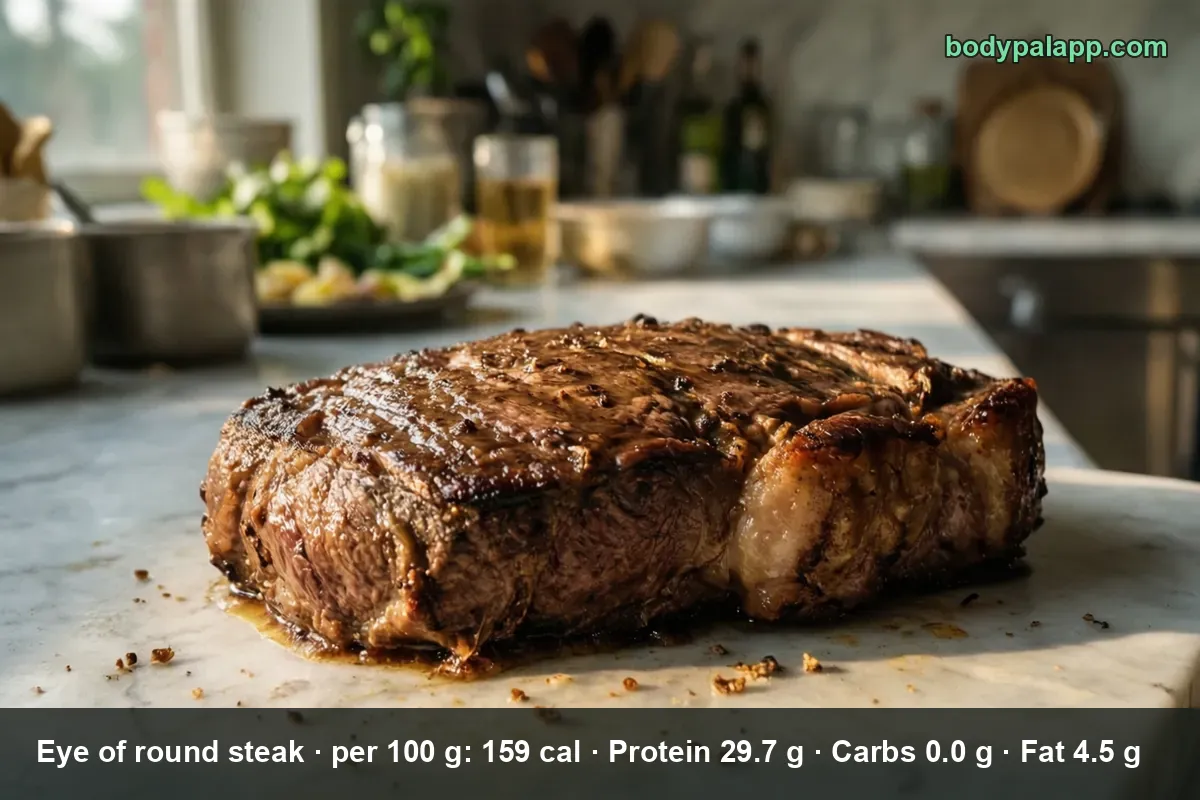
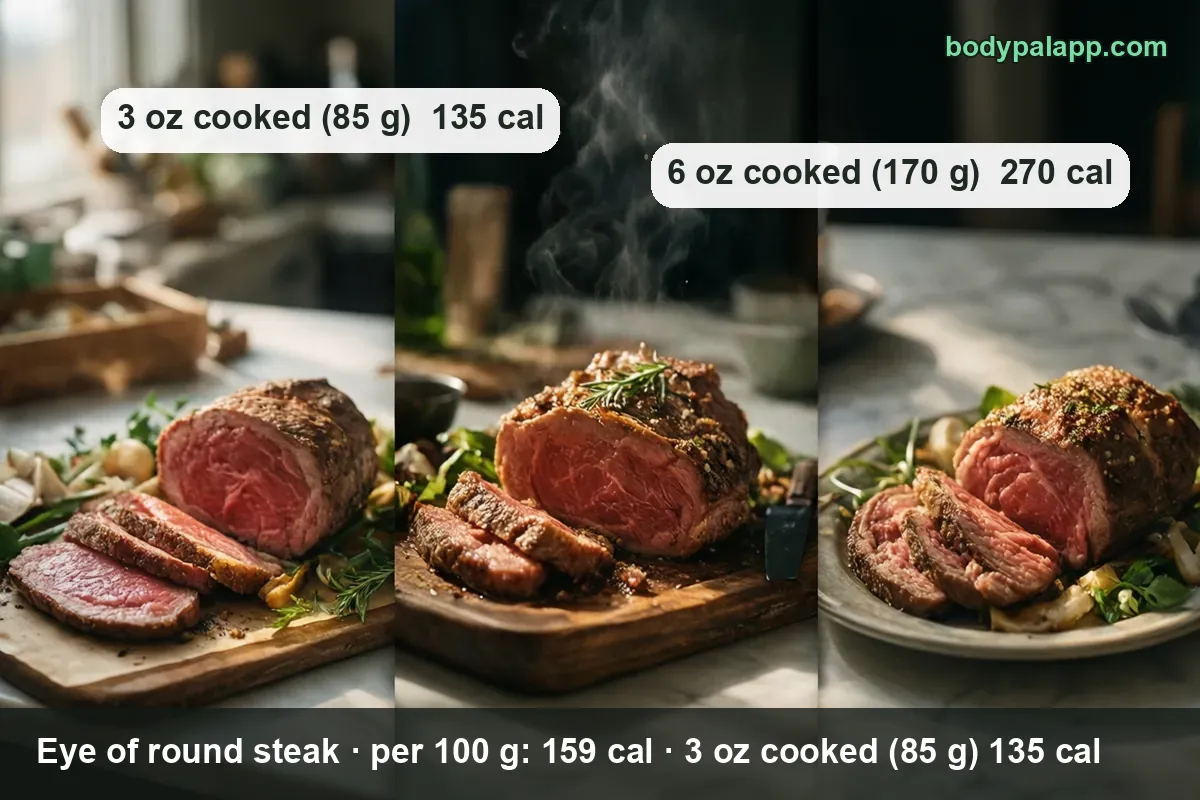
A 3 oz cooked eye of round steak is 135 calories, which works out to 159 calories per 100 g. Scale that to the 6 oz steak a restaurant plates and you are at 270 calories carrying 50 g of protein. The same cut raw reads 124 calories per 100 g, and the distance between those two numbers is where most people log this steak wrong.
On this page
- Eye of round steak quick facts
- The raw-versus-grilled trap
- US portions, ounce by ounce
- Trimming and grade barely move it
- What 3 ounces actually buys you
- How does eye of round steak compare?
- FAQ
Eye of round steak quick facts
The reference below is the steak the way you eat it: boneless eye of round, trimmed of external fat, grilled, and weighed after it comes off the heat. That is USDA SR Legacy 173993, the all-grades row that covers a steak with no Choice or Select sticker on the package.
| Nutrient | Per 100 g | Per 3 oz cooked (85 g) | % Daily Value |
|---|---|---|---|
| Calories | 159 cal | 135 cal | — |
| Total fat | 4.47 g | 3.8 g | 5% |
| Saturated fat | 1.67 g | 1.4 g | 7% |
| Carbohydrate | 0 g | 0 g | 0% |
| Dietary fiber | 0 g | 0 g | 0% |
| Total sugars | 0 g | 0 g | — |
| Protein | 29.66 g | 25.2 g | 50% |
| Sodium | 68 mg | 58 mg | 3% |
% Daily Value is based on a 2,000-calorie diet.
Verified nutrition data
Numbers on this page come from USDA FoodData Central, the U.S. Department of Agriculture’s food composition database, and from manufacturer labels where a branded product is named. Last verified September 2026. How we verify our data →
Two rows do the talking. Protein at 25.2 g is half an adult's day in one small steak, and it arrives for 135 calories. Sodium at 58 mg is close to nothing — 3% of the 2,300 mg the FDA sets as the Daily Value, or roughly a fortieth of a teaspoon of table salt. Everything a steak gets accused of on the sodium front happens at the seasoning stage, not in the meat.
There is no added-sugars line in the table, and that absence is deliberate. The SR Legacy release does not carry an added-sugars measurement for beef rows at all, so printing a zero would be inventing a reading rather than reporting one. Trans fat does have a measurement — 0.22 g per 100 g — and it stays, because ruminant meat carries a small amount naturally.
Two figures sit outside the standard label rows and are worth having. A 3 oz serving holds 66 mg of cholesterol, which is 22% of the 300 mg Daily Value, and 349 mg of potassium, about 7% of the day.
The raw-versus-grilled trap
Here is the number that catches people, and almost every calorie tracker walks into it.
Raw eye of round steak is 124 calories per 100 g. Grilled, the same cut is 159. That is a jump of 28%, and not one calorie of it is new energy. Water left the pan. The protein and fat stayed exactly where they were, packed into less weight.
Follow one steak through it. A raw steak of 140 g is 174 calories. Off the grill it weighs roughly 105 g, and at 159 calories per 100 g that is about 167. The steak lost a quarter of its mass and almost none of its calories.
So the trap is the crossover: weigh the steak raw, then log it against the cooked line in a database, and you have handed yourself about 28% of phantom calories. Do it the other way — weigh the cooked steak, log the raw figure — and you undercount by roughly the same margin. Pick one state and stay in it. Cooked is easier, because the cooked number is the one you can actually verify with a scale at the table.
US portions, ounce by ounce
| Portion | Weight | Calories |
|---|---|---|
| 1 oz cooked | 28 g | 45 cal |
| 3 oz cooked (the USDA serving) | 85 g | 135 cal |
| 4 oz cooked | 113 g | 180 cal |
| 6 oz cooked (restaurant plate) | 170 g | 270 cal |
| 100 g cooked | 100 g | 159 cal |
| 4 oz raw | 113 g | 140 cal |
| One whole steak, raw | 140 g | 174 cal |
The 3 oz row is the one the USDA itself attaches to this record, and it is also the serving the Dietary Guidelines use when they talk about ounce-equivalents of protein foods. The 1 oz, 4 oz and 6 oz cooked lines are our own scaling from the 159 calories per 100 g figure, because USDA attaches no other portion to this cooked row. It is smaller than it sounds. Three cooked ounces is a piece about the size of a deck of cards, and a steak house portion is double it.
Nothing on the fresh-meat counter comes with a Nutrition Facts panel to check this against. Whole cuts in the US are sold by weight with no UPC-linked label, which is why a search of the USDA Branded database returns zero packaged products called eye of round steak. The packaged things that share the name — deli roast beef, jerky — are a different food entirely, carrying three to twenty times the sodium. The number on this page comes from the composition database, not from a wrapper.
Trimming and grade barely move it
| Version, grilled | USDA row | Per 100 g | Per 3 oz (85 g) |
|---|---|---|---|
| Lean and fat, all grades | 173993 | 159 cal | 135 cal |
| Lean only, all grades | 171772 | 155 cal | 132 cal |
| USDA Choice, lean and fat | 173994 | 163 cal | 139 cal |
| USDA Select, lean and fat | 173995 | 154 cal | 131 cal |
Cut the fat off before you eat and you save 4 calories per 100 g. Four. On a 3 oz serving that is three calories, which is less than the error on most kitchen scales.
That is not how other steaks behave. Do the same trimming on a chuck eye steak and the number falls from 283 to 209 calories per 100 g — a 74 calorie swing, eighteen times bigger. Eye of round is so lean to begin with that there is simply nothing on it to cut off. The lean-only row even carries slightly more protein, 29.85 g against 29.66 g, because removing fat concentrates what is left.
Grade does about as little. Choice is 163 calories per 100 g and Select is 154, a spread of 9 calories. That is smaller than the difference between a 3 oz and a 3.5 oz portion, so the size you cut bites harder than the letter on the sticker.
One more thing that does not matter: whether it was cut as a steak or left whole as a roast. USDA lists eye of round roast at 124 calories per 100 g raw, the identical figure it gives the raw steak row. Same muscle, thicker slices, same energy.
What 3 ounces actually buys you
Percentages tell this steak's story better than grams do. On a 3 oz cooked serving:
- Protein: 25.2 g, 50% of the Daily Value
- Calories: 135, about 6.8% of a 2,000-calorie day
- Total fat: 3.8 g, 5% DV
- Saturated fat: 1.4 g, 7% DV
- Sodium: 58 mg, 3% DV
- Cholesterol: 66 mg, 22% DV
Half the day's protein for under 7% of the day's calories is an unusual ratio. Very few whole foods move it that far, and it is the reason MyPlate lists lean beef alongside poultry and fish rather than with the richer cuts.
The surprise in that list is not the fat. It is the cholesterol, at 22% of the Daily Value from a serving that delivers only 5% of the fat. Trimming a steak lowers the fat and leaves the cholesterol roughly where it was, because cholesterol lives in the muscle tissue, not in the fat cap. If that number matters to you, portion size is the lever, not the trimming knife — and the Dietary Guidelines for Americans frame it as a pattern question across the week rather than a per-steak one.
Carbs are zero, and so is fiber. Beef has neither, which makes this an easy item to log accurately: get the weight right and the rest follows.
How does eye of round steak compare?
Every row below is the same preparation — grilled, from the USDA SR Legacy set — so the comparison is like for like.
| Steak, grilled | Per 100 g | Protein | Fat | Per 3 oz (85 g) |
|---|---|---|---|---|
| Eye of round, lean and fat | 159 cal | 29.7 g | 4.5 g | 135 cal |
| Top round, lean only | 158 cal | 29.8 g | 3.4 g | 134 cal |
| Top loin (strip), lean only | 177 cal | 29.4 g | 5.7 g | 151 cal |
| Porterhouse, lean only | 221 cal | 27.7 g | 11.4 g | 188 cal |
| Chuck eye, lean and fat | 283 cal | 25.0 g | 20.4 g | 241 cal |
Our take: for the lowest calorie count per gram of protein, eye of round and top round are a dead heat — 159 against 158, with the same protein — and picking between them is a question of price and how you plan to cook, not of calories. If you want the eating experience of a steak and can spend the calories, the strip is only 16 calories per 3 oz more than eye of round and behaves far better under high heat. Chuck eye is the outlier: at 241 calories per 3 oz it costs 106 more than eye of round for 4 g less protein, which is the price of marbling.
That marbling is also why eye of round needs help. It is a working muscle from the back leg with very little fat to keep it tender, so it rewards a marinade, a fast sear, and slicing thin across the grain. None of that changes the calorie figure by a meaningful amount — but oil in the pan does, at about 120 calories a tablespoon, and that is the single biggest thing people forget to log with a lean steak.
Eye of round steak FAQs
How many calories in eye of round steak?
135 calories in a 3 oz cooked serving (85 g), at 159 calories per 100 g. A 4 oz cooked portion is 180 calories and a 6 oz restaurant steak is 270. Raw, the same cut reads 124 calories per 100 g, because cooking removes water rather than adding energy.
How many calories are in a 6 oz eye of round steak?
270 calories for 6 oz of cooked steak, which is 170 g. That serving carries about 50 g of protein and 7.6 g of fat. If the 6 oz is the raw weight instead, you are looking at roughly 211 calories, since raw eye of round runs 124 calories per 100 g.
Is eye of round steak lean?
Very — it carries 4.47 g of fat per 100 g cooked, of which 1.67 g is saturated — 5% and 7% of the Daily Value in a 3 oz serving. Trimming every visible scrap of fat off saves only 4 calories per 100 g, because there is almost nothing there to remove.
How much protein is in a 3 oz eye of round steak?
25.2 g, which is 50% of the Daily Value, from 135 calories. That is half a day's protein for under 7% of a 2,000-calorie day. Per 100 g the cooked steak holds 29.66 g of protein, and the lean-only version edges slightly higher at 29.85 g.
Does raw eye of round steak have fewer calories than cooked?
Per 100 g, yes: 124 raw against 159 grilled, a 28% difference. Per steak, no. A 140 g raw steak holds 174 calories and comes off the grill at about 105 g holding roughly 167. The water evaporated; the calories stayed. Weigh at one stage and log at the same stage.
Eye of round or top round — which is lighter?
They are effectively identical: 159 calories per 100 g for eye of round against 158 for top round, both grilled, with 29.7 g and 29.8 g of protein. The gap is one calorie per 100 g, well inside the noise. Choose on price and cooking method instead.
Does trimming the fat save calories on this cut?
Barely — lean-only grilled eye of round is 155 calories per 100 g against 159 with the fat left on, so a 3 oz serving drops from 135 to 132. On a chuck eye steak the same trimming saves 74 calories per 100 g, which shows how little fat this cut carries in the first place.
Does eye of round steak have any carbs?
None — carbohydrate is 0 g and fiber is 0 g, per 100 g and per serving alike, so total sugars are zero too. All 135 calories in a 3 oz serving come from 25.2 g of protein and 3.8 g of fat, which makes it straightforward to log once you have the weight.
Similar foods
- Broccoli Beef — 347 cal per cup
- Turkey Neck — 250 cal per medium neck
- Chicken Gizzards — 223 cal per cup chopped
- Corned Beef Hash — 361 cal per cup
- Ham Slice — 46 cal per slice
- Beef Heart — 140 cal for 3 oz cooked
Count it without the math
Point the camera at the plate and BodyPal reads the portion, the calories and the 25 g of protein in one shot.


How long does it take to burn off eye of round steak?
A 3 oz cooked serving (85 g) is 135 kcal. Enter your weight and the amount you ate to see how long it takes you to burn that off:
lb
| Activity | Time to burn 135 kcal |
|---|---|
| Walking, brisk | 27 min |
| Cycling, moderate | 17 min |
| Swimming, moderate | 19 min |
| Jogging | 16 min |
| Weight training, moderate | 30 min |
Times are for a 155 lb adult at a steady pace; change the weight to see yours. The amount is set to the portion in the text (85 g); change it to what you actually ate. BodyPal works this out from your steps automatically.
One food is easy to picture; a whole day is harder. See how many calories you need a day and what a deficit actually looks like.