
How many calories are in broccoli beef?
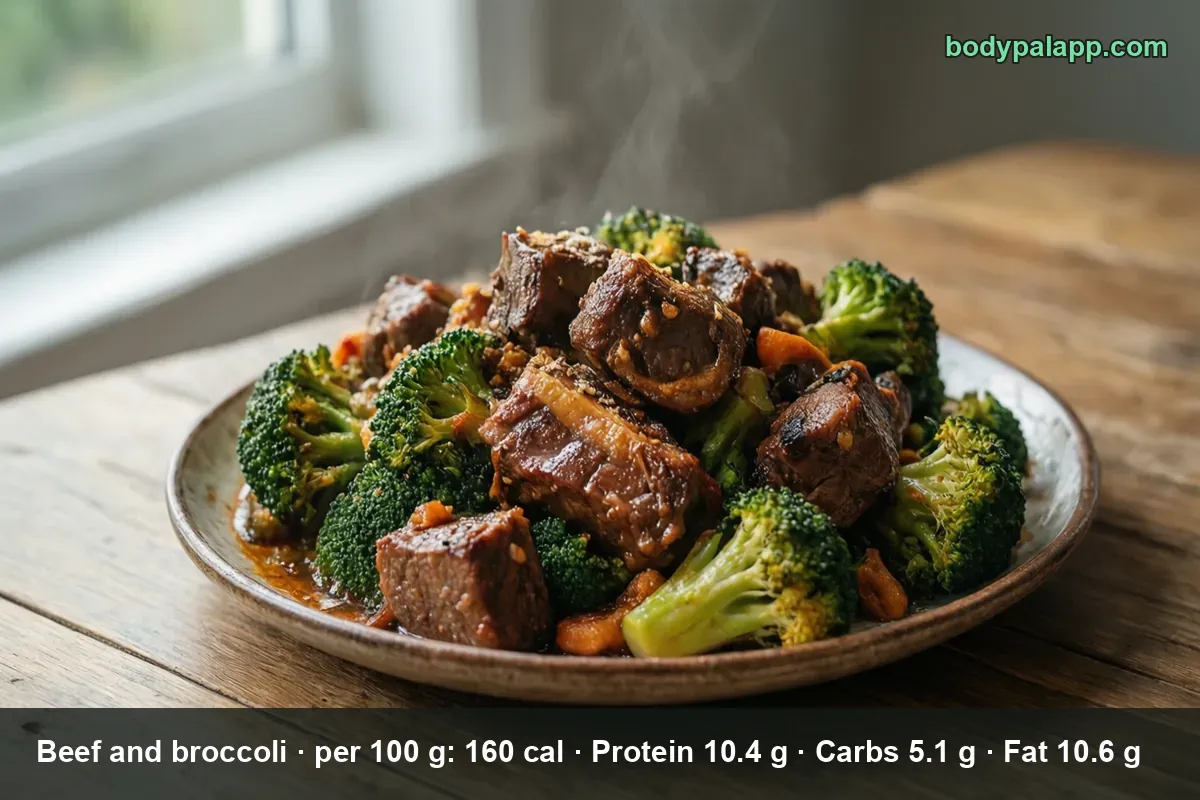
A restaurant-style cup of broccoli beef weighs 217 g and carries 347 calories. Per 100 g the dish runs 160 calories, which sounds mild until you notice how much people actually plate. The beef and the oil in the wok carry the calories here; the broccoli barely registers on the total.
On this page
- Broccoli beef quick facts
- US servings from one ounce to two cups
- What rice noodles and tofu do to the numbers
- The frozen boxes are lighter than the restaurant plate
- Sodium is the row to watch
- How does broccoli beef compare?
- Most popular beef and broccoli brands
- FAQ
Broccoli beef quick facts
The record used on this page is FNDDS 2706738, "Beef and broccoli", from the USDA group for stir-fry and soy-based sauce mixtures. It is the one entry that names the exact plate a person is holding: beef and broccoli in a soy-based sauce, nothing under it. Every other close record describes a different dish: rice, potatoes, noodles or tofu mixed in, or the sauce swapped or dropped. That is a difference in preparation, not a difference in source, and the alternatives get their own rows further down.
USDA measures a cup of it at 217 g. That is the number in the middle column below.
| Nutrient | Per 100 g | Per 1 cup (217 g) | % Daily Value |
|---|---|---|---|
| Calories | 160 | 347 | 17% |
| Total fat | 10.63 g | 23.1 g | 30% |
| Saturated fat | 1.88 g | 4.1 g | 20% |
| Carbohydrate | 5.09 g | 11.0 g | 4% |
| Dietary fiber | 1.3 g | 2.8 g | 10% |
| Total sugars | 1.23 g | 2.7 g | — |
| Protein | 10.43 g | 22.6 g | 45% |
| Sodium | 440 mg | 955 mg | 42% |
| Cholesterol | 25 mg | 54 mg | 18% |
| Potassium | 300 mg | 651 mg | 14% |
% Daily Value is based on a 2,000-calorie diet.
Verified nutrition data
Numbers on this page come from USDA FoodData Central, the U.S. Department of Agriculture’s food composition database, and from manufacturer labels where a branded product is named. Last verified September 2026. How we verify our data →
Two rows you would see on a supermarket label are missing here: added sugars and trans fat. This FNDDS edition does not publish either one for mixed dishes, so rather than guess at them we leave them off. The Daily Values used in the last column are the FDA reference amounts printed on every US Nutrition Facts label.
The shape of this dish is unusual for takeout. Protein at 22.6 g and fat at 23.1 g land almost level, while carbohydrate sits at 11.0 g, just 4% of a day. Most Chinese-American mains are the reverse.
US servings from one ounce to two cups
| Serving | Weight | Calories |
|---|---|---|
| 1 oz | 28 g | 45 kcal |
| 1/2 cup | 108.5 g | 174 kcal |
| 1 serving, size not specified | 163 g | 261 kcal |
| 1 cup | 217 g | 347 kcal |
| 2 cups, a full takeout container | 434 g | 694 kcal |
| Per 100 g | 100 g | 160 kcal |
Two of those weights come straight from USDA: the 1 cup at 217 g and the generic "1 serving" at 163 g, which is what the agency uses when a person cannot describe the portion. The half cup, the ounce and the two-cup line are our own arithmetic from the USDA 100 g figure, not USDA servings.
The two-cup line is the one that matters. A single cup of this is a side; a takeout container that gets tipped onto a plate is closer to two, and that is 694 calories before a scoop of rice joins it. Anyone logging "160 per 100 g" and picturing a plate is off by a factor of four.
Going the other way is easy too. Half a cup at 174 calories works as a protein add-on to a vegetable bowl, and it still brings 11.3 g of protein by the same arithmetic. The ounce line is there for anyone weighing leftovers straight into a food scale app.
What rice noodles and tofu do to the numbers
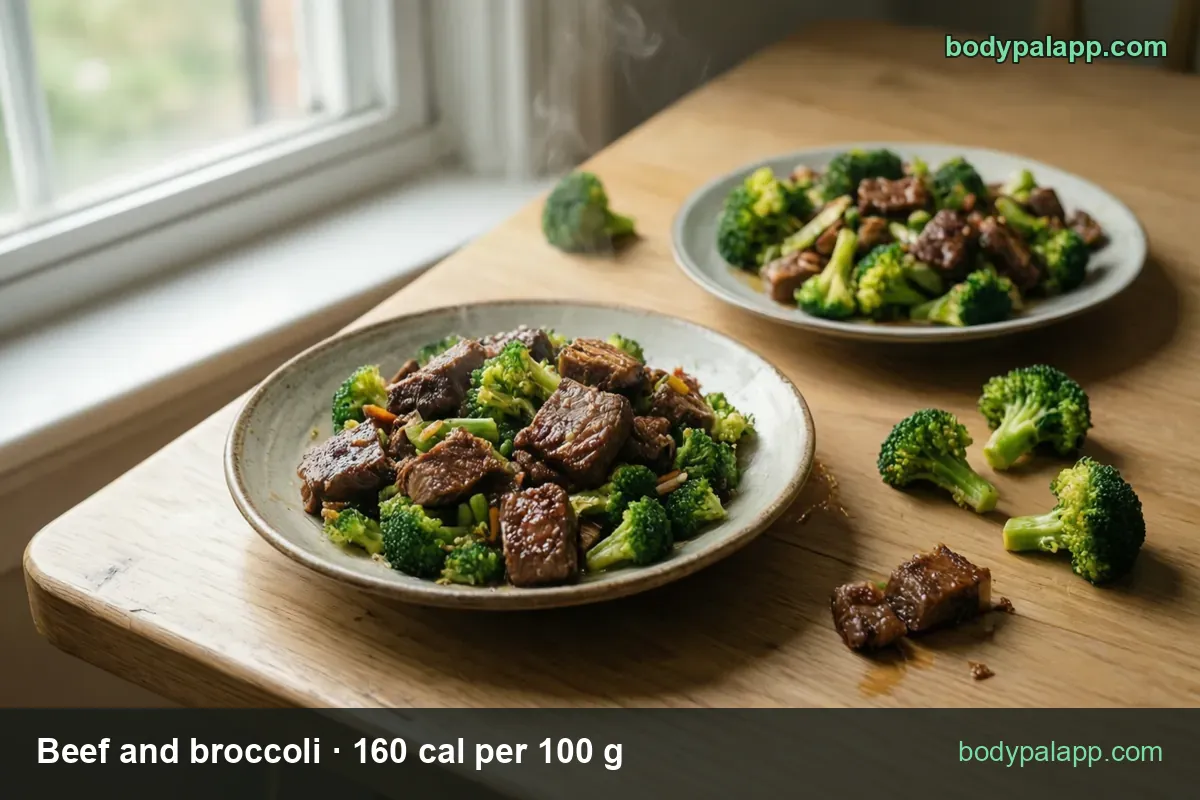
USDA carries a whole family of near-neighbors, and every one of them lands below the plain dish per 100 g. Seven records, and the plain beef and broccoli is the heaviest of the seven.
| Version | Per 100 g | Typical serving | Calories |
|---|---|---|---|
| Beef and broccoli, soy-based sauce (main record) | 160 kcal | 1 cup, 217 g | 347 kcal |
| Beef and mixed vegetables, soy-based sauce | 144 kcal | per 100 g | 144 kcal |
| Beef and broccoli with rice | 143 kcal | per 100 g | 143 kcal |
| Beef and broccoli with noodles | 139 kcal | per 100 g | 139 kcal |
| Beef and broccoli over rice with gravy | 131 kcal | 1 cup, 249 g | 326 kcal |
| Beef and broccoli, no sauce | 116 kcal | per 100 g | 116 kcal |
| Beef, tofu and broccoli, soy-based sauce | 115 kcal | per 100 g | 115 kcal |
That table trips people up, so read it as a density, not a verdict. Adding rice does not make a meal lighter. It drops the calories per 100 g to 143 because rice is bulkier and wetter than beef in oil, while the plate in front of you gets bigger. The versions without a listed cup weight are shown per 100 g on purpose: a cup of rice-heavy stir-fry weighs more than a cup of the plain dish, so lining them up per cup would compare two different amounts of food.
The genuinely lighter choice is the sauce, or the lack of it. Beef and vegetables with no sauce at all runs 116 calories per 100 g, about 28% below the sauced version, and its sodium falls from 440 mg to 316 mg per 100 g. Swapping half the beef for tofu lands at 115 calories per 100 g with 7.3 g of protein instead of 10.43 g, which is the trade you accept for the cut.
The gravy version deserves its own note. At 131 calories per 100 g it looks moderate, but USDA measures its cup at 249 g, so a cup comes to 326 calories, only 21 below the plain dish. Bigger cup, same result.
The frozen boxes are lighter than the restaurant plate
Retail frozen entrees do not match the restaurant number, and the gap is bigger than most people expect. Crazy Cuizine's Beijing Inspired Broccoli Beef runs 121 calories per 100 g, with 169 calories in its 1-cup (140 g) label serving. P.F. Chang's Home Menu Beef & Broccoli is lighter still at 101 calories per 100 g, or 270 calories for the 1 1/3 cups (267 g) the bag calls a serving.
That puts both between 24% and 37% below the 160 of the USDA restaurant-style record. The reason is prosaic: a factory line ladles a measured amount of oil into the sauce, a wok cook does not. If you are logging a supermarket box, use the box's own numbers rather than this page's main table.
Sodium is the row to watch
One cup delivers 955 mg of sodium, 42% of the 2,300 mg Daily Value, which is close to two fifths of a teaspoon of table salt sitting in a single bowl. Two cups lands near 1,910 mg, most of a day's worth, before rice, soup or a spring roll is counted. The Dietary Guidelines for Americans put 2,300 mg as the ceiling for adults, and soy-based sauces are among the fastest ways to reach it.
Set against that, the protein column is genuinely strong. At 22.6 g per cup, or 45% of the 50 g Daily Value, one bowl covers a serious share of the day from a single protein food. Saturated fat stays modest for a beef dish at 4.1 g, 20% of a day, because the cuts used in stir-fry are sliced thin and lean.
So the honest read: if you are counting calories, this is a good deal at 347 for a cup. If you are watching sodium, order it with the sauce on the side or make the no-sauce version at home, and the number drops by roughly a quarter.
How does broccoli beef compare?
| Dish | Per 100 g | US serving | Calories |
|---|---|---|---|
| Broccoli beef, soy-based sauce | 160 kcal | 1 cup, 217 g | 347 kcal |
| Beef, rice and vegetables, gravy | 135 kcal | 1 cup, 249 g | 336 kcal |
| Beef, noodles and vegetables, gravy | 131 kcal | 1 cup, 249 g | 326 kcal |
| Beef, potatoes and vegetables, gravy | 126 kcal | 1 cup, 252 g | 318 kcal |
Our take: broccoli beef is the densest of the four per 100 g and the highest per cup, yet it is still the one we would order. The spread between top and bottom is only 29 calories a cup, and the plain dish buys you 10.43 g of protein per 100 g where the starchy gravy plates give roughly 5 to 7 g. For weight loss, the no-sauce version at 116 calories per 100 g wins outright. For staying full through an afternoon, take the 347-calorie cup of the real thing and keep the rice to a half cup.
Most popular beef and broccoli brands in the United States
Ranked by how widely each product appears among foods sold in the United States, from the BodyPal food database of over 3.3 million products. Calories are the figures printed on each Nutrition Facts label, checked against USDA FoodData Central.
| Product | Calories (per 100 g) |
|---|---|
| Crazy Cuizine Beijing Inspired Broccoli Beef | 121 cal |
| P.F. Chang's Home Menu Beef & Broccoli | 101 cal |
Brand popularity: BodyPal food database. Nutrition: manufacturer labels / USDA FoodData Central.
Broccoli beef FAQs
How many calories are in beef and broccoli?
A 1-cup serving of 217 g holds 347 calories, and the dish runs 160 calories per 100 g. That cup also brings 22.6 g of protein and 23.1 g of fat. Two cups, which is what a takeout container usually holds, comes to 694 calories.
How many calories in 1 cup of broccoli beef?
347 calories in one cup, weighed by USDA at 217 g. Half a cup is 174 calories by our own arithmetic from the 100 g figure. The number climbs fast because the sauce carries oil: fat alone accounts for 23.1 g of that cup, or 30% of a day.
How much protein is in beef and broccoli?
22.6 g of protein in a 1-cup serving, which is 45% of the 50 g Daily Value used on US labels. Per 100 g the dish gives 10.43 g. Protein and fat land almost level here, 22.6 g against 23.1 g, and that balance is the best reason to order this over fried rice.
How many carbs are in beef and broccoli?
11.0 g of carbohydrate in a 1-cup serving, only 4% of the Daily Value, and 5.09 g per 100 g. Fiber takes 2.8 g of that, leaving about 8.2 g net by our own subtraction. Add steamed rice and the plate changes completely: the rice version runs 143 calories per 100 g.
Is beef and broccoli healthy?
On protein and carbohydrate it looks good: 22.6 g of protein and 11.0 g of carbohydrate per cup. Sodium is the problem at 955 mg, 42% of the 2,300 mg Daily Value in one cup. If you are watching sodium, the no-sauce version at 116 calories per 100 g is the better pick.
Is beef and broccoli keto friendly?
One cup carries 11.0 g of carbohydrate and 2.8 g of fiber, so roughly 8.2 g net by our own subtraction. That fits most low-carb days, as long as the dish arrives without rice or noodles. The rice version pushes carbohydrate to 7.9 g per 100 g, well above the 5.09 g here.
How much sodium is in beef and broccoli?
955 mg in a 1-cup serving, 42% of the 2,300 mg Daily Value, from 440 mg per 100 g. That is close to two fifths of a teaspoon of table salt. Two cups land near 1,910 mg, most of a day, before anything else on the table is counted.
How many calories in frozen beef and broccoli?
Retail frozen entrees run lighter: 121 calories per 100 g for Crazy Cuizine and 101 for P.F. Chang's Home Menu. Their label servings come to 169 calories for 1 cup and 270 for 1 1/3 cups. Both sit 24% to 37% under the 160 of the restaurant dish.
Similar foods
- Eye of round steak — 135 cal for 3 oz cooked
- Turkey Neck — 250 cal per medium neck
- Corned Beef Hash — 361 cal per cup
- Ham Slice — 46 cal per slice
- Beef Heart — 140 cal for 3 oz cooked
- Chicken Breast (4 Oz) — 186 cal per 4 oz
Count it without the math
Point the camera at the bowl and BodyPal counts the beef, the broccoli and the sauce for you.


How long does it take to burn off broccoli beef?
A 1-cup (217 g) serving is 347 kcal. Enter your weight and the amount you ate to see how long it takes you to burn that off:
lb
| Activity | Time to burn 347 kcal |
|---|---|
| Walking, brisk | 1 hr 9 min |
| Cycling, moderate | 43 min |
| Swimming, moderate | 50 min |
| Jogging | 41 min |
| Weight training, moderate | 1 hr 17 min |
Times are for a 155 lb adult at a steady pace; change the weight to see yours. The amount is set to the portion in the text (217 g); change it to what you actually ate. BodyPal works this out from your steps automatically.
Want the bigger picture? Calculate your daily calorie needs — your maintenance figure, a target for losing or gaining, and the date you get there.