
How many calories are in chicken gizzards?
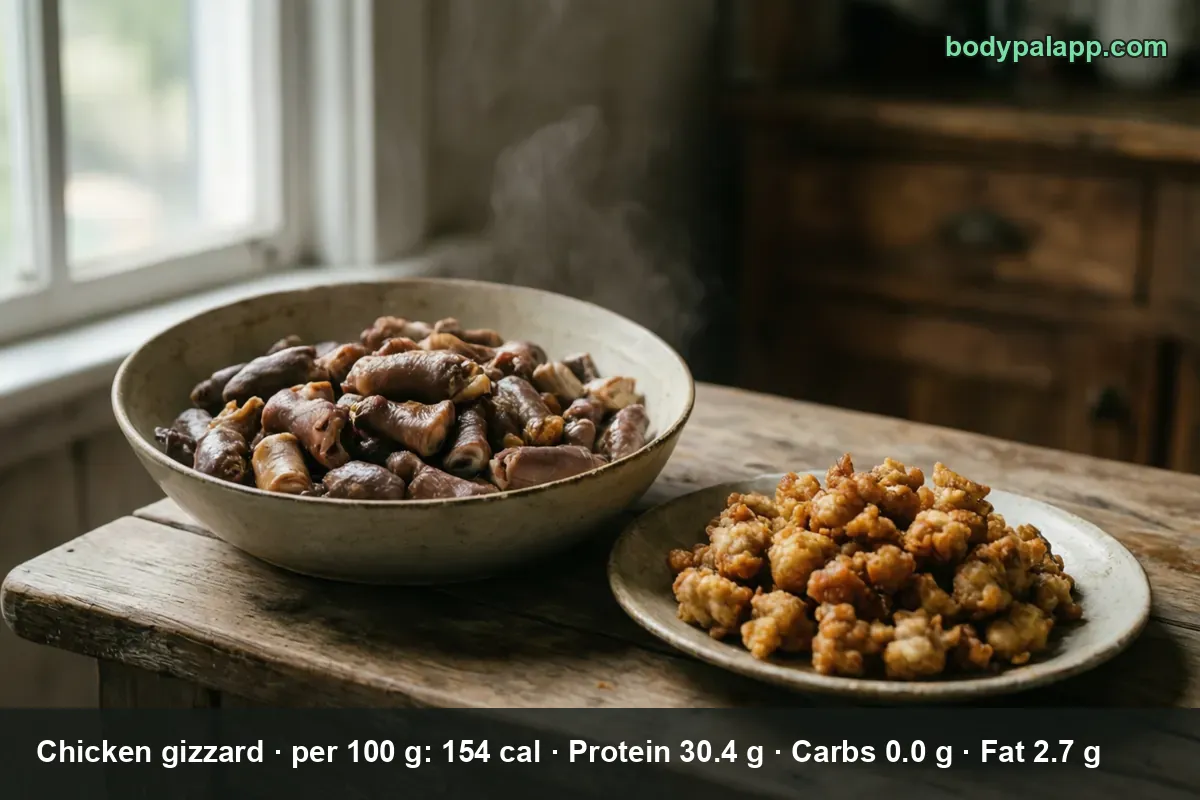
A 1-cup chopped serving of simmered chicken gizzards weighs 145 g and carries 223 calories. Per 100 g the same meat runs 154 calories, with 30.39 g of protein and 2.68 g of fat. Raw gizzards are far lighter, 94 calories per 100 g, because simmering drives water out of the muscle.
On this page
- Chicken gizzard quick facts
- US servings from one ounce to a full cup
- Raw versus simmered gizzards
- Breaded gizzards and gizzard fritters
- Cholesterol is the row to watch
- How does chicken gizzard compare to other poultry
- Most popular chicken gizzard brands
- FAQ
Chicken gizzard quick facts
Nobody eats a gizzard raw, so the row that matches your plate is the cooked one: SR Legacy 171457, "Chicken, gizzard, all classes, cooked, simmered". Simmering is the base American preparation, the step that comes before the skillet, the gravy or the fryer. USDA gives it a household measure of 1 cup chopped or diced at 145 g, which is why the numbers below are built on that cup rather than on an ounce.
The raw record exists too, and it is a different food arithmetically. It stays in the tables further down for anyone who weighs gizzards straight out of the package.
| Nutrient | Per 100 g | Per 1 cup chopped (145 g) | % Daily Value |
|---|---|---|---|
| Calories | 154 | 223 | — |
| Total fat | 2.68 g | 3.9 g | 5% |
| Saturated fat | 0.67 g | 1.0 g | 5% |
| Carbohydrate | 0 g | 0 g | 0% |
| Dietary fiber | 0 g | 0 g | 0% |
| Total sugars | 0 g | 0 g | — |
| Protein | 30.39 g | 44.1 g | 88% |
| Sodium | 56 mg | 81 mg | 4% |
| Cholesterol | 370 mg | 537 mg | 179% |
| Potassium | 179 mg | 260 mg | 6% |
% Daily Value is based on a 2,000-calorie diet.
Verified nutrition data
Numbers on this page come from USDA FoodData Central, the U.S. Department of Agriculture’s food composition database, and from manufacturer labels where a branded product is named. Last verified September 2026. How we verify our data →
There is no added sugars row here. The SR Legacy edition does not publish added sugars for this record, and plain muscle meat without a coating has none to publish. Trans fat is missing for the same reason.
Look at the protein line before anything else. One cup covers 88% of the 50 g Daily Value for 223 calories. Very little else in the meat case does that.
US servings from one ounce to a full cup
| Serving | Weight | Calories |
|---|---|---|
| 1 oz | 28 g | 43 kcal |
| 1/2 cup chopped | 73 g | 112 kcal |
| 3 oz cooked | 85 g | 131 kcal |
| 4 oz cooked | 113 g | 174 kcal |
| 1 cup chopped or diced | 145 g | 223 kcal |
| Per 100 g | 100 g | 154 kcal |
Only the cup is a USDA household measure. The ounce lines, the half cup and the 3 oz and 4 oz portions are our own arithmetic from the USDA 100 g figure, not USDA servings, so treat them as scaled math rather than published values.
The cup is where people get caught. Gizzards are dense, irregular nuggets that pack tighter than diced chicken breast, and a heaped cup can run well past 145 g. If your kitchen scale is out, weigh once and see. A 4 oz cooked portion, 113 g, is the closer match to how most people plate them: 174 calories, 34.3 g of protein and 418 mg of cholesterol.
Restaurant orders are a different animal again. A basket of fried gizzards is sold by the piece, not the cup, and the batter and frying oil come with their own numbers. USDA has no record for a restaurant fried gizzard, so anything you see quoted for one is somebody's estimate, not a measured value.
Raw versus simmered gizzards
Simmering is the single biggest number on this page, and it is not a cooking-oil story. Nothing is added. Water leaves.
| Version | fdc_id | Per 100 g | Typical serving | Calories |
|---|---|---|---|---|
| Raw chicken gizzards | 171456 | 94 kcal | 4 oz (113 g) | 106 kcal |
| Simmered chicken gizzards | 171457 | 154 kcal | 1 cup chopped (145 g) | 223 kcal |
| Store-bought raw gizzards and hearts | 2719261 | 69 kcal | 4 oz (112 g) | 77 kcal |
| Breaded gizzards, uncooked | 2701610 | 127 kcal | 4 oz (112 g) | 142 kcal |
| Gizzard fritters, uncooked | 2717647 | 204 kcal | 4 oz (112 g) | 228 kcal |
Cooked gizzards carry 64% more calories per gram than raw ones, 154 against 94. Protein moves with them, 17.66 g per 100 g raw against 30.39 g cooked. Same meat, less water.
That is a real logging trap. Weigh 100 g of gizzards in the package, cook them, eat the lot, and log 100 g of "chicken gizzard" without checking which row you picked, and you have written down 94 calories where 154 belongs. The fix is simple: log the weight at the moment you eat, and match the row to it. Raw weight goes with the raw record, cooked weight with the cooked one.
The store-bought line is worth a note of its own. Tyson's fresh gizzards-and-hearts pack declares 69 calories per 100 g on the label, below the USDA raw record's 94, because a retail pack of mixed offal in added solution is not the same composite USDA analyzed. Labels and USDA records are two different measurements of two slightly different things.
Breaded gizzards and gizzard fritters
Batter changes the food. Uncooked breaded gizzards sit at 127 calories per 100 g and fritters at 204 to 225, against 69 for the same brand's unbreaded pack. Per 4 oz pack serving that is 142 and 228 to 252 calories, and none of that includes what the fryer adds.
Sodium moves harder than calories do. The unbreaded packs list about 54 mg per 100 g; the breaded and fritter versions run 579 to 718 mg per 100 g. A 4 oz serving of the saltiest one lands near a third of the 2,300 mg Daily Value before you salt anything at the table. If you are watching sodium, the plain simmered gizzard at 56 mg per 100 g is the better pick by a wide margin.
Log breaded gizzards as their own food, not as gizzards with a mental markup. The coating roughly doubles the calories and multiplies the sodium by ten.
Cholesterol is the row to watch
Gizzards are organ meat, and the cholesterol number reads like it. One cup, 145 g, carries 537 mg, which is 179% of the 300 mg Daily Value, on only 223 calories and 3.9 g of fat. A 4 oz portion is 418 mg, still 139%. Nothing else about this food is remotely dense.
The Dietary Guidelines for Americans no longer set a hard numeric ceiling for dietary cholesterol; the advice is to keep it as low as practical while eating a healthy pattern, and organ meats are named as one of the foods that carry a lot of it. The Nutrition Facts panel still prints the 300 mg Daily Value, which is where the 179% comes from.
On the other side of the ledger, gizzards belong to the protein foods group in MyPlate, and 44.1 g of protein per cup is more than most 223-calorie meals deliver. If cholesterol is not something your doctor has flagged, this is a very efficient piece of meat. If it is, a half cup at 112 calories and 270 mg is the size that keeps it in proportion.
How does chicken gizzard compare to other poultry
The fair comparison is raw against raw, since the first three rows below are raw records; the simmered cup sits underneath for reference. Weighed that way, the gizzard is the lightest of the three.
| Food | Per 100 g | US serving | Calories |
|---|---|---|---|
| Chicken gizzards, raw | 94 kcal | 4 oz (113 g) | 106 kcal |
| Turkey breast, meat only, raw | 102 kcal | 4 oz (113 g) | 115 kcal |
| Chicken drumstick, meat only, raw | 106 kcal | 4 oz (113 g) | 120 kcal |
| Chicken gizzards, simmered | 154 kcal | 1 cup chopped (145 g) | 223 kcal |
The turkey and drumstick rows are both "with added solution" products, the kind sold pumped with brine, so their sodium runs higher than an untreated cut would. Protein per 100 g goes the other way from calories: 17.66 g for the raw gizzard, 19.19 g for the drumstick, 21.54 g for the turkey breast. Fat is closest of all, 2.06 g for the gizzard against 1.66 g for the breast.
Our take: for calorie counting alone, raw gizzards win by a nose, and it is a narrower win than their reputation suggests. Cooked is where they pull ahead, because 30.39 g of protein per 100 g beats anything else on this table by a distance. The reason to buy them is price and protein density, not a big calorie saving over turkey breast. The reason to be careful is cholesterol, not calories.
Most popular chicken gizzard brands in the United States
Ranked by how widely each product appears among foods sold in the United States, from the BodyPal food database of over 3.3 million products. Calories are the figures printed on each Nutrition Facts label, checked against USDA FoodData Central.
| Product | Calories (per 100 g) |
|---|---|
| Tyson All Natural Fresh Chicken Gizzards & Hearts | 69 cal |
| Tyson IF Unbreaded Chicken Gizzards | 69 cal |
| Tyson Uncooked Breaded Chicken Gizzards | 127 cal |
| Tyson Uncooked Chicken Gizzard Fritters | 204 cal |
| Tyson Uncooked Chicken Gizzard Fritters (23700608307) | 225 cal |
Brand popularity: BodyPal food database. Nutrition: manufacturer labels / USDA FoodData Central.
Chicken gizzard FAQs
How many calories are in chicken gizzards?
Simmered chicken gizzards are 154 calories per 100 g, so a 1-cup chopped serving of 145 g is 223 calories. A 3 oz portion, about 85 g, is 131 calories, our own arithmetic from the USDA 100 g figure. Raw gizzards are lighter, 94 calories per 100 g.
How many calories in 1 cup of cooked chicken gizzards?
One cup of chopped simmered gizzards, 145 g, is 223 calories. That cup also carries 44.1 g of protein, 3.9 g of fat and no carbohydrate at all. The cup is the USDA household measure for record 171457, so the weight and the calories come from the same row.
How many calories in fried chicken gizzards?
USDA does not publish a record for restaurant fried gizzards, so the closest measured numbers are the frozen branded ones. Uncooked breaded gizzards run 127 calories per 100 g, or 142 per 4 oz label serving. Gizzard fritters are heavier at 204 to 225 per 100 g, 228 to 252 per 4 oz.
How much protein is in 4 oz of chicken gizzards?
Four ounces of cooked gizzards, 113 g, holds about 34.3 g of protein, our own scaling from the USDA value of 30.39 g per 100 g. That is 69% of the 50 g Daily Value for 174 calories. Weighed raw instead, the same 4 oz gives roughly 20.0 g.
Are chicken gizzards high in cholesterol?
Yes, and by a lot: simmered gizzards carry 370 mg of cholesterol per 100 g, so a 1-cup serving of 145 g reaches 537 mg, or 179% of the 300 mg Daily Value. That is the one high number on an otherwise very lean food, since the same cup has just 3.9 g of fat.
Do chicken gizzards have any carbs?
Zero: the USDA record lists 0 g of carbohydrate, 0 g of fiber and 0 g of sugars per 100 g, raw or simmered. Any carbs you count come from the coating: breaded frozen gizzards climb to 127 calories per 100 g once the flour and crumbs are on them.
Are chicken gizzards healthy for weight loss?
At 154 calories and 30.39 g of protein per 100 g, gizzards are among the leanest protein foods in the meat case, and MyPlate counts organ meats in the protein group. If you are watching cholesterol, the 537 mg in a full cup is the figure to plan around, not the calories.
Should I log gizzards by raw or cooked weight?
Use the weight at the moment you eat them, because simmering drives off water and cooked gizzards carry 64% more calories per gram than raw ones, 154 against 94 per 100 g. Logging a cooked portion against the raw record undercounts the plate badly, and 145 g raw does not stay 145 g.
Similar foods
- Boneless Skinless Chicken Breast — 296 cal per breast
- Eye of round steak — 135 cal for 3 oz cooked
- Broccoli Beef — 347 cal per cup
- Turkey Breast — 125 cal per 3 oz
- Roasted Turkey Breast — 125 cal per 3 oz
- Turkey Neck — 250 cal per medium neck
Count it without the math
Point the camera at the plate and BodyPal counts the gizzards for you, breading and all.


How long does it take to burn off chicken gizzards?
A 1-cup chopped serving (145 g) is 223 kcal. Enter your weight and the amount you ate to see how long it takes you to burn that off:
lb
| Activity | Time to burn 223 kcal |
|---|---|
| Walking, brisk | 45 min |
| Cycling, moderate | 28 min |
| Swimming, moderate | 32 min |
| Jogging | 26 min |
| Weight training, moderate | 50 min |
Times are for a 155 lb adult at a steady pace; change the weight to see yours. The amount is set to the portion in the text (145 g); change it to what you actually ate. BodyPal works this out from your steps automatically.
Want the bigger picture? Calculate your daily calorie needs — your maintenance figure, a target for losing or gaining, and the date you get there.