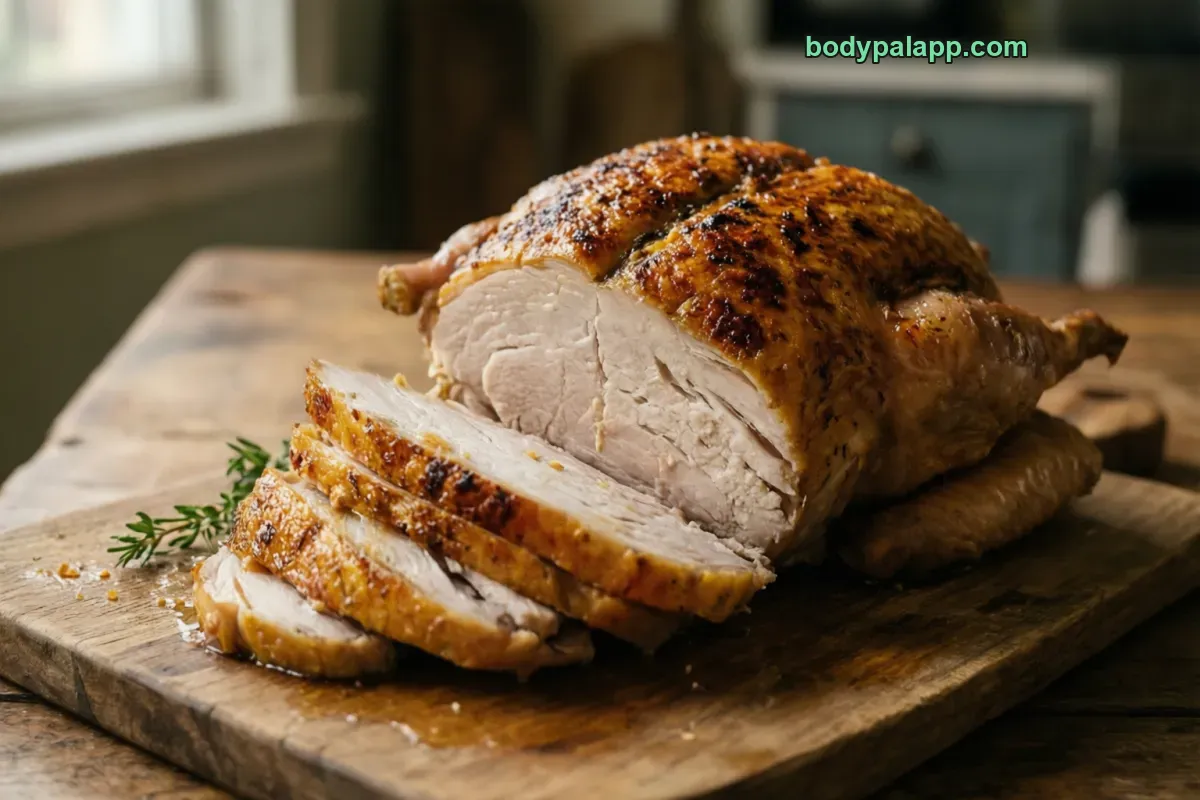
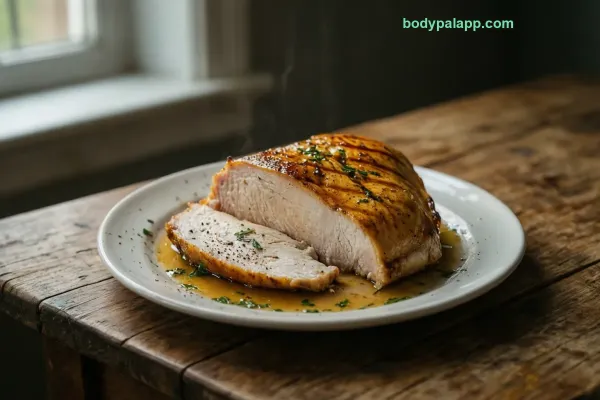
Roasted turkey breast calories come to 125 for a 3 oz portion (85 g) and 147 per 100 g, meat only. The number to notice is protein: it supplies 87% of those calories, so one 3 oz serving gives you 25.6 g of protein, 51% of the daily value, for just 6% of daily calories.
125kcal
1 3 oz portion · 85 g, roasted, meat only
87%protein
26 gProtein
0 gCarbs
1.8 gFat
How to burn off 125 kcal
—Walking, brisk
—Jogging
—Cycling, moderate
—Swimming
Skip the math. BodyPal counts these calories from your steps and workouts automatically.
Nutrition facts
Roasted, meat only · per 85 g
Calories
125 kcal
Protein
26 g
Carbohydrate
0 g
Fat
1.8 g
Saturated fat
0.5 g
Cholesterol
68 mg
Sodium
84 mg
Potassium
212 mg
Iron
0.6 mg
Source: USDA FoodData Central
🛡️
Verified nutrition data
Numbers on this page come from USDA FoodData Central, the U.S. Department of Agriculture’s food composition database, and from manufacturer labels where a branded product is named. Last verified September 2026. How we verify our data →
Roasted turkey breast: calories, protein and sodium by serving
Percent of daily value uses the FDA reference of 2,000 kcal a day.
Serving
kcal
Protein
Carbs
Fat
Sodium
% DV kcal
3 oz portion (85 g)
125
25.6 g
0 g
1.8 g
84 mg
6%
With skin, 3 oz (85 g)
161
24.4 g
0 g
6.3 g
54 mg
8%
4 oz portion (113 g)
166
34 g
0 g
2.4 g
112 mg
8%
100 g
147
30.1 g
0 g
2.1 g
99 mg
7%
3 × 3 oz portion (85 g)
375
76.8 g
252 mg
5 × 3 oz portion (85 g)
625
128.1 g
421 mg
A 3 oz slice is a 125-calorie serving
The standard 3 oz portion weighs 85 g and lands at 125 calories. That is roughly a deck of cards of sliced breast, and it is the serving most nutrition labels and recipes use. Step up to a 4 oz portion (113 g) and you reach 166 calories with 34 g of protein, which covers 68% of the protein daily value.
Turkey is easy to overserve because the slices are thin and stack fast. Two 3 oz portions (170 g) come to 250 calories and 51.2 g of protein. Three portions, or 255 g, reach 375 calories. A generous holiday plate of five portions (425 g) adds up to 625 calories and 128.1 g of protein before any stuffing or gravy touches it.
The good news is that the total climbs in a straight, predictable line. Every extra 3 oz adds about 125 calories and almost nothing else but protein. If you weigh your portion once, you can eyeball it for the rest of the meal with decent accuracy.
Nearly every calorie is protein
The calorie split is about as lopsided as food gets: 87% protein, 13% fat and 0% carbohydrate. Per 100 g, roasted breast meat carries 30.1 g of protein against only 2.1 g of fat, of which 0.6 g is saturated. There is no sugar and no fiber at all.
That makes it one of the leanest protein sources on any plate. You are paying very few calories for the protein you get, which is why turkey breast shows up so often in high-protein and calorie-conscious meal plans. The meat is filling for its size, though it brings nothing in the way of carbs for energy.
Cholesterol is the one row with some weight. A 100 g serving holds 80 mg, measured against a 300 mg daily value. It is a moderate figure, typical for lean poultry, and worth a glance only if you already track cholesterol closely.
The skin nearly quadruples the fat
Eating the skin is the single biggest swing on this page. A 3 oz portion with skin comes to 161 calories, against 125 for meat only. That moves the serving from 6% to 8% of daily calories, a modest jump on its own.
The fat is where the change shows. Meat only carries 1.8 g of fat per 3 oz; with skin it rises to 6.3 g. Protein actually dips slightly, from 25.6 g to 24.4 g, because some of the weight is now skin rather than muscle. Sodium is lower with skin at 54 mg versus 84 mg, a small difference either way.
If you want the leanest version, peel the skin after roasting. Cooking with it on keeps the breast moist, and removing it at the table still gets you close to the meat-only numbers. If you enjoy the crisp skin, a single slice of it is a reasonable trade rather than a dealbreaker.
Low sodium, so the sides decide the meal
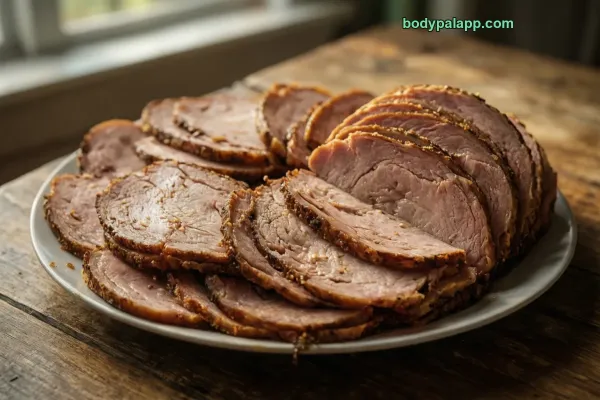
Plain roasted breast is low in sodium: 99 mg per 100 g, and 84 mg for a 3 oz portion, just 4% of the daily value. That changes fast once the meat is brined, cured or sliced for the deli counter. Turkey lunch meat, for comparison, carries 810 mg of sodium per 100 g, so check the label if your turkey came prepackaged, including slices from brands like Oscar Mayer.
Because the meat has zero carbs and zero fiber, the rest of the plate fills those gaps. Roasted vegetables, a grain, beans or a salad round it out without adding much fat. You also get 249 mg of potassium per 100 g from the turkey itself.
Gravy, stuffing and cranberry sauce are where a turkey dinner usually gains its calories, not the breast. If you are tracking, log the sides separately. BodyPal can log the plate from a photo so the turkey and the extras each get their own line.
How does roasted turkey breast compare?
Here is how roasted turkey breast stacks up against turkey lunch meat and two forms of chicken breast, per 100 g and per usual serving.
Verdict: For the leanest protein with the least sodium, roasted turkey breast wins, with 147 calories and 30.1 g of protein per 100 g against 165 calories for cooked chicken breast. Turkey lunch meat looks lighter at 106 calories per 100 g, but it carries 810 mg of sodium and only 14.8 g of protein, so pick it for convenience, not nutrition.
Most popular roasted turkey breast brands in the United States
3Oscar Mayer Oven Roasted Turkey Breast & White Turkey2 oz · 56 g107 kcal
4Oscar Mayer Premium Shaved Oven Roasted Turkey Breast & White Turkey2 oz · 56 g107 kcal
5Oscar Mayer Oven Roasted Turkey Breast & White Turkey Slices3 slices · 62 g113 kcal
These are sliced deli products with added water and solution, so their labels read lower than the home-roasted breast above. Source: manufacturer labels / USDA FoodData Central.
Roasted turkey breast FAQs
How many calories are in 3 oz of roasted turkey breast?
About 125 calories for 3 oz (85 g) of meat without skin, or 161 calories with the skin on.
Is roasted turkey breast good for weight loss?
A 3 oz portion has 125 calories with 25.6 g of protein and 1.8 g of fat, and no carbs.
Roasted turkey breast vs chicken breast: which has fewer calories?
Roasted turkey breast has 147 calories per 100 g, boneless skinless chicken breast 151. Per 3 oz that is 125 vs 128 calories.
How much protein is in roasted turkey breast?
30.1 g of protein per 100 g, which is 25.6 g in a 3 oz portion and 34 g in 4 oz.
How many calories are in 100 g of cooked turkey breast?
Roasted turkey breast, meat only, has 147 calories per 100 g. That same 100 g gives 30.1 g of protein, 2.1 g of fat and 0 g of carbs, which covers 60% of the protein daily value.
What are the macros of cooked turkey breast?
Per 100 g, roasted turkey breast has 30.1 g protein, 2.1 g fat and 0 g carbs. By calories that works out to 87% protein and 13% fat, with no sugar or fiber.
Does turkey breast have any carbs?
No. Roasted turkey breast has 0 g of carbohydrates, 0 g of sugar and 0 g of fiber per 100 g. Any carbs in a turkey meal come from breading, glazes, gravy or sides.
How many calories does the skin add to roasted turkey breast?
A 3 oz portion with skin has 161 calories, compared with 125 for meat only. Fat rises from 1.8 g to 6.3 g, while protein stays close at 24.4 g.
Is roasted turkey breast the same as oven roasted deli turkey?
Not nutritionally. Roasted breast meat has 99 mg of sodium per 100 g, while turkey lunch meat has 810 mg. Deli turkey also has less protein, 14.8 g per 100 g against 30.1 g.