
How many calories are in half and half?
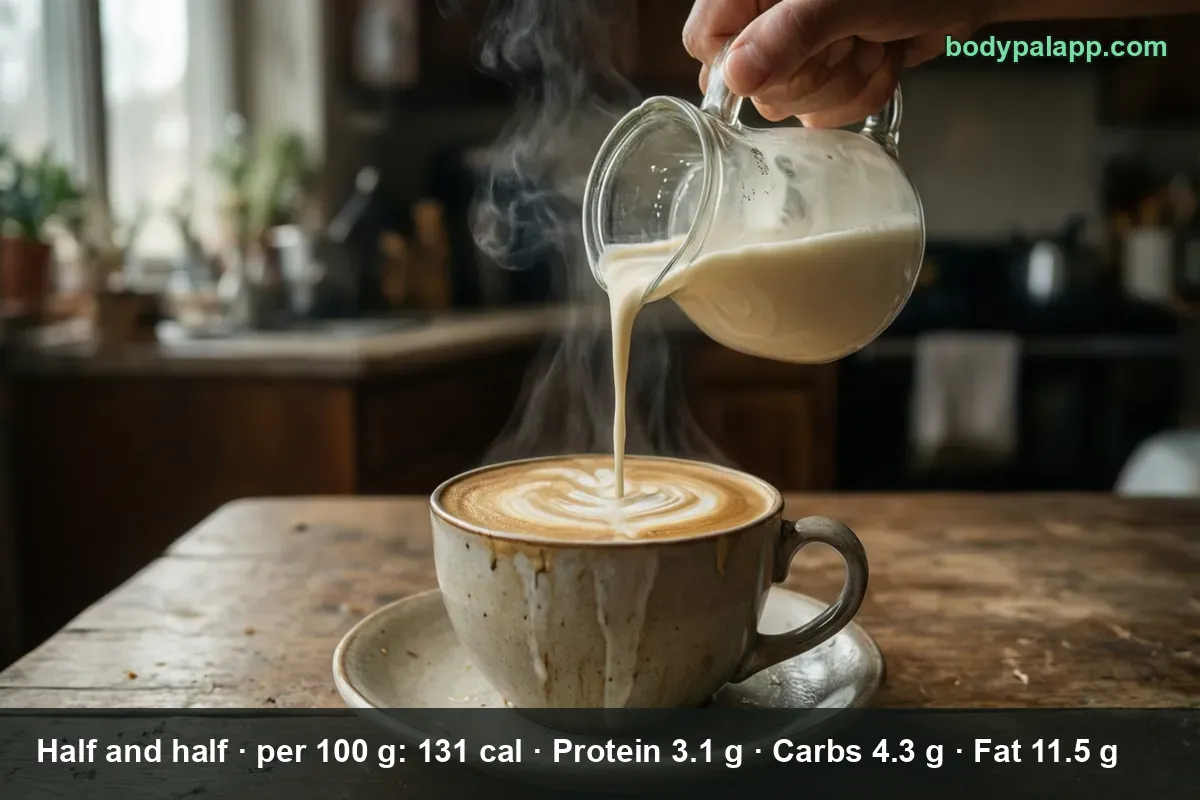
One tablespoon of half and half is 20 calories, and the carton itself runs 131 calories per 100 g. That is the pair of numbers worth memorizing, because nobody drinks half and half — they pour it. Two tablespoons, the printed label serving, come to 39 calories. A full cup comes to 317.
On this page
- Half and half quick facts
- US servings, from one tablespoon to a full cup
- Fat free, lowfat and flavored half and half
- Saturated fat is the row that moves
- How does half and half compare?
- Most popular half and half brands
- FAQ
Half and half quick facts
The record behind every number here is SR Legacy 171255, "Cream, fluid, half and half" — the plain liquid half and half sold in a carton in the dairy case. USDA also carries a survey copy of the same product (FNDDS 2705594) with identical values, but the SR Legacy entry is the fuller one: it publishes trans fat and it uses the real measuring cup weight of 242 g rather than a rounded one.
That matters more than it sounds. Half and half is one of the few foods people log by the spoon and consume by the quarter-cup, so the weight attached to each household measure does most of the work.
| Nutrient | Per 100 g | Per 1 tbsp (15 g) | % Daily Value |
|---|---|---|---|
| Calories | 131 | 20 | — |
| Total fat | 11.5 g | 1.7 g | 2% |
| Saturated fat | 7.03 g | 1.1 g | 5% |
| Carbohydrate | 4.3 g | 0.6 g | 0% |
| Dietary fiber | 0 g | 0 g | 0% |
| Total sugars | 4.13 g | 0.6 g | — |
| Protein | 3.13 g | 0.5 g | 1% |
| Sodium | 61 mg | 9 mg | 0% |
| Cholesterol | 35 mg | 5 mg | 2% |
| Potassium | 132 mg | 20 mg | 0% |
% Daily Value is based on a 2,000-calorie diet.
Verified nutrition data
Numbers on this page come from USDA FoodData Central, the U.S. Department of Agriculture’s food composition database, and from manufacturer labels where a branded product is named. Last verified September 2026. How we verify our data →
There is no added sugars row above because the SR Legacy edition does not publish one at all. The 4.13 g of sugars per 100 g is lactose, the sugar that arrives with the milk, not sweetener someone stirred in — which is why a plain carton lists sugars but no ingredient that sounds like sugar.
One row the label hides: the USDA record lists 0.46 g of trans fat per 100 g, naturally occurring in dairy fat. In the two-tablespoon label serving that is 0.14 g, and FDA labeling rules let anything under 0.5 g per serving be printed as 0 g. The carton is not wrong. It is just rounding.
US servings, from one tablespoon to a full cup
| Serving | Weight | Calories |
|---|---|---|
| 1 tbsp | 15 g | 20 kcal |
| 2 tbsp, the label serving | 30 g | 39 kcal |
| 1 fl oz | 30.2 g | 40 kcal |
| 1 oz | 28.35 g | 37 kcal |
| 1 cup | 242 g | 317 kcal |
| Per 100 g | 100 g | 131 kcal |
The tablespoon, the fluid ounce and the cup are USDA household measures with USDA weights. The 2 tbsp label serving, the 1 oz row, any quarter-cup figures below and every per-tablespoon calorie in the variant and comparison tables are our own arithmetic from the USDA 100 g value, not USDA servings.
Two things jump out of that table. First, a fluid ounce (30.2 g) and two tablespoons (30 g) land one calorie apart, 40 against 39 — if you measure by either, use the same number and stop worrying about it. Second, the jump from spoon to cup is brutal. Pour what a lot of people actually pour into a mug of coffee, a quarter cup at 60.5 g, and you are at 79 calories, four times a tablespoon, from a single unhurried tip of the carton.
The cup row is not a hypothetical either. Half and half goes into scrambled eggs, mashed potatoes, quiche and cream sauces by the cup, and that cup is 317 calories before anything else in the pan.
Fat free, lowfat and flavored half and half
| Version | Per 100 g | Typical pour | Calories |
|---|---|---|---|
| Half and half, regular | 131 kcal | 1 tbsp (15 g) | 20 kcal |
| Half and half, survey record (FNDDS 2705594) | 131 kcal | 1 tbsp (15 g) | 20 kcal |
| Half and half, flavored | 130 kcal | 1 tbsp (15 g) | 20 kcal |
| Half and half, lowfat | 72 kcal | 1 tbsp (15 g) | 11 kcal |
| Half and half, fat free | 59 kcal | 1 tbsp (15 g) | 9 kcal |
Flavored half and half is the surprise: 130 calories per 100 g against 131 for plain, close enough that the two round to the same 20 calories in a spoon. The sugars sit slightly higher, 4.33 g per 100 g against 4.13 g, and the fat slightly lower, 11.28 g against 11.5 g. Vanilla or hazelnut versions of true half and half are not the calorie problem people assume they are; the flavored creamers on the next shelf over are a different product entirely.
Fat free half and half is where the trade shows. Calories fall from 131 to 59 per 100 g, so a tablespoon drops from 20 to 9. But the fat has to be replaced with something to keep the pour thick, and that something is carbohydrate: 9 g per 100 g against 4.3 g, more than double. Sodium climbs too, from 61 mg to 100 mg per 100 g. Lowfat sits between the two at 72 calories per 100 g, 11 a spoon, with carbohydrate a little lower at 3.33 g.
Store brands track the USDA record closely. Harris Teeter's Grade A Ultra-Pasteurized half and half lists 133 calories per 100 g, about 40 for its 2 Tbsp (30 ml) label serving on our own arithmetic from that 133 — two calories off the generic 131 per 100 g, which is inside the noise of any dairy fat test.
Saturated fat is the row that moves
Calories are not the reason to watch half and half. A tablespoon is 20 calories, roughly a hard candy, and three cups of coffee a day at one spoon each is 59 calories — our own arithmetic from the USDA 100 g figure. Nobody's week turns on that.
Saturated fat is a different story, because half and half is 7.03 g of it per 100 g, and 61% of its total fat is saturated. One tablespoon is 1.1 g, or 5% of the 20 g Daily Value. The two-tablespoon label serving is 2.1 g, about 11%. A cup used in a sauce is 17.0 g — 85% of the Daily Value in a single ingredient, while contributing only 317 calories, 16% of a 2,000-calorie day. That mismatch between the calorie share and the saturated fat share is the whole point of this page.
The Dietary Guidelines for Americans put the ceiling at less than 10% of daily calories from saturated fat, which is where the 20 g Daily Value comes from. If you drink four coffees a day with a generous quarter-cup pour, that is 17.0 g of saturated fat and 316 calories before breakfast — again, our arithmetic from the USDA 100 g values, not a USDA serving. It is one of the most-logged blind spots we see: the coffee gets logged, the cream does not.
Cholesterol is worth a line: 35 mg per 100 g, 5 mg a tablespoon, 85 mg in a cup. Potassium runs 132 mg per 100 g and 320 mg in a cup, small but not nothing.
How does half and half compare?
| Pour | Per 100 g | US serving | Calories |
|---|---|---|---|
| Half and half | 131 kcal | 1 tbsp, 15 g | 20 kcal |
| Cream, light | 195 kcal | 1 tbsp, 15 g | 29 kcal |
| Coffee creamer, NFS | 136 kcal | 1 tbsp, 15 g | 20 kcal |
| Coffee creamer, liquid, fat free | 71 kcal | 1 tbsp, 15 g | 11 kcal |
Our take: switching from half and half to a regular nondairy creamer buys you nothing. Both land on 20 calories a tablespoon, but the creamer carries 11.38 g of carbohydrate per 100 g against 4.3 g and only 1 g of protein against 3.13 g — same calories, worse trade. Light cream costs nine extra calories a spoon, which is a fair price for a richer coffee. The only real saving on this list is the fat free liquid creamer at 11 calories a spoon, and it earns that the same way fat free half and half does, by swapping dairy fat for corn syrup solids. If you drink one or two coffees a day, stay on the real thing and measure it. If you pour by eye into a 20-ounce mug all morning, the pour is the problem, not the product.
Most popular half and half brands in the United States
Ranked by how widely each product appears among foods sold in the United States, from the BodyPal food database of over 3.3 million products. Calories are the figures printed on each Nutrition Facts label, checked against USDA FoodData Central.
| Product | Calories (per 100 g) |
|---|---|
| Harris Teeter Grade A Half and Half, Ultra-Pasteurized | 133 cal |
Brand popularity: BodyPal food database. Nutrition: manufacturer labels / USDA FoodData Central.
Half and half FAQs
How many calories are in half and half?
20 calories in one tablespoon (15 g), 39 in the two-tablespoon label serving and 317 in a full cup (242 g). Per 100 g the USDA record lists 131 calories. The number people underestimate is the cup, because a cup is eight label servings stacked together in one pour.
How many calories in 1 tablespoon of half and half?
20 calories per tablespoon (15 g), made of 1.7 g of fat, 0.6 g of carbohydrate and 0.5 g of protein. Three tablespoons in a large coffee comes to 59 calories, our own arithmetic from the USDA 100 g figure rather than a USDA serving. Sodium is negligible at 9 mg.
How many calories in half and half per cup?
317 calories in one cup (242 g), using the USDA's own cup weight. That cup also carries 27.8 g of fat, 17.0 g of it saturated, which is 85% of the Daily Value, plus 10.4 g of carbohydrate and 7.6 g of protein. A cup in a cream sauce is a meal's worth of fat.
Is half and half healthier than heavy cream?
131 calories per 100 g for half and half against 195 for light cream, the nearest cream record checked for this page. We do not quote a heavy cream number, because USDA's heavy cream record is not among the rows behind this page. Against light cream the gap is nine calories a tablespoon.
How many calories in fat free half and half?
9 calories per tablespoon (15 g) and 59 per 100 g, against 20 and 131 for the regular version. The fat comes out and carbohydrate goes in: 9 g per 100 g instead of 4.3 g, with sodium rising from 61 mg to 100 mg. Lighter, but effectively a different product.
Does half and half have sugar?
4.13 g of sugars per 100 g, which works out to 0.6 g in a tablespoon and 10.0 g in a cup. All of it is lactose, the sugar that comes with the milk. USDA's SR Legacy record does not publish an added sugars line at all, so none of that total is sweetener stirred in.
How much saturated fat is in half and half?
7.03 g per 100 g, so 1.1 g in a tablespoon, which is 5% of the Daily Value, 2.1 g in the two-tablespoon label serving and 17.0 g in a cup, or 85% of the 20 g Daily Value. The Dietary Guidelines cap saturated fat at under 10% of daily calories.
Is half and half keto friendly?
0.6 g of carbohydrate per tablespoon and 4.3 g per 100 g, so a two-spoon pour costs about 1.3 g. That fits most low-carb plans comfortably. A full cup is 10.4 g, which does not. Fat free half and half is the trap here: 9 g per 100 g, more than double the regular version.
Similar foods
- Coffee Mate Creamer — 20 cal per tablespoon
- Frozen Yogurt — 203 cal per scoop
- Frozen Yogurt — 203 cal per scoop
- Potato With Butter — 394 cal per medium baked potato
- Noosa Yogurt — 270 cal per container
- Cheese Manicotti — 219 cal per manicotti
Count it without the math
Point the camera at the mug and BodyPal counts the pour for you, spoon or quarter-cup.


Want the bigger picture? Calculate your daily calorie needs — your maintenance figure, a target for losing or gaining, and the date you get there.