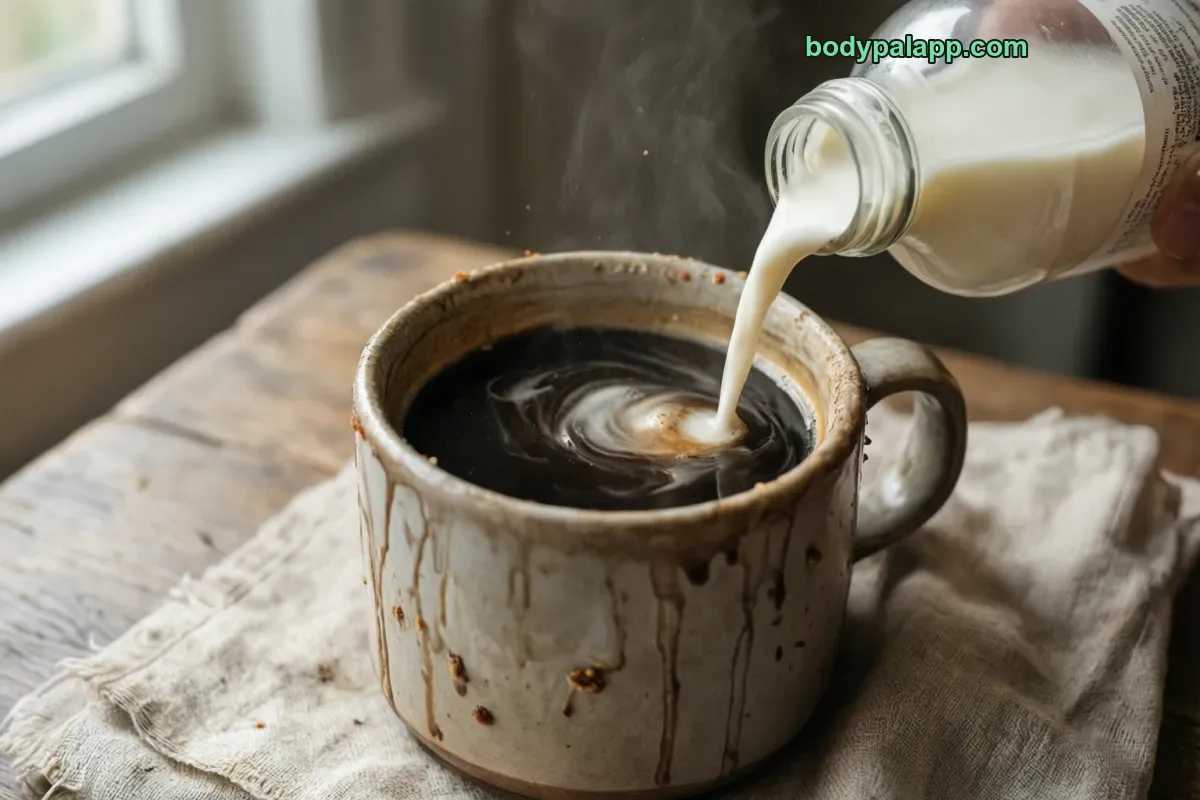
Coffee mate calories come to 20 for one tablespoon (15 g) and 133 per 100 g. What matters is less the calories per pour than how many pours you take: every calorie comes from sugar and fat, there is zero protein, and refills add up fast across a day of coffee.
20kcal
1 tablespoon · 15 g, liquid non-dairy creamer
0%protein
0 gProtein
3 gCarbs
1 gFat
How to burn off 20 kcal
—Walking, brisk
—Jogging
—Cycling, moderate
—Swimming
Skip the math. BodyPal counts these calories from your steps and workouts automatically.
Nutrition facts
Liquid non-dairy creamer · per 15 g
Calories
20 kcal
Protein
0 g
Carbohydrate
3 g
Fat
1 g
Saturated fat
0 g
Cholesterol
0 mg
Sodium
10 mg
Iron
0 mg
Source: USDA FoodData Central
🛡️
Verified nutrition data
Numbers on this page come from USDA FoodData Central, the U.S. Department of Agriculture’s food composition database, and from manufacturer labels where a branded product is named. Last verified September 2026. How we verify our data →
Coffee mate: calories, protein and sodium by serving
Percent of daily value uses the FDA reference of 2,000 kcal a day.
Serving
kcal
Protein
Carbs
Fat
Sodium
% DV kcal
1 tbsp (15 g)
20
0 g
3 g
1 g
10 mg
1%
Sugar free (15 g)
15
0 g
1 g
1 g
10 mg
1%
100 g
133
0 g
20 g
6.7 g
67 mg
7%
3 × 1 tbsp (15 g)
60
0 g
30 mg
5 × 1 tbsp (15 g)
100
0 g
50 mg
Five tablespoons turn 20 calories into 100
One tablespoon (15 g) of liquid Coffee mate carries 20 calories, just 1% of the daily value. That is small enough to ignore in a single cup. The catch is that few people measure. A free pour from the bottle often lands closer to two or three tablespoons.
The math is linear and unforgiving. Two tablespoons (30 g) add 40 calories, three (45 g) add 60, and five (75 g) reach 100. Every one of those calories arrives with 0 g of protein, so none of it makes the cup more filling. Spread generous pours across three or four cups a day and the creamer becomes the main calorie source in your coffee habit by a wide margin.
The fix takes one morning. Measure your usual pour with a real tablespoon so you know what it looks like, then log the creamer as its own line instead of folding it into the coffee. BodyPal can log it from a photo of your mug, but the total still depends on how much you actually poured.
Sugar and oil supply every calorie
Per 100 g, Coffee mate has 20 g of carbohydrate, all of it sugar, plus 6.7 g of fat and 0 g of protein. That splits the calories into 57% carbs and 43% fat. Nothing else in the bottle is doing nutritional work.
At the tablespoon scale, that is 3 g of sugar and 1 g of fat. Neither number looks alarming on its own. The point is what is missing: dairy options like half and half carry some protein, while this creamer adds energy and flavor and stops there. It is a sweetener and a texture, not a food.
Saturated fat and cholesterol are both listed at 0 per 100 g, and fiber is 0 as well. If your concern is dairy fat, this non-dairy creamer sidesteps it. If your concern is added sugar, it does not. A few tablespoons a day is a steady drip of sugar with nothing else attached, and that is the honest way to think about it.
Sugar free cuts the sugar, not the fat
The sugar free version weighs the same 15 g per tablespoon and comes in at 15 calories instead of 20. Sugar drops from 3 g to 0 g, and carbs fall to 1 g. Fat stays at 1 g, which is why the calories do not fall further. The savings are real but small.
That makes sugar free the better pick if you track sugar specifically, or if you drink several cups a day. Over one cup the difference barely registers. Over a day of refills it becomes something you can see in your log. Coffee mate sells this idea in several forms, from Zero Sugar Peppermint Mocha to a sugar free hazelnut liquid creamer.
Sodium is the same in both, 10 mg per tablespoon, which rounds to 0% of the daily value. Even five tablespoons bring only 50 mg. Sodium is not the row to watch here. Sugar and portion size are.
The creamer, not the coffee, sets your total
A cup of black coffee (248 g) has 5 calories. Add one tablespoon of Coffee mate and almost all the energy in the mug now comes from the creamer. That is fine, since it is still a small number. Just know which part of the cup you are actually counting.
If you want a creamier cup with some protein, half and half or coffee cream deliver it, at a higher fat cost per 100 g. If you want the lowest number with some creaminess, a single measured tablespoon of sugar free keeps the add-on at 15 calories. If you want flavor without a sugar hit, the zero sugar and sugar free flavored lines cover that.
Powdered packets and liquid concentrates are a different format. The figures on this page describe the liquid creamer by the tablespoon, so read the label on a powder or concentrate before assuming the same numbers apply.
How does coffee mate compare?
Here is how Coffee mate stacks up against half and half, coffee cream and black coffee, per 100 g and per usual serving.
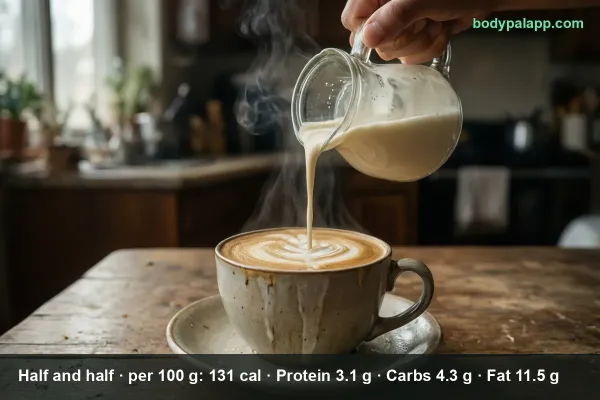
Verdict: For the fewest calories, black coffee wins outright at 5 per cup, and a tablespoon of Coffee mate still beats coffee cream at 29. Half and half lands close to Coffee mate per 100 g, 131 versus 133, but brings 3.1 g of protein, so pick it if you want a richer cup that feels more like food.
Most popular coffee mate brands in the United States
Powdered creamers are measured dry, so they read near 500 calories per 100 g, while the liquid bottles sit close to the 133 per 100 g used above. Source: manufacturer labels / USDA FoodData Central.
Coffee mate FAQs
How many calories are in Coffee mate?
One tablespoon of the liquid creamer is 20 calories, and 100 g is 133 calories.
Is Coffee mate good for weight loss?
A tablespoon adds 20 calories, 3 g of carbs and 1 g of fat, so three coffees a day with one tablespoon each come to 60 calories.
Coffee mate vs half and half: which has fewer calories?
Per 100 g the creamer is 133 calories and half and half is 131, so a tablespoon of either is about 20 calories.
How much sugar is in Coffee mate?
The sweetened liquid creamer has 20 g of sugar per 100 g, which is 3 g in a tablespoon; the sugar free version has 0 g.
How many calories are in black coffee with Coffee mate?
A cup of black coffee has 5 calories, and each tablespoon of Coffee mate adds 20. With one tablespoon, the creamer is nearly all of the total. Two tablespoons add 40 and three add 60.
Does Coffee mate have calories?
Yes. The liquid creamer has 20 calories per tablespoon (15 g) and 133 per 100 g. Even the sugar free version has 15 calories per tablespoon, because its fat stays at 1 g.
Is Coffee mate high in calories?
Not per tablespoon: 20 calories is 1% of the daily value. Per 100 g it reaches 133, about the same as half and half at 131, so the risk lies in pouring several tablespoons per cup, not in one.
How many carbs are in Coffee mate?
One tablespoon has 3 g of carbohydrate, and all of it is sugar. Per 100 g that is 20 g of carbs. The sugar free version cuts carbs to 1 g per tablespoon with 0 g of sugar.
What are the nutrition facts for Coffee mate?
Per 100 g, Coffee mate has 133 calories, 20 g of carbs (all sugar), 6.7 g of fat, 0 g of protein and 67 mg of sodium. Saturated fat and cholesterol are both listed at 0.