
How many calories are in a potato with butter?
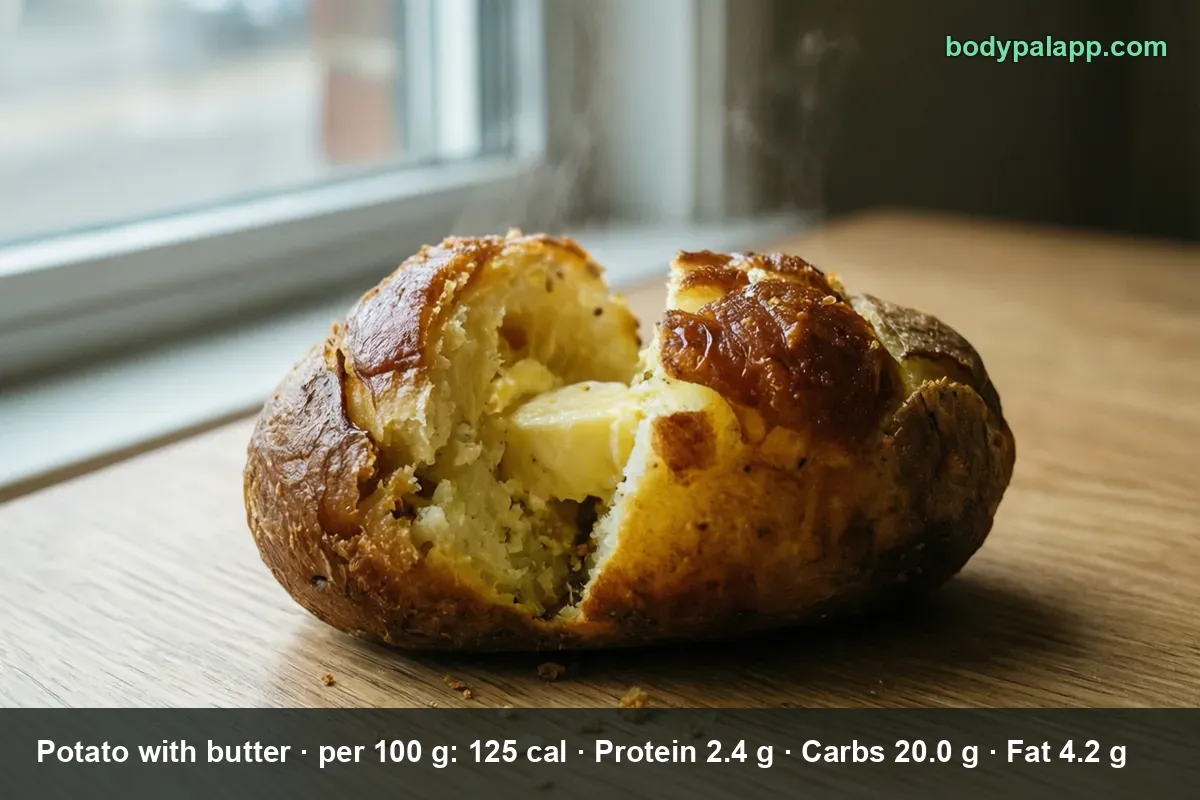
One medium baked potato eaten with the skin and a pat of butter weighs 315 g and carries 394 calories. Per 100 g the same dish runs 125 calories, which is low for something this filling. Most of that plate is potato, not butter: the carbohydrate, 63 grams of it, comes entirely from the spud.
On this page
- Potato with butter quick facts
- US servings, from one ounce to a large baked potato
- Baked, boiled, roasted and mashed with butter
- Saturated fat is the row the butter moves
- How does potato with butter compare?
- Most popular potato with butter brands
- Potato with butter FAQs
Potato with butter quick facts
The record behind this page is FNDDS 2709525, "Potato, baked, peel eaten, with butter", from the 2021-2023 survey release. It is the finished dish, butter already counted, which is what you actually put on the plate when you split a baked potato open and drop a pat inside. USDA keeps household portions on that record by potato size, so a medium potato has a real weight attached instead of a guess.
There is a separate record for the same potato with the skin left on the plate. It matters less for calories than people expect and more for fiber, and it gets its own section further down.
| Nutrient | Per 100 g | Per 1 medium baked potato (315 g) | % Daily Value |
|---|---|---|---|
| Calories | 125 | 394 | — |
| Total fat | 4.22 g | 13.3 g | 17% |
| Saturated fat | 2.3 g | 7.2 g | 36% |
| Carbohydrate | 20.01 g | 63.0 g | 23% |
| Dietary fiber | 2.1 g | 6.6 g | 24% |
| Total sugars | 1.14 g | 3.6 g | — |
| Protein | 2.41 g | 7.6 g | 15% |
| Sodium | 203 mg | 639 mg | 28% |
| Cholesterol | 12 mg | 38 mg | 13% |
| Potassium | 507 mg | 1597 mg | 34% |
% Daily Value is based on a 2,000-calorie diet.
Verified nutrition data
Numbers on this page come from USDA FoodData Central, the U.S. Department of Agriculture’s food composition database, and from manufacturer labels where a branded product is named. Last verified September 2026. How we verify our data →
Two rows you would see on a packaged label are missing here. Added sugars and trans fat are not published in this FNDDS release, so they are left out rather than filled in with a zero; a potato with butter has no added sugar by recipe anyway. The total sugars row is natural potato sugar, which is why it carries no Daily Value.
The number that surprises people is potassium: 1,597 mg in one medium potato, 34% of the Daily Value, more than you get from a banana-sized snack. The FDA's Daily Value reference puts the potassium target at 4,700 mg, and one buttered baked potato covers a third of it.
US servings, from one ounce to a large baked potato
| Serving | Weight | Calories |
|---|---|---|
| 1 oz | 28 g | 35 kcal |
| 1 cup | 160 g | 200 kcal |
| 1 small baked potato | 260 g | 325 kcal |
| 1 medium baked potato | 315 g | 394 kcal |
| 1 large baked potato | 445 g | 556 kcal |
| Per 100 g | 100 g | 125 kcal |
The small, medium, large and cup portions are USDA household measures on that record. The 1 oz line is our own arithmetic from the USDA 100 g figure, not a USDA serving, and it is there because meat-style ounce logging is a habit for a lot of people.
Here is the trap. A cup of potato with butter is 200 calories; a whole medium baked potato is 394, just under double, and the calorie density never changed. Both are 125 calories per 100 g. All that moved was the weight in front of you: 160 g scooped into a cup versus a 315 g potato sitting on the plate. If you log "potato with butter, 1 cup" out of habit while eating a whole baked potato, you are 194 calories short every time.
The spread from small to large is 231 calories, wider than most people would guess for one vegetable. A large potato at 556 calories is a meal; a small one at 325 is a side.
Baked, boiled, roasted and mashed with butter
| Version | Per 100 g | Typical portion | Calories |
|---|---|---|---|
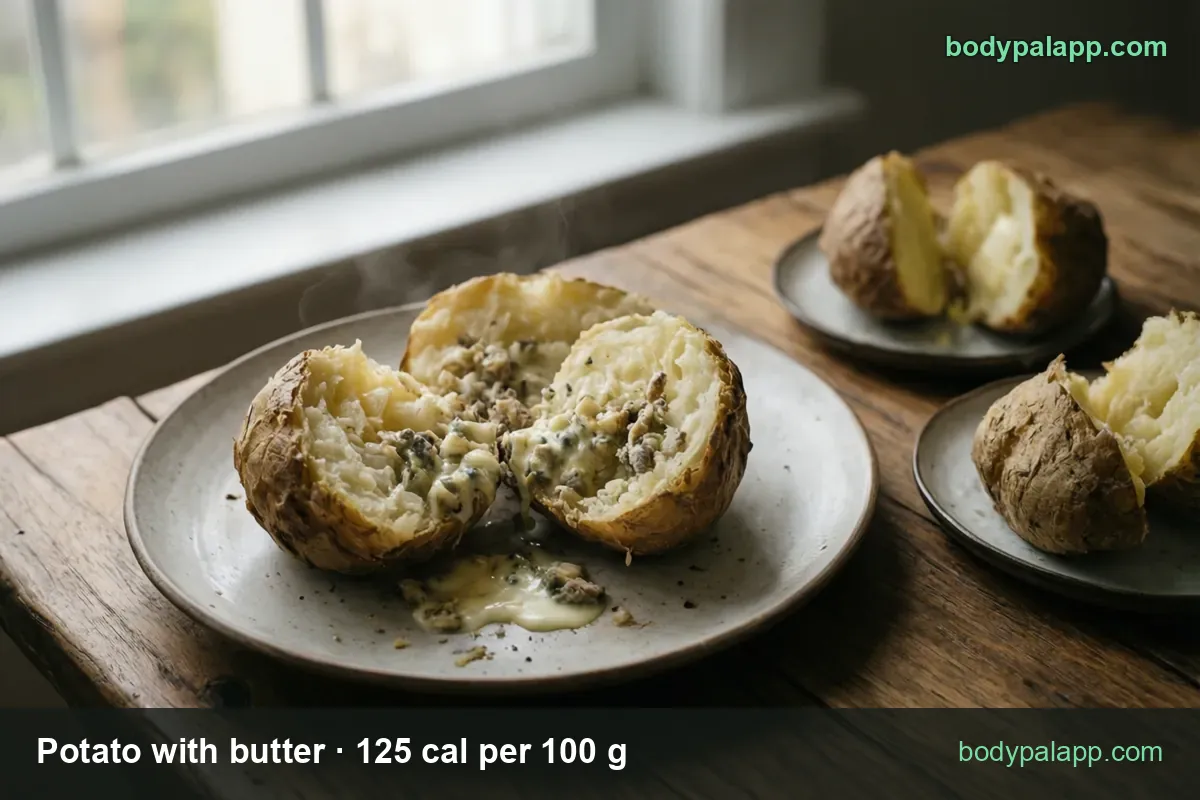
| Baked with butter, peel eaten | 125 kcal | 1 medium (315 g) | 394 kcal |
| Baked with butter, peel not eaten | 125 kcal | 1 medium (315 g) | 394 kcal |
| Boiled with butter, peel eaten | 123 kcal | 1 medium (170 g) | 209 kcal |
| Boiled with butter, peel not eaten | 123 kcal | 1 medium (170 g) | 209 kcal |
| Roasted with butter, peel eaten | 123 kcal | 1 medium (170 g) | 209 kcal |
| Mashed with whole milk and butter | 113 kcal | 1 oz (28 g) | 32 kcal |
| Potatoes au gratin made with butter | 134 kcal | 1 oz (28 g) | 38 kcal |
Cooking method barely moves the needle. Baked lands at 125 calories per 100 g, boiled and roasted at 123 - a two-calorie gap that disappears the moment your potato is 20 g bigger than the one USDA weighed. What moves the boiled and roasted numbers to 209 calories is the portion, not the pan: USDA's medium boiled potato is 170 g, roughly half the weight of a medium baked one.
Peeling changes almost nothing on the calorie line and quite a lot on the fiber line. Skin on gives 2.1 g of fiber and 507 mg of potassium per 100 g; skin off drops to 1.4 g of fiber and 371 mg of potassium at the same 125 calories. Across a 315 g potato that is 6.6 g of fiber versus about 4.4 g by our own scaling from the 100 g figure - a full quarter of the day's fiber turning into a sixth, for no calorie saving at all.
Mashed with whole milk and butter is the lightest version per gram on this page at 113 calories per 100 g, because milk dilutes the starch with water. Au gratin is the heaviest at 134, and it stops being a potato dish in any useful sense: cheese and cream push its saturated fat to 4.73 g per 100 g, more than double the 2.3 g in a buttered baked potato. The 1 oz lines for both are our own arithmetic from the USDA 100 g figures, not USDA servings.
Saturated fat is the row the butter moves
Look back at the quick facts table and notice the mismatch. Total fat in one medium potato is 13.3 g, 17% of the Daily Value - unremarkable. Saturated fat is 7.2 g, 36% of the Daily Value, which is more than a third of the day from a side dish. That gap is the butter's signature: butter is mostly saturated fat, so it pushes one row twice as hard as the other.
The Dietary Guidelines for Americans advise keeping saturated fat under 10% of daily calories, which is about 22 g on a 2,000-calorie day. One buttered baked potato uses roughly a third of that. If you are watching saturated fat specifically, halving the butter is the single most effective edit on this plate, and it costs you very little of what makes the potato good - the fiber, the potassium and the 63 g of carbohydrate all stay put.
Sodium is the other row worth a glance: 639 mg, 28% of the Daily Value, which is about a quarter teaspoon of table salt. That comes from salted butter plus seasoning, not from the potato, which is naturally almost sodium-free. Plain potato is one of the vegetables MyPlate counts toward the starchy vegetable group; what you add to it decides how the label reads.
Protein is honest but small: 7.6 g, 15% of the Daily Value. A baked potato is not a protein food, and topping it with butter does not change that.
How does potato with butter compare?
| Potato dish | Per 100 g | US serving | Calories |
|---|---|---|---|
| Baked potato with butter, peel eaten | 125 kcal | 1 medium, 315 g | 394 kcal |
| Boiled potato, peel eaten, fat not specified | 126 kcal | 1 baby potato, 60 g | 76 kcal |
| Boiled potato, peel not eaten, fat not specified | 126 kcal | 1 baby potato, 60 g | 76 kcal |
| Potato, NFS | 126 kcal | 1 baby potato, 60 g | 76 kcal |
Our take: the three comparison rows all land at 126 calories per 100 g, within one calorie of the buttered baked potato, because USDA's "not specified as to fat" records already assume some fat went in during cooking. So the honest conclusion is that "potato with butter" and "potato, however it was cooked" are the same food by density in this database - the 76-calorie serving looks small only because a baby potato is 60 g. For weight control, pick the potato size first and worry about the butter second; a small baked potato with butter at 325 calories beats a large one at 556 by more than any topping swap will get you. For staying full on the fewest calories, eat the skin: same 125 calories per 100 g, half again as much fiber.
Most popular potato with butter brands in the United States
Ranked by how widely each product appears among foods sold in the United States, from the BodyPal food database of over 3.3 million products. Calories are the figures printed on each Nutrition Facts label, checked against USDA FoodData Central.
| Product | Calories (per 100 g) |
|---|---|
| Bob Evans Mashed Potatoes Original | 121 cal |
| Birds Eye Steamfresh Roasted Red Potatoes with Garlic Butter Sauce | 116 cal |
| Eagle Eye Steakhouse Idaho Potatoes with Real Butter & Spices | 114 cal |
| Reser's Signature Mashed Potatoes with Whole Milk & Butter | 113 cal |
| Safeway Creamy Mashed Potatoes with Milk and Butter | 113 cal |
| Wegmans Creamy & Buttery Homestyle Yukon Gold Mashed Potatoes | 105 cal |
Brand popularity: BodyPal food database. Nutrition: manufacturer labels / USDA FoodData Central.
Potato with butter FAQs
How many calories are in a medium baked potato with butter?
394 calories for a medium 315 g baked potato eaten with the skin and butter, at 125 calories per 100 g. A small one, 260 g, is 325 calories, and a large 445 g potato reaches 556. USDA lists all three household sizes on the same record, so the weight is doing the work.
How many calories are in a cup of potatoes with butter?
200 calories per cup, which USDA weighs at 160 g. That is just over half a whole medium baked potato at 394 calories, even though the density is identical at 125 calories per 100 g. Logging a cup when you actually ate a whole potato undercounts you by 194 calories, so weigh it once.
How many carbs are in a potato with butter?
63.0 grams of carbohydrate in one medium 315 g potato, 23% of the Daily Value, of which 6.6 g is fiber and only 3.6 g is natural sugar. Per 100 g that is 20.01 g of carbohydrate. Butter adds none of it; every gram comes from the potato itself.
Baked vs boiled potato with butter, which has fewer calories?
Boiled is 123 calories per 100 g against baked at 125, a difference too small to matter. The real gap is portion size: USDA's medium boiled potato is 170 g and 209 calories, while a medium baked one is 315 g and 394. You are choosing a size, not a cooking method.
How much sodium is in a baked potato with butter?
639 mg in one medium 315 g potato, 28% of the Daily Value and roughly a quarter teaspoon of table salt. Per 100 g it is 203 mg. Almost all of it arrives with salted butter and seasoning, since a plain potato is naturally very low in sodium.
Does eating the potato skin add fiber?
Yes: 2.1 g of fiber per 100 g with the skin against 1.4 g without, at the same 125 calories. Over a 315 g potato that is 6.6 g versus about 4.4 g by our own scaling. Potassium moves too, 507 mg per 100 g with skin against 371 mg without.
Is a baked potato with butter healthy?
It delivers 6.6 g of fiber, 24% of the Daily Value, and 1,597 mg of potassium, 34%, for 394 calories. The row to watch is saturated fat at 7.2 g, 36% of the Daily Value, essentially all from the butter. Use less butter and the potato's own numbers stay exactly where they are.
Is potato with butter good for weight loss?
At 125 calories per 100 g it is genuinely light for how filling it is, and 6.6 g of fiber per medium potato helps. The catch is size: a small potato is 325 calories, a large one 556. If you are watching calories, take the small potato with the skin on.
Similar foods
- Frozen Yogurt — 203 cal per scoop
- Frozen Yogurt — 203 cal per scoop
- Half And Half — 20 cal per tbsp
- Noosa Yogurt — 270 cal per container
- Coffee Mate Creamer — 20 cal per tablespoon
- Cheese Grits — 259 cal per cup, cooked
Count it without the math
Point the camera at the plate and BodyPal counts the potato and the butter together, skin and all.


How long does it take to burn off 394 kcal of potato with butter?
One medium baked potato (315 g) is 394 kcal. Enter your weight and the amount you ate to see how long it takes you to burn that off:
lb
| Activity | Time to burn 394 kcal |
|---|---|
| Walking, brisk | 1 hr 19 min |
| Cycling, moderate | 49 min |
| Swimming, moderate | 56 min |
| Jogging | 46 min |
| Weight training, moderate | 1 hr 28 min |
Times are for a 155 lb adult at a steady pace; change the weight to see yours. The amount is set to the portion in the text (315 g); change it to what you actually ate. BodyPal works this out from your steps automatically.
Burning it off is one side of it. The other is knowing your number: work out how many calories you need a day, with macros and a goal date.