
How many calories are in frozen yogurt?
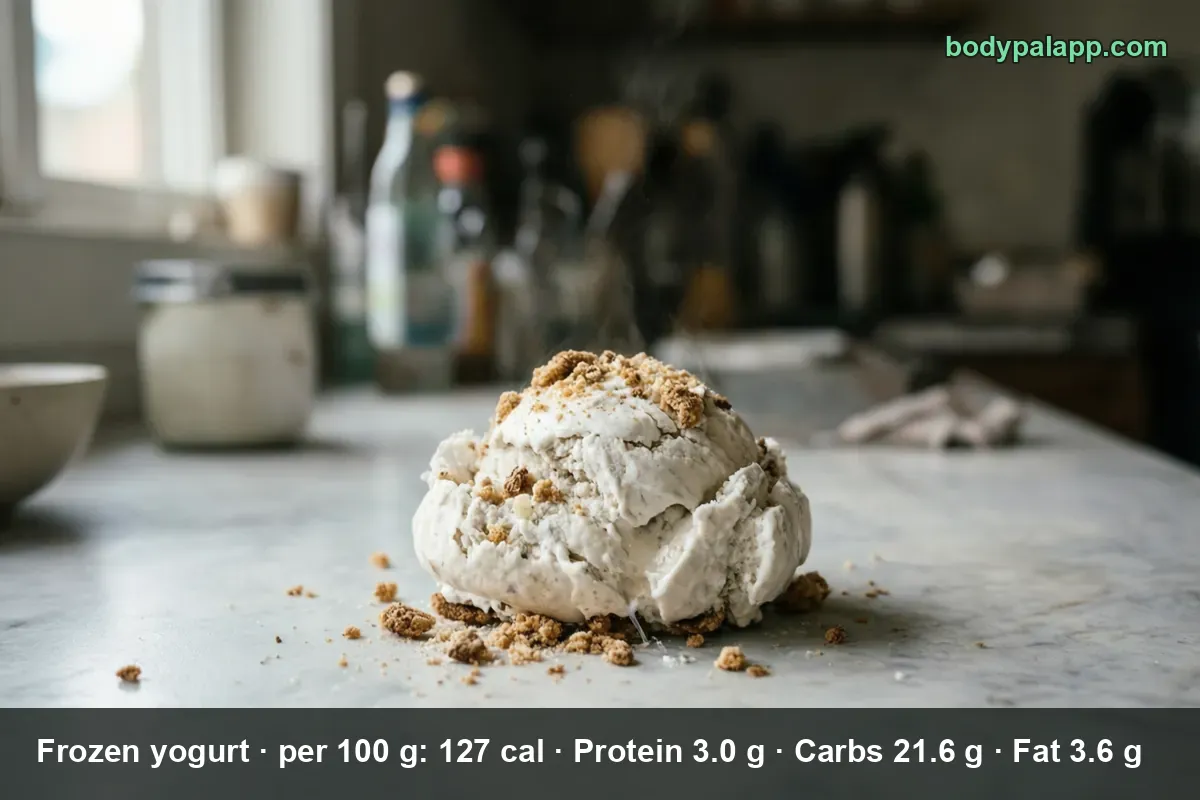
One scoop of frozen yogurt weighs about 160 g and carries 203 calories. Per 100 g the plain shop version runs 127 calories, lighter than most ice cream but not a free food. Fill a 175 g cup and you are at 222. Fill the large tub the counter hands you and you are at 610.
On this page
- Frozen yogurt quick facts
- US servings, from one ounce to a large froyo cup
- Vanilla, chocolate, soft serve, bars and cones
- Saturated fat, not sodium, is the row to watch
- How does frozen yogurt compare?
- Most popular frozen yogurt brands
- Frozen yogurt FAQs
Frozen yogurt quick facts
The record behind this page is FNDDS 2705451, "Frozen yogurt, NFS", from the 2021-2023 survey release. NFS means "not further specified", which is exactly the situation most people are in at the counter: a scoop or a cup from the case, flavor unstated. Vanilla carries an identical profile in the same release, so this one number covers the two most common orders.
Soft serve, bars and cones sit in separate records further down the page. They differ because of how the product is churned and served, not because the data comes from somewhere else.
| Nutrient | Per 100 g | Per 1 scoop (160 g) | % Daily Value |
|---|---|---|---|
| Calories | 127 | 203 | — |
| Total fat | 3.6 g | 5.8 g | 7% |
| Saturated fat | 2.33 g | 3.7 g | 19% |
| Carbohydrate | 21.6 g | 34.6 g | 13% |
| Dietary fiber | 0 g | 0 g | 0% |
| Total sugars | 19.92 g | 31.9 g | — |
| Protein | 3 g | 4.8 g | 10% |
| Sodium | 63 mg | 101 mg | 4% |
% Daily Value is based on a 2,000-calorie diet.
Verified nutrition data
Numbers on this page come from USDA FoodData Central, the U.S. Department of Agriculture’s food composition database, and from manufacturer labels where a branded product is named. Last verified September 2026. How we verify our data →
Two rows you will not find above: added sugars and trans fat. USDA does not publish an added-sugars breakdown for the frozen yogurt, NFS record, so there is no honest way to say how much of the 31.9 g in a scoop came from the sugar bin and how much came from the milk. Cholesterol and potassium are published: 13 mg and 156 mg per 100 g, which works out to 21 mg of cholesterol (7% DV) and 250 mg of potassium (5% DV) in a scoop.
US servings, from one ounce to a large froyo cup
| Serving | Weight | Calories |
|---|---|---|
| 1 oz | 28 g | 36 kcal |
| Per 100 g | 100 g | 127 kcal |
| One scoop | 160 g | 203 kcal |
| One cup | 175 g | 222 kcal |
| Medium shop cup | 320 g | 406 kcal |
| Large shop cup | 480 g | 610 kcal |
The scoop, the cup and the two shop cups are USDA household measures attached to this record. The 1 oz line is our own arithmetic from the USDA 100 g figure, not a USDA serving, and it is there for anyone weighing a bowl on a kitchen scale.
Here is the part worth staring at. The medium cup is exactly two scoops, 406 calories. The large is three, 610. Nobody orders "three scoops of froyo", but plenty of people fill the large cup to the rim and think of it as one dessert. The container decides more here than the flavor does, and the toppings bar has not even opened yet.
Vanilla, chocolate, soft serve, bars and cones
| Version | Per 100 g | Typical portion | Calories |
|---|---|---|---|
| Vanilla | 127 kcal | 1 cup, 175 g | 222 kcal |
| Chocolate | 131 kcal | 1 cup, 175 g | 229 kcal |
| Soft serve, vanilla | 159 kcal | 100 g | 159 kcal |
| Soft serve, chocolate | 160 kcal | 100 g | 160 kcal |
| Frozen yogurt bar, vanilla | 127 kcal | 1 bar, 65 g | 83 kcal |
| Frozen yogurt cone, vanilla | 139 kcal | 1 cone, 125 g | 174 kcal |
Vanilla and chocolate are seven calories apart over a whole cup. If you have been picking vanilla to save calories, that habit is worth about as much as skipping the last spoonful. Chocolate actually pays you something back: cocoa solids give it 2.3 g of fiber per 100 g, roughly 4.0 g in a 175 g cup, while vanilla has none at all.
Soft serve is the real fork in the road. It is a richer mix, 5.6 g of fat per 100 g against 3.6 g, so 100 g carries 159 calories instead of 127. USDA lists no household measure for the soft serve records, so if you want a cup comparison you have to scale it yourself: 175 g of soft serve vanilla comes to about 278 calories, our own arithmetic from the USDA 100 g figure. Same cup, same shop, 56 more calories than the scooped kind.
The stick and the cone cut in the other direction, because they cap the portion. A vanilla frozen yogurt bar is the same 127 calories per 100 g as a scoop, just pressed into a 65 g bar, which is 83 calories. A cone is 139 per 100 g once the wafer is counted, and a 125 g cone lands at 174.
Supermarket tubs and bars carry their own label numbers, which is where the Greek-style products sit. Oikos vanilla Greek frozen yogurt lists 150 calories per 89 g container and Yoplait strawberry frozen yogurt bars list 130 calories per 52 g bar, both from USDA's Branded database rather than the survey record above. If you want a truly light option, USDA's SR Legacy file has a chocolate frozen yogurt made with nonfat milk and sweetened without sugar at 107 calories per 100 g, about 187 in a 175 g cup by our own arithmetic.
Saturated fat, not sodium, is the row to watch
People come to frozen yogurt expecting the sodium story that ruins so many convenience foods. It is not the problem here. A scoop has 101 mg, 4% of the FDA Daily Value of 2,300 mg, which is less than a slice of white bread.
Saturated fat is the tight one. That same scoop has 3.7 g, 19% of the 20 g Daily Value, and the Dietary Guidelines for Americans put the recommended ceiling at under 10% of daily calories. Two scoops, the medium shop cup, is 7.4 g and roughly 37% of the day's allowance in one dessert. That is the number to plan around if dairy fat is already showing up at breakfast.
The protein line is better than the reputation suggests but still modest: 4.8 g in a scoop, 10% DV. Frozen yogurt counts toward the dairy group on MyPlate, though a cup of plain yogurt from the refrigerated case does the same job with a fraction of the sugar. If you are eating it for the protein rather than the pleasure, you are choosing the expensive way to get it.
How does frozen yogurt compare?
| Frozen dessert | Per 100 g | Protein | Carbohydrate | Fat |
|---|---|---|---|---|
| Frozen yogurt, NFS | 127 kcal | 3 g | 21.6 g | 3.6 g |
| Light ice cream, NFS | 174 kcal | 4.38 g | 25.44 g | 6.14 g |
| Sherbet, all flavors | 144 kcal | 1.1 g | 30.4 g | 2 g |
| Fudgesicle, light | 124 kcal | 3.67 g | 23.11 g | 1.87 g |
USDA does not attach a gram weight to the household measures on those three neighbor records, so there is no per-serving column to give you honestly. Scaled to the same 175 g cup by our own arithmetic, frozen yogurt is 222, sherbet about 252 and light ice cream about 305.
Our take: frozen yogurt earns its lighter reputation, but only just, and only against ice cream. It beats light ice cream by 47 calories per 100 g and sherbet by 17, while carrying nearly three times sherbet's protein. The one genuinely small dessert on this list is the light fudgesicle, and it wins on portion control rather than density. Order frozen yogurt in the small cup and you have a 222-calorie dessert with real dairy protein. Order it in the large cup with a topping bar in front of you and you have a 610-calorie meal that nobody logged.
Most popular frozen yogurt brands in the United States
Ranked by how widely each product appears among foods sold in the United States, from the BodyPal food database of over 3.3 million products. Calories are the figures printed on each Nutrition Facts label, checked against USDA FoodData Central.
| Product | Calories (per 100 g) |
|---|---|
| Oikos Chocolate Greek Frozen Yogurt | 169 cal |
| Oikos Strawberry Greek Frozen Yogurt | 157 cal |
| Yoplait Frozen Yogurt Bars Strawberry | 250 cal |
| Yoplait Original Lowfat Frozen Yogurt Strawberry | 151 cal |
| Purple Cow Strawberry Low Fat Frozen Yogurt | 153 cal |
| Oikos Vanilla Greek Frozen Yogurt | 169 cal |
Brand popularity: BodyPal food database. Nutrition: manufacturer labels / USDA FoodData Central.
Frozen yogurt FAQs
How many calories are in a cup of frozen yogurt?
A 1-cup serving of frozen yogurt weighs 175 g and comes to 222 calories, based on 127 calories per 100 g. That is the plain USDA record for shop-style frozen yogurt, with no toppings counted. Add granola or candy pieces and you can easily push the cup past 300.
How many calories are in one scoop of frozen yogurt?
One scoop is 203 calories at 160 g. That scoop also carries 34.6 g of carbohydrate, 4.8 g of protein and 3.7 g of saturated fat, which is 19% of the Daily Value. Two scoops make 406 calories, the same as the medium cup the shop hands you.
Is frozen yogurt lower in calories than ice cream?
Yes, by USDA's numbers. Frozen yogurt is 127 calories per 100 g against 174 for light ice cream. Over a 175 g cup that is 222 against about 305, our own arithmetic from the 100 g figures. Soft serve frozen yogurt narrows the gap to 159 per 100 g.
How many calories in soft serve frozen yogurt?
Soft serve vanilla frozen yogurt is 159 calories per 100 g, about a quarter more than the 127 of the scooped version, because it holds 5.6 g of fat, not 3.6. USDA lists no household serving for that record, so a 175 g cup works out to roughly 278 calories by our own arithmetic. Chocolate soft serve is 160.
How much sugar is in frozen yogurt?
Frozen yogurt carries 19.92 g of total sugars per 100 g, so a 160 g scoop holds 31.9 g and a 175 g cup about 34.9 g. USDA does not split added sugars from milk sugars for this record, so there is no way to say how much of that was poured in at the factory.
How much protein does frozen yogurt have?
Three grams per 100 g, which is 4.8 g in a 160 g scoop and about 5.3 g in a 175 g cup. That scoop covers 10% of the 50 g Daily Value. Greek-style retail tubs are usually denser, but the USDA survey record for shop frozen yogurt gives the 3 g figure.
How many calories in a frozen yogurt bar?
A vanilla frozen yogurt bar is 83 calories for a 65 g bar, at the same 127 calories per 100 g as the scooped kind, since the mass is simply packed onto a stick. Retail bars vary: Yoplait strawberry frozen yogurt bars list 130 calories for a 52 g bar.
How many calories does a large froyo cup hold?
A large shop cup holds 480 g, which is 610 calories before a single topping goes on. The medium cup, at 320 g, is 406. Both are USDA-listed portion sizes for this record, and both dwarf the 203-calorie scoop most people picture when they order froyo.
Similar foods
- Frozen Yogurt — 203 cal per scoop
- Potato With Butter — 394 cal per medium baked potato
- Half And Half — 20 cal per tbsp
- Coffee Mate Creamer — 20 cal per tablespoon
- Noosa Yogurt — 270 cal per container
- Cheese Grits — 259 cal per cup, cooked
Count it without the math
Point the camera at the cup and BodyPal counts the frozen yogurt for you, toppings and all.


How long does it take to burn off frozen yogurt?
One scoop (160 g) is 203 kcal. Enter your weight and the amount you ate to see how long it takes you to burn that off:
lb
| Activity | Time to burn 203 kcal |
|---|---|
| Walking, brisk | 41 min |
| Cycling, moderate | 25 min |
| Swimming, moderate | 29 min |
| Jogging | 24 min |
| Weight training, moderate | 45 min |
Times are for a 155 lb adult at a steady pace; change the weight to see yours. The amount is set to the portion in the text (160 g); change it to what you actually ate. BodyPal works this out from your steps automatically.
This table assumes you know your daily total. If you do not, the daily calorie calculator works it out from five numbers.