
How many calories are in cheese manicotti?
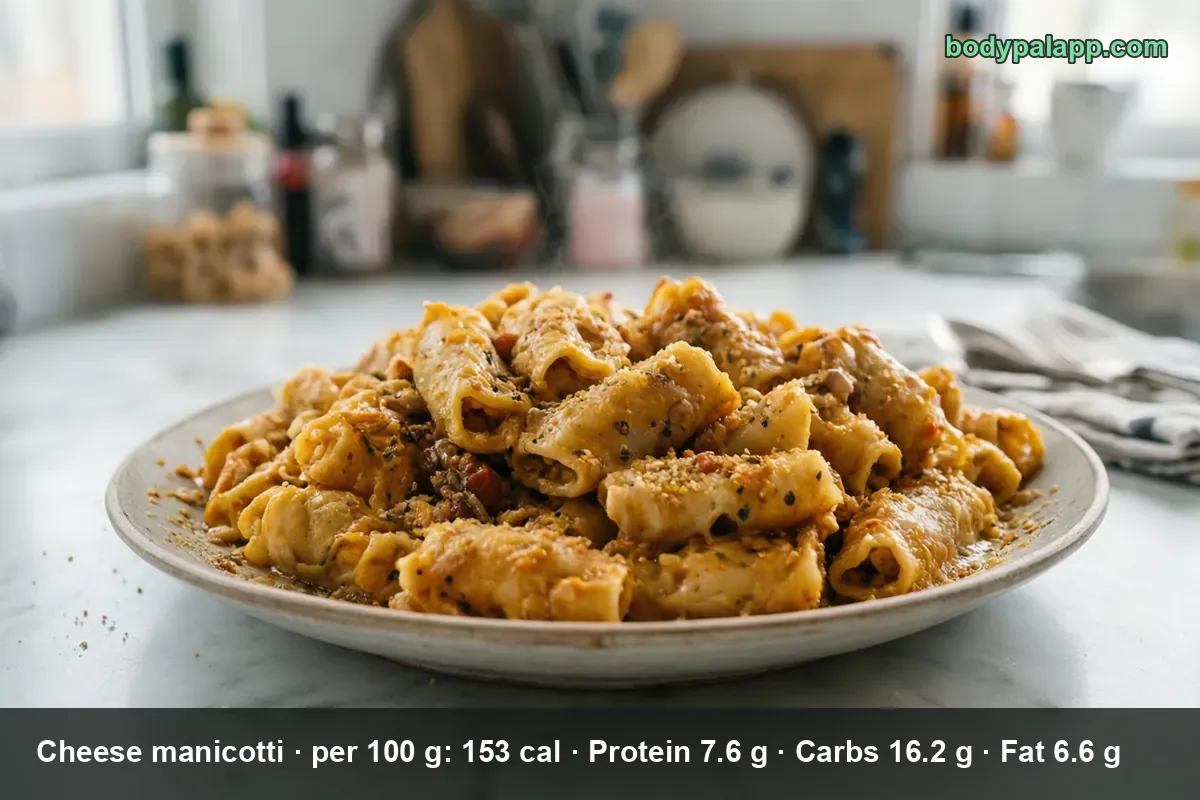
One cheese manicotti baked in tomato sauce weighs 143 g and carries 219 calories. Per 100 g the dish runs 153 calories, which is light for a pasta bake, because the sauce is mostly water. Two tubes, the plate most people actually eat, land at 438.
On this page
- Cheese manicotti quick facts
- US servings, from one tube to a full cup
- No sauce, meat sauce, and the vegetable version
- Sodium is the row to watch
- How does cheese manicotti compare?
- Most popular cheese manicotti brands
- FAQ
Cheese manicotti quick facts
The record that matches what lands on the plate is FNDDS 2708776, "Manicotti, cheese-filled, with tomato sauce, meatless". That is manicotti as it is served in the United States: pasta tubes stuffed with ricotta, baked, and spooned over with red sauce. USDA also publishes the same dish without sauce, with meat sauce, and with vegetables in the filling. Those are the same food prepared differently, and they sit in their own section further down rather than being averaged in here.
USDA's household measure for this record is one manicotti at 143 g, so that is the serving the table below prices.
| Nutrient | Per 100 g | Per 1 manicotti (143 g) | % Daily Value |
|---|---|---|---|
| Calories | 153 | 219 | — |
| Total fat | 6.59 g | 9.4 g | 12% |
| Saturated fat | 3.52 g | 5.0 g | 25% |
| Carbohydrate | 16.2 g | 23.2 g | 8% |
| Dietary fiber | 0.9 g | 1.3 g | 5% |
| Total sugars | 1.65 g | 2.4 g | — |
| Protein | 7.63 g | 10.9 g | 22% |
| Sodium | 436 mg | 623 mg | 27% |
% Daily Value is based on a 2,000-calorie diet.
Verified nutrition data
Numbers on this page come from USDA FoodData Central, the U.S. Department of Agriculture’s food composition database, and from manufacturer labels where a branded product is named. Last verified September 2026. How we verify our data →
Two rows you would see on a supermarket box are missing here on purpose: USDA does not publish added sugars or trans fat for this mixed pasta record, so there is nothing honest to print. Cholesterol comes to 80 mg per tube, 27% of the daily value, and potassium to 276 mg, about 6%. The daily values used throughout are the current FDA reference amounts.
US servings, from one tube to a full cup
| Serving | Weight | Calories |
|---|---|---|
| 1 oz | 28 g | 43 kcal |
| One manicotti, USDA measure | 143 g | 219 kcal |
| 1 cup, scooped from the dish | 235 g | 360 kcal |
| Two manicotti, a full plate | 286 g | 438 kcal |
| Per 100 g | 100 g | 153 kcal |
The single tube and the 1-cup scoop are both USDA household measures for this record. The 1 oz line and the two-tube plate are our own arithmetic from the USDA 100 g figure, not USDA servings.
The cup is the number worth memorizing, because it is where most people misjudge this dish. A cup of manicotti is not one tube; at 235 g it is a little more than one and a half of them, and it prices at 360 calories. Scoop a cup, call it "one serving," and you have already logged 64% more than the tube you pictured. Two tubes on a plate with a slice of garlic bread is a 600-calorie dinner before the salad.
Weigh the pan rather than counting shapes if you can. Restaurant and home-baked tubes run larger than the USDA 143 g, and a 160 g tube at the same density is 245 calories.
No sauce, meat sauce, and the vegetable version
| Version | Per 100 g | Typical piece | Calories |
|---|---|---|---|
| With tomato sauce | 153 kcal | 1 manicotti, 143 g | 219 kcal |
| No sauce | 207 kcal | 1 manicotti, 127 g | 263 kcal |
| With meat sauce | 160 kcal | 1 manicotti, 143 g | 229 kcal |
| Vegetable and cheese filling, tomato sauce | 135 kcal | 1 manicotti, 143 g | 193 kcal |
| With tomato sauce, cup measure | 153 kcal | 1 cup, 235 g | 360 kcal |
Here is the counterintuitive part. Sauce makes manicotti lighter per gram, not heavier. An unsauced tube is 207 calories per 100 g against 153 with tomato sauce, because red sauce is mostly water and it adds weight faster than it adds calories. But per piece the order flips: the bare tube weighs 127 g and costs 263 calories, while the sauced one weighs 143 g and costs 219. Skipping the sauce to save calories saves nothing. It costs you 44.
Meat sauce is close to a rounding error at 160 calories per 100 g, or 229 per tube, ten more than the plain version. What it really changes is the mix, trading a little starch for protein and fat: 8.83 g of protein and 7.28 g of fat per 100 g against 7.63 g and 6.59 g. Vegetables in the filling are the only genuine saving on this list, at 135 calories per 100 g and 193 per tube, because zucchini and spinach displace ricotta.
Frozen retail manicotti behaves nothing like a single curve. Across USDA's Branded records the same three words on the box span 89 calories per 100 g (Michelina's Cheese Manicotti with Marinara, 190 for the 213 g package) to 185 (Weis 2 Cheese Manicotti, 279 for two tubes at 151 g), with a Stouffer's 334 g tray in between at 126 per 100 g and 421 for the tray. That is a two-fold spread on identical labeling, so read the panel on the box you bought instead of borrowing the homestyle number.
Sodium is the row to watch
Calories are the mild part of this dish. Sodium is not. One tube carries 623 mg, 27% of the 2,300 mg daily value, and it gets there without a shaker: the sauce, the ricotta and the mozzarella arrive salted. A cup pushes that to 1,025 mg, or 45%. Two tubes reach 1,247 mg, 54% of the day in one plate, or roughly half a teaspoon of table salt. The Dietary Guidelines for Americans put the cap at 2,300 mg a day, and most adults are already over it before dinner.
Saturated fat is the second row. One tube is 5.0 g, a quarter of the 20 g daily value, and two tubes is half a day from a single dinner. If you are watching either number, the useful move is not a lighter sauce but a smaller count of tubes plus something bulky alongside: a green salad or a plate of roasted vegetables adds volume for almost nothing, and MyPlate's grains guidance treats a baked pasta dish as one grain serving, not the whole meal.
The number that flatters manicotti is protein: 10.9 g per tube, 22% of the daily value, and 21.8 g for two. For a pasta bake that is genuinely good, and it is the reason a single tube keeps people full longer than a same-calorie serving of plain buttered pasta.
How does cheese manicotti compare?
FNDDS does not publish a gram weight for the cup measure on the three dishes below, so this comparison runs on 100 g rather than on an invented serving.
| Dish | Per 100 g | Protein per 100 g | Fat per 100 g |
|---|---|---|---|
| Cheese manicotti, tomato sauce | 153 kcal | 7.63 g | 6.59 g |
| Tortellini, cheese-filled, cream sauce | 153 kcal | 5.82 g | 6.99 g |
| Pasta with cream sauce, home recipe | 154 kcal | 4.03 g | 7.70 g |
| Pasta with cream sauce, meat and vegetables | 153 kcal | 6.12 g | 6.52 g |
Our take: on calories these four are the same food. Three of them sit at exactly 153 per 100 g and the fourth at 154, so choosing between them to save calories is choosing between nothing. Protein is where they separate, and cheese manicotti wins it outright with 7.63 g per 100 g, nearly double the 4.03 g in plain pasta with cream sauce. If two Italian bakes are in front of you at the same weight, take the one with the ricotta in it: the calories are identical and the protein is not.
Most popular cheese manicotti brands in the United States
Ranked by how widely each product appears among foods sold in the United States, from the BodyPal food database of over 3.3 million products. Calories are the figures printed on each Nutrition Facts label, checked against USDA FoodData Central.
| Product | Calories (per 100 g) |
|---|---|
| Stouffer's Cheese Manicotti | 126 cal |
| Michelina's Cheese Manicotti with Marinara | 89 cal |
| 365 Whole Foods Market Cheese Manicotti with Marinara | 176 cal |
| Caesar's Ricotta Cheese Manicotti | 179 cal |
| Severino Cheese Manicotti | 176 cal |
| Weis 2 Cheese Manicotti | 185 cal |
Brand popularity: BodyPal food database. Nutrition: manufacturer labels / USDA FoodData Central.
Cheese manicotti FAQs
How many calories are in one cheese manicotti?
One manicotti filled with cheese and baked in tomato sauce is 219 calories at 143 g, or 153 calories per 100 g. That single tube also carries 10.9 g of protein, 23.2 g of carbohydrate and 623 mg of sodium, which is 27 percent of the daily value for sodium.
How many calories in a cup of cheese manicotti?
A 1-cup serving weighs 235 g and comes to 360 calories, and that cup is USDA's own household measure for the dish. It brings 17.9 g of protein, 38.1 g of carbohydrate and 1,025 mg of sodium, 45 percent of the daily value. A cup is a little more than one and a half tubes.
Is cheese manicotti high in protein?
One manicotti gives 10.9 g of protein, 22 percent of the 50 g daily value, from 143 g of food at 219 calories. That is strong for a pasta dish, since the ricotta does the work, but it is not a high-protein meal on its own. Two tubes reach 21.8 g.
How much sodium is in cheese manicotti?
One tube holds 623 mg of sodium, 27 percent of the 2,300 mg daily value, and two tubes reach 1,247 mg, or 54 percent. Most of it arrives with the sauce and the cheese rather than from salt added at the stove. That plate is about half a teaspoon of table salt.
How many calories in frozen cheese manicotti?
Frozen trays run from 89 to 185 calories per 100 g, a two-fold spread. A Stouffer's 334 g tray is 421 calories, while a Michelina's 213 g package is 190. Read the panel on the box rather than assuming the frozen version matches the 153 calories per 100 g USDA lists for the homestyle dish.
Does meat sauce add many calories to manicotti?
Barely: with meat sauce the dish is 160 calories per 100 g against 153 with plain tomato sauce, so the same 143 g tube goes from 219 to 229 calories. The mix changes more than the total: protein rises from 7.63 to 8.83 g per 100 g and fat from 6.59 to 7.28 g.
How many carbs are in cheese manicotti?
One 143 g manicotti has 23.2 g of carbohydrate, 8 percent of the 275 g daily value, alongside 1.3 g of fiber and 2.4 g of total sugars. A 235 g cup has 38.1 g. The pasta shell accounts for nearly all of it, since tomato sauce contributes very little starch.
Is cheese manicotti good for weight loss?
At 153 calories per 100 g it is one of the lighter pasta bakes, and one tube at 219 calories fits a 400-calorie lunch with a green salad. Two tubes at 438 calories, plus 1,247 mg of sodium, is where it stops being light. The count of tubes decides it.
Similar foods
- Eggplant Parmesan — 307 cal per cup
- Cheese Dip — 49 cal for 2 tbsp
- Cheese Sauce — 104 cal for 1/4 cup
- Coffee Mate Creamer — 20 cal per tablespoon
- Half And Half — 20 cal per tbsp
- Frozen Yogurt — 203 cal per scoop
Count it without the math
Point the camera at the plate and BodyPal counts the manicotti for you, sauce and all.


How long does it take to burn off cheese manicotti?
One manicotti (143 g) is 219 kcal. Enter your weight and the amount you ate to see how long it takes you to burn that off:
lb
| Activity | Time to burn 219 kcal |
|---|---|
| Walking, brisk | 44 min |
| Cycling, moderate | 27 min |
| Swimming, moderate | 31 min |
| Jogging | 26 min |
| Weight training, moderate | 49 min |
Times are for a 155 lb adult at a steady pace; change the weight to see yours. The amount is set to the portion in the text (143 g); change it to what you actually ate. BodyPal works this out from your steps automatically.
One food is easy to picture; a whole day is harder. See how many calories you need a day and what a deficit actually looks like.