
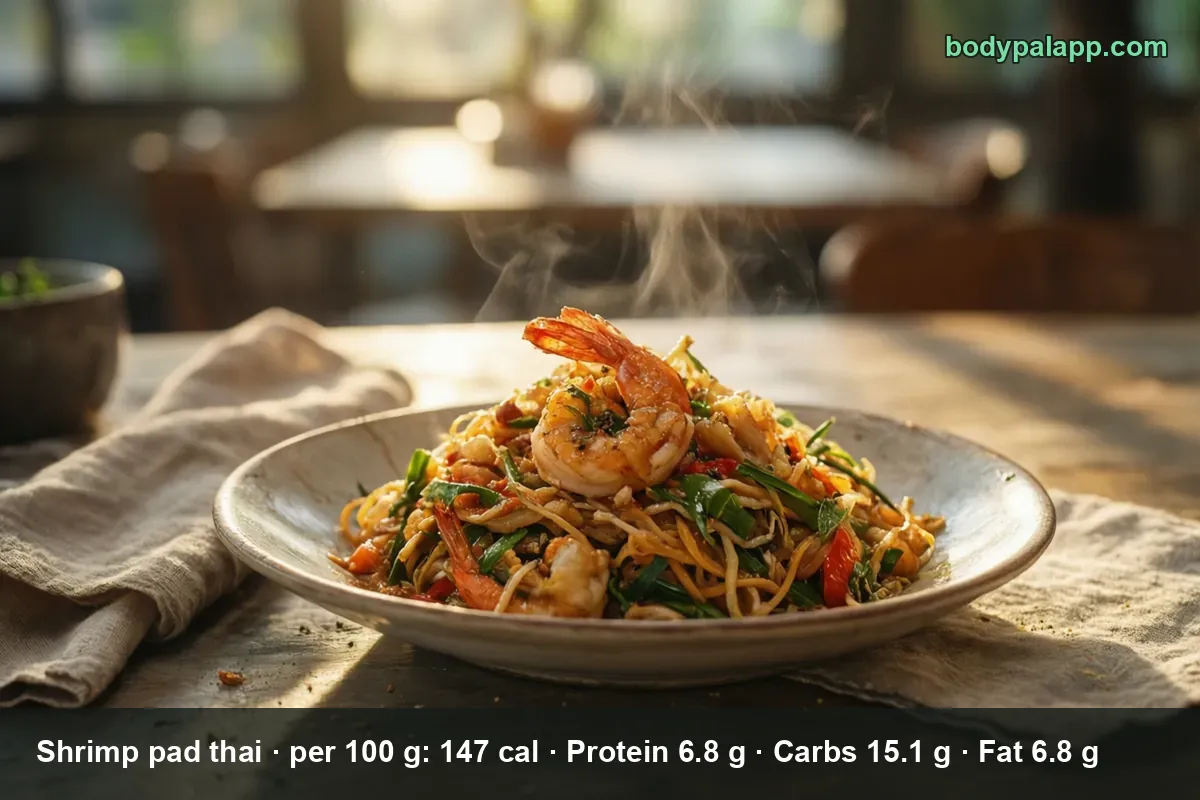
How many calories are in shrimp pad thai?
A 1-cup (200 g) serving of shrimp pad thai carries 294 calories, and the noodles run 147 calories per 100 g. That makes the seafood version the lightest of the five pad thai records USDA publishes. The catch is plate size: restaurants rarely hand you one cup, and two cups is 588 calories.
On this page
- Shrimp pad thai quick facts
- US servings from one ounce to a takeout box
- How the other pad thais stack up
- Frozen bowls look lighter than they eat
- Sodium and cholesterol are the rows to watch
- How does shrimp pad thai compare
- Most popular shrimp pad thai brands
- FAQ
Shrimp pad thai quick facts
The numbers below come from the USDA record FNDDS 2708807, "Pad Thai with seafood", which is the only USDA entry for pad thai built on shrimp or mixed seafood rather than chicken, pork or tofu. Its cholesterol tells you the protein is right: 60 mg per 100 g, against 42 to 48 mg in the meat versions.
It is also a record for the finished dish, sauce and all, which is what a search for pad thai calories is actually asking about. Nobody logs dry rice noodles and a spoon of tamarind paste separately.
| Nutrient | Per 100 g | Per 1 cup (200 g) | % Daily Value |
|---|---|---|---|
| Calories | 147 | 294 | — |
| Total fat | 6.82 g | 13.6 g | 17% |
| Saturated fat | 1.13 g | 2.3 g | 11% |
| Carbohydrate | 15.05 g | 30.1 g | 11% |
| Dietary fiber | 1.2 g | 2.4 g | 9% |
| Total sugars | 4.2 g | 8.4 g | — |
| Protein | 6.84 g | 13.7 g | 27% |
| Sodium | 349 mg | 698 mg | 30% |
| Cholesterol | 60 mg | 120 mg | 40% |
| Potassium | 130 mg | 260 mg | 6% |
% Daily Value is based on a 2,000-calorie diet.
Verified nutrition data
Numbers on this page come from USDA FoodData Central, the U.S. Department of Agriculture’s food composition database, and from manufacturer labels where a branded product is named. Last verified September 2026. How we verify our data →
Two rows a packaged label would show are missing here: added sugars and trans fat. USDA does not report added sugars for mixed restaurant dishes in this database, so there is no honest number to print, even though the sauce clearly contains palm sugar. The 8.4 g in the sugars row is everything sweet in the bowl, natural and added together, and it has no Daily Value to compare against.
US servings from one ounce to a takeout box
| Serving | Weight | Calories |
|---|---|---|
| 1 oz | 28 g | 41 kcal |
| 4 oz | 113 g | 166 kcal |
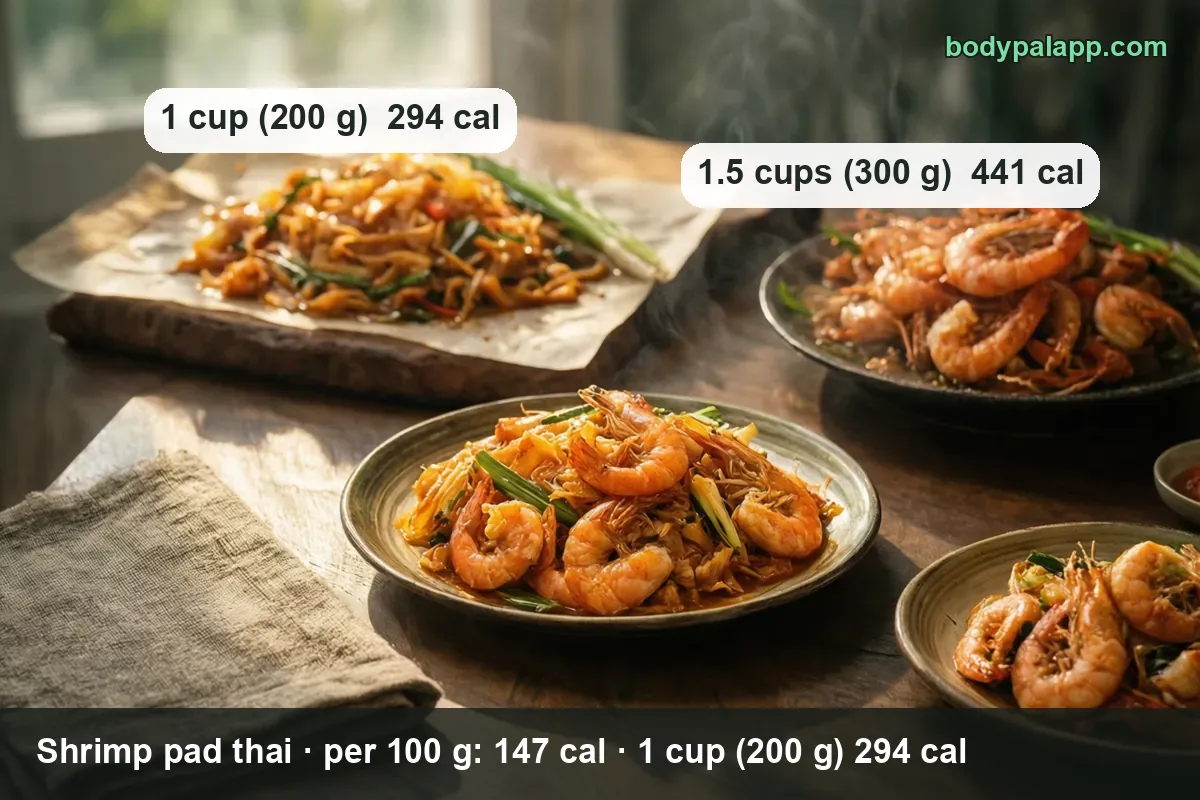
| 1 cup, USDA household measure | 200 g | 294 kcal |
| 1.5 cups, restaurant plate | 300 g | 441 kcal |
| 2 cups, takeout box | 400 g | 588 kcal |
| Per 100 g | 100 g | 147 kcal |
Only the 1-cup line is a USDA serving. The ounce weights and the 1.5- and 2-cup plates are our own arithmetic from the USDA 100 g figure, not USDA servings, because takeout containers do not come with a household measure printed on them.
That spread is the single most useful thing on this page. One cup of shrimp pad thai is a 294-calorie side. The same dish, plated the way a Thai restaurant plates it, is 441 to 588 calories before the spring roll. Nothing about the recipe changed — the difference between the one-cup serving and the two-cup box is 294 calories, exactly one extra cup. If you are counting, weigh or eyeball the portion first and worry about the sauce second.
A useful anchor: a cup of pad thai is roughly the volume of a standard cereal bowl filled level, and a 4 oz (113 g) tasting portion is a little over half of that.
How the other pad thais stack up
USDA keeps a separate record for each protein, and the shrimp version is the lightest of the group. The gap is not dramatic, but it runs in one direction: shrimp brings protein without much fat, while chicken thigh, pork and extra stir-fry oil all add calories.
| Version | Per 100 g | Typical serving | Calories |
|---|---|---|---|
| Pad thai with seafood (shrimp) | 147 kcal | 1 cup, 200 g | 294 kcal |
| Pad thai, NFS (unspecified) | 154 kcal | 1 cup, 200 g | 308 kcal |
| Chicken pad thai | 154 kcal | 1 cup, 200 g | 308 kcal |
| Pad thai with beef or pork | 160 kcal | 1 cup, 200 g | 320 kcal |
| Vegetarian meatless pad thai | 165 kcal | 1 cup, 200 g | 330 kcal |
The meatless row surprises people. Swapping shrimp for tofu adds 18 calories per 100 g, because the fat that the shrimp did not supply comes back as cooking oil: 9.2 g of fat per 100 g against 6.82 g in the seafood version. It also has the least protein of the five, 5.79 g per 100 g. Vegetarian pad thai is a fine order; it is not the light order.
If your menu just says "pad thai" with no protein named, the NFS record at 154 calories per 100 g is the safe default — it is USDA's average across all the versions.
Frozen bowls look lighter than they eat
Supermarket freezer bowls are made with more noodle and less oil than a restaurant wok, so they read lower per gram: 120 to 138 calories per 100 g against 147 for the restaurant-style dish. The Lemon Grass Kitchen half-package serving of 283 g is 340 calories. Other retail bowls land between 221 calories for a 160 g InnovAsian cup, 279 for a Scott & Jon's bowl and 291 for an Aqua Star bowl.
Lower per gram does not mean lower on the plate. That 283 g frozen serving carries roughly 1,030 mg of sodium, against 698 mg in a homemade cup — 45% of the day versus 30%. The freezer aisle wins on calories and loses on salt.
Sodium and cholesterol are the rows to watch
Sodium is the row that gets away from you. A single cup is 698 mg, 30% of the 2,300 mg Daily Value the FDA sets — about a third of a teaspoon of table salt. Take that to a 2-cup restaurant plate and you are at roughly 1,396 mg by our own scaling, 61% of the day, from one dish. The Dietary Guidelines for Americans put the ceiling at 2,300 mg a day, so if you are watching sodium, this is a dish to split and pair with something unsalted.
Cholesterol is the highest percentage on the whole panel: 120 mg a cup, 40% of the 300 mg Daily Value, and it comes almost entirely from the shrimp. Chicken pad thai lands near 96 mg per cup and the beef or pork version near 84 mg. Worth knowing rather than worth avoiding — that cholesterol arrives with only 2.3 g of saturated fat, 11% DV, which is low for a fried noodle dish.
The bright spot is protein: 13.7 g a cup, 27% of the 50 g Daily Value, and shrimp counts toward the seafood recommendation in the MyPlate protein foods group. Fiber does not do the same work — 2.4 g a cup, 9% DV, because rice noodles and bean sprouts are not a fiber source.
How does shrimp pad thai compare
| Dish | Per 100 g | Protein per 100 g | US serving | Calories |
|---|---|---|---|---|
| Shrimp pad thai | 147 kcal | 6.84 g | 1 cup, 200 g | 294 kcal |
| Shrimp fried rice | 166 kcal | 6.68 g | 1 cup, 198 g | 329 kcal |
| Pork lo mein | 138 kcal | 9.48 g | 1 cup, 200 g | 276 kcal |
| Pork chow mein with noodles | 143 kcal | 10.41 g | 1 cup, 220 g | 315 kcal |
Our take: shrimp pad thai is the middle of this pack, not the diet pick. Only pork lo mein is lighter per serving, and shrimp fried rice is the only dish here with less protein per 100 g. For a calorie deficit, order pad thai and eat one cup — 294 calories fits a normal lunch, while the 588-calorie box does not. For staying full, pork chow mein or lo mein give you roughly 40 to 50 percent more protein per gram, and that is what keeps you out of the snack drawer at four o'clock.
Most popular shrimp pad thai brands in the United States
Ranked by how widely each product appears among foods sold in the United States, from the BodyPal food database of over 3.3 million products. Calories are the figures printed on each Nutrition Facts label, checked against USDA FoodData Central.
| Product | Calories (per 100 g) |
|---|---|
| Lemon Grass Kitchen Shrimp Pad Thai | 120 cal |
| InnovAsian Shrimp Pad Thai | 138 cal |
| Aqua Star Shrimp Pad Thai | 128 cal |
| Scott & Jon's Shrimp Pad Thai | 123 cal |
Brand popularity: BodyPal food database. Nutrition: manufacturer labels / USDA FoodData Central.
Shrimp pad thai FAQs
How many calories are in shrimp pad thai?
294 calories in a 1-cup (200 g) serving, from the USDA record for pad thai with seafood at 147 calories per 100 g. That cup also brings 13.7 g of protein, 30.1 g of carbohydrate and 13.6 g of fat. A restaurant plate is usually one and a half to two cups.
How many calories in a restaurant plate of pad thai?
441 calories for a 1.5-cup (300 g) plate and 588 for a 2-cup (400 g) takeout box. Both are our own arithmetic from the USDA 100 g figure rather than USDA servings. Portion moves this dish more than protein does: the same noodles swing 294 calories between one cup and two.
Is shrimp pad thai high in sodium?
698 mg in a cup, 30% of the 2,300 mg Daily Value and about a third of a teaspoon of table salt. Two cups reach roughly 1,396 mg by our own scaling, 61% of a day's limit. That same 283 g frozen serving carries about 1,030 mg on its own.
How much protein is in shrimp pad thai?
13.7 g per cup, 27% of the 50 g Daily Value, from 6.84 g per 100 g. Decent, but not high for a main dish: pork lo mein carries 9.48 g per 100 g and pork chow mein 10.41 g. The shrimp count on your plate matters more than the noodle portion here.
How many carbs are in shrimp pad thai?
30.1 g of carbohydrate in a cup, including 2.4 g of fiber and 8.4 g of sugars from the tamarind and palm sugar in the sauce. Per 100 g that is 15.05 g. A 2-cup takeout box works out to about 60 g, roughly 22% of the 275 g Daily Value.
Is shrimp pad thai healthier than chicken pad thai?
On calories, slightly: 294 per cup with seafood against 308 with chicken, because shrimp brings less fat than thigh meat. Sodium is lower too, 698 mg versus 768 mg. Cholesterol flips the comparison, at 120 mg per cup with shrimp and about 96 mg with chicken. Pick on the number you track.
How much cholesterol is in shrimp pad thai?
120 mg per cup, 40% of the 300 mg Daily Value and the highest percentage on the panel. Shrimp is the reason: chicken pad thai lands near 96 mg per cup and the beef or pork version near 84 mg. It arrives with only 2.3 g of saturated fat, which is 11% DV.
How many calories in a frozen shrimp pad thai bowl?
340 calories for a 283 g half-package serving at 120 calories per 100 g, lighter per gram than the 147 of the restaurant-style dish. Other retail bowls run 221 calories for a 160 g cup up to 291 for a 227 g bowl. Sodium is the trade-off, near 1,030 mg for that 283 g serving.
Similar foods
- Toor Dal — 348 cal per cup
- Lasagna — 286 cal per piece
- Eye of round steak — 135 cal for 3 oz cooked
- Chicken Chow Mein — 288 cal per cup
- Half And Half — 20 cal per tbsp
- Snow Cone — 256 cal per snow cone
Count it without the math
Point the camera at the plate and BodyPal counts the noodles and the shrimp for you.


How long does it take to burn off 294 kcal of shrimp pad Thai?
A 1-cup (200 g) serving is 294 kcal. Enter your weight and the amount you ate to see how long it takes you to burn that off:
lb
| Activity | Time to burn 294 kcal |
|---|---|
| Walking, brisk | 59 min |
| Cycling, moderate | 37 min |
| Swimming, moderate | 42 min |
| Jogging | 35 min |
| Weight training, moderate | 1 hr 5 min |
Times are for a 155 lb adult at a steady pace; change the weight to see yours. The amount is set to the portion in the text (200 g); change it to what you actually ate. BodyPal works this out from your steps automatically.
Want the bigger picture? Calculate your daily calorie needs — your maintenance figure, a target for losing or gaining, and the date you get there.