
How many calories are in an olive?
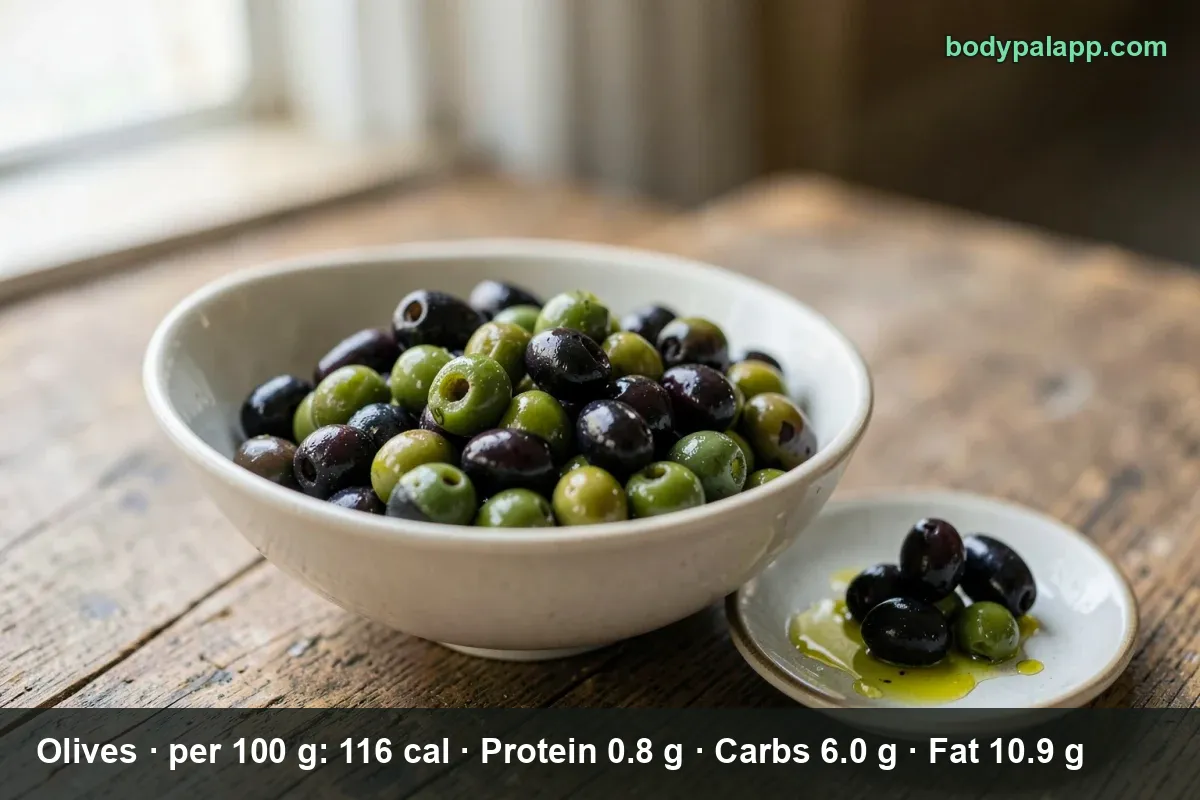
Five large canned black olives weigh 22 g and carry 26 calories. Per 100 g the drained fruit runs 116 calories, which sounds steep for something you eat five at a time, and it is: olives are mostly fat and water. The number that deserves your attention here is not the calorie count. It is the sodium.
On this page
- Olive quick facts
- US servings, from one olive to a whole ounce
- Green, black, stuffed and blended
- Sodium is the row to watch
- How do olives compare?
- Most popular olives brands
- FAQ
Olive quick facts
The row behind every number on this page is SR Legacy 169094, "Olives, ripe, canned (small-extra large)". That is the can of black olives on the pantry shelf and the pizza topping, drained, which is what most people are actually counting. The FNDDS entry `Olives, NFS` lands on the same 116 calories per 100 g, but the SR Legacy record is the only one that ships with per-olive household weights, so it wins.
The serving column below is five large olives, 22 g. That is our own arithmetic scaled from the USDA 100 g figure, not a USDA serving size, but it matches how olives leave a jar.
| Nutrient | Per 100 g | Per 5 large olives (22 g) | % Daily Value |
|---|---|---|---|
| Calories | 116 | 26 | — |
| Total fat | 10.9 g | 2.4 g | 3% |
| Saturated fat | 2.28 g | 0.5 g | 3% |
| Carbohydrate | 6.04 g | 1.3 g | 0% |
| Dietary fiber | 1.6 g | 0.4 g | 1% |
| Total sugars | 0 g | 0 g | — |
| Protein | 0.84 g | 0.2 g | 0% |
| Sodium | 735 mg | 162 mg | 7% |
% Daily Value is based on a 2,000-calorie diet.
Verified nutrition data
Numbers on this page come from USDA FoodData Central, the U.S. Department of Agriculture’s food composition database, and from manufacturer labels where a branded product is named. Last verified September 2026. How we verify our data →
Two rows you would expect on a package label are missing here. USDA's SR Legacy edition does not publish added sugars or trans fat for this record, and in the case of sugar there is nothing to add anyway: olives are cured in salt, not syrup, and total sugars sit at 0 g. Cholesterol is 0 mg, since this is a fruit. Potassium is a token 8 mg per 100 g, or 2 mg in the serving, so olives are not a potassium food no matter how the jar is marketed.
US servings, from one olive to a whole ounce
| Serving | Weight | Calories |
|---|---|---|
| 1 small olive | 3.2 g | 4 kcal |
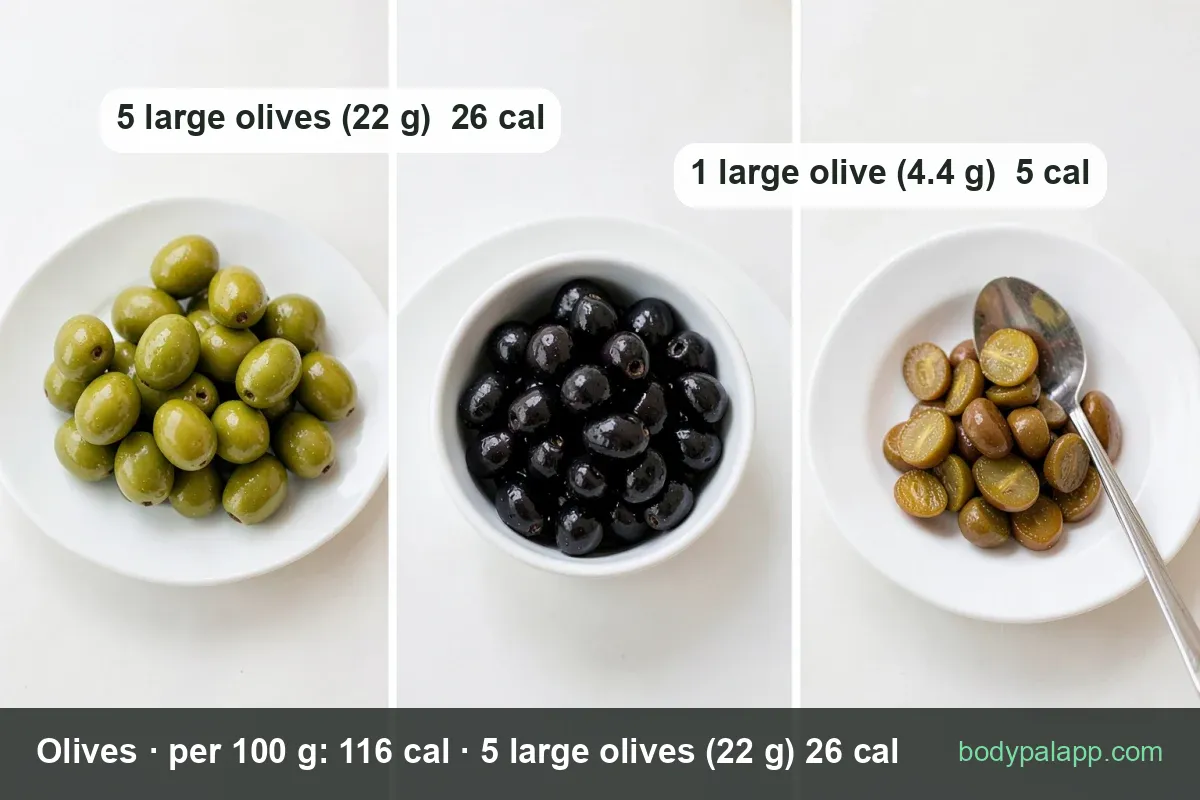
| 1 large olive | 4.4 g | 5 kcal |
| 1 tbsp sliced | 8.4 g | 10 kcal |
| 5 large olives | 22 g | 26 kcal |
| 1 oz | 28.4 g | 33 kcal |
| Per 100 g | 100 g | 116 kcal |
The first three lines are USDA household measures published with the record. The five-olive serving and the ounce are our arithmetic from the 100 g figure, because nobody counts out 100 g of olives in a kitchen.
Notice how flat the top of that table is. Going from one olive to a tablespoon of sliced ones doubles the weight and adds five calories. That is why olives behave differently from most snack foods: the per-gram number is high, but the per-piece number is so small that portion drift barely registers on the calorie side. Ten large olives, 44 g, is about 51 calories, roughly one bite of a sandwich.
Green, black, stuffed and blended
| Version | Per 100 g | Typical piece | Calories |
|---|---|---|---|
| Black (ripe) olives, canned | 116 kcal | 5 large (22 g) | 26 kcal |
| Green olives, pickled | 145 kcal | 1 olive (2.7 g) | 4 kcal |
| Black (ripe), jumbo to super colossal | 81 kcal | 1 super colossal (15 g) | 12 kcal |
| Stuffed green, Manzanilla with pimiento | 130 kcal | 1 oz (28.4 g) | 37 kcal |
| Olive tapenade | 282 kcal | 1 oz (28.4 g) | 80 kcal |
Green olives are the same fruit picked unripe and held in brine. They come out 25% heavier in calories per gram, 145 against 116, and the reason is fat: 15.32 g per 100 g versus 10.9 g. Per olive it hardly matters, since a green olive is small at about 2.7 g, but per cup it does.
The jumbo and super colossal ripe olives are the odd entry: 81 calories per 100 g, the lightest of the eight USDA olive records, because the bigger cultivars hold more water per gram. This is the trap worth knowing. One super colossal olive weighs 15 g and costs 12 calories, while a tablespoon of sliced small olives weighs 8.4 g and costs 10. Nearly double the weight for two calories.
Stuffed green olives come with two USDA numbers, not one. The Foundation measurement of Manzanilla olives stuffed with pimiento gives 130 calories per 100 g; the older FNDDS entry for stuffed olives gives 141. Same product, two lab runs, and the honest answer is that a martini olive is somewhere in that band. An ounce, 28.4 g, is roughly 37 calories on the Foundation figure. Tapenade is a different animal: the olives are ground with added oil, which is why it hits 282 calories per 100 g and 80 for an ounce spread on bread.
Sodium is the row to watch
Five olives at 26 calories is nothing. Five olives at 162 mg of sodium is 7% of the 2,300 mg Daily Value used on the Nutrition Facts label, which is a real dent for a garnish.
Green olives are where it gets loud. At 1,556 mg per 100 g they are more than twice as salty as canned ripe olives, and 100 g clears 68% of the day's sodium on its own. That is about two-thirds of a teaspoon of table salt sitting in a small bowl. Stuffed green olives are saltier still at 1,620 mg per 100 g, so an ounce alongside a drink carries roughly 460 mg, or 20% of a day. The Dietary Guidelines for Americans put the ceiling at 2,300 mg for adults, and most people are already over it before the appetizers arrive.
Practical version: if you are watching sodium, black canned olives are the better pick, and draining and rinsing them helps more than switching brands. If you are only watching calories, the difference between green and black is about six calories for the same 22 g handful and not worth a thought.
How do olives compare?
| Food | Per 100 g | US serving | Calories |
|---|---|---|---|
| Black olives, canned ripe | 116 kcal | 5 large, 22 g | 26 kcal |
| Green olives, pickled | 145 kcal | 1 olive, 2.7 g | 4 kcal |
| Black olives, super colossal | 81 kcal | 1 olive, 15 g | 12 kcal |
| Olive oil | 900 kcal | 1 tablespoon, 14 g | 126 kcal |
Our take: the jar and the bottle are not close relatives at the dinner table. One tablespoon of olive oil costs 126 calories, nearly five times what five whole olives cost, and it disappears into a salad without being seen. If you want the olive flavor and the fat that comes with it, the fruit is the cheaper way to buy it. Between green and black, choose on salt rather than calories: black canned olives at 735 mg per 100 g leave you far more room than green at 1,556 mg. And if you are buying the giant super colossal olives because they look like more food, they are: more water, fewer calories per gram, same salt.
Most popular olives brands in the United States
Ranked by how widely each product appears among foods sold in the United States, from the BodyPal food database of over 3.3 million products. Calories are the figures printed on each Nutrition Facts label, checked against USDA FoodData Central.
| Product | Calories (per 100 g) |
|---|---|
| Gaea Pitted Kalamata Olives | 233 cal |
| Mezzetta Jalapeño Stuffed Olives | 105 cal |
| Jeff's Garden Garlic Stuffed Olives | 158 cal |
| Acorsa Spanish Green Olives Stuffed with Minced Pimiento | 167 cal |
| Peloponnese Ionian Gourmet Green Olives | 167 cal |
| Signature Select Ripe Sliced Olives | 125 cal |
Brand popularity: BodyPal food database. Nutrition: manufacturer labels / USDA FoodData Central.
Olive FAQs
How many calories are in one olive?
One large canned ripe olive weighs 4.4 g and is 5 calories; a small one at 3.2 g is 4. Five large olives come to 26 calories. A green olive is smaller still, about 2.7 g, and lands near 4 calories. Almost all of it is fat.
Are black olives lower in calories than green olives?
Yes, by about 20% per gram: canned ripe black olives are 116 calories per 100 g against 145 for pickled green ones. Green olives are picked unripe and cured in brine, which leaves them with 15.32 g of fat per 100 g versus 10.9 g in the ripe ones.
How much sodium is in canned olives?
735 mg per 100 g of canned ripe olives, which works out to 162 mg in a five-olive serving, or 7% of the 2,300 mg Daily Value. Green olives are far saltier at 1,556 mg per 100 g, and stuffed green olives reach 1,620 mg. The curing brine does it.
Are olives good for weight loss?
At 26 calories for five, olives are a cheap way to make a salad or a grain bowl taste finished. Per gram they are not light, at 116 calories per 100 g, so the portion is what keeps them useful. Ten large olives, 44 g, is still only about 51 calories.
How many olives are in one serving?
Five large olives, 22 g, is the serving used on this page: 26 calories and 162 mg of sodium. USDA publishes per-olive weights of 3.2 g for small and 4.4 g for large, so a handful of ten runs 44 g and about 51 calories. One tablespoon sliced is 8.4 g.
Do olives have carbs or sugar?
6.04 g of carbohydrate per 100 g, of which 1.6 g is fiber and 0 g is sugar. In a five-olive serving that is 1.3 g of carbohydrate and 0.4 g of fiber. Curing takes out the bitterness without adding any sweetener, so the sugar row stays at zero.
Are stuffed olives higher in calories?
Per 100 g, yes: 130 calories for Manzanilla olives stuffed with pimiento against 116 for plain canned ripe ones. An ounce, 28.4 g, is about 37 calories. The bigger jump is salt, at 1,620 mg of sodium per 100 g, roughly 460 mg an ounce, or 20% of a day.
Do kalamata olives have more calories?
Kalamata is not one of the 8 USDA olive records, so there is no official figure to quote. They are ripe olives cured in brine, which puts them between the two entries that do exist: ripe canned olives at 116 calories per 100 g and pickled green olives at 145.
Similar foods
- Coleslaw — 257 cal per cup
- Masoor Dal — 207 cal per cup cooked
- Cucumber Salad — 191 cal per cup
- Salad With Italian Dressing — 191 cal per cup
- Broccoli Slaw — 229 cal per cup
- Urad Dal — 189 cal per cup cooked
Count it without the math
Point the camera at the plate and BodyPal counts the olives for you, green, black or stuffed.


How long does it take to burn off Olives?
A serving of five large olives (22 g) is 26 kcal. Enter your weight and the amount you ate to see how long it takes you to burn that off:
lb
| Activity | Time to burn 26 kcal |
|---|---|
| Walking, brisk | 5 min |
| Cycling, moderate | 3 min |
| Swimming, moderate | 4 min |
| Jogging | 3 min |
| Weight training, moderate | 6 min |
Times are for a 155 lb adult at a steady pace; change the weight to see yours. The amount is set to the portion in the text (22 g); change it to what you actually ate. BodyPal works this out from your steps automatically.
One food is easy to picture; a whole day is harder. See how many calories you need a day and what a deficit actually looks like.