
How many calories are in urad dal?
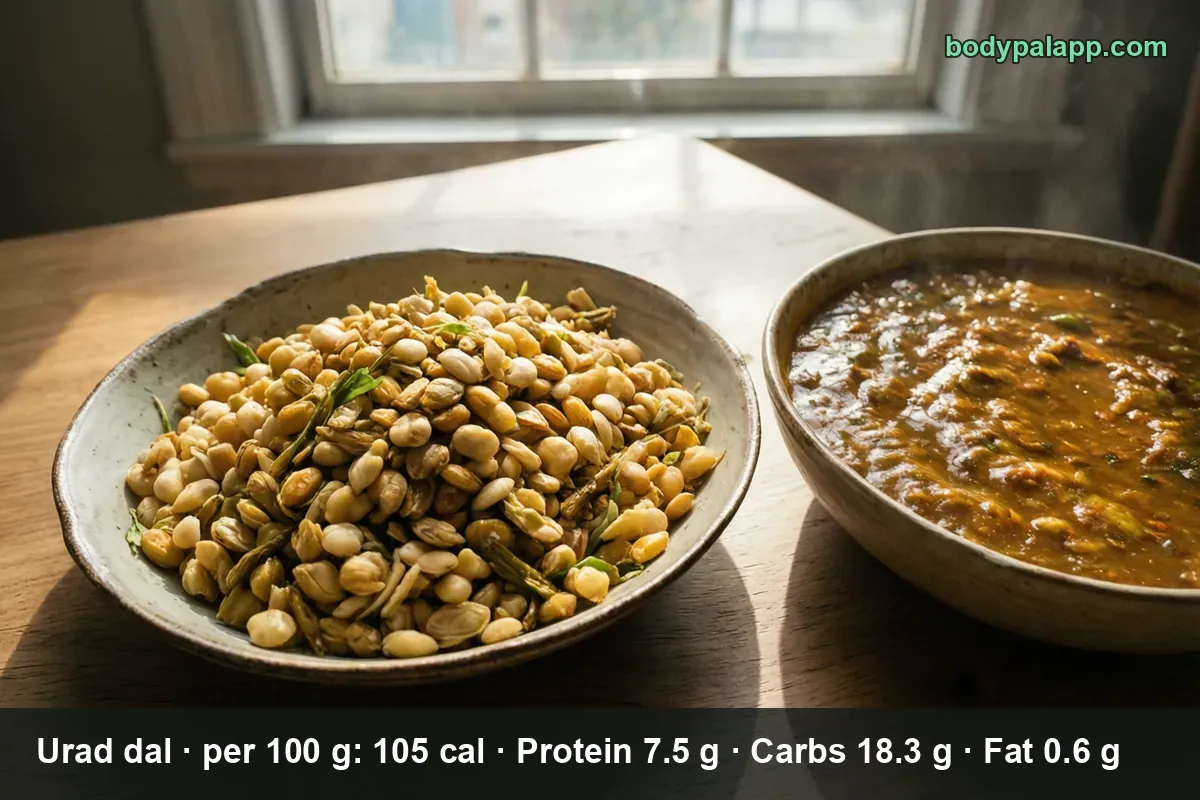
A 1-cup serving of cooked urad dal weighs 180 g and carries 189 calories. Per 100 g the boiled dal runs 105 calories, which is why a bowl of it is one of the cheaper ways to put 13.6 g of protein on the table. Dry urad is a different animal entirely.
On this page
- Urad dal quick facts
- US servings, from an ounce to a full cup
- Dry, cooked, salted and canned
- Fiber is the bigger number, not protein
- How does urad dal compare?
- Most popular urad dal brands
- Urad dal FAQs
Urad dal quick facts
Urad dal is Vigna mungo, and USDA files it under a name almost nobody types into a search box: SR Legacy 172427, "Mungo beans, mature seeds, cooked, boiled, without salt". That is the record used for every headline number here. The reasoning is simple — the person asking is holding a bowl of cooked dal, not a bag of dry beans, so the cooked line is the honest default.
There are only three USDA standard records for this bean: raw, boiled without salt, and boiled with salt. Everything else in the database is a brand label. The plain boiled record wins because it separates the bean from whatever a cook adds to it, and because the salted version is nutritionally identical except for one row.
| Nutrient | Per 100 g | Per 1 cup (180 g) | % Daily Value |
|---|---|---|---|
| Calories | 105 | 189 | — |
| Total fat | 0.55 g | 1.0 g | 1% |
| Saturated fat | 0.04 g | 0.1 g | 0% |
| Carbohydrate | 18.34 g | 33.0 g | 12% |
| Dietary fiber | 6.4 g | 11.5 g | 41% |
| Total sugars | 2.01 g | 3.6 g | — |
| Protein | 7.54 g | 13.6 g | 27% |
| Sodium | 7 mg | 13 mg | 1% |
% Daily Value is based on a 2,000-calorie diet.
Verified nutrition data
Numbers on this page come from USDA FoodData Central, the U.S. Department of Agriculture’s food composition database, and from manufacturer labels where a branded product is named. Last verified September 2026. How we verify our data →
There is no added sugars row above because USDA does not publish added sugars for this SR Legacy record, and boiled dal with nothing stirred into it has none to declare. Cholesterol is zero, as it is in every bean. Potassium is worth a mention: 231 mg per 100 g, or 416 mg in a cup, which is 9% of the Daily Value the FDA sets for the label.
US servings, from an ounce to a full cup
| Serving | Weight | Calories |
|---|---|---|
| 1 oz cooked | 28 g | 30 kcal |
| 1 oz dry, weighed after cooking | 69 g | 72 kcal |
| 1/2 cup cooked | 90 g | 95 kcal |
| 1 cup cooked | 180 g | 189 kcal |
| Per 100 g | 100 g | 105 kcal |
The 1-cup, 180 g line is the USDA household measure for this record, so it is the one to trust. The half cup and the 1 oz cooked line are our own arithmetic from the USDA 100 g figure, not USDA servings.
The third row is the one that catches people. One ounce of dry urad — a rounded tablespoon and a half — turns into roughly 69 g of cooked dal, which is 72 calories. Weigh the beans dry and multiply by the cooked number and you will underestimate your bowl by a factor of two and a half. Weigh what is on the plate, or weigh dry and use the dry figure.
A restaurant ladle of dal is usually closer to a cup and a half than a cup, and it is rarely cooked without fat. The USDA record is water and beans. Ghee, oil or cream go on top of 189, not inside it: a tablespoon of ghee is another 120 or so, and that single spoon costs more calories than half the bowl underneath it.
Dry, cooked, salted and canned
| Version | Per 100 g | Typical serving | Calories |
|---|---|---|---|
| Cooked, no salt | 105 kcal | 1 cup (180 g) | 189 kcal |
| Dry, raw | 341 kcal | 1 cup (207 g) | 706 kcal |
| Boiled with salt | 105 kcal | 1 cup (180 g) | 189 kcal |
| Canned black gram curry, ready to heat | 112 kcal | 1/2 cup (125 g) | 140 kcal |
| Sabut urad, whole black gram, dry | 371 kcal | 1/4 cup (35 g) | 130 kcal |
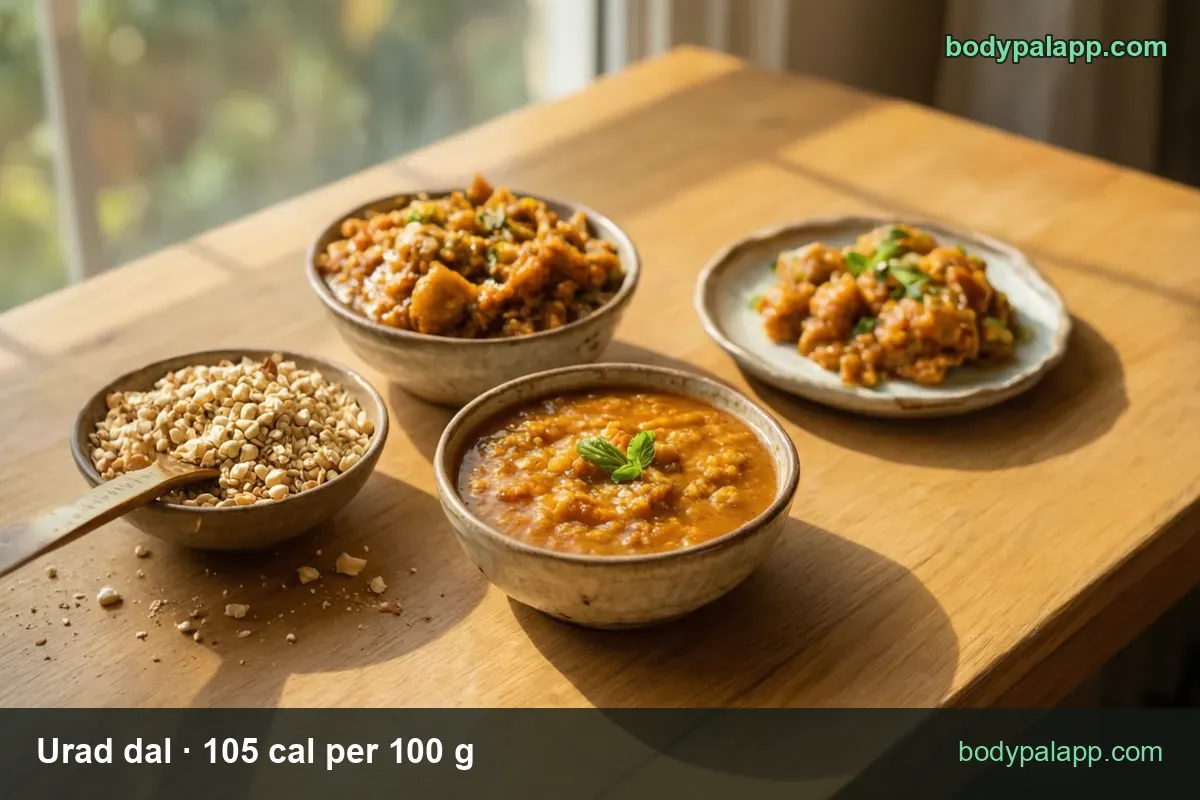
Dry versus cooked is the whole story. Raw urad is 341 calories per 100 g; boiled, it is 105. A cup of dry beans is 706 calories and a cup of the same beans after cooking is 189, because the bean drinks roughly three times its weight in water. Nothing was lost and nothing was added — the calories simply spread out.
Salt is the second surprise. Boiling in salted water leaves the calories at exactly 105 per 100 g and moves sodium from 7 mg to 243 mg. On a cup that is 13 mg against 437 mg, or a little under a fifth of a teaspoon of table salt. If you are watching sodium rather than calories, that is the only decision on this page that matters.
Packaged urad on US shelves splits along the same line. Dry bags sit where you would expect — a national brand of split urad lists 343 calories per 100 g and 120 for a 1/4-cup dry scoop, and whole black gram runs 371 per 100 g. A canned black gram curry, already cooked and already buttered, lands at 112 per 100 g, barely above plain boiled dal, because the water in the sauce dilutes the fat that was added to it.
Fiber is the bigger number, not protein
Urad dal gets sold as a protein food, and 13.6 g in a cup is respectable — 27% of the Daily Value, in the same range as two eggs. But fiber is the row that actually stands out. A cup delivers 11.5 g, which is 41% of the 28 g Daily Value, and it does it inside 189 calories. Almost no whole food gets close to that ratio.
For context, MyPlate counts beans, peas and lentils in both the protein group and the vegetable group precisely because of this double duty, and the Dietary Guidelines name dietary fiber as a nutrient most Americans fall short on. One bowl of dal covers well over a third of the day's fiber target.
Fat is negligible: 1.0 g in a cup, 0.1 g of it saturated, so 0% of the saturated fat Daily Value. Every gram of fat in a plate of dal makhani or a bowl of restaurant dal tadka comes from the pan, not the bean. That is useful, because it means the number you need to estimate is the ghee, not the dal.
How does urad dal compare?
| Bean, cooked | Per 100 g | US serving | Protein / 100 g | Calories |
|---|---|---|---|---|
| Urad dal (black gram) | 105 kcal | 1 cup (180 g) | 7.54 g | 189 kcal |
| Mung beans | 105 kcal | 1 oz (28 g) | 7.02 g | 30 kcal |
| Fava beans | 110 kcal | 1 oz (28 g) | 7.6 g | 31 kcal |
| Canned baked beans, no salt added | 105 kcal | 1 oz (28 g) | 4.8 g | 30 kcal |
Our take: cooked beans are astonishingly consistent, and urad dal has no calorie advantage over its neighbors — it ties mung beans and no-salt baked beans at 105 per 100 g, and fava beans are only 110. Where it separates itself is protein per calorie: 7.54 g against 4.8 g for baked beans at the identical calorie count, with fava beans a hair higher per 100 g at 7.6 g, though on 110 calories rather than 105. So if the goal is fullness for the fewest calories, urad dal and fava are the picks; if you are choosing between urad and canned baked beans, urad gives you more than half again the protein for free. The real calorie decision is never the bean, it is the fat and the sugar the recipe wraps around it.
Most popular urad dal brands in the United States
Ranked by how widely each product appears among foods sold in the United States, from the BodyPal food database of over 3.3 million products. Calories are the figures printed on each Nutrition Facts label, checked against USDA FoodData Central.
| Product | Calories (per 100 g) |
|---|---|
| Kitchens of India Dal Bukhara | 112 cal |
| Deep Urad Dal | 343 cal |
| Diya Urad Dal | 350 cal |
| Desi Delights Black Gram Split | 347 cal |
| Khazana Organic Urad Dal | 305 cal |
| Indian As Apple Pie Whole Black Gram | 371 cal |
Brand popularity: BodyPal food database. Nutrition: manufacturer labels / USDA FoodData Central.
Urad dal FAQs
How many calories are in 1 cup of urad dal?
189 calories in one cup of cooked urad dal, which weighs 180 g, at 105 calories per 100 g. That cup also carries 13.6 g of protein, 11.5 g of fiber and 33.0 g of carbohydrate. The figure is for dal boiled in plain water, with no ghee, oil or cream added.
How much protein is in urad dal?
13.6 g of protein in a 1-cup cooked serving, or 7.54 g per 100 g, which is 27% of the Daily Value. Dry urad concentrates it: 25.21 g per 100 g before cooking, because the bean has not taken on water yet. Cooked and dry protein figures are not interchangeable.
How many calories is urad dal raw versus cooked?
341 calories per 100 g raw against 105 cooked, a three-fold gap. A cup of dry urad is 706 calories; a cup of the same beans after boiling is 189. Nothing is lost in the pot — the beans absorb roughly three times their weight in water, so the calories spread across more grams.
Is urad dal good for weight loss?
At 189 calories a cup with 11.5 g of fiber and 13.6 g of protein, urad dal is one of the more filling things you can put in that calorie budget. What usually undoes it is the cooking fat: a single tablespoon of ghee adds more calories than half the bowl beneath it.
Is urad dal the same as black gram?
Yes — urad dal, black gram and mungo beans are three names for Vigna mungo, and USDA lists it as "Mungo beans" under record 172427. Whole black gram, sold as sabut urad, is the same bean with the black skin on; split and skinned urad dal is the pale version.
Does urad dal have a lot of fiber?
11.5 g of fiber in a cooked cup, which is 41% of the 28 g Daily Value, from 6.4 g per 100 g. That is a higher share of the day's target than the protein contributes, and it arrives inside just 189 calories. Dry urad is denser still at 18.3 g per 100 g.
Is urad dal high in carbs?
33.0 g of carbohydrate in a cup, 12% of the Daily Value, from 18.34 g per 100 g. Roughly a third of that is fiber, at 11.5 g. Total sugars are 3.6 g per cup and none of it is added sugar, since USDA does not report added sugars for this plain boiled record.
How many calories are in 100 g of urad dal?
105 calories per 100 g cooked, with 7.54 g protein, 18.34 g carbohydrate, 6.4 g fiber and 0.55 g fat. Dry urad is 341 calories per 100 g. Always check which one a label or app means, because 100 g of dry beans becomes roughly 240 g of cooked dal.
Similar foods
- Boiled Corn On The Cob — 99 cal per medium ear
- Grilled Corn On The Cob — 99 cal per medium ear
- Ear of Corn — 99 cal per medium ear
- Maize (sweet Corn) — 143 cal per cup cut
- Masoor Dal — 207 cal per cup cooked
- Corn On The Cob — 59 cal per ear
Count it without the math
Point the camera at the bowl and BodyPal counts the dal for you, ghee and all.


How long does it take to burn off urad dal?
A 1-cup (180 g) cooked serving is 189 kcal. Enter your weight and the amount you ate to see how long it takes you to burn that off:
lb
| Activity | Time to burn 189 kcal |
|---|---|
| Walking, brisk | 38 min |
| Cycling, moderate | 24 min |
| Swimming, moderate | 27 min |
| Jogging | 22 min |
| Weight training, moderate | 42 min |
Times are for a 155 lb adult at a steady pace; change the weight to see yours. The amount is set to the portion in the text (180 g); change it to what you actually ate. BodyPal works this out from your steps automatically.
This table assumes you know your daily total. If you do not, the daily calorie calculator works it out from five numbers.