
How Many Calories Are in Maize (Sweet Corn)?
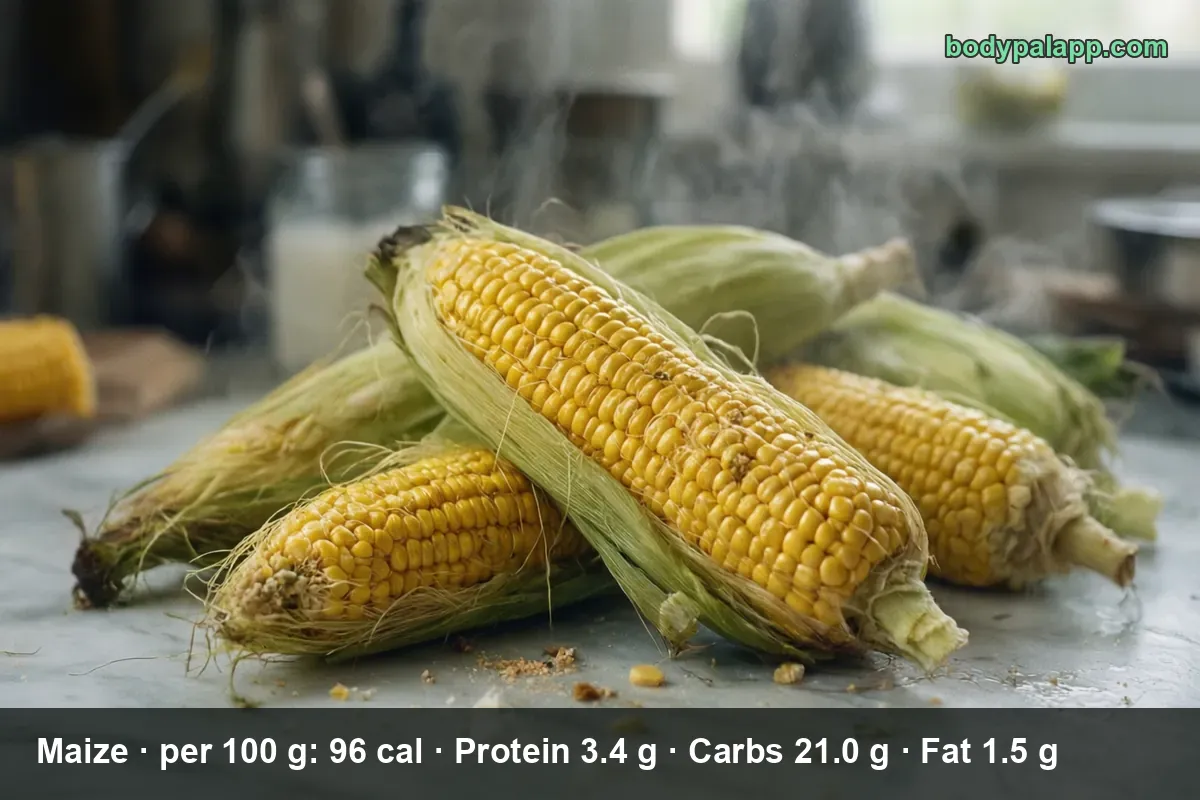
A 1-cup (149 g) serving of boiled maize kernels carries 143 calories, and cooked maize runs 96 calories per 100 g. One medium ear is smaller than most people guess: 103 g of kernels, 99 calories. The starch is real, but so is the fiber, at 3.6 g in that cup.
On this page
- Maize quick facts
- US servings from one ear to a full cup
- From raw cobs to cream style corn
- Fiber and sodium are the rows that move
- How does maize compare?
- Most popular maize brands
- Maize FAQs
Maize quick facts
In American search, "maize" almost always means sweet corn on the plate, not field corn in a silo. The row below is SR Legacy 169999, "Corn, sweet, yellow, cooked, boiled, drained, without salt" — kernels boiled and drained, no salt in the water. That matches what ends up on a dinner plate: a cob dropped in a pot, or kernels cut off and served with a fork. Salted water changes the sodium and nothing else, so the salted record appears further down instead of being blended in here.
The USDA household measure for this record is 1 cup of cut kernels, 149 g. That is the serving used in the second column.
| Nutrient | Per 100 g | Per 1 cup cut (149 g) | % Daily Value |
|---|---|---|---|
| Calories | 96 | 143 | — |
| Total fat | 1.5 g | 2.2 g | 3% |
| Saturated fat | 0.2 g | 0.3 g | 1% |
| Carbohydrate | 20.98 g | 31.3 g | 11% |
| Dietary fiber | 2.4 g | 3.6 g | 13% |
| Total sugars | 4.54 g | 6.8 g | — |
| Protein | 3.41 g | 5.1 g | 10% |
| Sodium | 1 mg | 1 mg | 0% |
% Daily Value is based on a 2,000-calorie diet.
Verified nutrition data
Numbers on this page come from USDA FoodData Central, the U.S. Department of Agriculture’s food composition database, and from manufacturer labels where a branded product is named. Last verified September 2026. How we verify our data →
There is no added sugars row here, because the SR Legacy edition does not publish added sugars for this record. Nothing is added to a boiled cob anyway — the 6.8 g of sugar in a cup is the kernel's own. Cholesterol is 0 mg, as it is in every plant food. Potassium is the quiet win: 218 mg per 100 g, or 325 mg in the cup, which is 7% of the FDA Daily Value of 4,700 mg.
US servings from one ear to a full cup
Corn is one of the few foods where the household unit and the mental unit disagree. People log "one corn" and picture a cob. The USDA cup is bigger than that.
| Serving | Weight | Calories |
|---|---|---|
| 1 oz | 28 g | 27 kcal |
| 1 ear small, 5-1/2 to 6-1/2 inches | 89 g | 85 kcal |
| 1 ear medium, 6-3/4 to 7-1/2 inches | 103 g | 99 kcal |
| 1 ear large, 7-3/4 to 9 inches | 118 g | 113 kcal |
| 1 cup cut kernels | 149 g | 143 kcal |
| Per 100 g | 100 g | 96 kcal |
The three ear weights and the cup are USDA household measures for record 169999; the ear weights count kernels only, not the cob you leave on the plate. The 1 oz line is our own arithmetic from the USDA 100 g figure, not a USDA serving.
Here is the trap worth remembering: a cup of cut kernels weighs 149 g, which is about 1.4 medium ears. Logging "1 cup" when you actually ate one ear overstates you by roughly 44 calories, and logging "1 ear" when you ate a scooped cup understates you by the same amount. Neither is a rounding error over a week.
From raw cobs to cream style corn
| Version | Per 100 g | Typical serving | Calories |
|---|---|---|---|
| Raw sweet corn | 86 kcal | 1 cup, 145 g | 125 kcal |
| Corn on the cob, boiled with salt | 96 kcal | 1 ear medium, 103 g | 99 kcal |
| Canned whole kernel, drained | 67 kcal | 1 cup, 164 g | 110 kcal |
| Canned cream style | 72 kcal | 1 cup, 256 g | 184 kcal |
| Frozen kernels, boiled | 81 kcal | 1 cup, 149 g | 121 kcal |
| Frozen corn on the cob, boiled | 94 kcal | 1 ear medium, 103 g | 97 kcal |
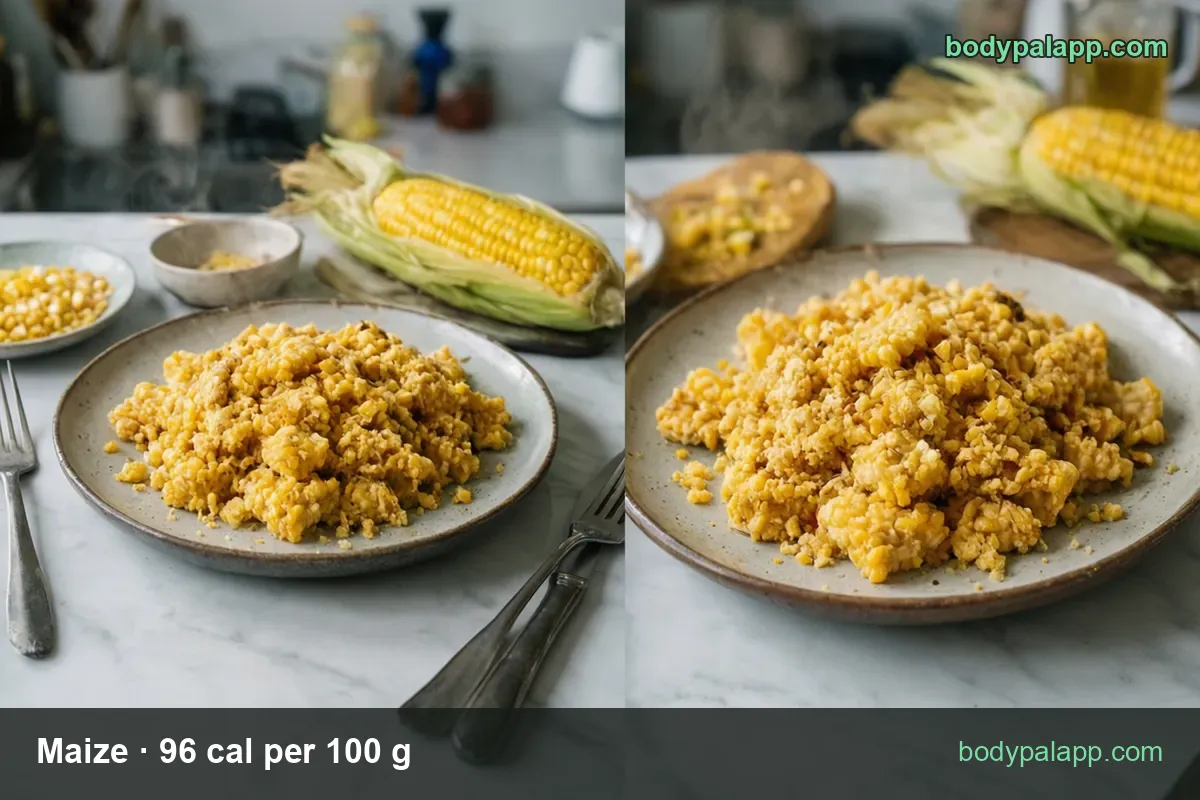
Raw looks lighter per 100 g than boiled — 86 against 96 — and that reads backwards until you remember what boiling does. It drains water out of the kernel, so the same kernel weighs a little less and every gram gets denser. The ear itself did not gain anything. A medium boiled ear is still 99 calories.
Canned corn goes the other way. Drained whole kernel sits at 67 per 100 g because the kernels are packed young and soft and hold more water, but the standard cup is 164 g rather than 149 g, so a cup still lands at 110. Cream style is the outlier: only 72 per 100 g, yet the cup is 256 g, and that pushes it to 184 calories — the biggest number on this page, from the version that looks lightest on the label.
Frozen kernels cut off the cob come in at 81 per 100 g, lighter than fresh boiled but heavier than drained canned. The two frozen serving weights above are our own arithmetic from the USDA 100 g figures, matched to the fresh cup and ear so the comparison is fair, not USDA household measures.
Store labels round in their own direction. Publix lists its yellow kernels at 100 calories for a 0.667-cup (90 g) serving, which works out to 111 per 100 g; a canned import brand like Tazah declares 60 calories for a 1/2-cup (125 g) serving, or 48 per 100 g. Both sit outside the USDA range because label rules allow rounding and because drained weight varies with how long you tip the can.
Fiber and sodium are the rows that move
A cup of boiled maize delivers 3.6 g of fiber, 13% of the 28 g Daily Value, which is more than most people expect from something they think of as starch. It also brings 5.1 g of protein, 10% of the DV — modest, but not nothing for a side dish.
Sodium is where the versions split hardest. Boiled without salt: 1 mg per 100 g. Boiled with salt in the water: 253 mg. Drained canned whole kernel: 205 mg, and cream style 261 mg. If you are watching sodium, the plain boiled cob is effectively free, and rinsing canned kernels under the tap before they hit the plate is the cheapest fix available.
One more classification question that follows people around the grocery store: MyPlate counts corn as a starchy vegetable, not a grain, even though the plant is a grass and the dried kernel becomes cornmeal. On the plate it belongs in the vegetable column; in a mill it becomes something else entirely.
How does maize compare?
| Food | Per 100 g | US serving | Calories |
|---|---|---|---|
| Maize, yellow, boiled | 96 kcal | 1 cup cut, 149 g | 143 kcal |
| White sweet corn, boiled with salt | 97 kcal | 1 cup cut, 149 g | 145 kcal |
| Russet potato, baked with skin | 95 kcal | 3 oz, 85 g | 81 kcal |
| Blackeyed peas, immature, boiled | 97 kcal | 3 oz, 85 g | 82 kcal |
Our take: per gram these four are effectively the same food, spread across a range of only 2 calories, and the baked russet is the single lightest of them at 95. What separates them on a plate is the serving, not the crop. Corn gets scooped by the cup and the others get spooned in smaller piles, so maize shows up as the 143-calorie line while the potato shows up as 81. If you are choosing a starchy side for weight loss, pick the one you will serve in a smaller bowl; if you want the side to hold you longer, corn's 3.6 g of fiber per cup is the argument for it over a plain potato at the same density.
Most popular maize brands in the United States
Ranked by how widely each product appears among foods sold in the United States, from the BodyPal food database of over 3.3 million products. Calories are the figures printed on each Nutrition Facts label, checked against USDA FoodData Central.
| Product | Calories (per 100 g) |
|---|---|
| Publix Sweet Corn Yellow Kernels | 111 cal |
| Tazah Whole Kernel Corn (Maize) | 48 cal |
Brand popularity: BodyPal food database. Nutrition: manufacturer labels / USDA FoodData Central.
Maize FAQs
How many calories are in one ear of corn?
A medium ear gives 99 calories, counting 103 g of kernels and not the cob. A small ear, 89 g, is 85 calories, and a large one at 118 g is 113. All three come from the same USDA record for boiled yellow sweet corn at 96 calories per 100 g.
How many calories are in 1 cup of corn?
One cup of cut boiled kernels weighs 149 g and holds 143 calories, with 31.3 g of carbohydrate, 5.1 g of protein and 3.6 g of fiber. That cup is about 1.4 medium ears, which is why logging a cup after eating one cob overstates the meal by roughly 44 calories.
Is maize the same as corn?
Yes, and the USDA files both under sweet corn at 96 calories per 100 g boiled. Maize is the older botanical name used across much of the world; American shoppers say corn. The sweet corn you eat off the cob is one type, distinct from field corn grown for feed, cornmeal and starch.
Is boiled corn good for weight loss?
A medium ear costs 99 calories and carries 2.4 g of fiber per 100 g, which makes it a reasonable side if you count the ears rather than the scoops. The risk is not the corn but the cup: 149 g of cut kernels is 143 calories before any butter goes on.
How much fiber is in sweet corn?
Boiled sweet corn has 2.4 g of fiber per 100 g, so a 149 g cup gives 3.6 g, or 13% of the 28 g Daily Value. Frozen kernels on the cob run slightly higher at 2.8 g per 100 g, and drained canned corn slightly lower at 2 g.
Does canned corn have fewer calories than fresh?
Per 100 g yes, at 67 calories for drained whole kernel against 96 boiled, because canned kernels hold more water. Per serving the gap closes: the standard canned cup is 164 g and lands at 110 calories. Cream style is 72 per 100 g but 184 in its 256 g cup.
How much sugar is in corn?
Boiled sweet corn has 4.54 g of total sugars per 100 g, or 6.8 g in a 149 g cup. Raw kernels are sweeter at 6.26 g per 100 g, since some sugar converts to starch with heat and storage. None of it is added sugar; it is all the kernel's own.
How much protein is in maize?
Boiled sweet corn has 3.41 g of protein per 100 g, so a 149 g cup provides 5.1 g, which is 10% of the 50 g Daily Value. A medium ear gives about 3.5 g. Useful for a vegetable side, but corn is a carbohydrate food first.
Similar foods
- Boiled Corn On The Cob — 99 cal per medium ear
- Grilled Corn On The Cob — 99 cal per medium ear
- Ear of Corn — 99 cal per medium ear
- Corn On The Cob — 59 cal per ear
- Cobb Salad — 98 cal per cup
- Potato — 161 cal per medium potato
Count it without the math
Point the camera at the plate and BodyPal counts the corn for you, cob or cup.


How long does it take to burn off maize?
A 1-cup (149 g) serving is 143 kcal. Enter your weight and the amount you ate to see how long it takes you to burn that off:
lb
| Activity | Time to burn 143 kcal |
|---|---|
| Walking, brisk | 29 min |
| Cycling, moderate | 18 min |
| Swimming, moderate | 20 min |
| Jogging | 17 min |
| Weight training, moderate | 32 min |
Times are for a 155 lb adult at a steady pace; change the weight to see yours. The amount is set to the portion in the text (149 g); change it to what you actually ate. BodyPal works this out from your steps automatically.
Burning it off is one side of it. The other is knowing your number: work out how many calories you need a day, with macros and a goal date.