
How many calories are in a Cobb salad?
A 1-cup serving of Cobb salad with no dressing is 98 calories, and the salad runs 93 calories per 100 g. That is light for a plate carrying bacon, egg and cheese, because those toppings sit on a base of lettuce and tomato, and because the dressing has not been poured yet.
On this page
- Cobb salad quick facts
- US servings, from one ounce to a three-cup bowl
- Dressing and store bowls change the number
- Protein is the row that surprises people
- How does a Cobb salad compare?
- Most popular cobb salad brands
- Cobb salad FAQs
Cobb salad quick facts
The number above comes from one record: FNDDS 2709832, "Cobb salad, no dressing". It is the only generic USDA entry for the assembled dish rather than for its parts, and it is the version most people are actually holding when they look this up — a bowl of chopped lettuce, tomato, bacon, egg, chicken and blue cheese with the dressing still in the little cup on the side. Its household measure is 1 cup, 105 g.
One thing worth saying out loud: the record is undressed. Every packaged bowl in the store comes with dressing in the tray, and those land higher. They get their own section below.
| Nutrient | Per 100 g | Per 1 cup (105 g) | % Daily Value |
|---|---|---|---|
| Calories | 93 | 98 | — |
| Total fat | 4.33 g | 4.5 g | 6% |
| Saturated fat | 1.05 g | 1.1 g | 6% |
| Carbohydrate | 2.65 g | 2.8 g | 1% |
| Dietary fiber | 1.2 g | 1.3 g | 5% |
| Total sugars | 1.1 g | 1.2 g | — |
| Protein | 11.32 g | 11.9 g | 24% |
| Sodium | 159 mg | 167 mg | 7% |
| Cholesterol | 61 mg | 64 mg | 21% |
| Potassium | 281 mg | 295 mg | 6% |
% Daily Value is based on a 2,000-calorie diet.
Verified nutrition data
Numbers on this page come from USDA FoodData Central, the U.S. Department of Agriculture’s food composition database, and from manufacturer labels where a branded product is named. Last verified September 2026. How we verify our data →
There is no added-sugars row and no trans-fat row here, because this edition of FNDDS does not publish either value for the record — better an absent row than a guessed one. Cholesterol and potassium are published, so they are in the table: 64 mg and 295 mg in a cup, 21% and 6% of the Daily Value.
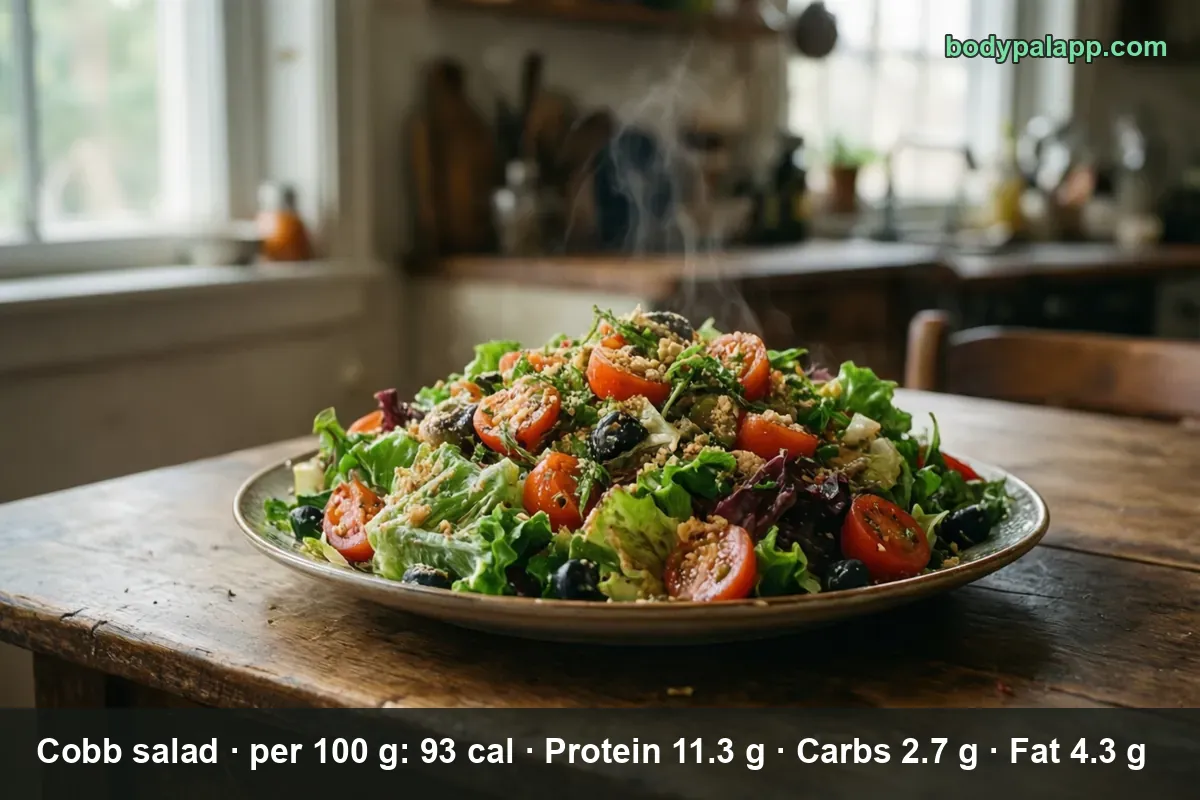
Photo note: the plate in the picture above shows the base — greens, tomato, olives, cheese crumbles — without the egg, bacon and avocado a full Cobb usually carries. The numbers in this table are for the complete assembled salad, not for that lighter plate.
US servings, from one ounce to a three-cup bowl
| Serving | Weight | Calories |
|---|---|---|
| 1 oz | 28.4 g | 26 kcal |
| Per 100 g | 100 g | 93 kcal |
| 1 cup, USDA household measure | 105 g | 98 kcal |
| 1 1/2 cups, side salad at a diner | 157.5 g | 146 kcal |
| 2 cups, lunch portion | 210 g | 195 kcal |
| 3 cups, entree bowl | 315 g | 293 kcal |
Only the 1-cup line is a USDA household measure. Everything from 1 1/2 cups down the list is our own arithmetic from the USDA 100 g figure, not a USDA serving — a cup of this salad weighs 105 g, so we multiplied from there.
That matters more here than it does for most foods, because almost nobody eats a cup of Cobb salad. A cup is a scoop next to a sandwich. The bowl a restaurant sets down as a meal is closer to three cups, and that is 293 calories, 13.6 g of fat and 501 mg of sodium — 22% of the day's sodium, again by our own scaling. About a quarter teaspoon of table salt, before the dressing.
So the honest range for "a Cobb salad" is roughly 98 to 293 calories, and which end you land on has nothing to do with the recipe. It is the size of the bowl.
Dressing and store bowls change the number
| Version | Per 100 g | Typical serving | Calories |
|---|---|---|---|
| Cobb salad, no dressing (USDA base) | 93 kcal | 1 cup (105 g) | 98 kcal |
| Southwest Cobb salad, organic | 83 kcal | 5 1/2 oz (156 g) | 129 kcal |
| Cobb salad with ranch dressing | 120 kcal | 1 cup + 1.5 tbsp dressing (100 g) | 120 kcal |
| Turkey and bacon Cobb salad bowl | 141 kcal | 1 bowl (205 g) | 289 kcal |
| Chicken and bacon Cobb salad | 150 kcal | 1 cup (100 g) | 150 kcal |
| Chicken Cobb salad, entree pack | 148 kcal | 1 salad (305 g) | 451 kcal |
Line up the first and third rows and you get the single most useful fact on this page. The undressed salad is 93 calories per 100 g; the same salad with 1 1/2 tablespoons of ranch worked in is 120 per 100 g. That is 29% more before you have added a single extra topping. People fixate on the bacon. The bacon is already in the 93.
The refrigerated aisle stacks the difference higher again. A chicken-and-bacon Cobb sold by the cup is 150 calories per 100 g, about 60% above the assembled base, and a 305 g grab-and-go chicken Cobb pack is 451 calories — roughly four and a half times the calories of a single 1-cup serving. Store labels also disagree with each other more than you would expect: two Ready Pac turkey-and-bacon Cobb records sit at 107 and 141 calories per 100 g, and a Marketside turkey-and-bacon container is 155 per 100 g, or 319 calories for the 206 g tub. Read the panel on the box you bought rather than assuming your brand matches the last one.
The lightest version in the table is the organic Southwest Cobb at 83 calories per 100 g, and even that becomes 129 calories once you eat the whole 156 g pack.
Protein is the row that surprises people
A cup of Cobb salad carries 11.9 g of protein, 24% of the Daily Value, against 2.8 g of carbohydrate, which is 1% of the Daily Value. Protein outweighs carbohydrate more than four to one. That is not a salad profile; that is closer to what you would expect from a small serving of meat, and it is the reason a Cobb bowl holds off hunger in a way a garden salad does not. Scale it to a three-cup bowl and our arithmetic puts it near 35.7 g of protein for 293 calories.
Two rows push back. Cholesterol is 64 mg a cup, 21% of the Daily Value, from the egg and the bacon, and it climbs to about 192 mg in a three-cup bowl. Sodium behaves the same way — modest at 7% for a cup, 22% for the bowl. Both Daily Values come from the FDA's Daily Value reference for nutrition labels, based on a 2,000-calorie day.
The greens underneath are doing real work too. A three-cup bowl is, by our own estimate, roughly 1 1/2 cups of vegetables against the MyPlate vegetable target of 2 to 3 cups a day for most adults. If you are watching sodium, the undressed version plus oil and vinegar you pour yourself is the better pick over a dressed bowl from the cooler.
How does a Cobb salad compare?
| Dish | Per 100 g | US serving | Calories |
|---|---|---|---|
| Cobb salad, no dressing | 93 kcal | 1 cup (105 g) | 98 kcal |
| Eggplant with cheese and tomato sauce | 90 kcal | 1 oz (28.4 g) | 26 kcal |
| Summer squash casserole with cheese sauce | 92 kcal | 1 oz (28.4 g) | 26 kcal |
| Stuffed tomato with rice and meat | 99 kcal | 1 oz (28.4 g) | 28 kcal |
Our take: all four of these vegetable dishes land between 90 and 99 calories per 100 g, so calories alone will not tell them apart. The macros will. Cobb salad has the most protein of the four at 11.32 g per 100 g — the next closest is the eggplant dish at 6.16 g — and the least carbohydrate at 2.65 g, against 9.86 g in the stuffed tomato. For a lunch you want to still feel at 4 p.m., the Cobb is the pick. For volume on the plate at the same calorie cost, any of them works.
Most popular cobb salad brands in the United States
Ranked by how widely each product appears among foods sold in the United States, from the BodyPal food database of over 3.3 million products. Calories are the figures printed on each Nutrition Facts label, checked against USDA FoodData Central.
| Product | Calories (per 100 g) |
|---|---|
| Ready Pac Bistro Turkey & Bacon Cobb Salad | 107 cal |
| Ready Pac Turkey and Bacon Cobb Salad | 141 cal |
| Marketside Ranch Cobb Salad | 120 cal |
| Kroger Fresh Foods Market Cobb Salad with Chicken & Bacon | 150 cal |
| Marketside Cobb Salad with Turkey & Bacon | 155 cal |
| Taylor Farms Cobb Salad with Chicken | 148 cal |
Brand popularity: BodyPal food database. Nutrition: manufacturer labels / USDA FoodData Central.
Cobb salad FAQs
How many calories are in a Cobb salad?
98 calories for a 1-cup serving of undressed Cobb salad, which USDA lists at 93 calories per 100 g. A three-cup entree bowl, closer to what a restaurant hands you, works out to 293 calories by our own arithmetic from that same 100 g figure. Dressing is extra.
How many calories in a Cobb salad without dressing?
93 calories per 100 g is the undressed number, so a 1-cup serving is 98 calories and two cups are 195. The USDA record for Cobb salad is built without dressing, which is why it reads so light next to a packaged store bowl at 120 to 155 calories per 100 g.
How much protein is in a Cobb salad?
11.9 g of protein in a 1-cup serving, 24% of the Daily Value, from 11.32 g per 100 g. That is more than four times the carbohydrate in the same cup, and it comes from the chicken, egg, bacon and blue cheese rather than from the lettuce underneath them.
Is Cobb salad good for weight loss?
98 calories a cup with 11.9 g of protein makes undressed Cobb salad an efficient lunch base, and a three-cup bowl is 293 calories with roughly 35.7 g of protein by our arithmetic. The dressing decides the rest: a ranch-dressed version is 120 calories per 100 g instead of 93.
How many calories in a chicken Cobb salad?
150 calories per 100 g for a chicken-and-bacon Cobb salad sold by the cup, about 60% above the plain assembled salad at 93 per 100 g. A full 305 g chicken Cobb entree pack from the refrigerated aisle comes to 451 calories, since you are eating three times as much food.
How many carbs are in a Cobb salad?
2.8 g of carbohydrate in a 1-cup serving, only 1% of the Daily Value, with 1.3 g of it fiber and 1.2 g sugars. That is the lowest carbohydrate figure among the four dishes compared on this page. Carbs arrive later, with dressing, croutons or bread on the side.
How much sodium is in a Cobb salad?
167 mg of sodium in a 1-cup serving, 7% of the Daily Value, from 159 mg per 100 g. Scaled to a three-cup bowl that is 501 mg, 22% of the day, and still before dressing. In kitchen terms, roughly a quarter teaspoon of table salt.
What is in a classic Cobb salad?
Seven ingredients show up in nearly every version: romaine, tomato, bacon, chicken breast, hard-boiled egg, avocado and blue cheese, usually with vinaigrette served on the side. USDA's assembled record for that mix, undressed, is 93 calories per 100 g with 11.32 g of protein and 2.65 g of carbohydrate.
Similar foods
- Potato — 161 cal per medium potato
- Yellow Potato — 161 cal per medium potato
- Corn On The Cob — 59 cal per ear
- Gold Potato — 159 cal per medium potato
- Golden Potato — 159 cal per medium potato
- Ear of Corn — 99 cal per medium ear
Count it without the math
Point the camera at the bowl and BodyPal counts the Cobb salad for you, dressing and all.


How long does it take to burn off Cobb salad?
A 1-cup (105 g) serving is 98 kcal. Enter your weight and the amount you ate to see how long it takes you to burn that off:
lb
| Activity | Time to burn 98 kcal |
|---|---|
| Walking, brisk | 20 min |
| Cycling, moderate | 12 min |
| Swimming, moderate | 14 min |
| Jogging | 12 min |
| Weight training, moderate | 22 min |
Times are for a 155 lb adult at a steady pace; change the weight to see yours. The amount is set to the portion in the text (105 g); change it to what you actually ate. BodyPal works this out from your steps automatically.
This table assumes you know your daily total. If you do not, the daily calorie calculator works it out from five numbers.