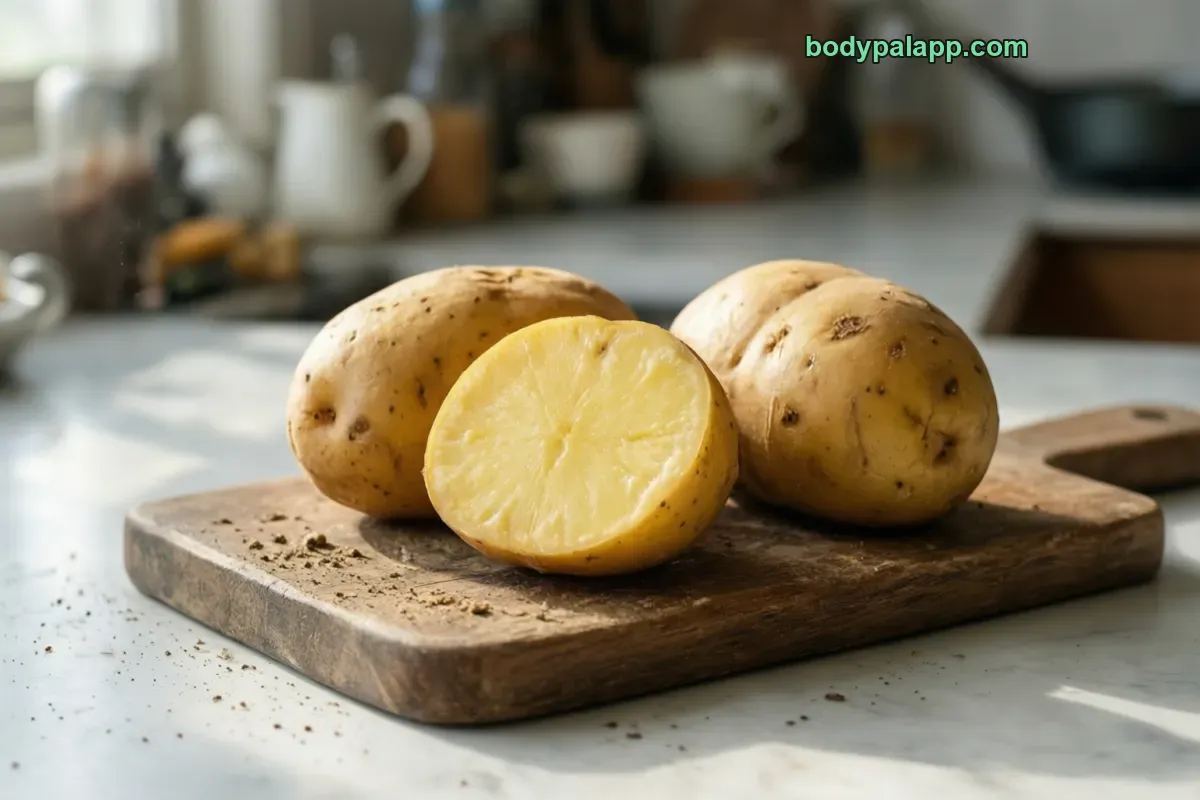
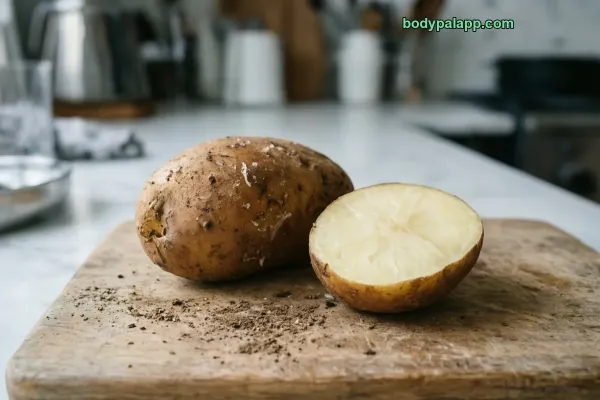
Gold potato calories come to 159 for one medium potato (173 g) baked with skin, or 92 per 100 g. Nearly all of that is carbohydrate: 90% of the calories come from carbs and almost none from fat, so the size of the potato and what you put on top decide your total.
159kcal
1 medium potato · 173 g, gold variety, baked with skin
9%protein
3.6 gProtein
36 gCarbs
0.3 gFat
How to burn off 159 kcal
—Walking, brisk
—Jogging
—Cycling, moderate
—Swimming
Skip the math. BodyPal counts these calories from your steps and workouts automatically.
Nutrition facts
Gold variety, baked with skin · per 173 g
Calories
159 kcal
Protein
3.6 g
Carbohydrate
36 g
Fat
0.3 g
Saturated fat
0.1 g
Cholesterol
0 mg
Sodium
12 mg
Potassium
941 mg
Iron
1.1 mg
Source: USDA FoodData Central
🛡️
Verified nutrition data
Numbers on this page come from USDA FoodData Central, the U.S. Department of Agriculture’s food composition database, and from manufacturer labels where a branded product is named. Last verified September 2026. How we verify our data →
Gold potato: calories, protein and sodium by serving
Percent of daily value uses the FDA reference of 2,000 kcal a day.
Serving
kcal
Protein
Carbs
Fat
Sodium
% DV kcal
1 medium (173 g)
159
3.6 g
36.5 g
0.3 g
12 mg
8%
1 small (138 g)
127
2.9 g
29.1 g
0.2 g
10 mg
6%
1 large (299 g)
275
6.3 g
63 g
0.4 g
21 mg
14%
100 g
92
2.1 g
21.1 g
0.2 g
7 mg
5%
3 × 1 medium (173 g)
477
10.9 g
36 mg
5 × 1 medium (173 g)
796
18.2 g
61 mg
A large gold potato runs 275 calories
Size moves the total more than anything else. A small gold potato (138 g) has 127 calories, a medium one (173 g) has 159, and a large one (299 g) climbs to 275. That large potato is 14% of the daily calorie value on its own, against 6% for the small. Same food, more than double the count.
Multiples add up fast when potatoes are a side for the whole table. Two medium potatoes (346 g) come to 318 calories, three (519 g) reach 477, and five (865 g) total 796. Roasted halves on a sheet pan disappear quickly, so count the pieces before you serve. Protein barely keeps pace: three medium potatoes still deliver only 10.9 g.
Grocery potatoes are rarely labeled by size, and a medium from one bag can be a large from another. If you track closely, weigh one potato on a kitchen scale once. After that, the figure of 92 calories per 100 g lets you size up any gold potato by eye and stay close to the real number.
Carbs supply 90% of the calories
A gold potato is a carbohydrate food with very little else attached. Per 100 g it has 21.1 g of carbs, 2.1 g of protein and just 0.2 g of fat. In calorie terms that splits into 90% carbs, 9% protein and 1% fat.
Most of those carbs are starch, not sugar. Sugars are only 1.5 g per 100 g, and fiber matches protein at 2.1 g. A medium potato gives 36.5 g of carbs, 3.6 g of fiber and 2.6 g of sugars, so it behaves like a plain starch on the plate rather than a sweet one.
Protein is the weak spot. A medium potato covers 7% of the daily value for protein with 3.6 g, and even a large one reaches only 6.3 g. Fat is so low, 0.3 g in a medium, that nearly any fat on your plate will come from toppings or cooking oil rather than the potato.
Sodium is near zero until you add salt
The potato itself is almost sodium-free. There are 7 mg per 100 g and 12 mg in a medium potato, which is 1% of the daily value. Even the large potato carries just 21 mg. Saturated fat and cholesterol both read 0.
Potassium is the standout row instead, at 544 mg per 100 g. That is the number that makes a plain baked potato more than empty starch, and it comes with no added work: no peeling, no special prep, just the potato baked with its skin.
So the row to watch is not on the potato. It is on whatever goes on top. Salt, butter, cheese, bacon bits and sour cream bring the sodium and saturated fat the potato lacks. If you watch sodium, season with herbs, black pepper or a squeeze of lemon, and log toppings as separate items. BodyPal can log the potato and its toppings from a photo.
Treat it as the starch and pair it with protein
These numbers come from the USDA row for baked white potato, flesh and skin, the closest match for a gold potato baked whole. Peeling, mashing with butter or frying moves you to a different set of numbers, so log the preparation you actually ate.
Because a medium potato brings 159 calories but only 3.6 g of protein, it works best as the starch on a plate rather than the whole meal. Pair it with chicken, fish, eggs or beans, or spoon Greek yogurt on top instead of sour cream, and add a green vegetable for volume. That turns a side into a balanced plate without much effort.
Packaged options vary. Top Brass Organic Gold Potato sells plain potatoes, while mixes such as Hy-Vee Roasted Gold Potato Blend or L&M Family Farms Baby Red & Gold Potato Medley may come seasoned, oiled or mixed with other varieties. Check that label before assuming these plain baked values apply.
How does gold potato compare?
Here is how a baked gold potato stacks up against red and yellow potatoes, per 100 g and per medium potato.
Verdict: Red potato is the lightest pick at 87 calories per 100 g and 151 per medium, so choose it if every calorie counts. Gold and yellow are practically twins at 92 and 93 per 100 g, so pick between them on taste and texture.
Most popular gold potato brands in the United States
Ranked by popularity in the BodyPal database
# Productkcal / 100 g
1Top Brass Organic Gold Potato5.3 oz · 148 g74 kcal
2Hy-Vee Roasted Gold Potato Blend3/4 cup · 81 g74 kcal
3L&M Family Farms Baby Red & Gold Potato Medley5.3 oz · 148 g74 kcal
Fresh potatoes are labeled by raw weight at 74 calories per 100 g, so they read lower than the baked numbers above. Source: manufacturer labels / USDA FoodData Central.
Gold potato FAQs
How many calories are in one gold potato?
A medium gold potato (173 g) baked with the skin is about 159 calories. A small one is 127 calories and a large one 275.
Are gold potatoes good for weight loss?
A medium gold potato is 159 calories with 0.3 g of fat and 3.6 g of fiber. Per 100 g that is 92 calories, close to the 87 of a red potato baked in its skin.
Gold potato vs red potato: which has fewer calories?
Red potatoes are 87 calories per 100 g baked with the skin and gold potatoes 92, a difference of about 8 calories on a 173 g potato.
How many carbs are in a gold potato?
A medium gold potato has 36.5 g of carbs, including 3.6 g of fiber and 2.6 g of sugars, plus 3.6 g of protein.
How many calories are in 100 g of gold potato?
There are 92 calories in 100 g of baked gold potato with skin. That weight also holds 21.1 g of carbs, 2.1 g of protein, 0.2 g of fat and 2.1 g of fiber.
What are the macros of a gold potato?
A medium gold potato (173 g) has 36.5 g of carbs, 3.6 g of protein and 0.3 g of fat. By calories that works out to 90% carbs, 9% protein and 1% fat.
How many calories are in 3 gold potatoes?
Three medium gold potatoes (519 g) have 477 calories. They also provide 10.9 g of protein and 36 mg of sodium, so almost every calorie still comes from carbohydrate.
How many calories are in a small or large gold potato?
A small gold potato (138 g) has 127 calories and a large one (299 g) has 275. The large potato is 14% of the daily calorie value, more than double the small one's 6%.
What nutrients does a gold potato have besides calories?
Per 100 g, a baked gold potato has 544 mg of potassium, 2.1 g of fiber, 1.5 g of sugars and only 7 mg of sodium. Saturated fat and cholesterol are both 0.