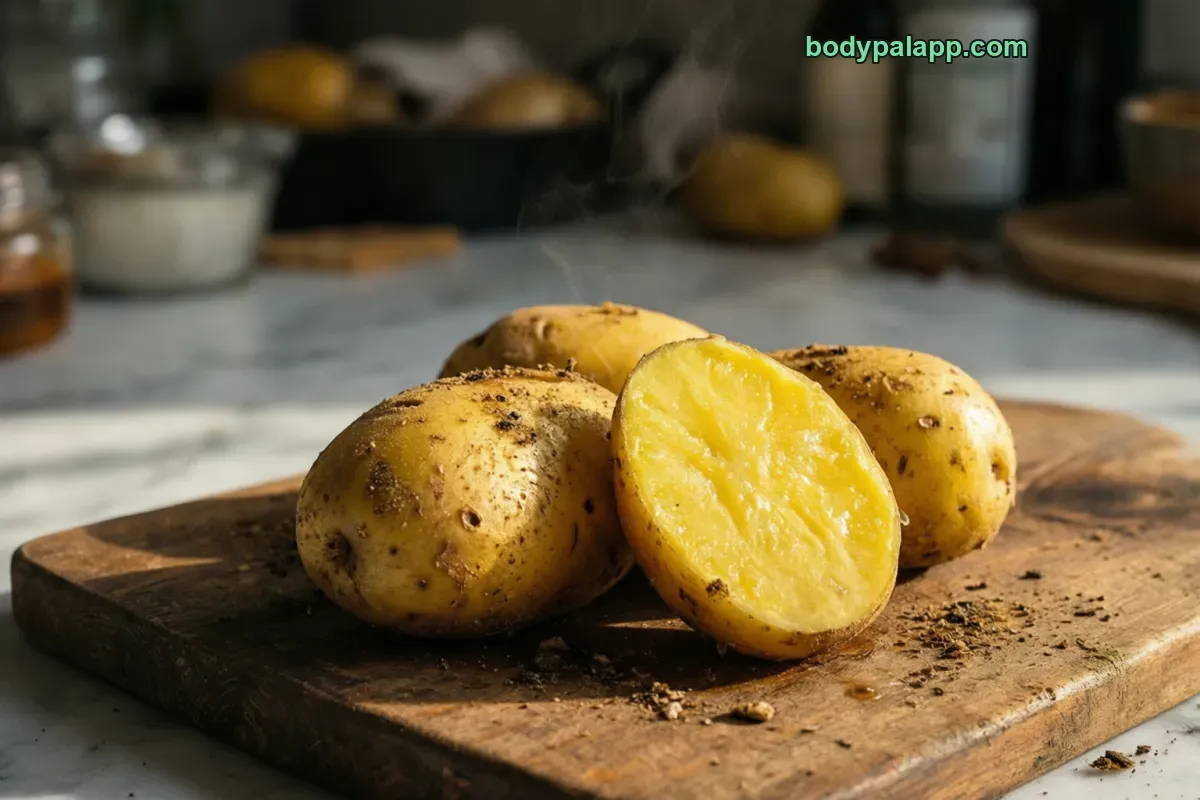
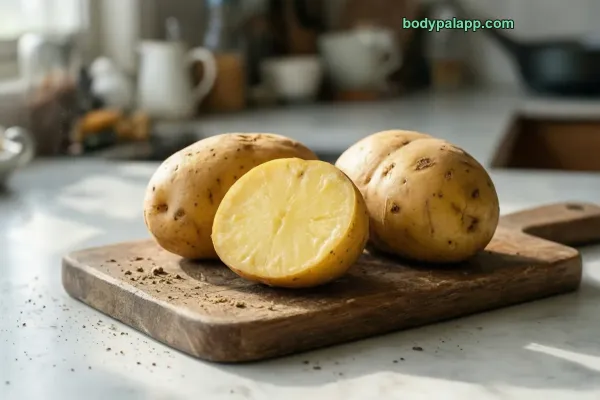
Yellow potato calories come to 161 for one medium potato (173 g) baked with the skin, and 93 per 100 g. Almost all of that energy is carbohydrate, 88% of it, while fat barely registers at 0.2 g. Size is the real variable: a small potato runs 128 calories and a large one 278.
161kcal
1 medium potato · 173 g, yellow variety, baked with skin
10%protein
4.3 gProtein
37 gCarbs
0.2 gFat
How to burn off 161 kcal
—Walking, brisk
—Jogging
—Cycling, moderate
—Swimming
Skip the math. BodyPal counts these calories from your steps and workouts automatically.
Nutrition facts
Yellow variety, baked with skin · per 173 g
Calories
161 kcal
Protein
4.3 g
Carbohydrate
37 g
Fat
0.2 g
Saturated fat
0.1 g
Cholesterol
0 mg
Sodium
17 mg
Potassium
926 mg
Iron
1.9 mg
Source: USDA FoodData Central
🛡️
Verified nutrition data
Numbers on this page come from USDA FoodData Central, the U.S. Department of Agriculture’s food composition database, and from manufacturer labels where a branded product is named. Last verified September 2026. How we verify our data →
Yellow potato: calories, protein and sodium by serving
Percent of daily value uses the FDA reference of 2,000 kcal a day.
Serving
kcal
Protein
Carbs
Fat
Sodium
% DV kcal
1 medium (173 g)
161
4.3 g
36.6 g
0.2 g
17 mg
8%
1 small (138 g)
128
3.5 g
29.2 g
0.2 g
14 mg
6%
1 large (299 g)
278
7.5 g
63.2 g
0.4 g
30 mg
14%
100 g
93
2.5 g
21.2 g
0.1 g
10 mg
5%
3 × 1 medium (173 g)
483
13 g
52 mg
5 × 1 medium (173 g)
804
21.6 g
87 mg
Potato size swings the total from 128 to 278 calories
Baked with the skin on, a medium yellow potato of 173 g lands at 161 calories, or 8% of the daily value for calories. A small one at 138 g drops to 128 calories. A large one at 299 g climbs to 278, more than double the small, so the word on the bag tells you less than the scale does.
Stores do not sort potatoes by weight, and a medium in one bag can look large in the next. If you track closely, weigh it after baking. Every 100 g of baked yellow potato is 93 calories, with 2.5 g of protein and 21.2 g of carbs, which makes any odd size easy to log.
Multiples add up quickly in a family-style dish. Two medium potatoes come to 322 calories, three reach 483, and five, roughly a sheet pan of roasted wedges for a group, total 804 calories across 865 g. Sodium stays tiny even then, at 87 mg for all five. The potato is rarely the part of the dish that pushes the total out of range.
Carbs supply 88% of every calorie
The calorie split is lopsided: 88% carbohydrate, 10% protein and 1% fat. Per 100 g that is 21.2 g of carbs, 2.5 g of protein and only 0.1 g of fat. Saturated fat and cholesterol both sit at 0.
That makes a yellow potato a starchy side, not a protein source. A medium gives 4.3 g of protein, which is 9% of the daily value, and a large gives 7.5 g, or 15%. Those are modest shares. The protein on the plate has to come from somewhere else.
Sugar is low for something this starchy. There are 1.2 g of sugars per 100 g and 2 g in a medium potato. Of the 36.6 g of carbs in that medium potato, only 2 g are sugars and 3.8 g are fiber, so most of the carbohydrate is neither. If you count carbs rather than calories, the medium potato's 36.6 g is the figure to log, and a small one brings it down to 29.2 g.
Fiber and potassium are the rows worth reading
These figures are for flesh and skin eaten together, and the fiber row reflects a whole potato. A medium brings 3.8 g of fiber against a daily value of 28 g. A small brings 3 g, a large 6.6 g, and every 100 g gives 2.2 g. For a side dish with almost no fat, that is a respectable fiber line.
Potassium is the standout number on the label: 535 mg per 100 g, against a daily value of 4700 mg. Few foods at 93 calories per 100 g post a potassium figure that large, which is a good reason not to dismiss the potato as empty starch.
Sodium is the row you can mostly ignore. The USDA entry is baked with salt, yet it lists just 10 mg per 100 g and 17 mg in a medium potato, 1% of the daily value. Even a large one stays at 30 mg. If you watch sodium, the number to track is whatever you add at the table or in the seasoning blend, not the potato itself.
Toppings decide what a baked potato ends up costing
At 161 calories with almost no fat, a plain medium yellow potato is one of the leaner starches you can put on a dinner plate. The total changes with what goes on top. Butter, sour cream, cheese and bacon each add fat the potato itself lacks, and none of those calories are in the 161.
If you want the potato to satisfy without heavy add-ons, lean on its texture. Yellow varieties are creamy and taste buttery on their own, so plain yogurt, chives, salsa, or lemon with black pepper often does the job. Roasting with a light coat of oil adds calories too, so count the oil separately.
Pair it with a protein, since the potato brings only 4.3 g, and with a green vegetable for volume. Packaged products such as Earthbound Farm Roasted Organic Yellow Potato Wedges With Rosemary & Garlic or Goya Yellow Potato may be prepared differently, so read their labels rather than borrowing these numbers. BodyPal can log a plated potato from a photo.
How does yellow potato compare?
Here is how a baked yellow potato stacks up against gold and red potatoes, per 100 g and per usual medium serving.
Verdict: Yellow and gold are effectively a tie, with gold at 92 calories per 100 g and 159 per medium, so choose them on taste and texture. For the fewest calories pick red at 151 per medium; for a little more protein, yellow beats gold's 2.1 g per 100 g.
Most popular yellow potato brands in the United States
Ranked by popularity in the BodyPal database
# Productkcal / 100 g
1Earthbound Farm Roasted Organic Yellow Potato Wedges With Rosemary & Garlic2/3 cup · 110 g100 kcal
2Goya Yellow Potato7 pieces · 85 g65 kcal
Packaged versions are not plain baked potato: canned potatoes are packed in water and read lower, while roasted wedges add oil. Source: manufacturer labels / USDA FoodData Central.
Yellow potato FAQs
How many calories are in a yellow potato?
A medium yellow potato baked with the skin (173 g) is about 161 calories. A small one is 128 calories and a large 299 g potato is 278.
Are yellow potatoes good for weight loss?
Baked with the skin they are 93 calories per 100 g with 0.13 g of fat, so a medium potato adds 161 calories and 3.8 g of fiber.
Yellow potato vs red potato: which has fewer calories?
Red potatoes are 87 calories per 100 g baked with the skin, against 93 for yellow, a gap of 6 calories per 100 g.
How many carbs are in a yellow potato?
A medium 173 g potato has 36.6 g of carbs, of which 3.8 g is fiber, plus 4.3 g of protein. Per 100 g that is 21.15 g of carbs.
How many calories are in 100 grams of yellow potato?
There are 93 calories in 100 g of baked yellow potato with skin. That weight also holds 21.2 g of carbs, 2.5 g of protein, 0.1 g of fat and 2.2 g of fiber, so weighing is the easiest way to log an odd-sized potato.
How many calories are in a small yellow potato?
A small yellow potato of 138 g has 128 calories when baked with the skin. It carries 29.2 g of carbs, 3.5 g of protein and 3 g of fiber, and covers 6% of the daily value for calories.
How much fiber is in a yellow potato?
A medium yellow potato has 3.8 g of fiber, against a daily value of 28 g. A small one has 3 g, a large one 6.6 g, and every 100 g gives 2.2 g with the skin included.
What are the macros of a yellow potato?
By calories, a yellow potato is 88% carbs, 10% protein and 1% fat. A medium one works out to 36.6 g of carbs, 4.3 g of protein and 0.2 g of fat for 161 calories.
What is a serving size of yellow potatoes?
One medium potato of 173 g is the usual serving, at 161 calories. If you prefer weighing, 100 g is 93 calories, while a large potato of 299 g is closer to two servings at 278 calories.