
How Many Calories in an Ear of Corn?
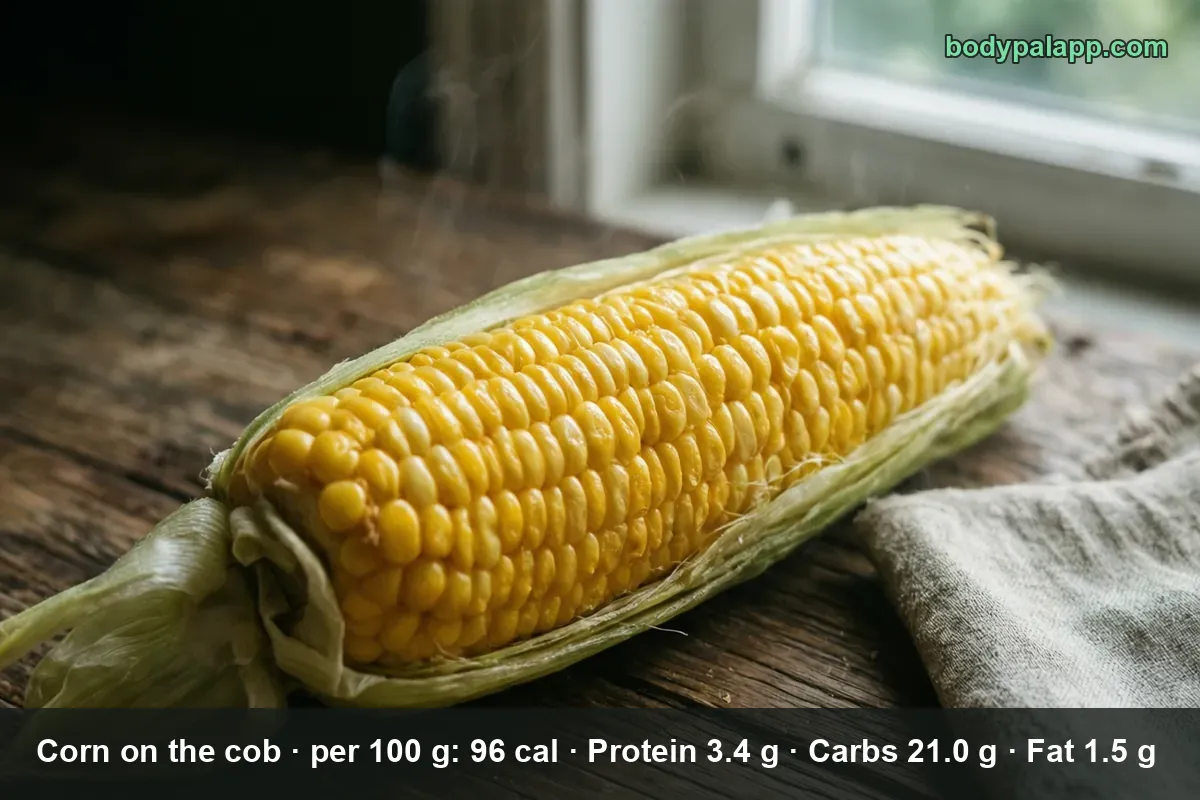
A medium ear of corn is 99 calories. That comes from USDA's cooked sweet corn at 96 calories per 100 g, scaled to the 103 g of kernels a medium ear carries. A small ear is 85 calories, a large one 113, and a cup of kernels cut off the cob is 143.
On this page
- Ear of corn quick facts
- Why USDA has two numbers for one cooked ear
- Small, medium and large ears
- What a tablespoon of butter does
- One cup of kernels is not one ear
- Frozen, canned and grilled corn
- How does corn on the cob compare
- Most popular corn on the cob brands
- FAQ
Ear of corn quick facts
The reference here is the ear that comes out of the pot at a cookout: SR Legacy 169999, "Corn, sweet, yellow, cooked, boiled, drained, without salt", with nothing on it yet.
| Nutrient | Per 100 g | Per 1 medium ear (103 g) | % Daily Value |
|---|---|---|---|
| Calories | 96 | 99 | — |
| Total fat | 1.5 g | 1.5 g | 2% |
| Saturated fat | 0.2 g | 0.2 g | 1% |
| Carbohydrate | 21.0 g | 21.6 g | 8% |
| Dietary fiber | 2.4 g | 2.5 g | 9% |
| Total sugars | 4.5 g | 4.7 g | — |
| Protein | 3.4 g | 3.5 g | 7% |
| Sodium | 1 mg | 1 mg | 0% |
% Daily Value is based on a 2,000-calorie diet.
Verified nutrition data
Numbers on this page come from USDA FoodData Central, the U.S. Department of Agriculture’s food composition database, and from manufacturer labels where a branded product is named. Last verified September 2026. How we verify our data →
One number in that table is doing something unusual. Sodium: 1 mg in a whole ear, which rounds to 0% of the day. Almost nothing else you eat off a grill can say that, and it matters later, because everything people put on corn is salted.
Potassium is the quiet win at 225 mg an ear, 5% DV. The Dietary Guidelines for Americans list potassium among the nutrients Americans fall short on, and corn contributes without carrying any sodium alongside it. There is no added sugar row on this page, because a plain vegetable has none to report.
Why USDA has two numbers for one cooked ear
Search around and you will find both 99 calories and 90 calories for the same cooked ear. Neither one is wrong, and the gap is worth understanding before you decide which to log.
USDA keeps two databases that describe cooked corn differently. SR Legacy 169999, the boiled row above, is 96 calories per 100 g. FNDDS 2709910, "Corn, fresh, cooked, no added fat", is 86 per 100 g, which is the same figure USDA gives for raw sweet corn (169998, also 86). The survey database does not apply the water loss that boiling causes; the laboratory row does. Boil an ear and some water leaves it, so what is left is a little denser per gram.
Run both through their own serving sizes and you get 103 g × 0.96 = 99 calories against 105 g × 0.86 = 90 calories. We lead with the SR Legacy figure because it is the measured cooked value and the more conservative one to log. What we do not do is split the difference: an average of the two would describe no ear of corn anywhere.
Raw corn has its own row. USDA's raw sweet corn (169998) is 86 calories per 100 g and a medium ear yields 102 g, so 88 calories straight off the stalk. USDA's newest measurement of raw kernels, Foundation 2710826 from 2024, lands at 84.55 calories per 100 g by Atwater general factors, close enough to confirm the older number rather than replace it.
Small, medium and large ears
Here is the part almost nobody explains. USDA's "medium ear" is 103 g of kernels, not 103 g of corn on the cob. The cob, husk and silk are not in the number. You can see it stated outright in the raw row, where the same measure is written as "ear, medium, yields 102 g".
So do not put the ear on a kitchen scale. Size it by length, exactly the way USDA does.
| Serving | Kernel weight | Calories |
|---|---|---|
| 1 small ear (5½–6½ inches) | 89 g | 85 |
| 1 medium ear (6¾–7½ inches) | 103 g | 99 |
| 1 large ear (7¾–9 inches) | 118 g | 113 |
| 1 cup kernels, cut off the cob | 149 g | 143 |
| 1 baby ear | 8 g | 8 |
| 1 oz kernels | 28 g | 27 |
The spread from small to large is 28 calories. That is the entire range of ordinary corn, which makes this one of the few foods where guessing the size wrong barely costs you anything. Two ears of any size land between 170 and 226 calories.
A medium ear also brings 3.5 g of protein, 21.6 g of carbohydrate and 2.5 g of fiber. Baby corn, the kind that turns up in stir-fry, is a rounding error at 8 calories an ear.
What a tablespoon of butter does
This is the real story on a plate of corn, and it is not the corn.
One tablespoon of butter is 14.2 g by USDA's own measure, and salted butter (SR 173410) runs 717 calories per 100 g. That tablespoon is 102 calories on its own. Put it on a medium ear and the item goes from 99 to 201 calories. The butter is not a topping in calorie terms; it is a second ear of corn.
| Version | Calories | Total fat | Saturated fat | Sodium |
|---|---|---|---|---|
| Medium ear, plain | 99 | 1.5 g (2% DV) | 0.2 g (1% DV) | 1 mg (0% DV) |
| Medium ear + 1 tbsp butter | 201 | 13.1 g (17% DV) | 7.5 g (38% DV) | 92 mg (4% DV) |
Look at the saturated fat line rather than the calorie line. A plain ear uses 1% of the daily limit; a buttered one uses 38%, better than a third of the day, and the corn contributed essentially none of it. The FDA Daily Value for saturated fat is 20 g.
Scale it to what you actually use. A pat of butter, the 5 g square from a restaurant dish, is 36 calories. USDA's own survey row for buttered corn (FNDDS 2709918) comes to 111 calories for a 108 g ear, which is a thin smear rather than a melting tablespoon. The cookout ear sits somewhere between 111 and 201, and where it sits is decided by your hand, not by the corn.
One cup of kernels is not one ear
Trackers offer both "1 ear" and "1 cup" of corn, and people swap them freely. They are not the same portion.
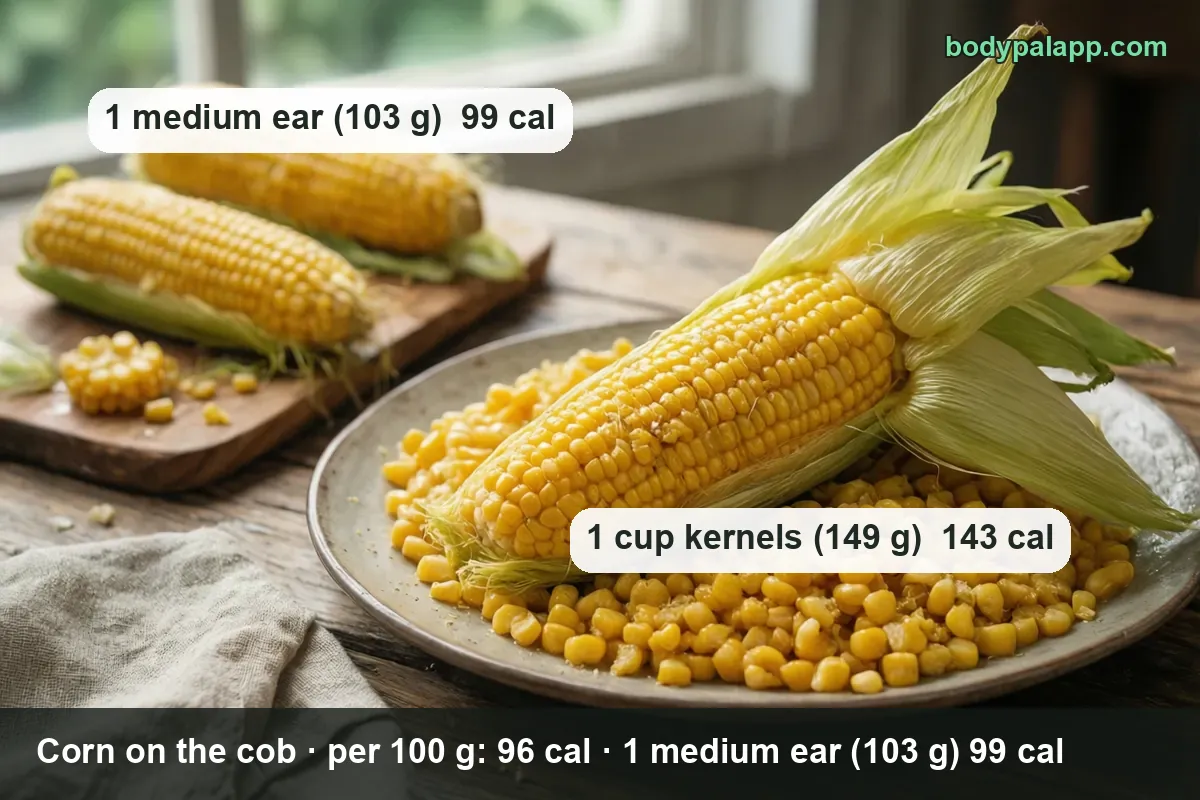
A cup of cooked kernels is 149 g, so 149 ÷ 103 = 1.45 medium ears. In calories that is 143 against 99. Eat one ear and log a cup and you have added about 44 calories that never happened; strip a cup of kernels into a salad and log "1 ear" and you have hidden the same 44.
The cup is a genuinely useful serving once you treat it as its own thing: 143 calories, 5.1 g protein (10% DV), 31.3 g carbohydrate (11% DV), 3.6 g fiber (13% DV) and 325 mg potassium (7% DV), still with 1 mg of sodium. As a side of starch that is a strong trade, and the fiber figure is the reason.
Frozen, canned and grilled corn
Corn changes more in the can than it does on the grill. These are all USDA rows, per 100 g and per the serving people actually eat.
| Form (USDA row) | Per 100 g | Serving | Calories | Sodium per 100 g |
|---|---|---|---|---|
| Fresh, boiled, no salt (SR 169999) | 96 | 1 medium ear (103 g) | 99 | 1 mg |
| Fresh, boiled, salted (SR 168525) | 96 | 1 medium ear (103 g) | 99 | 253 mg |
| White sweet corn, boiled (SR 168539) | 97 | — | — | 3 mg |
| Frozen ear, boiled (SR 168401) | 94 | 1 ear, yields 63 g | 59 | 4 mg |
| Frozen kernels, boiled (SR 168399) | 81 | 1 cup (165 g) | 134 | 1 mg |
| Cooked with oil (FNDDS 2709917) | 109 | — | — | 127 mg |
| Restaurant corn (FNDDS 2709909) | 119 | 1 ear (108 g) | 129 | 212 mg |
| Canned, drained (SR 169214) | 67 | 1 cup (164 g) | 110 | 205 mg |
| Canned, no salt added (SR 169345) | 61 | — | — | 12 mg |
| Canned, cream style (SR 169215) | 72 | 1 cup (256 g) | 184 | 261 mg |
Three rows have no serving figure because USDA does not attach an ear or a cup measure to them, and inventing one would mean borrowing a weight from a different food record. White sweet corn is one of them: per 100 g it is 97 calories, with noticeably more sugar than yellow (7.7 g against 4.5 g) and a little more fiber at 2.7 g.
Canned corn looks like the diet option at 67 calories per 100 g against 96 on the cob. It is not lighter because it is better for you; it is lighter because it is packed in liquid, so a gram of canned corn is partly water. What comes with that water is sodium: a cup of drained canned kernels carries 336 mg, 15% of the day, where a whole ear on the cob carries 0%. Buy the no-salt-added can and the sodium drops to 12 mg per 100 g while the calories stay where they are.
Salting the pot does the same thing on a smaller scale. USDA's boiled-with-salt row is identical to the unsalted one on every macro, calories included, and moves sodium from 1 mg to 253 mg per 100 g. The salt shaker changes your corn, the corn never does.
Grilling gets asked about constantly and the answer is dull: dry heat does not add calories. USDA has no separate grilled row, and the closest match, "Corn, fresh, cooked with oil", is 109 calories per 100 g against 86 with no added fat. That difference is the oil brushed on before the corn hit the grate, not the grate. Frozen ears are worth knowing about for a different reason. They are smaller than they look, yielding about 63 g of kernels, so one comes to 59 calories.
How does corn on the cob compare
| Food (USDA row) | Per 100 g | US serving | Calories | P / C / F per serving |
|---|---|---|---|---|
| Corn on the cob (SR 169999) | 96 | 1 medium ear (103 g) | 99 | 3.5 / 21.6 / 1.5 |
| Baked potato with skin (SR 170093) | 93 | 1 medium potato (173 g) | 161 | 4.3 / 36.6 / 0.2 |
| Green peas, frozen, boiled (SR 170017) | 78 | ½ cup (80 g) | 62 | 4.1 / 11.4 / 0.2 |
| Broccoli, boiled (SR 169967) | 35 | ½ cup chopped (78 g) | 27 | 1.9 / 5.6 / 0.3 |
| White rice, cooked (SR 168878) | 130 | 1 cup (158 g) | 205 | 4.3 / 44.5 / 0.4 |
Per 100 g corn sits almost exactly with the baked potato, but the serving decides the plate: an ear is 99 calories and a medium potato is 161, because the potato is simply a bigger object. Corn is the better swap for rice by a distance, 99 against 205, and it brings 2.5 g of fiber where a cup of white rice brings almost none.
Our take: if the goal is the lowest-calorie side on the table, broccoli wins and it is not close at 27 calories a half cup. If the goal is a starchy side that feels like one and still stays under 100 calories, corn on the cob is the best thing here, and it is the only one on the list that arrives with zero sodium attached. MyPlate counts corn in the starchy vegetable subgroup rather than with grains, which is the right way to slot it into a plate: it is the potato's neighbor, not the rice's.
Most popular corn on the cob brands in the United States
Ranked by how widely each product appears among foods sold in the United States, from the BodyPal food database of over 3.3 million products. Calories are the figures printed on each Nutrition Facts label, checked against USDA FoodData Central.
| Product | Calories (per 100 g) |
|---|---|
| Birds Eye Sweet Mini Corn on the Cob | 106 cal |
| Birds Eye Extra Sweet Corn on the Cob | 108 cal |
| Pictsweet Corn-on-the-Cob | 114 cal |
| Great Value Corn on the Cobs | 82 cal |
| Signature Select Sweet Corn on the Cob | 89 cal |
| Wegmans Super Sweet Cob Corn | 81 cal |
Brand popularity: BodyPal food database. Nutrition: manufacturer labels / USDA FoodData Central.
Corn on the cob FAQs
How many calories in an ear of corn?
99 calories in a medium ear, which is 103 g of kernels at 96 calories per 100 g (USDA SR Legacy 169999, boiled without salt). That ear also gives 3.5 g of protein, 21.6 g of carbohydrate, 2.5 g of fiber and 1 mg of sodium.
How many calories in a small, medium or large ear of corn?
85 calories for a small ear (89 g of kernels, 5½–6½ inches), 99 for a medium (103 g, 6¾–7½ inches) and 113 for a large (118 g, 7¾–9 inches). USDA sizes ears by length, not by weight, so measure the cob rather than weighing it.
How many calories in corn on the cob with butter?
201 calories for a medium ear with a tablespoon of butter. The butter is 102 of those calories on its own, and it takes saturated fat from 0.2 g to 7.5 g, or 38% of the daily value. A 5 g pat instead adds 36 calories.
How many calories in a cup of corn kernels?
143 calories for a cup of cooked kernels, 149 g. That is 1.45 medium ears, not one, so swapping the two in a tracker costs or saves about 44 calories. The cup carries 5.1 g protein, 31.3 g carbohydrate and 3.6 g fiber.
Is corn on the cob a vegetable or a starch?
Both, and USDA files it as a starchy vegetable. A medium ear is 99 calories with 21.6 g of carbohydrate (8% DV), 2.5 g of fiber (9% DV) and 225 mg of potassium (5% DV). Sweet corn eaten fresh counts in the vegetable group; dried corn ground into meal counts as a grain.
How much protein and fiber is in an ear of corn?
3.5 g of protein and 2.5 g of fiber in a medium ear, which is 7% and 9% of the daily value. A cup of kernels does better on both at 5.1 g protein and 3.6 g fiber. Corn is a decent fiber source for a side dish but not a protein food.
Does grilling corn change the calories?
No. Dry heat adds nothing, so a grilled ear is the same 99 calories as a boiled one. What changes the number is fat: USDA's row for corn cooked with oil is 109 calories per 100 g against 86 with no added fat, and that gap is the oil brushed on before grilling.
Canned corn or corn on the cob — which is better?
Canned drained corn is lower in calories at 67 per 100 g against 96, because it is packed in liquid. It is far higher in sodium: 336 mg in a cup, 15% of the day, against 1 mg for a whole ear. Choose no-salt-added cans and the sodium falls to 12 mg per 100 g.
Similar foods
- Boiled Corn On The Cob — 99 cal per medium ear
- Grilled Corn On The Cob — 99 cal per medium ear
- Maize (sweet Corn) — 143 cal per cup cut
- Corn On The Cob — 59 cal per ear
- Cobb Salad — 98 cal per cup
- Potato — 161 cal per medium potato
Log it without the math
Point the camera at the plate and BodyPal works out whether that ear came with butter, and what it cost you.


How long does it take to burn off an ear of corn?
A medium ear is 99 kcal. Enter your weight to see how long it takes you to burn that off:
lb
| Activity | Time to burn 99 kcal |
|---|---|
| Walking, brisk | 20 min |
| Cycling, moderate | 12 min |
| Swimming, moderate | 14 min |
| Jogging | 12 min |
| Weight training, moderate | 22 min |
Times are for a 155 lb adult at a steady pace; change the weight to see yours. BodyPal works this out from your steps automatically.
Want the bigger picture? Calculate your daily calorie needs — your maintenance figure, a target for losing or gaining, and the date you get there.