
How many calories are in a duck egg?
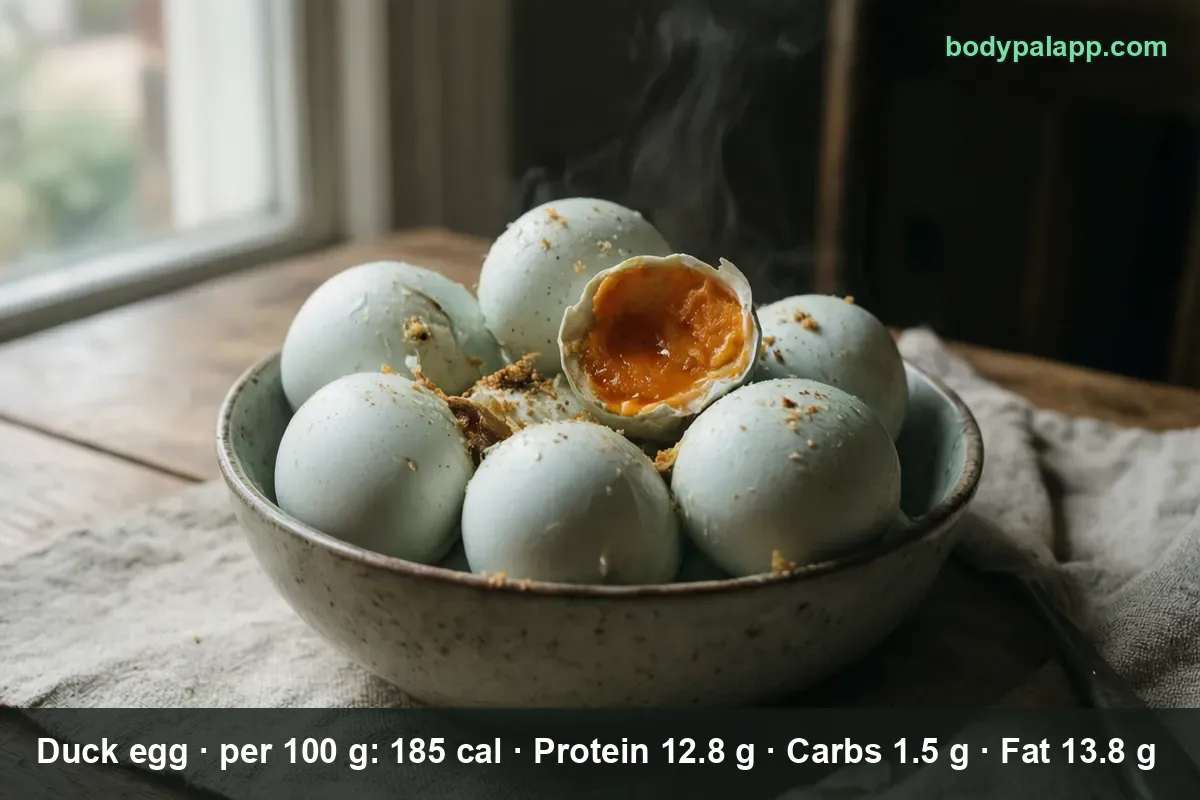
One duck egg weighs about 70 grams out of the shell and carries 130 calories. Per 100 grams the raw egg runs 185 calories, with 12.81 g of protein and 13.77 g of fat. That is a denser egg than most people expect, and the fat sits almost entirely in the big orange yolk.
On this page
- Duck egg quick facts
- US servings from one ounce to three eggs
- Fried salted and century duck eggs
- Cholesterol is the row that moves
- How does a duck egg compare?
- Most popular duck egg brands
- FAQ
Duck egg quick facts
The number on this page comes from the raw whole-egg record, SR Legacy 172189, "Egg, duck, whole, fresh, raw". That is the food a person actually holds: a shell egg from the carton, cracked into a pan or dropped into simmering water. Boiling in plain water moves none of these numbers, because nothing enters the egg and nothing leaves it. The separate FNDDS record for cooked duck egg is higher, but the extra calories come from the fat in the skillet rather than from the bird.
Two rows you would expect on a package label are missing below. USDA does not publish added sugars or trans fat for whole raw duck egg in this edition, so those lines are left out instead of guessed at.
| Nutrient | Per 100 g | Per 1 duck egg (70 g) | % Daily Value |
|---|---|---|---|
| Calories | 185 | 130 | — |
| Total fat | 13.77 g | 9.6 g | 12% |
| Saturated fat | 3.68 g | 2.6 g | 13% |
| Carbohydrate | 1.45 g | 1.0 g | 0% |
| Dietary fiber | 0 g | 0 g | 0% |
| Total sugars | 0.93 g | 0.7 g | — |
| Protein | 12.81 g | 9.0 g | 18% |
| Sodium | 146 mg | 102 mg | 4% |
| Cholesterol | 884 mg | 619 mg | 206% |
| Potassium | 222 mg | 155 mg | 3% |
% Daily Value is based on a 2,000-calorie diet.
Verified nutrition data
Numbers on this page come from USDA FoodData Central, the U.S. Department of Agriculture’s food composition database, and from manufacturer labels where a branded product is named. Last verified September 2026. How we verify our data →
Potassium is modest at 155 mg per egg, about 3% of the day. The sodium is low too, 102 mg in an untouched egg, which is roughly a twentieth of a teaspoon of table salt. Salt and sodium only become an issue once the egg is cured, and that is a different food entirely.
US servings from one ounce to three eggs
| Serving | Weight | Calories |
|---|---|---|
| 1 oz | 28 g | 52 kcal |
| One duck egg | 70 g | 130 kcal |
| One jumbo duck egg | 85 g | 157 kcal |
| Two duck eggs | 140 g | 259 kcal |
| Three duck eggs | 210 g | 389 kcal |
| Per 100 g | 100 g | 185 kcal |
The 70 g egg is the USDA household measure for this record. The ounce, the jumbo egg and the two- and three-egg lines are our own arithmetic from the USDA 100 g figure, not USDA servings, and duck eggs vary enough in the carton that 70 g is a working average rather than a promise.
Here is the practical trap. Fresh duck egg labels in the USDA Branded database do not agree on what an egg weighs. Duck Duck Eggs prints 1 egg as 50 g and 92 calories, while Mary's Duck and Washoe Valley Duck Farm both print 1 egg as 70 g and 130 calories, and Farmer Jon's uses an 85 g egg at 140 calories. Same food, and a 41% gap between the smallest and the most common "one egg." If you log by package serving, check the grams on your own carton before you trust the calorie count printed next to it.
Fried salted and century duck eggs

| Version | Per 100 g | Typical piece | Calories |
|---|---|---|---|
| Raw or plain boiled duck egg | 185 kcal | 1 egg, 70 g | 130 kcal |
| Duck egg cooked in fat | 224 kcal | 1 egg, 70 g | 157 kcal |
| Duck egg cooked and chopped | 224 kcal | 1 cup, 135 g | 302 kcal |
| Boiled salted duck egg | 212 kcal | 1 egg, 55 g | 117 kcal |
| Preserved century egg | 133 kcal | 1 egg, 60 g | 80 kcal |
Fried. The cooked record sits at 224 calories per 100 g against 185 raw. Look at where the gap lives: fat climbs from 13.77 g to 18.55 g per 100 g and sodium from 146 mg to 264 mg. That is butter or oil and a pinch of salt, not a change in the egg. A duck egg boiled in water and peeled is still the 130-calorie item; the same egg fried is 157.
Chopped by the cup. Once cooked eggs are chopped for a salad or a rice bowl, a packed cup weighs about 135 g and lands at 302 calories before any dressing. Cups are where egg dishes get away from people, because a cup is a shade under two eggs by weight, 135 g against 140 g, yet it lands at 302 calories against the 259 in two raw eggs.
Salted. A boiled salted duck egg from a US branded record runs 212 calories per 100 g, or 117 for a 55 g egg. The yolk gives up water in the brine, so it gets denser while the whole egg gets smaller.
Century, or preserved. The alkaline-cured egg is the lightest of the group at 133 calories per 100 g and about 80 calories for a 60 g egg. Cured eggs were kept out of the main number on this page for a reason: the preserved and salted records carried 450 to 2,064 mg of sodium per 100 g, against 146 mg for a fresh one. They are a seasoning as much as a protein.
Cholesterol is the row that moves
Most people arrive at this page expecting the calorie count to be the surprise. It is not. A single 70 g duck egg carries 619 mg of cholesterol, which is 206% of the 300 mg Daily Value used on US labels. Nothing else on the page comes close: protein is 18% of the day, saturated fat 13%, total fat 12%.
Federal guidance asks people to keep dietary cholesterol as low as they can while still eating a healthy pattern, and there is no numeric limit attached to that anymore. If your doctor has given you a personal target, one duck egg is a large share of it. If not, the more useful read is what you get in exchange: 9 g of complete protein for 130 calories, which sits well inside the MyPlate protein foods group.
The other quiet number is fiber. There is none, at all, in any egg. That matters for the shape of a breakfast rather than the calorie count: two duck eggs are 259 calories and 18 g of protein, but nothing on the plate is slowing digestion until you add the toast, the beans or the fruit.
How does a duck egg compare?
| Food | Per 100 g | US serving | Calories |
|---|---|---|---|
| Duck egg, raw or boiled | 185 kcal | 1 egg, 70 g | 130 kcal |
| Duck egg, cooked in fat | 224 kcal | 1 egg, 70 g | 157 kcal |
| Goose egg, cooked | 224 kcal | 100 g | 224 kcal |
| Egg omelet or scrambled with cheese and meat, made with oil | 215 kcal | 100 g | 215 kcal |
Our take: the raw or boiled duck egg is the lightest food in this table per 100 g, and by a clear margin, since the other three all sit between 215 and 224. Everything above 185 got there through a pan, a filling or another bird, not through being an egg. If you are counting, boil rather than fry and you keep 27 calories per egg without touching the protein. If you want the meal to feel like a meal, the cheese-and-meat omelet earns its 215 per 100 g, but log the cup, not the egg count.
Most popular duck egg brands in the United States
Ranked by how widely each product appears among foods sold in the United States, from the BodyPal food database of over 3.3 million products. Calories are the figures printed on each Nutrition Facts label, checked against USDA FoodData Central.
| Product | Calories (per 100 g) |
|---|---|
| Duck Duck Eggs Large Duck Eggs | 184 cal |
| Mary's Duck Duck Eggs | 186 cal |
| Washoe Valley Duck Farm Duck Eggs | 186 cal |
| Farmer Jon's Valley Pride Duck Eggs | 165 cal |
Brand popularity: BodyPal food database. Nutrition: manufacturer labels / USDA FoodData Central.
Duck egg FAQs
How many calories are in one duck egg?
130 calories, based on a 70 g duck egg at 185 calories per 100 g. That is the raw USDA figure for the whole egg with the shell removed, and boiling changes nothing about it. Two eggs come to 259 calories, three to 389.
How many calories in a boiled duck egg?
Still 130 calories for a 70 g egg. Water adds nothing, so the boiled number is the raw number: 185 calories per 100 g, 9 g of protein and 9.6 g of fat per egg. A salted boiled duck egg is a different food at 117 calories for a 55 g egg.
How much protein is in a duck egg?
9 g in one 70 g egg, which is 18% of the 50 g Daily Value, and 12.81 g per 100 g. Two duck eggs put you at 18 g of protein for 259 calories, a ratio close to lean meat once you set the fat aside.
How much cholesterol is in a duck egg?
619 mg in a single 70 g egg, or 884 mg per 100 g. Against the 300 mg Daily Value on the US label that is 206%, the highest percentage on this page by a wide margin. Federal guidance is to keep dietary cholesterol low within a healthy eating pattern.
How big is a duck egg in grams?
70 g is the working number for a whole duck egg out of the shell, and USDA's own serving for the raw record uses it. Labels disagree: one US brand calls 50 g an egg at 92 calories, two others call 70 g an egg at 130. Jumbo eggs run near 85 g and 157 calories.
How many calories in a fried duck egg?
157 calories for a 70 g egg cooked in fat, up from 130 raw. USDA's cooked record runs 224 calories per 100 g because the pan adds fat, 18.55 g against 13.77 g, and sodium jumps from 146 mg to 264 mg per 100 g. A chopped cup is 302.
How many calories in a salted duck egg?
117 calories for a 55 g salted boiled duck egg, from a branded USDA record at 212 calories per 100 g. The salt, not the calories, is the story: the preserved and salted duck egg records we set aside ran 450 to 2,064 mg of sodium per 100 g against 146 mg fresh.
Are duck eggs healthier than chicken eggs?
One 70 g duck egg brings 9 g of protein, 130 calories and 619 mg of cholesterol. This page is costed from the duck egg records only, so no chicken egg number is quoted for the comparison. On its own terms the duck egg is protein-dense and very high in cholesterol at 206% of the Daily Value.
Similar foods
- Egg And Toast — 248 cal per fried egg + 2 slices toast
- Egg Omelet — 204 cal per omelet, 2 eggs
- Omelet — 305 cal for 3-egg omelet
- Scrambled Eggs — 102 cal per egg
- Egg Dosa — 208 cal per small dosa
- Egg Fried In Butter — 100 cal per fried egg
Count it without the math
Point the camera at the plate and BodyPal counts the eggs for you, yolks and all.


How long does it take to burn off a duck egg?
One duck egg (70 g) is 130 kcal. Enter your weight and the amount you ate to see how long it takes you to burn that off:
lb
| Activity | Time to burn 130 kcal |
|---|---|
| Walking, brisk | 26 min |
| Cycling, moderate | 16 min |
| Swimming, moderate | 19 min |
| Jogging | 15 min |
| Weight training, moderate | 29 min |
Times are for a 155 lb adult at a steady pace; change the weight to see yours. The amount is set to the portion in the text (70 g); change it to what you actually ate. BodyPal works this out from your steps automatically.
This table assumes you know your daily total. If you do not, the daily calorie calculator works it out from five numbers.