
How Many Calories Are in a Gyro?
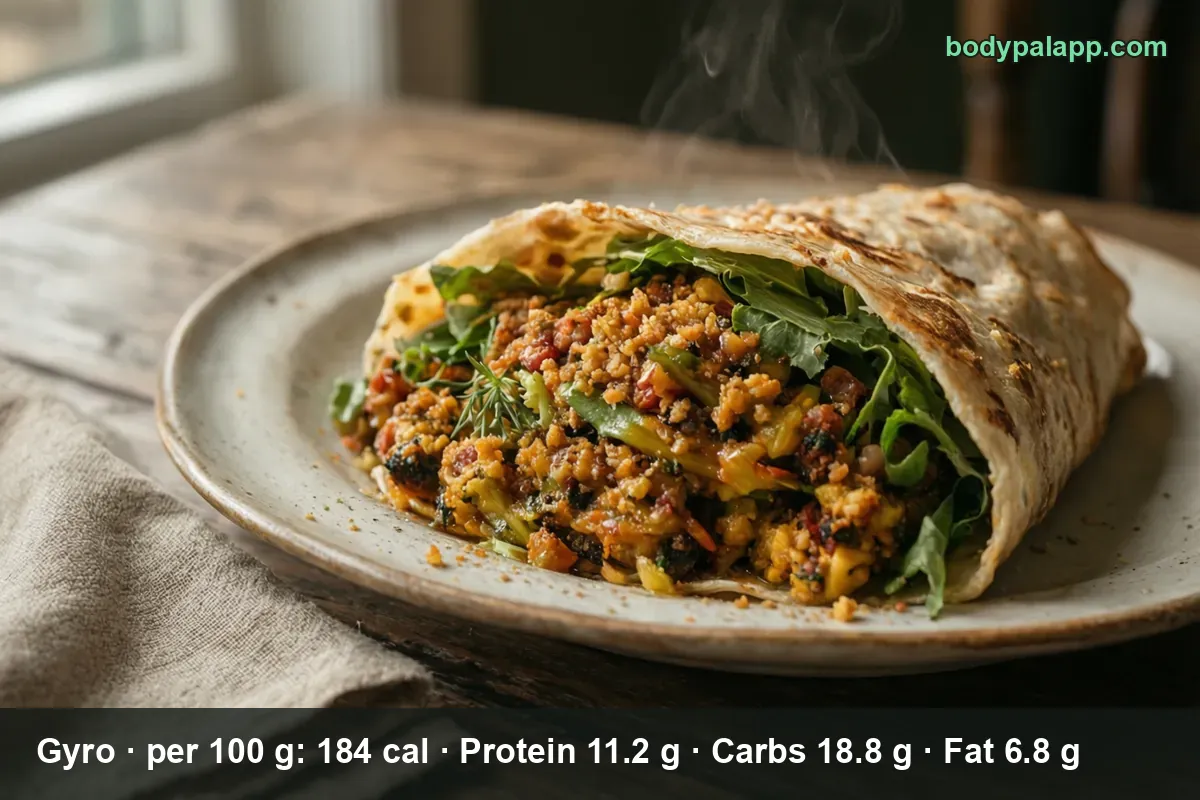
A gyro is 368 calories for the 200 g sandwich USDA measures, or 184 calories per 100 g. Half of one is 184. The meat on its own is a different food: packaged gyro slices run 318 to 365 calories per 100 g, so 3 oz of extra meat costs more than the second half of the sandwich does.
On this page
- Gyro quick facts
- The record behind the 184
- Gyro meat is a different number
- Gyro portions in ounces and halves
- Sodium is the heavy column
- Protein for the calories
- Chicken gyro and gyro bowls
- How does a gyro compare?
- Most popular gyro brands
- FAQ
Gyro quick facts
The reference here is the whole object in the foil: seasoned roast meat, tomato, onion and sauce rolled into a pita, weighed at 200 g.
| Nutrient | Per 100 g | Per 1 sandwich (200 g) | % Daily Value |
|---|---|---|---|
| Calories | 184 | 368 | — |
| Total fat | 6.76 g | 13.5 g | 17% |
| Saturated fat | 2.52 g | 5.0 g | 25% |
| Carbohydrate | 18.78 g | 37.6 g | 14% |
| Dietary fiber | 1 g | 2.0 g | 7% |
| Total sugars | 1.74 g | 3.5 g | — |
| Protein | 11.24 g | 22.5 g | 45% |
| Sodium | 323 mg | 646 mg | 28% |
| Cholesterol | 29 mg | 58 mg | 19% |
| Potassium | 205 mg | 410 mg | 9% |
% Daily Value is based on a 2,000-calorie diet.
Verified nutrition data
Numbers on this page come from USDA FoodData Central, the U.S. Department of Agriculture’s food composition database, and from manufacturer labels where a branded product is named. Last verified September 2026. How we verify our data →
Two rows are absent on purpose. This edition of the USDA survey database publishes no added sugars figure and no trans fat figure for composite dishes, and an unpublished value is not a zero, so neither row is invented here. Total sugars carry no Daily Value at all under the FDA labeling rules, which is why that cell stays blank.
Read the %DV column downward and the ranking is not the one people expect. Protein leads the whole column at 45%, and among the numbers you want kept low sodium is the tallest bar at 28%, ahead of saturated fat at 25%, cholesterol at 19%, total fat at 17% and carbohydrate at 14%. Fat is the thing a gyro gets accused of. Salt is the thing it actually delivers.
The record behind the 184
USDA holds exactly one unbranded record for this food: FNDDS 2706962, "Gyro sandwich", filed under Meat and BBQ sandwiches. Foundation Foods has nothing. SR Legacy has nothing. Search the same databases for gyro meat by itself and you get zero unbranded rows, only packaged products with a barcode.
That shapes the whole page. Every figure describing the assembled sandwich comes from that one survey record. Every figure describing the sliced meat comes from a manufacturer label. The two are never blended into a single average, because an average of a sandwich and a slice of meat describes neither.
The serving attached to the record deserves to be read literally. USDA names it "1 sandwich, any size" and weighs it at 200 g. Any size. So 368 calories belongs to a 200 g gyro and to nothing else, and the honest way to handle a bigger one is to scale from the 184 per 100 g rather than assume the round number covers it. The per-100 g column exists for exactly that job, and a gyro that visibly outweighs the one in the photograph needs it.
Gyro meat is a different number
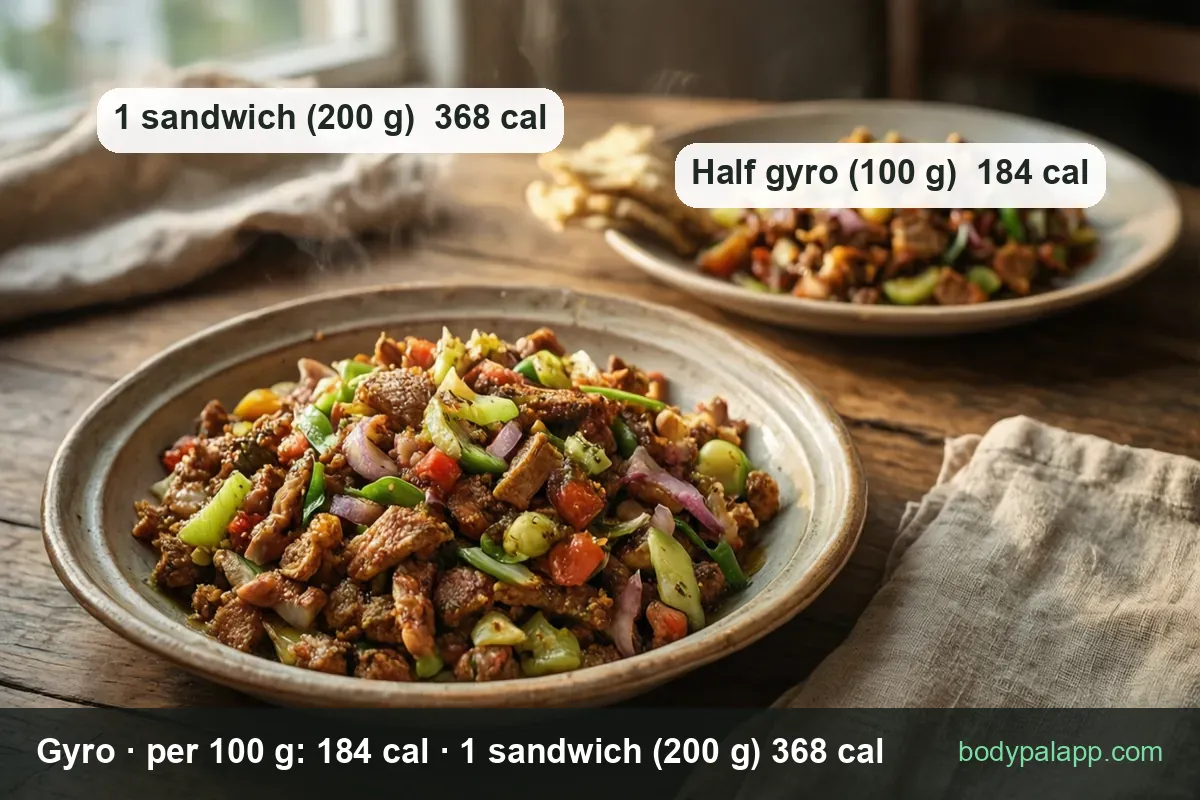
One word covers two objects that sit almost twice apart per gram. The assembled sandwich is 184 calories per 100 g, which is 368 for the 200 g portion and 184 for a half; retail gyro meat slices are 318 calories per 100 g for Kronos Authentic, 345 for Opaa! flame broiled beef and 365 for Kronos Gyros Slices. At the 3 oz serving printed on those labels that is 270, 290 and 310 calories respectively.
The mechanism is dilution. A pita is flour and water, the tomato and onion are mostly water, and both drag the density of the finished sandwich down to 184. Strip them away and what is left is roast meat at 318 calories per 100 g, running to 365 for a fattier recipe from the same producer. Per 100 g of Kronos Authentic slices you get 12.94 g of protein, 25.88 g of fat and 9.41 g of carbohydrate, against 11.24 g, 6.76 g and 18.78 g in the sandwich. Almost four times the fat, half the carbohydrate.
So the practical trap: "extra meat" is the most expensive way to make a gyro bigger. Three ounces of slices adds 270 calories. A second half of an actual sandwich, meat and pita and vegetables together, adds 184. You pay a 47% premium for the privilege of skipping the bread.
Two more differences hide in the same numbers. The three packaged products span 47 calories per 100 g from the lightest to the heaviest, which is the difference between one producer's recipe and another's, not between two sources disagreeing. And USDA has no composite record for a gyro bowl or a gyro plate at all, so the meat figures above are the only measurable part of the deconstructed version. Build the bowl from its pieces and log them separately.
Gyro portions in ounces and halves
| Serving | Weight | Calories |
|---|---|---|
| 1 sandwich, any size | 200 g | 368 |
| Half gyro | 100 g | 184 |
| 4 oz | 113 g | 208 |
| 1 oz | 28 g | 52 |
| 100 g | 100 g | 184 |
The 200 g comes from USDA's own portion table for record 2706962. The half, the ounce rows and every gram weight below the sandwich are our own scaling from 184 calories per 100 g, not USDA portions, and they are the useful ones if you eat half of something and want a number for it without weighing the rest.
The 4 oz row is worth memorizing at 208 calories, because 4 oz is roughly the amount of gyro that ends up on a fork when the pita tears and you finish it as a plate. It lands 24 calories above half a sandwich, close enough that the two are interchangeable in a log.
Raw against cooked does not apply to the main figure. The survey record is a finished dish, meat roasted and pita already baked, so what you weigh is what you eat. It does matter for the packaged slices: those labels describe fully cooked meat sold to be reheated, so the gram weight on the pack is the gram weight that lands on the plate, with no shrink to allow for.
Sodium is the heavy column
- Whole gyro, 200 g: 646 mg of sodium, 28% of the Daily Value
- Half gyro, 100 g: 323 mg, 14%
- 3 oz of Opaa! flame broiled slices on their own: 810 mg, 35%
Six hundred and forty-six milligrams is a bit more than a quarter teaspoon of table salt's worth, arriving from three directions at once: cured and seasoned meat, the pita, and whatever sauce goes on last. The CDC puts the daily ceiling at 2,300 mg and names sandwiches among the everyday items that carry Americans past it. A gyro is a sandwich with a Mediterranean reputation.
The third row above is the one that changes decisions. Adding 3 oz of packaged gyro meat to a bowl puts 810 mg of sodium on the table by itself, more than the entire 200 g sandwich carries. The meat is not a lighter option that happens to skip bread. On sodium it is the heavier one.
Saturated fat sits just behind at 5.0 g, a quarter of the 20 g Daily Value from a single hand-held item. The Dietary Guidelines for Americans keep saturated fat under 10% of daily calories, and one gyro spends a quarter of that allowance before anything else in the day. What comes back the other way is thin: 2.0 g of fiber, 7% of the Daily Value, because a white pita gives almost nothing there and the tomato and onion are too small a share of the sandwich to help.
If you eat gyros regularly, sodium and saturated fat are the two lines to watch. Calories are the least interesting thing about this food.
Protein for the calories
Here is where the gyro earns its place. 22.5 g of protein, 45% of the Daily Value, for 368 calories — that is a real meal rather than a snack, and it is why MyPlate counts an item like this in the protein group despite looking like bread.
The comparison that makes the point is a meatball sub, which USDA prices at 373 calories for a 180 g portion. Five calories more than the gyro, and it hands back 20.3 g of protein against 22.5, with 14.8 g of fat against 13.5. Same calories, slightly less protein, slightly more fat. The gyro wins that matchup on every line, which is not the result its reputation predicts.
Half a gyro still delivers 11.2 g of protein for 184 calories. That ratio holds all the way down, so splitting one is a genuine option rather than a compromise.
Chicken gyro and gyro bowls
There is no USDA record called "chicken gyro". Not in Foundation Foods, not in SR Legacy, not in the survey database. This page will not print a calorie figure for one, because the only honest way to produce that figure would be to invent it.
What is measurable is a neighboring American sandwich. Barbecue chicken sandwich on a wheat bun runs 199 calories per 100 g and 358 calories for a 180 g sandwich, with 29.6 g of protein and 8.0 g of fat. Read that as the general shape of a chicken sandwich, not as a chicken gyro number. Chicken breast is leaner than gyro cone meat and carries more protein per calorie, which is the direction a chicken version would move, but the size of the move is unknown.
Gyro bowls and gyro plates have the same gap. USDA has no composite record for meat over rice or salad without the pita. The measurable half is the meat, at 318 to 365 calories per 100 g from the labels above, and the rest of the bowl is rice, greens and sauce that belong to their own records. Log the components. Do not guess at the total.
How does a gyro compare?
Every row here is a USDA survey record for a hand-held sandwich, each priced at its own published portion weight, which is how these things are actually sold.
| Item | Per 100 g | Serving | Calories | Protein | Fat |
|---|---|---|---|---|---|
| Gyro sandwich | 184 | 1 sandwich (200 g) | 368 | 22.5 g | 13.5 g |
| Sloppy joe on a white bun | 185 | 1 sandwich (185 g) | 342 | 20.9 g | 11.9 g |
| Barbecue chicken on a wheat bun | 199 | 1 regular (180 g) | 358 | 29.6 g | 8.0 g |
| Meatball sandwich or sub | 207 | 1 regular (180 g) | 373 | 20.3 g | 14.8 g |
| Pork sandwich | 226 | 1 sandwich (115 g) | 260 | 20.4 g | 6.3 g |
Per 100 g the gyro is the lightest thing on the list. Per sandwich it is the second heaviest, beaten only by the meatball sub. The gap is size: a gyro is a bigger object than a pork sandwich, so the least calorie-dense item on the counter turns into one of the largest meals on it. Density is a property of the recipe. Calories are a property of the portion.
Our take: for the smallest number, the pork sandwich at 260 calories wins, though only because USDA weighs it at 115 g, and a bigger one erases the advantage immediately. For the best return on the calories, the barbecue chicken sandwich is the pick at 358 calories with 29.6 g of protein and just 8.0 g of fat. The pork sandwich is the runner-up on that measure with 20.4 g for 260 calories. The gyro is the better everyday choice than either the meatball sub or the sloppy joe, both of which cost about the same and give back less protein. If sodium is the number you manage, none of these is an escape route; they are all counter food, and counter food is salted.
Most popular gyro brands in the United States
Ranked by how widely each product appears among foods sold in the United States, from the BodyPal food database of over 3.3 million products. Calories are the figures printed on each Nutrition Facts label, checked against USDA FoodData Central.
| Product | Calories (per 100 g) |
|---|---|
| Kronos Authentic Gyros Slices | 318 cal |
| Opaa! Gyros Slices Flame Broiled Beef | 345 cal |
| Kronos Gyros Slices | 365 cal |
Brand popularity: BodyPal food database. Nutrition: manufacturer labels / USDA FoodData Central.
Gyro FAQs
How many calories are in a gyro?
368 calories for a 200 g gyro sandwich, at 184 calories per 100 g, using USDA survey record 2706962. Half a gyro is 184. USDA names that portion "1 sandwich, any size", so a heavier gyro should be scaled up from the 184 per 100 g figure.
How many calories are in gyro meat by itself?
318 to 365 calories per 100 g, depending on the recipe, which works out at 270 to 310 calories for a 3 oz serving of packaged slices. That is nearly double the whole sandwich per gram, because the pita and the vegetables dilute the meat rather than adding to it.
How many calories are in half a gyro?
184 calories for a 100 g half, with 11.2 g of protein, 6.8 g of fat and 323 mg of sodium. The ratios hold exactly, so a half is a genuine half on every line. Three ounces of extra meat, by contrast, adds 270 calories.
Is a gyro high in protein?
Yes. One 200 g gyro carries 22.5 g of protein, which is 45% of the Daily Value, for 368 calories. A meatball sub costs five calories more and gives back 20.3 g, so the gyro is the better protein buy of the two.
Is a gyro healthy?
The protein is strong at 22.5 g, or 45% of the Daily Value. The two figures to manage are sodium at 646 mg, 28% of the day, and saturated fat at 5.0 g, 25% of the day. Fiber is the weak line at 2.0 g, which is 7%.
How many calories are in a chicken gyro?
USDA publishes no record for a chicken gyro, so no reliable figure exists. The nearest measurable American sandwich is barbecue chicken on a wheat bun at 199 calories per 100 g, or 358 calories for a 180 g sandwich with 29.6 g of protein. Treat that as a rough scale, not an answer.
How much sodium is in a gyro?
646 mg in a 200 g sandwich, which is 28% of the 2,300 mg Daily Value, or 323 mg per 100 g. That is a larger share of the day than the fat, the saturated fat or the carbohydrate. Three ounces of packaged gyro slices alone carry 810 mg.
Gyro or meatball sub, which has fewer calories?
The gyro, narrowly: 368 calories for a 200 g sandwich against 373 for a 180 g meatball sub. The gyro is also lighter per 100 g, at 184 against 207, and carries more protein at 22.5 g against 20.3 g with less fat.
Similar foods
- Pork Chop — 220 cal per regular chop
- Sloppy Joe — 342 cal per sandwich
- Beef Cube Steak — 299 cal per steak
- Turkey Sandwich — 215 cal plain, 433 loaded
- Shrimp Shumai — 180 cal for 6 pieces
- Shrimp Fajita — 227 cal per cup
Count it without the math
Point the camera at the foil and BodyPal reads the calories, the protein and the sodium in one shot.


How long does it take to burn off a gyro?
A 200 g sandwich is 368 kcal. Enter your weight and the amount you ate to see how long it takes you to burn that off:
lb
| Activity | Time to burn 368 kcal |
|---|---|
| Walking, brisk | 1 hr 14 min |
| Cycling, moderate | 46 min |
| Swimming, moderate | 53 min |
| Jogging | 43 min |
| Weight training, moderate | 1 hr 22 min |
Times are for a 155 lb adult at a steady pace; change the weight to see yours. The amount is set to the portion in the text (200 g); change it to what you actually ate. BodyPal works this out from your steps automatically.
One food is easy to picture; a whole day is harder. See how many calories you need a day and what a deficit actually looks like.