Hard candy calories come to 24 for one 6 g piece and 394 per 100 g. Almost all of that is carbohydrate. Protein reads 0 and fat barely registers at 0.2 g per 100 g. A single piece looks harmless. The total climbs with the handful, so count pieces as you eat them.
24kcal
1 piece · 6 g, ready to eat
0%protein
0 gProtein
6 gCarbs
0 gFat
How to burn off 24 kcal
—Walking, brisk
—Jogging
—Cycling, moderate
—Swimming
Skip the math. BodyPal counts these calories from your steps and workouts automatically.
Nutrition facts
Ready to eat · per 6 g
Calories
24 kcal
Protein
0 g
Carbohydrate
5.9 g
Fat
0 g
Saturated fat
0 g
Cholesterol
0 mg
Sodium
2 mg
Potassium
0 mg
Iron
0 mg
Source: USDA FoodData Central
🛡️
Verified nutrition data
Numbers on this page come from USDA FoodData Central, the U.S. Department of Agriculture’s food composition database, and from manufacturer labels where a branded product is named. Last verified October 2026. How we verify our data →
Hard candy: calories, protein and sodium by serving
Percent of daily value uses the FDA reference of 2,000 kcal a day.
Serving
kcal
Protein
Carbs
Fat
Sodium
% DV kcal
1 piece (6 g)
24
0 g
5.9 g
0 g
2 mg
1%
Small piece (3 g)
12
0 g
2.9 g
0 g
1 mg
1%
1 oz (28 g)
110
0 g
27.4 g
0.1 g
11 mg
6%
100 g
394
0 g
98 g
0.2 g
38 mg
20%
3 × 1 piece (6 g)
71
0 g
7 mg
5 × 1 piece (6 g)
118
0 g
11 mg
One piece is 24 calories, five are 118
A standard 6 g piece of hard candy carries 24 calories, about 1% of the daily calorie value. A small 3 g piece halves that to 12. Few people stop at one, though. Two pieces come to 47 calories, three to 71, and five pieces (30 g) reach 118.
Weighed by the ounce, 28 g of hard candy is 110 calories and 27.4 g of carbohydrate, or 6% of the daily calorie value. That is roughly what a loose handful from a candy dish weighs. A full 100 g, about the size of a small bag, lands at 394 calories. That is 20% of the daily value, with 0 g of protein and only 0.2 g of fat.
Each piece takes a while to dissolve, so hard candy can stretch a small sweet allowance further than chewy candy. Counting is the hard part. If you keep a dish on your desk, log the pieces as you take them instead of guessing at the end of the day.
Every calorie comes from carbohydrate
The calorie split for hard candy is 100% carbohydrate, 0% protein and 0% fat. Per 100 g it holds 98 g of carbohydrate, 0.2 g of fat, 0 g of fiber and 0 g of protein. Very little else shows up. Sodium is 38 mg and potassium 5 mg per 100 g.
Of those 98 g of carbohydrate, 62.9 g are listed as sugars. The remaining carbohydrate isn't counted as sugar, but it adds calories just the same. So the sugar line alone understates where the energy comes from.
Per piece, that comes to 5.9 g of carbohydrate and 3.8 g of sugars in a 6 g candy. An ounce carries 17.6 g of sugars. Nothing in the profile offsets it: no fiber, no protein, no fat to speak of. That makes hard candy simple to understand. The weight on the scale is almost entirely carbohydrate.
Sugar is the only row that moves
Sodium is not a concern here. A piece has 2 mg and an ounce has 11 mg, which rounds to 0% of the daily value. Even a full 100 g only reaches 2%. Cholesterol and saturated fat both read 0.
Sugar is the number worth tracking. A single piece adds 3.8 g, which is a small entry. An ounce adds 17.6 g of sugars inside 27.4 g of carbohydrate, set against a carbohydrate daily value of 275 g. A 100 g bag brings 62.9 g of sugars. If you track sugar, count pieces, not bags.
Fruit-flavored candies such as Jolly Rancher Hard Candy Original, Blue Raspberry and Cinnamon Fire fall into this category. This page uses the USDA row "Candies, hard," so check each package for that brand's exact figures.
Hard candy works as a small, counted treat
At 24 calories a piece, hard candy is one of the easier sweets to fit into a calorie target, as long as it stays at a piece or two. It adds nothing toward the 50 g protein daily value and nothing toward fiber. Treat it as a flavor, not as food.
If you crave something sweet after dinner, one piece is a small, defined cost. It sits better after a meal that already has protein and fiber than on an empty stomach between meals, where a dish of candy is easy to keep reaching into.
BodyPal can log hard candy from a photo, which helps when the pieces come from a mixed dish. Counting wrappers works too: 3 pieces is 71 calories and 5 pieces is 118.
How does hard candy compare?
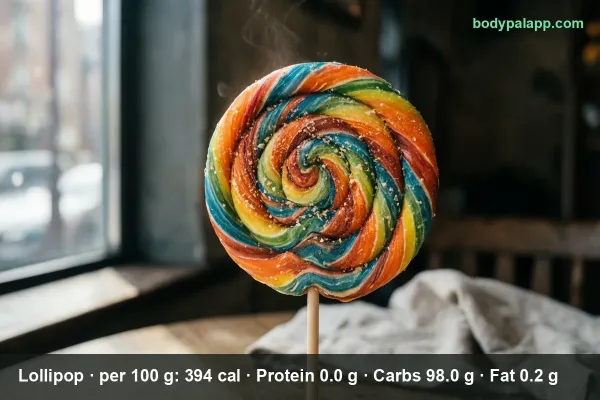
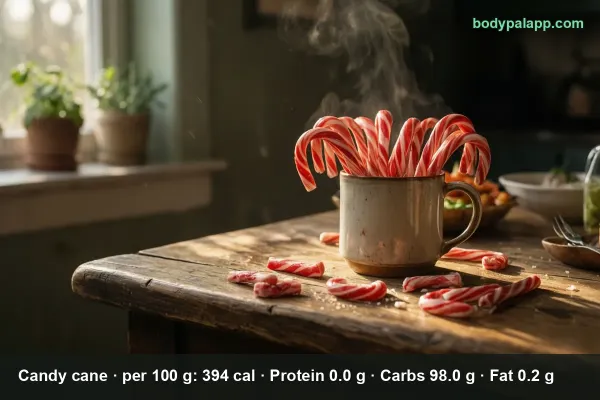
Here is hard candy next to lollipops, candy canes and lemon drops, compared per 100 g and per usual serving.
Verdict: These are the same food in different shapes: each one carries 394 calories, 98 g of carbohydrate and 0.2 g of fat per 100 g. Pick the format that comes in the smallest unit, like a single 24-calorie lemon drop, rather than a 100 g bag of any of them.
Most popular hard candy brands in the United States
Ranked by popularity in the BodyPal database
# Productkcal / 100 g
1Jolly Rancher Hard Candy Original3 pieces · 18 g389 kcal
2Jolly Rancher Hard Candy Lemon3 pieces · 18 g389 kcal
3Jolly Rancher Hard Candy Cinnamon3 pieces · 18 g389 kcal
About 24 calories in a 6 g piece, or 12 calories in a small 3 g piece.
Is hard candy good for weight loss?
One piece has only 24 calories and almost no fat, but it is nearly pure sugar: 98 g of carbs per 100 g, 62.9 g of them sugars.
Hard candy vs lollipop: which has fewer calories?
Both have 394 calories per 100 g, so the difference comes down to the size of the piece.
How much sugar is in a piece of hard candy?
A 6 g piece has 5.9 g of carbs, 3.8 g of them sugars. Per 100 g that is 98 g of carbs and 62.9 g of sugars.
How many calories are in an ounce of hard candy?
One ounce (28 g) of hard candy has 110 calories, or 6% of the daily value. It brings 27.4 g of carbohydrate, including 17.6 g of sugars, and only 0.1 g of fat.
How many calories are in 5 pieces of hard candy?
Five 6 g pieces of hard candy (30 g) come to 118 calories. For comparison, three pieces are 71 calories and two pieces are 47, so the total climbs by about 24 with every piece.
Does hard candy have any protein or fat?
Hard candy has 0 g of protein and just 0.2 g of fat per 100 g. Of its calories, 100% come from carbohydrate: 98 g per 100 g, of which 62.9 g are sugars.
How much sodium is in hard candy?
A 6 g piece of hard candy has 2 mg of sodium, and 100 g has 38 mg, which is 2% of the daily value. Even an ounce has only 11 mg.