
How many calories are in a lollipop?
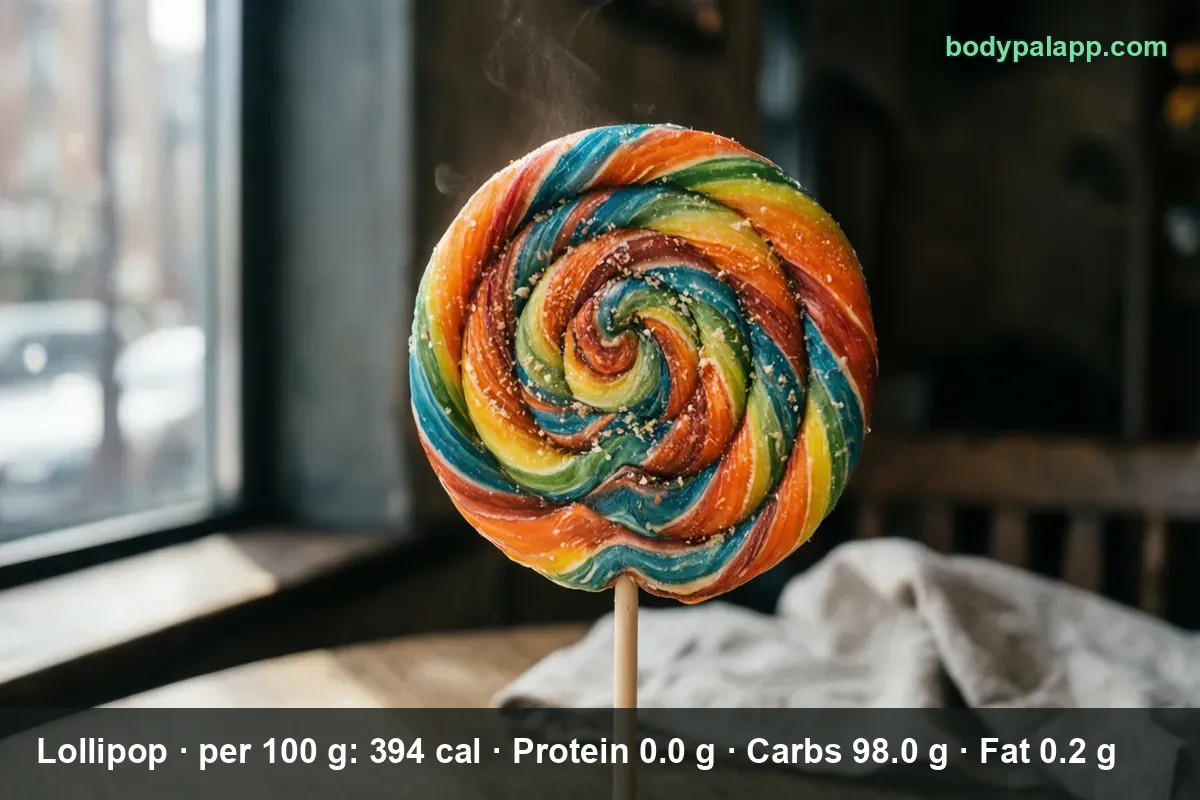
A standard 10 g lollipop carries 39 calories. Per 100 g the candy runs 394 calories, a number that looks alarming until you remember a pop weighs about as much as two teaspoons of sugar. By weight it is 98 percent carbohydrate, with no protein and a rounding error of fat.
On this page
- Lollipop quick facts
- US servings, from one pop to an ounce
- Hard candy, gummies, mints and sugar-free pops
- Carbs outrun the sugar line
- How does a lollipop compare?
- Most popular lollipop brands
- FAQ
Lollipop quick facts
The figures below come from FNDDS 2710361, "Candy, lollipop", the one USDA record written specifically for candy on a stick. Its household measure is one piece, which is exactly what a person is holding when they wonder what this costs them. A standard pop weighs 10 g, so the per-piece column is the one to read first.
Two rows you would see on a wrapper are missing here on purpose. This edition of FNDDS does not publish added sugars or trans fat for the record, so rather than guess at them, we left them out.
| Nutrient | Per 100 g | Per 1 lollipop (10 g) | % Daily Value |
|---|---|---|---|
| Calories | 394 | 39 | — |
| Total fat | 0.2 g | 0.0 g | 0% |
| Saturated fat | 0 g | 0 g | 0% |
| Carbohydrate | 98 g | 9.8 g | 4% |
| Dietary fiber | 0 g | 0 g | 0% |
| Total sugars | 62.9 g | 6.3 g | — |
| Protein | 0 g | 0 g | 0% |
| Sodium | 38 mg | 4 mg | 0% |
% Daily Value is based on a 2,000-calorie diet.
Verified nutrition data
Numbers on this page come from USDA FoodData Central, the U.S. Department of Agriculture’s food composition database, and from manufacturer labels where a branded product is named. Last verified September 2026. How we verify our data →
Cholesterol is zero, and potassium is 5 mg per 100 g, which comes to 1 mg in a single pop. Neither is worth a row. Sodium is worth one sentence only: 38 mg per 100 g is far less than a tenth of a teaspoon of table salt across an entire 100 g of candy, so lollipops never register on a sodium budget.
US servings, from one pop to an ounce
| Serving | Weight | Calories |
|---|---|---|
| 1 lollipop | 10 g | 39 kcal |
| 2 lollipops | 20 g | 79 kcal |
| 3 lollipops | 30 g | 118 kcal |
| 1 oz | 28 g | 110 kcal |
| Per 100 g | 100 g | 394 kcal |
Only the first and last rows are USDA servings. The two- and three-pop lines and the ounce are our own arithmetic from the USDA 100 g figure, scaled straight down, which works cleanly here because a lollipop is a uniform sugar casting with no crust, filling or moisture loss to complicate it.
That ounce row is the useful one. An ounce of lollipops is 28 g, so roughly three pops, and 110 calories. Nobody weighs candy, which is why the ounce is such a good sanity check: three pops from a bowl over an afternoon costs about the same as a slice of bread, and it lands as sugar with nothing attached to slow it down.
Sizes drift by brand, and the drift matters more than the recipe. A 15 g Chupa Chups strawberry pop is 60 calories on its own label, the smaller creamy version is 12 g and 45 calories, and a 20 g Walgreens Disney pop reaches 80. At the other end, an 8 g WOW! Swirl pop is 30, and the two-pop Disney and Nickelodeon packs list 60 calories for 14 g of candy.
Hard candy, gummies, mints and sugar-free pops
| Version | Per 100 g | Typical piece | Calories |
|---|---|---|---|
| Lollipop | 394 kcal | one pop, 10 g | 39 kcal |
| Hard candy | 394 kcal | 1 oz, 28 g | 110 kcal |
| Sugar-free hard candy | 394 kcal | 1 oz, 28 g | 110 kcal |
| Mints | 394 kcal | 1 oz, 28 g | 110 kcal |
| Gummy candy | 396 kcal | 1 oz, 28 g | 111 kcal |
| Licorice | 396 kcal | 1 oz, 28 g | 111 kcal |
| Cough drops | 394 kcal | one drop, 10 g | 39 kcal |
Five of these seven records sit on exactly 394 calories per 100 g, and the other two are within two calories of it. That is not sloppy data. It is what happens when a food is boiled sugar and syrup: there is almost no room left in 100 g for anything that would move the number.
The sugar-free row is the one that surprises people. Sugar-free non-chocolate candy still lists 394 calories per 100 g, because the sugar alcohols standing in for sucrose carry calories of their own. What drops is the sugars line, not the calorie line. Sugar-free is a sugar decision, not a calorie decision.
Cough drops deserve a note for the same reason. USDA files them at 394 calories per 100 g, identical to hard candy, so a drop taken every hour through a bad afternoon is a stack of 39-calorie candies wearing a medicinal label. Gummies and licorice edge two calories higher per 100 g because gelatin, syrup and, in licorice, a little flour push carbohydrate up to 98.9 g.
Carbs outrun the sugar line
Here is the gap most candy pages skip. Per 100 g, a lollipop is 98 g carbohydrate but only 62.9 g total sugars. The missing 35 g is glucose syrup solids: real carbohydrate, real calories, but chains too long to be counted on the sugars line. The carbohydrate load is about 1.6 times the sugar figure, so reading only the sugar number understates what a pop does to a carb count by a third.
In a single 10 g pop that is 9.8 g of carbohydrate against 6.3 g of sugars, a difference of 3.5 g. Small on its own, and not small across a handful. If you track carbohydrate rather than sugar, use 9.8 g per pop and 4% of the Daily Value, not the sugar number.
The FDA's Daily Value reference sets added sugars at 50 g a day, but USDA does not break out added sugars for this record, so we are not putting a percentage on it. What can be said plainly is that a lollipop contributes nothing else: no fiber, no protein, no meaningful micronutrients. The Dietary Guidelines call that a calorie with no nutrient company, and MyPlate files it the same way. That is an argument about the shape of a day, not about whether one pop is allowed.
How does a lollipop compare?
| Candy | Per 100 g | US serving | Calories |
|---|---|---|---|
| Lollipop | 394 kcal | one pop, 10 g | 39 kcal |
| Hard candy | 394 kcal | 1 oz, 28 g | 110 kcal |
| Gummy candy | 396 kcal | 1 oz, 28 g | 111 kcal |
| Sugar-free candy | 394 kcal | 1 oz, 28 g | 110 kcal |
Our take: per gram these four are interchangeable, and gummy candy is the only one of the group above 394 calories per 100 g, by a margin of two. So stop choosing between them on calories and choose on pacing instead. A lollipop wins that argument, because it arrives as one object that takes several minutes to finish, and one pop is the smallest committed unit in the aisle. Gummies and loose hard candy arrive as a handful, and a handful is an ounce before you have decided anything. If you want candy inside a calorie budget, buy it on a stick.
Most popular lollipop brands in the United States
Ranked by how widely each product appears among foods sold in the United States, from the BodyPal food database of over 3.3 million products. Calories are the figures printed on each Nutrition Facts label, checked against USDA FoodData Central.
| Product | Calories (per 100 g) |
|---|---|
| Chupa Chups Creamy Lollipops | 375 cal |
| Disney Lollipops | 429 cal |
| Disney Lollipops (Walgreens) | 400 cal |
| Chupa Chups Lollipops Strawberry | 400 cal |
| Nickelodeon Lollipops | 429 cal |
| WOW! Swirl Lollipops | 375 cal |
Brand popularity: BodyPal food database. Nutrition: manufacturer labels / USDA FoodData Central.
Lollipop FAQs
How many calories are in one lollipop?
39 calories for a standard 10 g pop, based on USDA's 394 calories per 100 g. Bigger pops scale straight up: a 15 g Chupa Chups is 60 calories on its own label, and a 20 g Walgreens swirl pop reaches 80. The stick itself weighs nothing.
How many carbs are in a lollipop?
9.8 grams of carbohydrate in a 10 g pop, which is 4% of the Daily Value. Per 100 g the figure is 98 grams, close to the ceiling for any food, because boiled sugar and syrup leave nothing else to occupy the weight. Three pops come to 29.4 grams.
How much sugar is in a lollipop?
6.3 grams of total sugars in one 10 g pop, and 62.9 grams per 100 g. That sits below the carbohydrate figure because glucose syrup solids count as carbohydrate but not as sugars. USDA does not publish an added sugars value for this record, so we give no percentage for it.
Are sugar-free lollipops lower in calories?
Barely: USDA lists sugar-free non-chocolate candy at 394 calories per 100 g, the same figure as regular lollipops, because the sugar alcohols replacing sucrose still carry calories. What falls is the sugars line. If you are counting calories, sugar-free pops are a lateral move; if you are counting sugar, they help.
How many calories in a Chupa Chups lollipop?
60 calories for the 15 g strawberry pop, according to the label in USDA's branded database, which works out to 400 calories per 100 g. The creamy version is smaller, 12 grams and 45 calories. Both land within five percent of the generic USDA lollipop figure of 394.
How many lollipops are in one ounce?
About three: an ounce is 28 grams and a standard pop is 10 grams, so an ounce of lollipops runs 110 calories, our own arithmetic from the USDA 100 g figure rather than a USDA serving. That is the number worth remembering, since people count pops rather than ounces.
Do lollipops have any fat or protein?
Essentially none: USDA lists 0.2 grams of fat per 100 g, which rounds to zero in a 10 g pop, and zero protein. Cholesterol is zero and sodium is 38 mg per 100 g, about 4 mg in one pop. A lollipop is carbohydrate and flavoring, and nothing else.
Are lollipops worse than hard candy?
No: both sit at 394 calories per 100 g in USDA's records, since a lollipop is hard candy on a stick. The practical difference is pacing: a pop is one object that takes minutes to finish, while loose hard candy leaves a bowl a piece at a time and reaches an ounce quickly.
Similar foods
- Candy Cane — 47 cal per candy cane
- Chocolate Cheesecake — 690 cal per slice
- Dum Dum Pop — 20 cal per pop
- Jolly Rancher — 71 cal for 3 pieces
- Lemon Drop Candy — 24 cal per drop
- Smarties Candy — 24 cal per roll
Count it without the math
Point the camera at the wrapper and BodyPal counts the pop for you, size and all.


How long does it take to burn off a lollipop?
One lollipop (10 g) is 39 kcal. Enter your weight and the amount you ate to see how long it takes you to burn that off:
lb
| Activity | Time to burn 39 kcal |
|---|---|
| Walking, brisk | 8 min |
| Cycling, moderate | 5 min |
| Swimming, moderate | 6 min |
| Jogging | 5 min |
| Weight training, moderate | 9 min |
Times are for a 155 lb adult at a steady pace; change the weight to see yours. The amount is set to the portion in the text (10 g); change it to what you actually ate. BodyPal works this out from your steps automatically.
Burning it off is one side of it. The other is knowing your number: work out how many calories you need a day, with macros and a goal date.