
How many calories are in a candy cane?
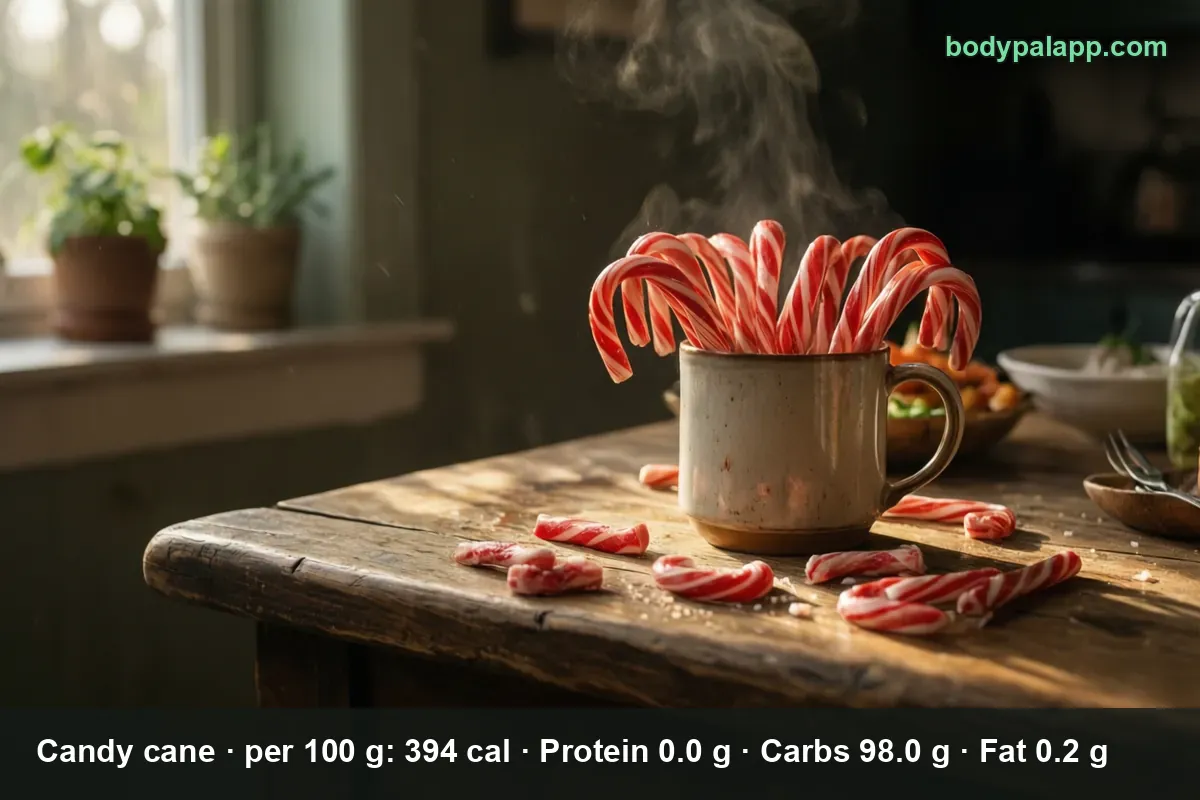
One standard candy cane weighs 12 grams and carries 47 calories. Boiled sugar runs 394 calories per 100 g, so the cane is small rather than light: nearly every calorie in it is carbohydrate, there is no fat worth counting, and the whole thing disappears in about ten minutes of absent-minded sucking.
On this page
- Candy cane quick facts
- US servings, from a broken piece to a large cane
- Mini, large and sugar-free candy canes
- Carbohydrate is the only row that moves
- How does a candy cane compare?
- Most popular candy cane brands
- FAQ
Candy cane quick facts
There is no standalone "candy cane" entry in USDA FoodData Central, and that is fine, because a candy cane is not its own recipe. It is the same boiled sugar glass as every other hard candy, bent into a hook. The row that describes it is FNDDS 2710360, "Candy, hard", at 394 calories per 100 g.
The 12 g serving is the one printed on the bags Americans actually buy: Spangler and Santa's Choice both call one cane 12 g, and their own labels land at 45 calories against our 47. Brach's counts three pieces as 13 g and 50 calories. Everything sits inside a five-calorie band, which is about as close as candy labeling ever gets.
| Nutrient | Per 100 g | Per 1 candy cane (12 g) | % Daily Value |
|---|---|---|---|
| Calories | 394 | 47 | — |
| Total fat | 0.2 g | 0.0 g | 0% |
| Saturated fat | 0 g | 0.0 g | 0% |
| Carbohydrate | 98 g | 11.8 g | 4% |
| Dietary fiber | 0 g | 0.0 g | 0% |
| Total sugars | 62.9 g | 7.5 g | — |
| Protein | 0 g | 0.0 g | 0% |
| Sodium | 38 mg | 5 mg | 0% |
% Daily Value is based on a 2,000-calorie diet.
Verified nutrition data
Numbers on this page come from USDA FoodData Central, the U.S. Department of Agriculture’s food composition database, and from manufacturer labels where a branded product is named. Last verified September 2026. How we verify our data →
Two rows you would expect are missing. USDA does not publish added sugars or trans fat for this record, so we leave both out rather than guess; the wrapper on a store cane does list added sugars, and for a plain peppermint cane that figure is effectively the whole sugar line. Cholesterol is 0 mg per 100 g and potassium is 5 mg per 100 g, which works out to a single milligram in one cane. Neither is worth a table row.
US servings, from a broken piece to a large cane
| Serving | Weight | Calories |
|---|---|---|
| 1 broken piece | 5 g | 20 kcal |
| One candy cane, standard | 12 g | 47 kcal |
| One stick, thick style | 15 g | 59 kcal |
| One large candy cane | 28 g | 110 kcal |
| 1 oz | 28.4 g | 112 kcal |
| Per 100 g | 100 g | 394 kcal |
Only the 12 g cane comes from package weights, and the 5 g broken piece and the 15 g stick are USDA portion sizes. The 28 g large cane and the ounce are our own arithmetic from the USDA 100 g figure, not USDA servings. Half a standard cane, the way most people abandon one on a saucer, is 6 g and 24 calories on the same math.
The useful habit here is weighing once. Candy canes are sold in a spread of sizes that all carry the same word on the box, and unlike a slice of bread or a cup of rice, you cannot eyeball the difference between a 12 g cane and a 20 g one through cellophane. One session with a kitchen scale settles the whole jar for the season.
Mini, large and sugar-free candy canes
| Version | Per 100 g | Typical serving | Calories |
|---|---|---|---|
| Mini candy canes | 385 kcal | 3 mini canes (13 g) | 50 kcal |
| Standard candy cane | 394 kcal | 1 cane (12 g) | 47 kcal |
| Large candy cane | 393 kcal | 1 large cane (28 g) | 110 kcal |
| Fruit-flavored candy canes | 400 kcal | 1 cane (10 g) | 40 kcal |
| Starlight peppermint mints | 400 kcal | 3 pieces (15 g) | 60 kcal |
| Sugar-free peppermint hard candy | 200 kcal | 4 pieces (15 g) | 30 kcal |
Read that first column and the variants collapse into one thing: every sugar cane on the list is 385 to 400 calories per 100 g. The differences you see in the last column are differences in how much candy the piece holds, not in what the candy is. A large cane is 110 calories against 47 for a standard one, more than double, for a shape most people would describe with the same two words.
Minis are the exception that catches people out. Three of them is 50 calories, three more than a full-size cane, because "mini" means about 4.3 g each and nobody eats one. A single mini is roughly 17 calories by our arithmetic from the label serving, which is genuinely small, but they are handed out in bowls.
Sugar-free is the one variant where the two USDA record types disagree. The branded sugar-free peppermint candy record shows 200 calories per 100 g, while the FNDDS row for sugar-free non-chocolate candy shows 394. That is not an error in either. Nutrition Facts labels are allowed to discount the calories from sugar alcohols like isomalt, and FNDDS counts them at full value. The truth for your day is somewhere between, and closer to the label than to FNDDS.
Brand labels track the FNDDS number closely for regular canes. Brach's peppermint canes come in at 385 calories per 100 g, Spangler and Santa's Choice at 375. Against 394 that is a spread of under 5 percent, which is why we did not bother building the page around a single brand.
Carbohydrate is the only row that moves
Look down the % Daily Value column and one number is not zero. Carbohydrate at 4 percent of the FDA Daily Value is the entire nutritional story of a candy cane. Fat is 0.2 g per 100 g, which rounds to nothing in a 12 g piece. Sodium is 38 mg per 100 g, five milligrams in a cane. Protein and fiber are flat zero.
Here is the part almost nobody notices. The carbohydrate line is 98 g per 100 g, but total sugars are only 62.9 g. The missing 35 g, about 36 percent of the carbohydrate, is corn syrup solids and glucose that the label does not classify as sugars. Those grams still deliver four calories each. So a candy cane is meaningfully more carbohydrate than its sugar line suggests, and if you are counting carbs rather than sugars, use 11.8 g per cane.
Because USDA does not carry an added sugars figure for this record, we do not put a percentage on that row. The Dietary Guidelines for Americans suggest keeping added sugars under 10 percent of daily calories, and a candy cane is a small, contained way to spend some of that: it is portioned by nature, it takes a long time to eat, and it stops when the hook does.
How does a candy cane compare?
| Candy | Per 100 g | US serving | Calories |
|---|---|---|---|
| Candy cane | 394 kcal | one cane, 12 g | 47 kcal |
| Peppermint candy | 394 kcal | 1 oz, 28.4 g | 112 kcal |
| Lollipop | 394 kcal | 1 oz, 28.4 g | 112 kcal |
| Gummy candy | 396 kcal | 1 oz, 28.4 g | 112 kcal |
Our take: by weight these four are the same food. Put a candy cane on the ounce line with the rest and it is 112 calories too, identical to peppermint rounds, lollipops and gummies down to the rounding. What makes the cane the better choice on a snack table is not its composition but its architecture. Twelve grams is a small, fixed dose that takes ten minutes to finish, while a handful of mints or gummies is an open-ended ounce that takes two. If you want the peppermint without the calories, sugar-free canes at roughly 30 calories per 15 g serving are the real saving on this page.
Most popular candy cane brands in the United States
Ranked by how widely each product appears among foods sold in the United States, from the BodyPal food database of over 3.3 million products. Calories are the figures printed on each Nutrition Facts label, checked against USDA FoodData Central.
| Product | Calories (per 100 g) |
|---|---|
| Brach's Peppermint Candy Canes | 385 cal |
| Spangler Peppermint Candy Canes | 375 cal |
| Spangler Natural Peppermint Candy Canes | 375 cal |
| Santa's Choice Peppermint Candy Canes | 375 cal |
| Brach's Mini Peppermint Candy Canes | 385 cal |
| Smarties Candy Canes | 375 cal |
Brand popularity: BodyPal food database. Nutrition: manufacturer labels / USDA FoodData Central.
Candy cane FAQs
How many calories are in one candy cane?
One standard candy cane of 12 g has 47 calories, based on USDA's hard candy record at 394 calories per 100 g. Store labels from Spangler and Santa's Choice print 45 calories for the same 12 g cane, so anywhere in the 45 to 50 range is right.
How many calories in a mini candy cane?
Three mini canes weigh 13 g and carry 50 calories, which is the serving printed on the bag. One mini on its own is about 4.3 g and roughly 17 calories by our arithmetic. Minis are lighter per piece but heavier per handful than one full-size cane.
How much sugar is in a candy cane?
A 12 g candy cane holds 7.5 g of total sugars, from 62.9 g per 100 g in USDA's record. Total carbohydrate is higher, 11.8 g per cane, because glucose and corn syrup solids are not counted on the sugars line even though they carry the same calories.
Are candy canes fat free?
Effectively yes: USDA lists 0.2 g of fat per 100 g, which is 0.0 g and 0% of the Daily Value in a 12 g cane. Saturated fat and cholesterol are both zero. A candy cane is boiled sugar, flavor and color, with nothing for fat to come from.
How many carbs are in a candy cane?
11.8 g of carbohydrate in one 12 g cane, or 4% of the Daily Value, from 98 g per 100 g. That is the number to log if you count carbs rather than sugars, and it runs about 4 g higher than the sugar line for the same piece of candy.
Do sugar-free candy canes have fewer calories?
Yes, by label: sugar-free peppermint candy shows 200 calories per 100 g, about 30 calories for a 15 g serving of four pieces. USDA's FNDDS row for sugar-free candy still says 394, because it counts sugar alcohols at full value while Nutrition Facts labels discount them.
How many calories in a large candy cane?
A large candy cane of 28 g runs 110 calories, more than double a standard 12 g cane at 47. The recipe is identical at roughly 393 calories per 100 g; only the amount of candy changes. The giant novelty canes sold in tubes are heavier still, so weigh before logging.
Are candy canes vegan?
Nutritionally there is nothing animal in the numbers: 0 g protein, 0 mg cholesterol and 0.2 g fat per 100 g. Ingredients still vary by brand, and some colorings and flavor carriers are animal-derived, so the ingredient panel on the bag is the only reliable answer.
Similar foods
- Chocolate Cheesecake — 690 cal per slice
- Dum Dum Pop — 20 cal per pop
- Jolly Rancher — 71 cal for 3 pieces
- Lemon Drop Candy — 24 cal per drop
- Lollipop — 39 cal per lollipop
- Smarties Candy — 24 cal per roll
Count it without the math
Point the camera at the plate and BodyPal counts the candy cane for you, mini or full size.


How long does it take to burn off a candy cane?
One candy cane (12 g) is 47 kcal. Enter your weight and the amount you ate to see how long it takes you to burn that off:
lb
| Activity | Time to burn 47 kcal |
|---|---|
| Walking, brisk | 9 min |
| Cycling, moderate | 6 min |
| Swimming, moderate | 7 min |
| Jogging | 6 min |
| Weight training, moderate | 10 min |
Times are for a 155 lb adult at a steady pace; change the weight to see yours. The amount is set to the portion in the text (12 g); change it to what you actually ate. BodyPal works this out from your steps automatically.
Burning it off is one side of it. The other is knowing your number: work out how many calories you need a day, with macros and a goal date.