
How many calories are in a Dum Dum pop?
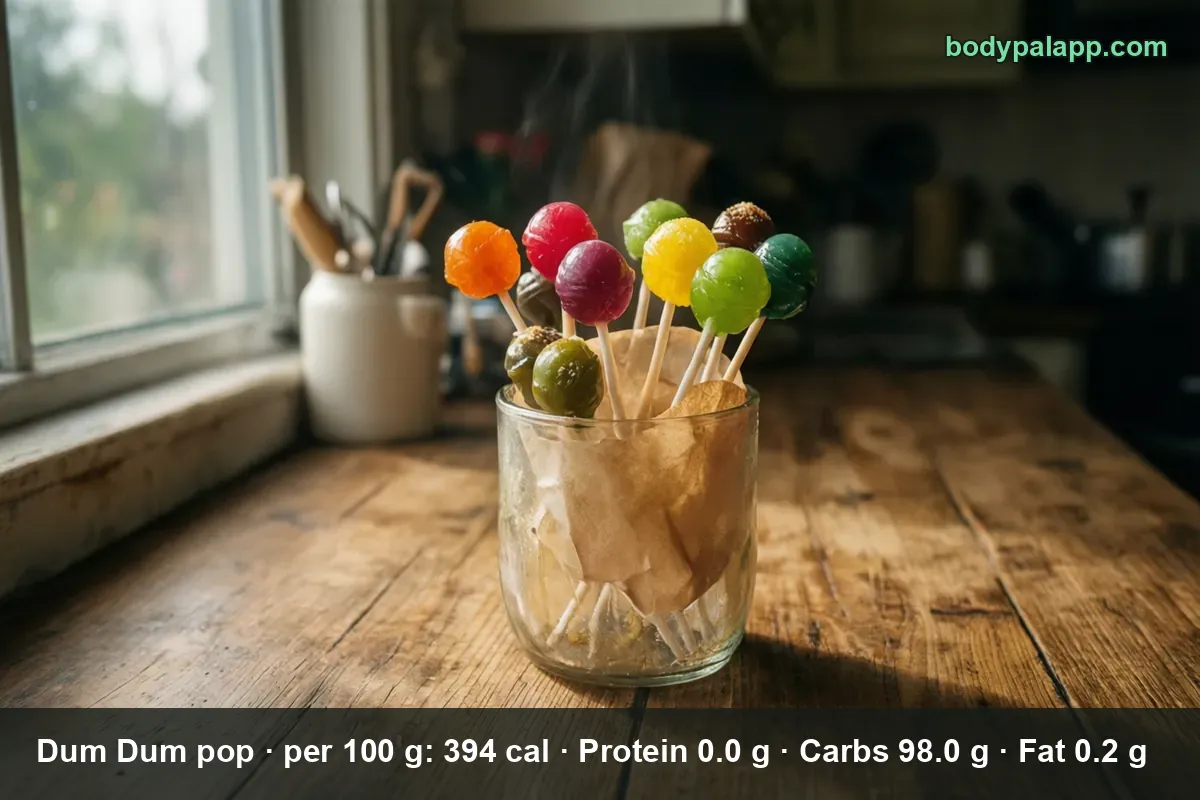
One Dum Dum pop weighs 5 g and carries 20 calories. Per 100 g the candy runs 394 calories, which sounds enormous until you remember it takes about twenty pops to reach that weight. The whole thing is sugar and glucose syrup: no fat worth counting, no protein, no fiber.
On this page
- Dum Dum pop quick facts
- Servings, from one pop to a cup of candy
- Hard candy, gummies and the Tootsie Pop
- What the sugar and carb rows really say
- How does a Dum Dum pop compare?
- Most popular dum dum pop brands
- FAQ
Dum Dum pop quick facts
The numbers below sit on the USDA lollipop record, FNDDS 2710361, "Candy, lollipop". It is the only lollipop entry in FoodData Central with a complete nutrient profile, so it carries every row you see. There is a store-label record for DUM DUM POPS as well, but it lists only calories, protein, carbohydrate, fat and sodium. What that branded record gives us is the piece weight: three pops to a 15 g serving, which puts one pop at 5 g.
So the composition is generic lollipop and the weight is the real bag. That combination is what makes the per-piece column trustworthy.
| Nutrient | Per 100 g | Per 1 pop (5 g) | % Daily Value |
|---|---|---|---|
| Calories | 394 | 20 | — |
| Total fat | 0.2 g | 0.0 g | 0% |
| Saturated fat | 0 g | 0.0 g | 0% |
| Carbohydrate | 98 g | 4.9 g | 2% |
| Dietary fiber | 0 g | 0.0 g | 0% |
| Total sugars | 62.9 g | 3.1 g | — |
| Protein | 0 g | 0.0 g | 0% |
| Sodium | 38 mg | 2 mg | 0% |
% Daily Value is based on a 2,000-calorie diet.
Verified nutrition data
Numbers on this page come from USDA FoodData Central, the U.S. Department of Agriculture’s food composition database, and from manufacturer labels where a branded product is named. Last verified September 2026. How we verify our data →
Two rows you would expect on a candy label are missing here: added sugars and trans fat. USDA does not publish either value for this record, so rather than guess, this page leaves them out. Cholesterol is 0 mg and potassium is 5 mg per 100 g, both of which round to zero on a 5 g piece. The Daily Values used in the table come from the FDA nutrition label reference.
Servings, from one pop to a cup of candy
| Serving | Weight | Calories |
|---|---|---|
| 1 pop, bag weight | 5 g | 20 kcal |
| 3 pops, the label serving | 15 g | 59 kcal |
| 1 piece, USDA household measure | 10 g | 39 kcal |
| 4 pops | 20 g | 79 kcal |
| 1 oz, about six pops | 28.35 g | 112 kcal |
| 100 g, about 20 pops | 100 g | 394 kcal |
Only two of those lines are USDA measures. The 10 g "1 piece" is the household measure attached to the lollipop record, and the 100 g line is the record itself. Everything else — the single pop, the three-pop serving, the four-pop handful, the ounce — is our own arithmetic from the USDA 100 g figure, scaled to the piece weight on the bag, not a USDA serving.
That 10 g line is worth a second look. The generic USDA lollipop is twice the weight of a Dum Dum and therefore twice the calories, 39 against 20. Nothing about the recipe changed. If you log "lollipop" from a database without checking the gram field, you will book double what you actually ate.
The other trap runs the opposite way. Nobody eats one pop and stops, and the bag does not ask you to: the printed serving is three, which is 59 calories, 14.7 g of carbohydrate and 5% of the carbohydrate Daily Value. Three is the honest unit for most people.
Hard candy, gummies and the Tootsie Pop
Hard candy is hard candy. Once you strip off the stick, almost every version in the USDA tables lands within a few calories of the same place, and what separates them is how much of it you are holding.
| Version | Per 100 g | Typical piece | Calories |
|---|---|---|---|
| Lollipop, the Dum Dum size | 394 kcal | 1 pop (5 g) | 20 kcal |
| Hard candy, no stick | 394 kcal | 1 piece (5 g) | 20 kcal |
| Sugar-free lollipop | 394 kcal | 1 oz (28.35 g) | 112 kcal |
| Gummy candy | 396 kcal | 1 oz (28.35 g) | 112 kcal |
| Mint candy | 394 kcal | 1 oz (28.35 g) | 112 kcal |
| Taffy | 390 kcal | 1 oz (28.35 g) | 111 kcal |
| Tootsie Pop | 353 kcal | 1 pop (17 g) | 60 kcal |
The sugar-free line surprises people. Swapping sugar for polyols does not change the USDA energy figure at all — 394 calories per 100 g, the same as the sugared version — because the carbohydrate total barely moves, 98.6 g against 98 g. Sugar-free candy is a dental and blood-sugar decision, not a calorie one.
The Tootsie Pop is the opposite kind of surprise. It is the least energy-dense candy in the table at 353 calories per 100 g, and it still costs 60 calories a piece, because it weighs 17 g. Three Dum Dums come to 59, within a calorie of it.
Brand labels tell the same story through the piece weight. The Dum Dums bag runs 400 calories per 100 g with a 15 g serving of three pops at 60; a Chupa Chups strawberry lollipop is 400 per 100 g but 15 g in one piece, so a single one is 60; Jolly Rancher lollipops are 385 per 100 g at 13 g a piece, 50 calories; and an Original Gourmet lollipop, at 31 g, reaches 130. The recipes barely move. The stick does the work.
What the sugar and carb rows really say
A Dum Dum is 4.9 g of carbohydrate, of which 3.1 g is sugars. The gap is the interesting part: per 100 g the record lists 98 g of carbohydrate against 62.9 g of total sugars, leaving about 35 g of glucose and corn syrup carbohydrate that FNDDS does not classify as sugars. On a single pop that gap is 1.8 g. If you have ever wondered why a candy that is nothing but sugar does not show a sugar figure equal to its carbohydrate figure, that is the reason — and it is a database convention, not a recipe secret.
The Dietary Guidelines for Americans ask adults to keep added sugars under 10% of daily calories, about 50 g on a 2,000-calorie day. This page cannot score a Dum Dum against that ceiling honestly, because USDA does not publish an added sugars value for the lollipop record, and total sugars are not the same measurement. What is fair to say is that the calorie cost of a pop is small and the nutrient return is nothing at all: no protein, no fiber, no potassium worth listing. MyPlate files candy where you would expect, outside the food groups.
Sodium is a non-issue. Two milligrams a pop is 0% of the Daily Value, and you would need roughly 1,200 pops to reach a teaspoon of table salt's worth. If you are watching sodium, candy is not where the problem is.
Where the number does get away from people is the bowl. A 1 cup scoop of hard candy weighs about 160 g, which is 630 calories and 156.8 g of carbohydrate — 57% of the carbohydrate Daily Value, against 2% for one pop. That cup weight is our own arithmetic from the USDA 100 g figure, not a USDA serving, but it is the shape of the office candy dish. One pop is a rounding error. A cup is a meal.
How does a Dum Dum pop compare?
| Candy | Per 100 g | US serving | Calories |
|---|---|---|---|
| Lollipop, Dum Dum size | 394 kcal | 1 pop, 5 g | 20 kcal |
| Hard candy | 394 kcal | 1 piece, 5 g | 20 kcal |
| Gummy candy | 396 kcal | 1 oz, 28.35 g | 112 kcal |
| Fruit flavored pieces | 400 kcal | 1 oz, 28.35 g | 113 kcal |
Our take: per gram these four are effectively the same candy, spread across just 6 calories per 100 g from the lightest to the heaviest. The lollipop wins on portion control alone — it is tied with plain hard candy as the least energy-dense of the four, and it comes attached to a stick that forces you to eat it one piece at a time. Gummies and fruit-flavored pieces arrive by the handful, and a handful is an ounce, and an ounce is 112 calories. If you want candy inside a calorie budget, take the one you cannot pour.
Most popular dum dum pop brands in the United States
Ranked by how widely each product appears among foods sold in the United States, from the BodyPal food database of over 3.3 million products. Calories are the figures printed on each Nutrition Facts label, checked against USDA FoodData Central.
| Product | Calories (per 100 g) |
|---|---|
| TOPS Dum Dum Pops | 400 cal |
| Chupa Chups Lollipops Strawberry | 400 cal |
| Jolly Rancher Lollipops | 385 cal |
| YummyEarth Organic Lollipops | 368 cal |
| Original Gourmet Lollipop | 419 cal |
| Tootsie Roll Tootsie Pop | 353 cal |
Brand popularity: BodyPal food database. Nutrition: manufacturer labels / USDA FoodData Central.
Dum Dum pop FAQs
How many calories are in one Dum Dum pop?
One Dum Dum pop is 20 calories, from a 5 g piece at 394 calories per 100 g. That is 4.9 g of carbohydrate, 3.1 g of it sugars, and nothing else worth logging: no fat, no protein, no fiber. The 5 g weight comes from the bag's own label, scaled against the USDA lollipop record.
How many calories are in 3 Dum Dum pops?
Three pops are 59 calories, and three is the serving size printed on a Dum Dums bag. Fifteen grams brings 14.7 g of carbohydrate, 9.4 g of total sugars and 6 mg of sodium. Most people take three without thinking about it, so 59 is the number worth carrying in your head, not 20.
How much sugar is in a Dum Dum pop?
One pop holds 3.1 g of total sugars, and three hold 9.4 g. USDA does not publish an added sugars figure for this lollipop record, so the sugar row on this page is total sugars only. The other 1.8 g of carbohydrate per pop is syrup carbohydrate that FNDDS does not classify as sugars.
How many carbs are in a Dum Dum lollipop?
One pop carries 4.9 g of carbohydrate, which is 2% of the 275 g Daily Value. Three pops make 14.7 g, or 5%. Per 100 g the figure is 98 g, almost the entire weight of the candy. There is no fiber in it, so total and net carbohydrate are the same number here.
Do Dum Dums have any fat or protein?
No, a pop rounds to 0.0 g of both. Per 100 g the USDA lollipop record lists 0.2 g of fat, 0 g of saturated fat and 0 g of protein, so a 5 g piece contributes about 0.01 g of fat. Cholesterol is zero. Hard candy is sugar, syrup and flavoring, nothing else.
Are Dum Dums lower in calories than a Tootsie Pop?
A Tootsie Pop is 60 calories to a Dum Dum's 20, because it weighs 17 g against 5 g. Per gram the Tootsie Pop is actually the lighter candy, 353 calories per 100 g versus 394, but the piece is more than three times the size. Three Dum Dums equal one Tootsie Pop.
How many Dum Dums are in 100 grams?
About 20 pops make 100 g, since each one weighs 5 g. That much candy is 394 calories, 98 g of carbohydrate and 62.9 g of total sugars. Nobody eats lollipops by the 100 g, which is exactly why the per-piece column matters more on this page than the per-100 g column.
How many calories are in a cup of hard candy?
About 630 calories for a 1 cup scoop of hard candy, roughly 160 g. That is 156.8 g of carbohydrate, or 57% of the Daily Value, against 2% for a single pop. The cup weight is our own arithmetic from the USDA 100 g figure, not a USDA serving, but it is the office candy dish.
Similar foods
- Candy Cane — 47 cal per candy cane
- Chocolate Cheesecake — 690 cal per slice
- Jolly Rancher — 71 cal for 3 pieces
- Lemon Drop Candy — 24 cal per drop
- Lollipop — 39 cal per lollipop
- Smarties Candy — 24 cal per roll
Count it without the math
Point the camera at the candy dish and BodyPal counts the pops for you, sticks and all.


Want the bigger picture? Calculate your daily calorie needs — your maintenance figure, a target for losing or gaining, and the date you get there.