
How many calories are in a Jolly Rancher?
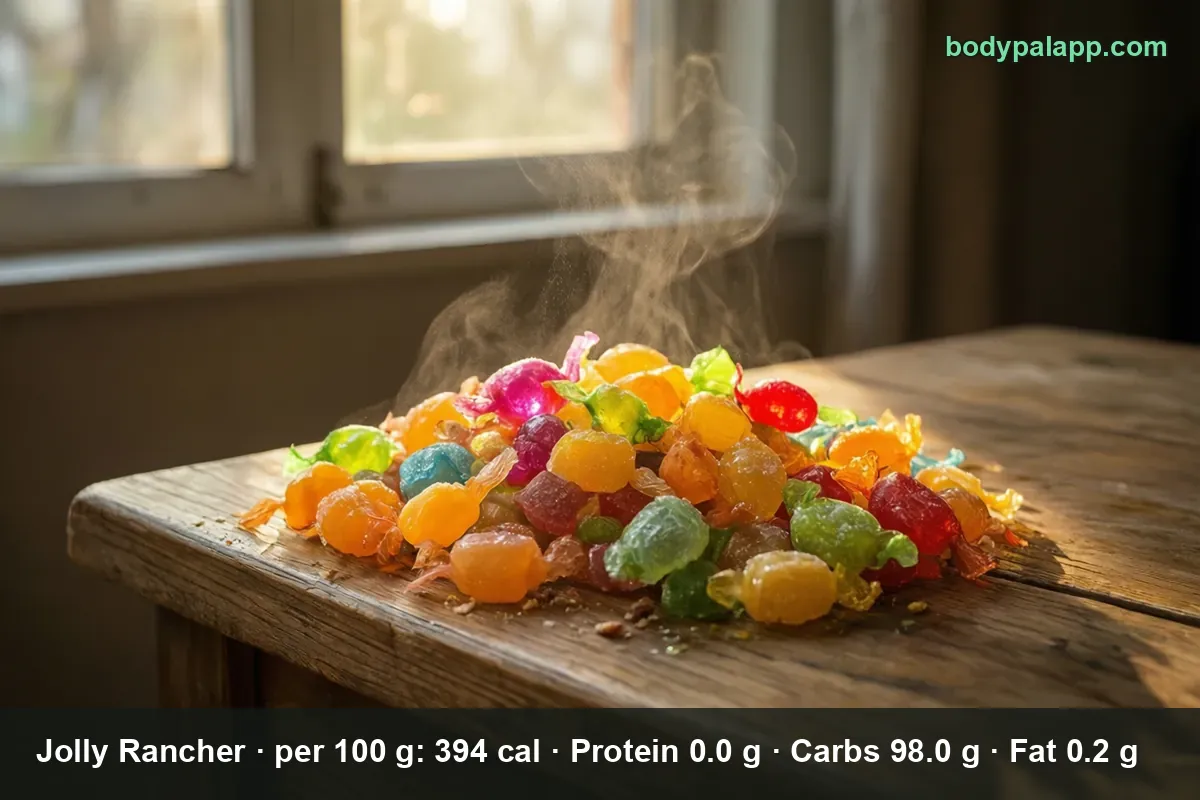
Three Jolly Ranchers weigh 18 g and carry 71 calories, which is the serving printed on the bag. Per 100 g, hard candy runs 394 calories, so one 6 g piece lands at about 24. This is one of the few snacks where the wrapper does most of the portion control for you.
On this page
- Jolly Rancher quick facts
- US servings, from one piece to a full cup
- Gummies, chews and freeze pops
- Where the carbs come from
- How does a Jolly Rancher compare?
- Most popular jolly rancher brands
- FAQ
Jolly Rancher quick facts
The numbers below come from the generic USDA record FNDDS 2710360, "Candy, hard". It is the only hard-candy entry with a complete nutrient panel and household measures attached, which is what you need if you want to count a handful rather than a printed serving. The branded Jolly Rancher record, Branded 1915074, lists 389 calories per 100 g. That is a gap of about 1 percent, smaller than the rounding a nutrition label is allowed to do, so either number gets you to the same place.
The serving column uses three pieces, 18 g, because that is the count Hershey prints on the bag and the count most people search for.
| Nutrient | Per 100 g | Per 3 pieces (18 g) | % Daily Value |
|---|---|---|---|
| Calories | 394 | 71 | — |
| Total fat | 0.2 g | 0.0 g | 0% |
| Saturated fat | 0 g | 0.0 g | 0% |
| Carbohydrate | 98 g | 17.6 g | 6% |
| Dietary fiber | 0 g | 0.0 g | 0% |
| Total sugars | 62.9 g | 11.3 g | — |
| Protein | 0 g | 0.0 g | 0% |
| Sodium | 38 mg | 7 mg | 0% |
% Daily Value is based on a 2,000-calorie diet.
Verified nutrition data
Numbers on this page come from USDA FoodData Central, the U.S. Department of Agriculture’s food composition database, and from manufacturer labels where a branded product is named. Last verified September 2026. How we verify our data →
Two rows you would see on a wrapper are missing here on purpose. USDA does not publish added sugars or trans fat for this generic record, so putting a number in either row would mean inventing one. Cholesterol is 0 mg and potassium is 5 mg per 100 g, which works out to 1 mg in a three-piece serving. Neither is worth a row.
The shape of this food is unusual enough to say out loud: no fat worth measuring, no protein, no fiber, no meaningful sodium. Everything in a Jolly Rancher is carbohydrate, and the calories track the weight almost perfectly. That makes the math easier than it is for most snacks. Weigh the pile, multiply by 3.94, and you are done.
US servings, from one piece to a full cup
| Serving | Weight | Calories |
|---|---|---|
| 1 piece | 6 g | 24 kcal |
| 3 pieces, the bag serving | 18 g | 71 kcal |
| 1 oz | 28.35 g | 112 kcal |
| 1 pouch, regular size | 60 g | 236 kcal |
| Per 100 g | 100 g | 394 kcal |
| 1 cup | 160 g | 630 kcal |
The 60 g pouch, the cup and the 100 g row come straight from the USDA household measures on record 2710360. The single piece, the three-piece serving and the ounce are our own arithmetic from the USDA 100 g figure rather than USDA servings, scaled at 3.94 calories per gram.
The cup is the row that surprises people. A cup of loose hard candy holds about 160 g and 630 calories, roughly nine times the bag serving. Candy dishes at an office desk are usually sized somewhere near that, which is how a food that costs 24 calories a piece turns into a meal-sized number by five o'clock. A single 60 g pouch, the kind sold at a checkout counter, is 236 calories on its own.
One ounce is a useful anchor if you buy from a bulk bin. At 112 calories, an ounce of hard candy is just under five pieces.
Gummies, chews and freeze pops
The Jolly Rancher name now sits on six different products, and they are not interchangeable when you are counting. The label figures below are the branded USDA records.
| Version | Per 100 g | Typical serving | Calories |
|---|---|---|---|
| Hard candy, label figures | 389 kcal | 3 pieces (18 g) | 70 kcal |
| Gummies | 300 kcal | 9 pieces (40 g) | 120 kcal |
| Chews | 390 kcal | 9 pieces (41 g) | 160 kcal |
| Crunch N Chew | 400 kcal | 3 pieces (15 g) | 60 kcal |
| Freeze pops | 83 kcal | 1 pop (120 g) | 100 kcal |
| Fruit Roll-Ups | 400 kcal | 1 roll (14 g) | 56 kcal |
Setting the freeze pops aside, gummies are the lightest per gram at 300 calories per 100 g, because gelatin and water take up space that sugar would otherwise fill. The advantage holds at the serving level too: nine gummies weigh 40 g and cost 120 calories, while nine chews weigh about the same and cost 160. Whether you count by the handful or by the gram, the gummies come out roughly a quarter lighter.
Freeze pops are the outlier and the only row here under 300 calories per 100 g, at 83. That is because a freeze pop is mostly frozen water. A whole 120 g pop is 100 calories, less than a 40 g handful of gummies, and it takes ten minutes to eat instead of thirty seconds. Crunch N Chew and the Fruit Roll-Ups tie for the densest of the six at 400 calories per 100 g, but both come in small pieces, so a three-piece serving of Crunch N Chew is only 60 calories and one fruit roll is 56.
The flavor lines do not change anything. Cinnamon Fire, Blue Raspberry and Watermelon all carry the same 389 calories per 100 g and the same 70 per three pieces as the original hard candy.
Where the carbs come from
Here is the number that does not add up at first glance. Per 100 g the USDA record shows 98 g of carbohydrate but only 62.9 g of total sugars. The missing 35.1 g is corn syrup solids, which are carbohydrate chains long enough that they do not register as sugar in the lab but still deliver the same 4 calories per gram. So "a Jolly Rancher is pure sugar" is not quite right. It is pure carbohydrate, and about two thirds of that is sugar.
For a three-piece serving that means 17.6 g of carbohydrate, or 6% of the FDA Daily Value of 275 g. If you are counting carbs for any reason, one Jolly Rancher is about 5.9 g, our own arithmetic from the 100 g figure.
USDA does not publish added sugars for this generic record, which is why that row is absent from the table above. The Dietary Guidelines for Americans recommend keeping added sugars under 10% of daily calories, and MyPlate puts candy squarely in the category worth budgeting rather than banning. Hard candy is at least an honest place to spend that budget: the piece is small, it is wrapped, and it lasts long enough that you notice you are eating it.
The other row worth a glance is sodium. At 7 mg per serving and 38 mg per 100 g, it rounds to 0% of the Daily Value. Even a whole cup works out to about 61 mg, our own scaling of the 100 g figure, which is under 3%. Fat is 0.2 g per 100 g, which disappears entirely at serving size.
How does a Jolly Rancher compare?
| Candy | Per 100 g | US serving | Calories |
|---|---|---|---|
| Hard candy | 394 kcal | 1 oz (28.35 g) | 112 kcal |
| Gummy candy | 396 kcal | 1 oz (28.35 g) | 112 kcal |
| Taffy | 390 kcal | 1 oz (28.35 g) | 111 kcal |
| Sugar-free non-chocolate candy | 394 kcal | 1 oz (28.35 g) | 112 kcal |
Our take: by weight these four are the same food. Gummy candy is the only row above hard candy per 100 g, and the margin is 2 calories. Taffy is the lightest at 390 and it gets there by swapping 10 g of carbohydrate for 4.12 g of fat, which is not a win. The row that should change your behavior is the sugar-free one, at 394 calories per 100 g, exactly the same as regular hard candy. Sugar alcohols carry nearly as much energy as sugar does, so sugar-free candy is a tooth decision and a blood-sugar decision, not a calorie decision.
If you want the lowest calorie cost per minute of eating, the pick is a freeze pop at 100 calories for a whole 120 g pop. If you want a unit small enough to count without thinking, one hard candy is 24 calories. Both beat reaching into a bowl without counting, which is the only way this food gets expensive.
Most popular jolly rancher brands in the United States
Ranked by how widely each product appears among foods sold in the United States, from the BodyPal food database of over 3.3 million products. Calories are the figures printed on each Nutrition Facts label, checked against USDA FoodData Central.
| Product | Calories (per 100 g) |
|---|---|
| Jolly Rancher Hard Candy, Original | 389 cal |
| Jolly Rancher Hard Candy, Cinnamon Fire | 389 cal |
| Jolly Rancher Hard Candy, Blue Raspberry | 389 cal |
| Jolly Rancher Watermelon Hard Candy | 389 cal |
| Jolly Rancher Gummies, Original | 300 cal |
| Jolly Rancher Chews, Original | 390 cal |
Brand popularity: BodyPal food database. Nutrition: manufacturer labels / USDA FoodData Central.
Jolly Rancher FAQs
How many calories are in one Jolly Rancher?
One piece is about 24 calories. A single hard candy weighs roughly 6 g, and USDA lists hard candy at 394 calories per 100 g, so the piece works out to 23.6 before rounding. That figure is our own arithmetic from the 100 g record rather than a USDA serving.
How many calories in 3 Jolly Ranchers?
Three pieces are 71 calories at 18 g total, which is the serving size printed on the bag. Hershey's own label rounds it to 70 for the branded record. All of it is carbohydrate: 17.6 g, with no fat, no protein and no fiber to speak of.
How much sugar is in a Jolly Rancher?
About 3.8 g of total sugars in one 6 g piece, and 11.3 g in a three-piece serving. USDA reports 62.9 g of total sugars per 100 g of hard candy. USDA does not publish added sugars for this generic record, so we do not list that number anywhere on the page.
Are Jolly Ranchers fat free?
Effectively yes: 0.2 g of fat per 100 g, which rounds to 0.0 g in a three-piece serving and 0% of the Daily Value. Saturated fat is 0 g. Cholesterol is 0 mg. The energy comes entirely from carbohydrate, which is why the calorie count tracks weight so closely.
How many calories in a bag of Jolly Ranchers?
A regular 60 g pouch is 236 calories. A loose cup, about 160 g, comes to 630. Both are USDA household measures for hard candy. That means a cup is roughly nine of the three-piece servings printed on the bag, which is the number worth remembering if there is a candy dish on your desk.
Jolly Rancher gummies vs hard candy calories?
Gummies are 300 calories per 100 g against 389 for the branded hard candy. Nine gummies weigh 40 g and cost 120 calories, while three hard candies weigh 18 g and cost 70. Per gram the gummies win, and piece for piece they win as well, because a gummy weighs less than a hard candy.
Do sugar-free hard candies have fewer calories?
No. USDA lists sugar-free non-chocolate candy at 394 calories per 100 g, the same figure as regular hard candy. Sugar alcohols supply nearly as much energy as sugar. Sugar-free versions matter for teeth and for blood sugar response, but they will not move your daily calorie total.
How many carbs are in a Jolly Rancher?
About 5.9 g per piece and 17.6 g in a three-piece serving, which is 6% of the 275 g Daily Value. Per 100 g the record shows 98 g of carbohydrate against 62.9 g of sugars, so roughly 35 g of it is corn syrup solids rather than sugar.
Similar foods
- Candy Cane — 47 cal per candy cane
- Chocolate Cheesecake — 690 cal per slice
- Dum Dum Pop — 20 cal per pop
- Lemon Drop Candy — 24 cal per drop
- Lollipop — 39 cal per lollipop
- Smarties Candy — 24 cal per roll
Count it without the math
Point the camera at the candy dish and BodyPal counts the pieces for you.


How long does it take to burn off Jolly Rancher?
Three pieces (18 g) is 71 kcal. Enter your weight and the amount you ate to see how long it takes you to burn that off:
lb
| Activity | Time to burn 71 kcal |
|---|---|
| Walking, brisk | 14 min |
| Cycling, moderate | 9 min |
| Swimming, moderate | 10 min |
| Jogging | 8 min |
| Weight training, moderate | 16 min |
Times are for a 155 lb adult at a steady pace; change the weight to see yours. The amount is set to the portion in the text (18 g); change it to what you actually ate. BodyPal works this out from your steps automatically.
Want the bigger picture? Calculate your daily calorie needs — your maintenance figure, a target for losing or gaining, and the date you get there.