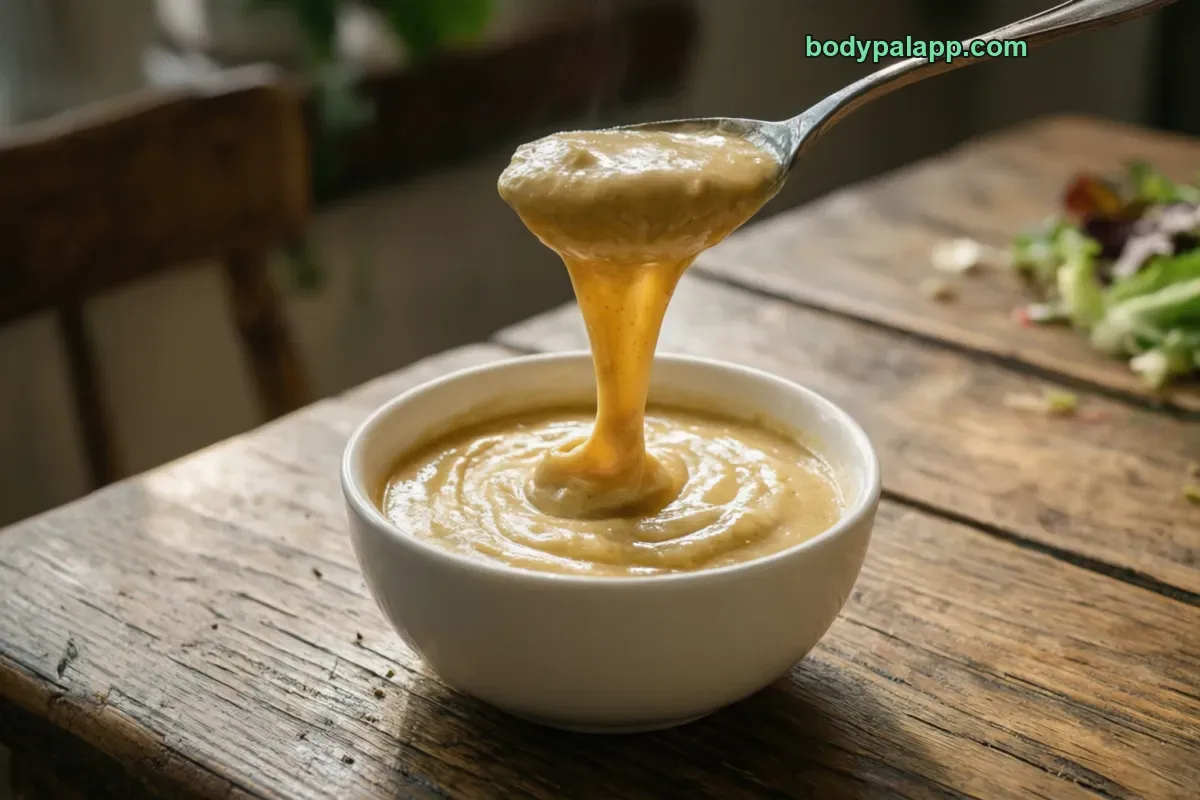
Honey mustard dressing calories come to 139 for 2 tbsp (30 g) of regular bottled dressing and 464 per 100 g. The detail worth noticing: fat supplies 79% of those calories, not the honey. A light version brings the same 2 tbsp down to 62, so the bottle you pick and the size of your pour decide the total.
139kcal
1 2 tbsp serving · 30 g, regular, bottled
1%protein
0.3 gProtein
7 gCarbs
12.2 gFat
How to burn off 139 kcal
—Walking, brisk
—Jogging
—Cycling, moderate
—Swimming
Skip the math. BodyPal counts these calories from your steps and workouts automatically.
Nutrition facts
Regular, bottled · per 30 g
Calories
139 kcal
Protein
0.3 g
Carbohydrate
7 g
Fat
12.2 g
Saturated fat
1.5 g
Cholesterol
9 mg
Sodium
154 mg
Potassium
6 mg
Iron
0.1 mg
Source: USDA FoodData Central
🛡️
Verified nutrition data
Numbers on this page come from USDA FoodData Central, the U.S. Department of Agriculture’s food composition database, and from manufacturer labels where a branded product is named. Last verified September 2026. How we verify our data →
Honey mustard dressing: calories, protein and sodium by serving
Percent of daily value uses the FDA reference of 2,000 kcal a day.
Serving
kcal
Protein
Carbs
Fat
Sodium
% DV kcal
2 tbsp (30 g)
139
0.3 g
7 g
12.2 g
154 mg
7%
Light, 2 tbsp (30 g)
62
0.3 g
8.5 g
3 g
210 mg
3%
1 packet (44 g)
204
0.4 g
10.3 g
18 g
225 mg
10%
100 g
464
0.9 g
23.3 g
40.8 g
512 mg
23%
3 × 2 tbsp (30 g)
418
0.8 g
461 mg
5 × 2 tbsp (30 g)
696
1.3 g
768 mg
The pour decides the total, not the salad
A measured 2 tbsp (30 g) of regular honey mustard adds 139 calories and 154 mg of sodium, about 7% of the daily value for each. That is a modest number on paper. The trouble is that few people measure dressing, and a salad bowl hides how much goes in.
Double the pour to 60 g and you reach 278 calories. Three servings, or 90 g, land at 418, which is more than many of the vegetables underneath. A generous 150 g drench, the kind that pools at the bottom of a takeout container, totals 696 calories and 768 mg of sodium. A single 1 packet (44 g) sits in between at 204 calories, or 10% of the daily value.
The practical move is simple. Pour into a spoon or a small cup first, then onto the salad. Dipping the fork before each bite also works, since it coats the food without soaking it. If you track your meals, BodyPal can log the dressing from a photo, but a measured pour still beats any estimate.
Fat, not honey, carries 79% of the calories
The name suggests sugar, yet the calorie split says otherwise: 79% from fat, 20% from carbs and 1% from protein. Per 100 g the dressing holds 40.8 g of fat against 23.3 g of carbs. The oil base does most of the work, and the honey and mustard mainly add flavor.
Sugar is still present. There are 15.8 g of sugars per 100 g, which works out to 4.8 g in a 2 tbsp serving and 7 g in a packet. That is noticeable for a condiment but far from dessert territory. The fat is the bigger lever: 12.2 g in one regular serving, with saturated fat at 5 g per 100 g.
Protein barely registers at 0.3 g per serving, and fiber is 0.1 g. So the dressing adds energy and taste but no staying power of its own. Whatever keeps you full has to come from the salad itself.
Light honey mustard cuts fat but adds sodium
The light version is the clearest swap on this page. A 2 tbsp (30 g) serving drops from 139 to 62 calories, and fat falls from 12.2 g to 3 g. If calories are your main concern, that difference adds up fast across a week of salads.
The trade is in the other rows. Light dressing carries 8.5 g of carbs and 5.5 g of sugars per serving, slightly more than the regular 7 g and 4.8 g. Sodium climbs too, from 154 mg to 210 mg, or 9% of the daily value instead of 7%. Manufacturers often replace fat with sugar, starch and salt to keep the texture and taste.
If you watch sodium more than calories, regular dressing in a small pour may suit you better than a large pour of light. If calories come first, light wins clearly. Brands such as Ken's Steak House sell both regular and lite honey mustard, so it pays to check which bottle is in the fridge.
Pair it with foods that bring the protein
Because the dressing offers almost no protein or fiber, it works best on plates that supply both. Grilled chicken, eggs or beans on a bed of greens balance a dressing that is mostly fat. Raw vegetables such as carrots and cucumber make a good dipping base too, since they add volume for very few calories.
Honey mustard also turns up as a dip for chicken tenders and pretzels and as a glaze for pork or salmon. In those roles, portions drift even higher than on salads. Treat a packet as one serving and the numbers above stay honest.
A thinner option is to stretch the dressing with a squeeze of lemon or a splash of vinegar. You keep the honey mustard taste while spreading the same 2 tbsp over more leaves.
How does honey mustard dressing compare?
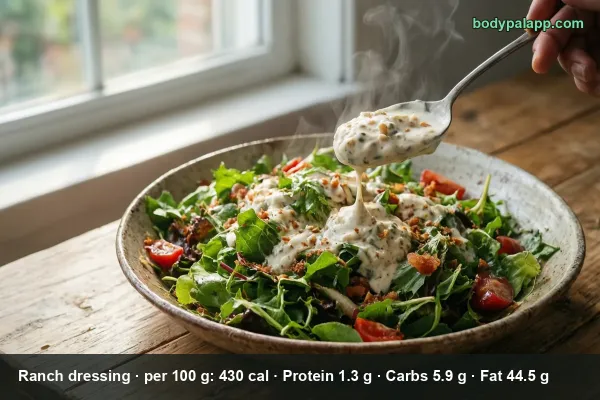
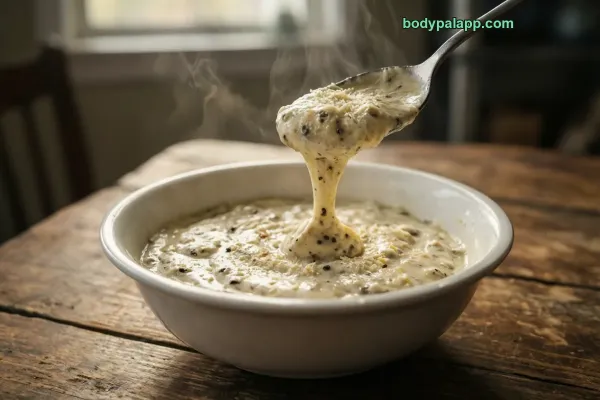
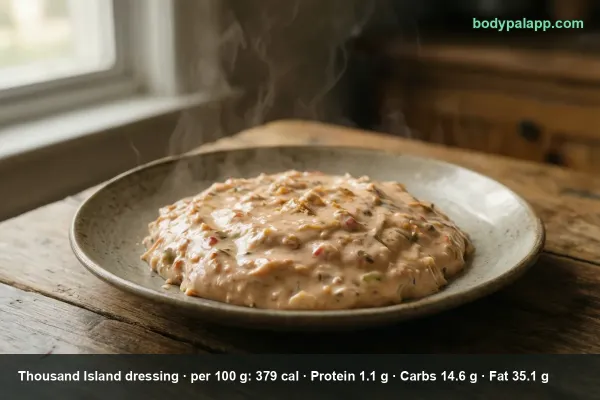
Here is how honey mustard dressing compares with ranch, caesar and thousand island dressing per 100 g and per usual serving.
Verdict: For the fewest calories per 100 g, thousand island at 379 edges out honey mustard at 464, while caesar is the heaviest at 542 per 100 g and 163 per 2 tbsp. If sodium matters most, honey mustard is the pick at 512 mg per 100 g, well under ranch at 810 mg, thousand island at 962 mg and caesar at 1,209 mg.
Most popular honey mustard dressing brands in the United States
Two tablespoons (30 g) have 139 calories, and a 44 g packet has 204.
Is honey mustard dressing good for weight loss?
Regular honey mustard has 464 calories per 100 g, so 2 tbsp give 139 calories and 12.2 g fat. The light version has 62 calories per 2 tbsp and fat-free has 51.
Honey mustard vs ranch dressing: which has more calories?
Honey mustard has 464 calories per 100 g and ranch 430, so 2 tbsp (30 g) come to 139 vs 129. Honey mustard also has 15.8 g sugar per 100 g against 4.7 g in ranch.
How much sugar is in honey mustard dressing?
Two tablespoons contain 4.8 g sugar and 7.0 g carbs, which is 15.8 g sugar per 100 g.
How many calories are in a packet of honey mustard dressing?
A 1 packet (44 g) portion of honey mustard dressing has 204 calories, about 10% of the daily value. It also carries 18 g of fat, 7 g of sugars and 225 mg of sodium.
How many calories are in light honey mustard dressing?
Light honey mustard dressing has 62 calories per 2 tbsp (30 g), compared with 139 for regular. Fat drops to 3 g, but sodium rises to 210 mg and sugars to 5.5 g.
How much fat is in honey mustard dressing?
Regular honey mustard dressing has 12.2 g of fat per 2 tbsp (30 g) and 40.8 g per 100 g. Fat supplies 79% of its calories, with saturated fat at 5 g per 100 g.
How much sodium is in honey mustard dressing?
A 2 tbsp (30 g) serving of regular honey mustard dressing holds 154 mg of sodium, about 7% of the daily value. Per 100 g it is 512 mg, lower than ranch, caesar or thousand island.
Does honey mustard dressing have protein?
Barely. A 2 tbsp (30 g) serving has 0.3 g of protein, and 100 g has just 0.9 g. Protein makes up only 1% of its calories, so the protein in your meal has to come from other foods.