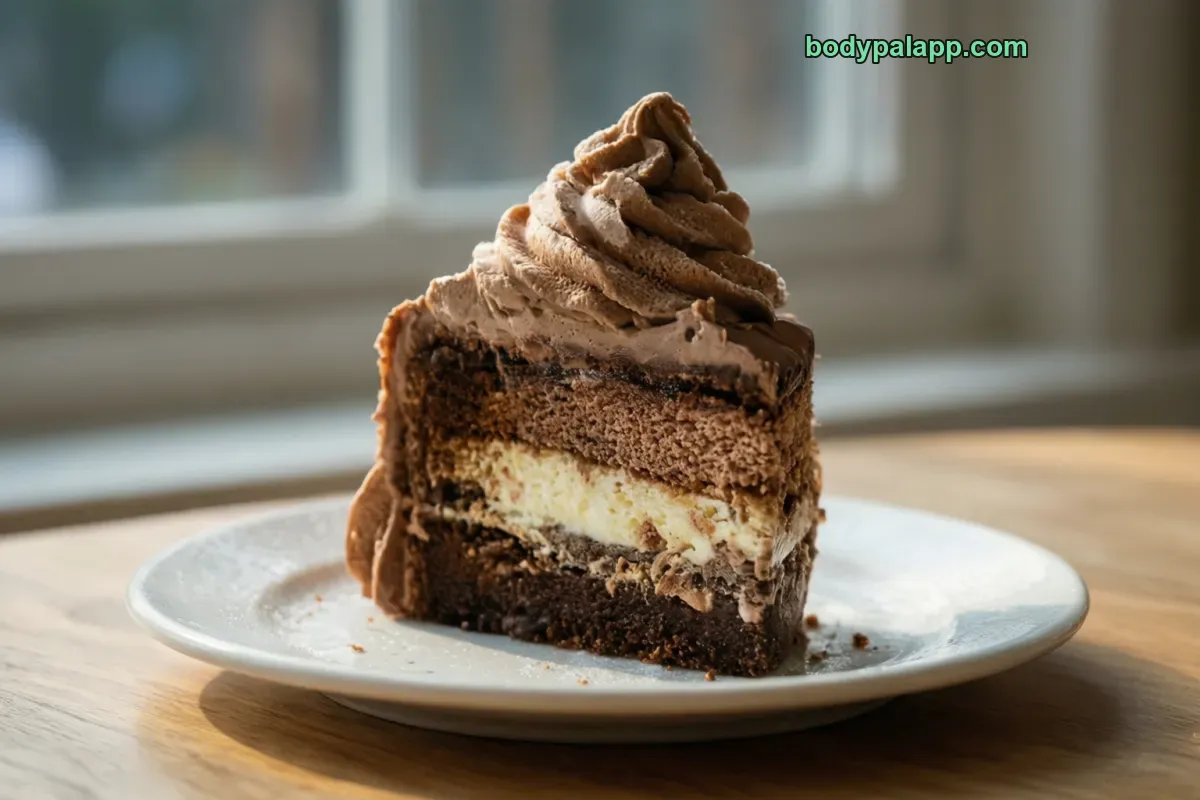
Ice cream cake calories come to 96 for one 34 g slice and 283 per 100 g. The slice is small, and most people eat more than one. Carbs give 56% of the energy and fat 40%, and much of that carb load is sugar. How much you cut matters more than anything else on the label.
96kcal
1 slice · 34 g, frozen, ready to eat
4%protein
1 gProtein
13 gCarbs
4.3 gFat
How to burn off 96 kcal
—Walking, brisk
—Jogging
—Cycling, moderate
—Swimming
Skip the math. BodyPal counts these calories from your steps and workouts automatically.
Nutrition facts
Frozen, ready to eat · per 34 g
Calories
96 kcal
Protein
1 g
Carbohydrate
13.4 g
Fat
4.3 g
Saturated fat
1.6 g
Cholesterol
15 mg
Sodium
67 mg
Potassium
41 mg
Iron
0.2 mg
Source: USDA FoodData Central
🛡️
Verified nutrition data
Numbers on this page come from USDA FoodData Central, the U.S. Department of Agriculture’s food composition database, and from manufacturer labels where a branded product is named. Last verified September 2026. How we verify our data →
Ice cream cake: calories, protein and sodium by serving
Percent of daily value uses the FDA reference of 2,000 kcal a day.
Serving
kcal
Protein
Carbs
Fat
Sodium
% DV kcal
1 slice (34 g)
96
1 g
13.4 g
4.3 g
67 mg
5%
1 cup (138 g)
391
4.1 g
54.2 g
17.5 g
270 mg
20%
Whole 12 oz roll (340 g)
962
10 g
133.6 g
43.1 g
666 mg
48%
100 g
283
3 g
39.3 g
12.7 g
196 mg
14%
3 × 1 slice (34 g)
289
3 g
200 mg
5 × 1 slice (34 g)
481
5 g
333 mg
A 34 g slice is small, so the total climbs fast
The default slice weighs 34 g and carries 96 calories, about 5% of a 2000-calorie daily value. That is a thin wedge, closer to a sliver than the piece most party knives cut. Two of those slices (68 g) come to 192 calories. Three (102 g) reach 289.
A cup of ice cream cake, 138 g, lands at 391 calories, or 20% of the daily value. That is a realistic plate at a birthday table, and it is four times the label slice. Five slices together (170 g) add up to 481 calories.
The whole 12 oz roll, 340 g, holds 962 calories, 48% of the daily value. If you are counting, weigh one serving once so you know what your usual cut looks like. BodyPal can also log the slice from a photo, which helps when the portion is a guess.
Carbs and fat supply almost every calorie
Per 100 g, ice cream cake has 39.3 g of carbs, 12.7 g of fat and only 3 g of protein. In calorie terms that is 56% carbs, 40% fat and 4% protein. This is a dessert built from sugar and cream, and the numbers read that way.
Protein barely registers. A slice gives 1 g, and even a full cup supplies 4.1 g, just 8% of the 50 g daily value. Fiber is close to zero too, at 0.5 g per 100 g and 0.2 g per slice.
Fat is the second engine. A cup carries 17.5 g of fat, and the whole roll 43.1 g. With little protein or fiber to slow things down, ice cream cake is easy to eat quickly and does little to keep you full afterward.
Sugar is the row to watch
Ice cream cake has 31.2 g of sugars per 100 g, out of 39.3 g of total carbs. So most of the carbohydrate is sugar rather than starch. One 34 g slice brings 10.6 g of it.
Scale up and the figure gets large. A cup has 43.1 g of sugars, and the whole roll 106.2 g. If you track added sugar or carbs, the cup is the serving to think about, since that is closer to what lands on a party plate than the label slice.
Saturated fat sits at 4.8 g per 100 g, against a daily value of 20 g. Cholesterol is 44 mg per 100 g against a 300 mg daily value. Sodium is mild for a dessert: 67 mg per slice, 3% of the daily value, and 270 mg per cup, 12%.
One slice fits; the cup needs a plan
At 96 calories, a single slice slots into most days without much adjustment. The cup at 391 calories is closer to the size of a small meal, and it brings little protein or fiber to show for it. Treat it as the dessert it is.
If ice cream cake is on the menu, a meal with lean protein and vegetables beforehand leaves room for it and covers what the cake lacks. Fresh fruit on the side adds volume to the plate for a modest calorie cost. Water or unsweetened drinks keep the sugar total from stacking further.
Serve it frozen and cut thin slices. A firm cake cuts cleaner, and thin slices make it easier to stop at one or two.
How does ice cream cake compare?
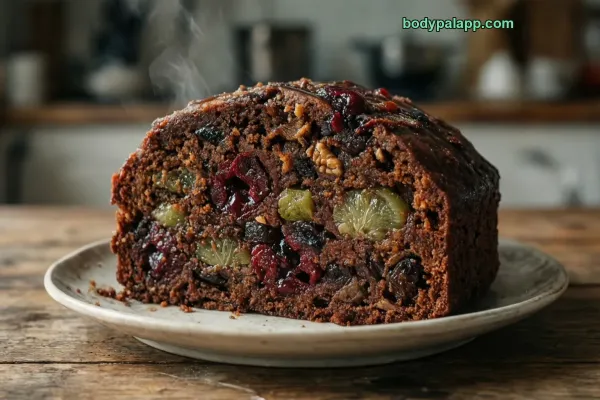
Here is how ice cream cake stacks up against fruit cake, lemon cake and butter cake, per 100 g and per usual serving.
Verdict: Ice cream cake is the lightest of the four at 283 calories per 100 g, against 324 for fruit cake, 339 for lemon cake and 353 for butter cake. For the smallest dessert pick a 96-calorie slice of ice cream cake; skip a 175 g slice of lemon cake at 593 unless you plan to share it.
Ice cream cake FAQs
How many calories are in a slice of ice cream cake?
A 34 g slice of ice cream cake has about 96 calories, and a 138 g cup has 391.
How much sugar is in ice cream cake?
Ice cream cake has 31.2 g of sugar per 100 g, which is about 10.6 g in a 34 g slice.
Is ice cream cake good for weight loss?
It is a sugary dessert at 283 calories per 100 g, with 39.3 g of carbs and 12.7 g of fat. A 34 g slice comes to 96 calories.
Ice cream cake vs fruit cake: which has fewer calories?
Ice cream cake has 283 calories per 100 g, while fruit cake has 324, so ice cream cake is lower by weight.
How many calories are in a cup of ice cream cake?
A cup of ice cream cake (138 g) has 391 calories, about 20% of a 2000-calorie daily value. It also carries 17.5 g of fat, 54.2 g of carbs and 4.1 g of protein.
How many calories are in a whole ice cream cake roll?
A whole 12 oz ice cream cake roll (340 g) has 962 calories, 48% of the daily value. It holds 106.2 g of sugars and 43.1 g of fat, so it is best shared.
How much fat is in a slice of ice cream cake?
A 34 g slice of ice cream cake has 4.3 g of fat. Per 100 g the figure is 12.7 g, including 4.8 g of saturated fat, and fat supplies 40% of the calories.
Does ice cream cake have much protein?
No. Ice cream cake has 3 g of protein per 100 g and 1 g per slice. Protein provides only 4% of its calories, while carbs give 56% and fat 40%.