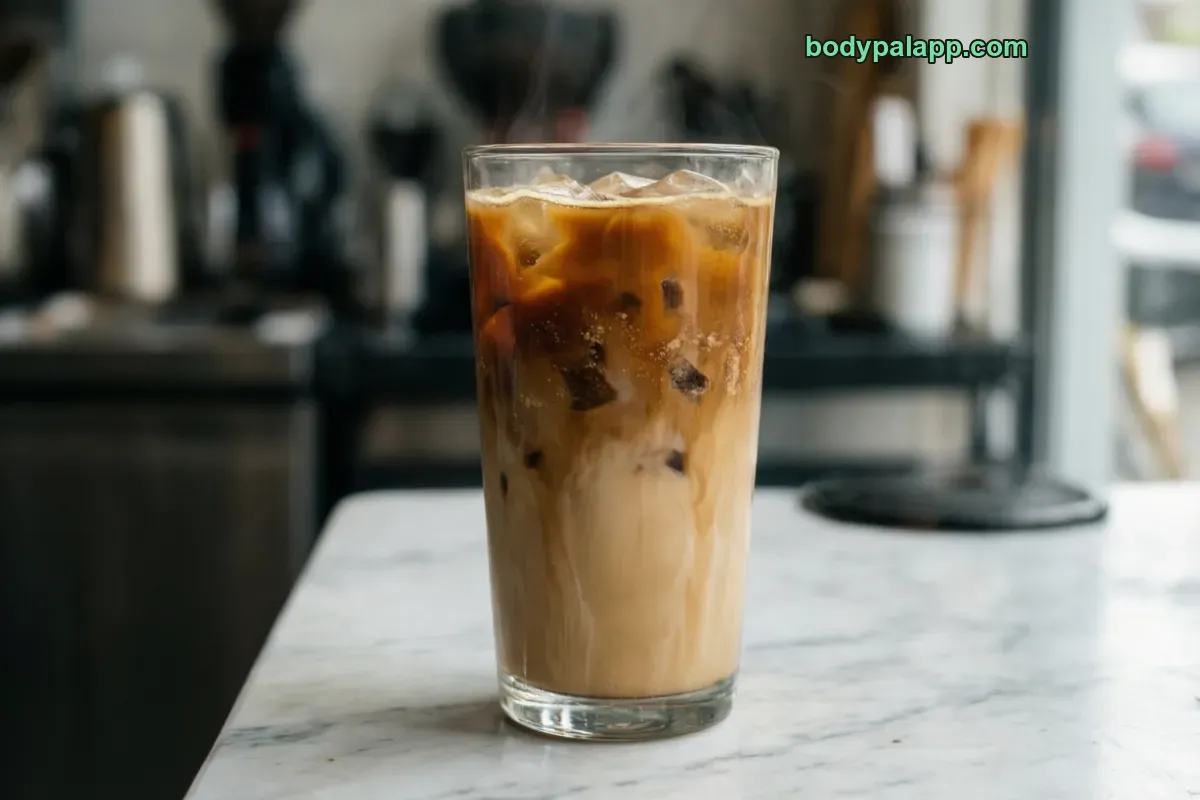
Iced latte calories come to 130 for a medium (480 g) cup and 27 per 100 g, made unsweetened with milk. The number to watch is the cup size: the same drink runs from 97 calories in a small to 162 in a large, and switching to nonfat milk brings a medium down to 91.
130kcal
1 medium iced latte · 480 g, unsweetened, with milk
26%protein
8.4 gProtein
13 gCarbs
4.8 gFat
How to burn off 130 kcal
—Walking, brisk
—Jogging
—Cycling, moderate
—Swimming
Skip the math. BodyPal counts these calories from your steps and workouts automatically.
Nutrition facts
Unsweetened, with milk · per 480 g
Calories
130 kcal
Protein
8.4 g
Carbohydrate
13.5 g
Fat
4.8 g
Saturated fat
2.8 g
Cholesterol
19 mg
Sodium
110 mg
Potassium
490 mg
Iron
0.1 mg
Source: USDA FoodData Central
🛡️
Verified nutrition data
Numbers on this page come from USDA FoodData Central, the U.S. Department of Agriculture’s food composition database, and from manufacturer labels where a branded product is named. Last verified October 2026. How we verify our data →
Iced latte: calories, protein and sodium by serving
Percent of daily value uses the FDA reference of 2,000 kcal a day.
Serving
kcal
Protein
Carbs
Fat
Sodium
% DV kcal
Medium (480 g)
130
8.4 g
13.5 g
4.8 g
110 mg
6%
Small (360 g)
97
6.3 g
10.1 g
3.6 g
83 mg
5%
Large (600 g)
162
10.5 g
16.9 g
6.1 g
138 mg
8%
Nonfat medium (480 g)
91
8.5 g
13.5 g
0.3 g
115 mg
5%
3 × Medium (480 g)
389
25.2 g
331 mg
5 × Medium (480 g)
648
42 g
552 mg
Cup size sets the total, not the coffee
A small iced latte (360 g) has 97 calories, a medium (480 g) has 130 and a large (600 g) has 162. The espresso adds almost nothing; the milk does the work. So when you size up, you are mostly ordering more milk, and the sugar follows the same path, from 9 g in a small to 15.1 g in a large.
Habits matter more than any single cup. Two medium iced lattes a day add 259 calories, three add 389, and a five-cup day reaches 648 calories with 552 mg of sodium. None of those cups looks big on its own, which is exactly why a daily routine is easy to undercount.
Against the daily value, a small covers 5% of your calories, a medium 6% and a large 8%. That is modest for a drink that also brings real protein. If you log your coffee, log the cup size you actually ordered, because the jump from small to large is bigger than most people guess.
A third of the calories is fat, a quarter is protein
The calorie split is 41% carbs, 33% fat and 26% protein. Per 100 g that works out to 2.8 g of carbs, 1 g of fat and 1.8 g of protein. Of those carbs, 2.5 g are sugars and fiber is 0, so in an unsweetened iced latte nearly all the carbohydrate is the sugar that comes with the milk.
The protein is the strong part of the label. A medium cup gives 8.4 g, which is 17% of the daily value, and a large gives 10.5 g, or 21%. Few drinks in this calorie range come close. Two medium cups put 16.8 g of protein on your day.
Saturated fat is 0.6 g per 100 g, and a medium carries 4.8 g of total fat. That fat is where the whole milk version spends its calories. If you want the same protein for less energy, the milk choice is the lever, not the size of the espresso shot.
Nonfat milk takes a medium down to 91 calories
Swap to nonfat milk and a medium (480 g) drops from 130 calories to 91. Fat falls from 4.8 g to 0.3 g. Protein holds steady at 8.5 g, still 17% of the daily value, so you give up nothing on the part that keeps you full.
What does not change is the carbohydrate. Both mediums carry 13.5 g of carbs, and the nonfat cup has 12.5 g of sugars against 12 g for the regular one. Sodium barely moves either, 115 mg versus 110 mg. Nonfat is a fat cut, not a sugar cut.
Flavored iced lattes are a different drink. Caramel, vanilla and mocha versions, like the bottled ones from Black Stag or Maxwell House, add sweetener on top of the milk, so the numbers on this page describe the unsweetened base. If you order a flavored cup, the syrup comes in addition to the figures above.
Sodium is low, so the cup fits most days
A medium iced latte has 110 mg of sodium, only 5% of the daily value, and even a large stays at 138 mg, or 6%. Cholesterol is 4 mg per 100 g and potassium is 102 mg per 100 g. This is not a drink with a hidden problem row; the totals are driven by milk and portion.
Because it brings protein but no fiber, an iced latte works best next to food rather than as a meal on its own. Pairing it with something that has fiber, such as fruit or a whole grain, rounds out what the cup lacks. If you drink it mid-afternoon, it can stand in as a small snack.
If you track your intake, the easiest win is consistency: same cup size, same milk, logged every time. BodyPal can log an iced latte from a photo, which helps when the coffee is a daily habit and the cups start to blur together.
How does iced latte compare?
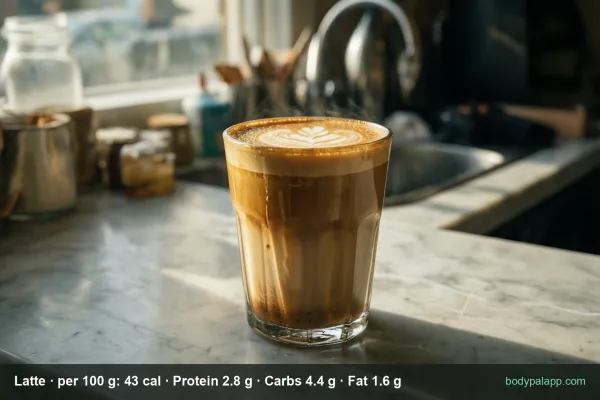
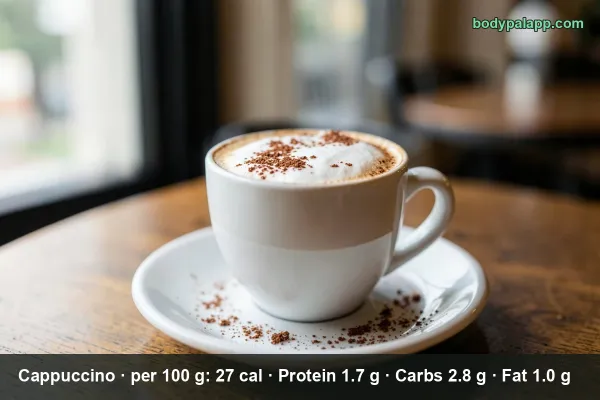
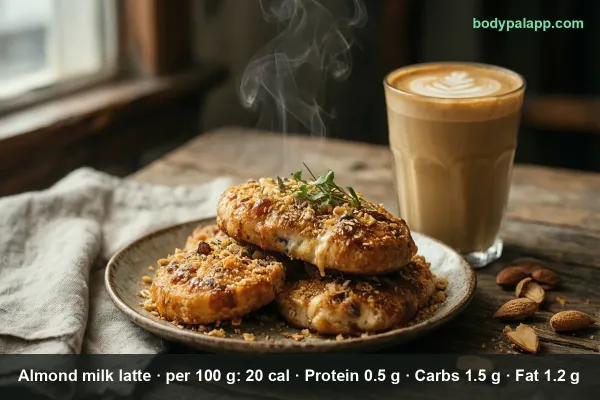
Here is how an iced latte stacks up against a hot latte, a cappuccino and an almond milk latte, per 100 g and per usual serving.
Verdict: For the fewest calories pick the almond milk latte at 20 per 100 g, though it gives just 0.5 g of protein against 1.8 g in an iced latte. The hot latte at 43 per 100 g runs about 1.6 times the iced version, while the cappuccino matches it at 27, so choose between those two on taste alone.
Most popular iced latte brands in the United States
Ranked by popularity in the BodyPal database
# Productkcal / 100 g
1Maxwell House Caramel With Foam Iced Latte1 packet · 28 g429 kcal
8Hostess Honey Bun Iced Latte1 bottle · 405 ml69 kcal
Bottled iced lattes are flavored and sweetened, so they read higher per 100 g, and the Maxwell House packet is a dry powder weighed before mixing. Source: manufacturer labels / USDA FoodData Central.
Iced latte FAQs
How many calories are in an iced latte?
A medium iced latte (480 g) has about 130 calories, a small (360 g) 97 and a large (600 g) 162.
Is an iced latte good for weight loss?
An unsweetened medium iced latte is 130 calories, or 91 made with nonfat milk. A flavored medium (496 g) comes to about 198 calories.
Iced latte vs latte: which has fewer calories?
An iced latte has 27 calories per 100 g, compared with 43 per 100 g for a hot latte.
How much protein and sugar is in an iced latte?
A medium iced latte has about 8.4 g protein, 13.5 g carbs and 12.0 g sugar, all from the milk, with 4.8 g fat.
How many calories are in a medium iced latte?
A medium iced latte (480 g) has 130 calories when made unsweetened with milk. It also gives 8.4 g of protein, 13.5 g of carbs and 4.8 g of fat, about 6% of the daily value for calories.
How many calories are in one small iced latte?
One small iced latte (360 g) has 97 calories. It carries 6.3 g of protein, 9 g of sugars and 83 mg of sodium, which is 5% of the daily value for calories.
How many calories are in a large iced latte?
A large iced latte (600 g) has 162 calories. That cup brings 10.5 g of protein, 15.1 g of sugars and 138 mg of sodium, or 8% of the daily value for calories.
How many calories are in a nonfat iced latte?
A nonfat medium iced latte (480 g) has 91 calories, against 130 for the regular medium. Fat drops to 0.3 g while protein stays at 8.5 g, and sugars sit at 12.5 g.
How many calories are in two iced lattes?
Two medium iced lattes add up to 259 calories. Together they give 16.8 g of protein and 221 mg of sodium. Three mediums reach 389 calories.