
How many calories are in a cappuccino?
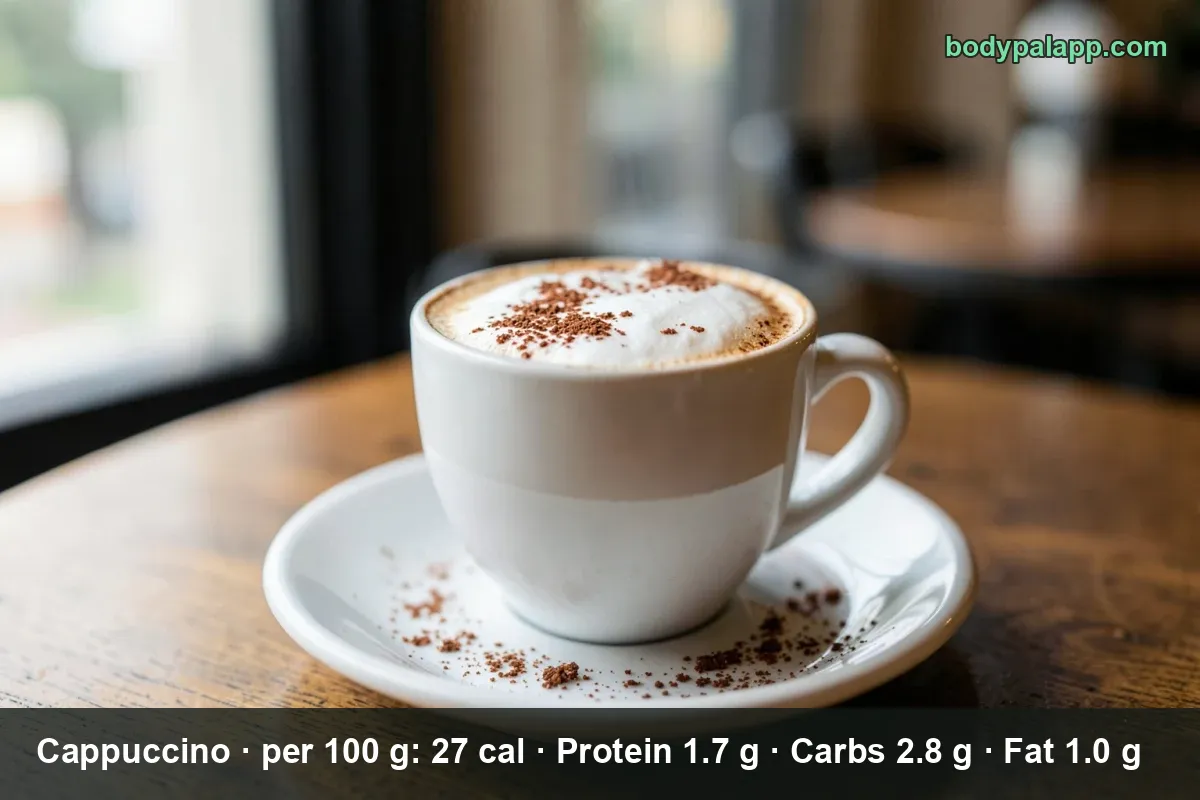
A 1-cup (240 g) cappuccino made with whole milk is 65 calories. The drink itself is light — 27 calories per 100 g — because most of what fills the cup is steamed milk and foam. What actually moves the number is the pour: an American large holds 600 g and lands at 162 calories.
On this page
- Cappuccino quick facts
- US servings, from one ounce to a large
- Skim, decaf and non-dairy cappuccinos
- Protein is the row people miss
- How does a cappuccino compare?
- Most popular cappuccino brands
- Cappuccino FAQs
Cappuccino quick facts
The record behind every number here is FNDDS 2710472, "Coffee, Cappuccino", from the 2021–2023 survey release. It is the prepared drink with regular milk — the cup a person is holding when they look this up, not a powder and not a syrup-flavored version. Five other cappuccino records exist in the same release; each one is this same drink with different milk or without caffeine, and they get their own section below.
USDA's own household measure for this record is 1 cup, 8 fl oz, 240 g. That is the column on the right.
| Nutrient | Per 100 g | Per 1 cup (240 g) | % Daily Value |
|---|---|---|---|
| Calories | 27 | 65 | — |
| Total fat | 0.99 g | 2.4 g | 3% |
| Saturated fat | 0.57 g | 1.4 g | 7% |
| Carbohydrate | 2.75 g | 6.6 g | 2% |
| Dietary fiber | 0 g | 0 g | 0% |
| Total sugars | 2.46 g | 5.9 g | — |
| Protein | 1.71 g | 4.1 g | 8% |
| Sodium | 23 mg | 55 mg | 2% |
| Cholesterol | 4 mg | 10 mg | 3% |
| Potassium | 100 mg | 240 mg | 5% |
% Daily Value is based on a 2,000-calorie diet.
Verified nutrition data
Numbers on this page come from USDA FoodData Central, the U.S. Department of Agriculture’s food composition database, and from manufacturer labels where a branded product is named. Last verified September 2026. How we verify our data →
Two rows you would see on a packaged label are missing on purpose. USDA does not publish added sugars or trans fat for this record, so there is nothing honest to print in either line. The 5.9 g of sugar in the cup is lactose that arrived with the milk; a pump of vanilla syrup would sit on top of it and is not counted anywhere on this page. The percentages come from the FDA's Daily Value reference amounts for a 2,000-calorie day.
US servings, from one ounce to a large
| Serving | Weight | Calories |
|---|---|---|
| 1 oz | 28 g | 8 kcal |
| 1 cup (8 fl oz) | 240 g | 65 kcal |
| 1 small | 360 g | 97 kcal |
| 1 medium | 480 g | 130 kcal |
| 1 large | 600 g | 162 kcal |
| Per 100 g | 100 g | 27 kcal |
Small, medium and large are USDA's own size steps for this drink, not our invention — which makes the spread unusually trustworthy. Only the 1 oz line is our own arithmetic from the USDA 100 g figure, and it exists mainly to show how little a single ounce of this stuff is worth.
Here is the trap. A cappuccino is roughly a third espresso, a third steamed milk, a third foam, so a bigger cup is mostly more air and more milk in the same ratio. People treat "large" as a small upgrade. It is 600 g against 240 g — two and a half times the cup, and 162 calories against 65. Ordering a large instead of a regular costs you more calories than adding a whole extra regular cappuccino later in the day.
Instant cappuccino mixes are a separate animal. Dry powders in USDA's branded data run 429 to 759 calories per 100 g, but the scoop is tiny: a 7.9 g Tassimo disc is 60 calories, while a 28 g Cafe Bustelo envelope is 120 — nearly double a brewed cup, because the mix brings its own sugar and creamer.
Skim, decaf and non-dairy cappuccinos
| Version | Per 100 g | 1 cup (240 g) | Protein per cup |
|---|---|---|---|
| Regular milk | 27 kcal | 65 kcal | 4.1 g |
| Nonfat (skinny) | 19 kcal | 46 kcal | 4.2 g |
| Decaffeinated | 27 kcal | 65 kcal | 4.1 g |
| Non-dairy milk | 17 kcal | 41 kcal | 1.4 g |
| Decaf, nonfat | 19 kcal | 46 kcal | 4.2 g |
| Decaf, non-dairy | 17 kcal | 41 kcal | 1.4 g |
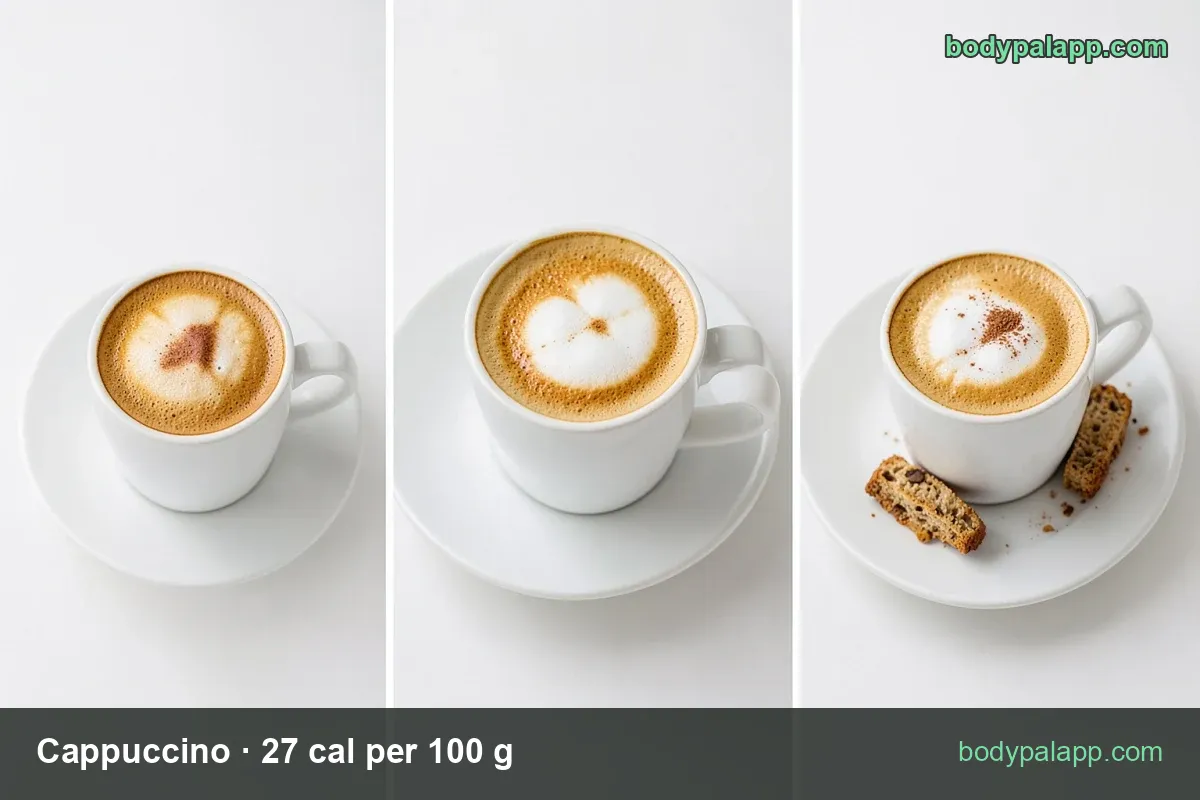
Nonfat is the efficient swap. Skim milk takes the cup from 65 to 46 calories and saturated fat from 1.4 g down to 0.1 g, while protein actually nudges up to 4.2 g. Nineteen calories is not dramatic on one cup; across a two-a-day habit it is close to 14,000 calories a year, which is the kind of number that only shows up on a calendar.
Decaf changes nothing on the label. USDA keeps a separate record for it, and the macros land within a rounding step of the caffeinated row — 1.72 g of protein per 100 g against 1.71 g. If you are switching to decaf, switch for sleep, not for calories.
Non-dairy is the lowest and the emptiest. At 41 calories a cup it beats every other version, but protein collapses from 4.1 g to 1.4 g and sugars drop to 2.5 g. USDA carries one generic non-dairy row, so oat, almond and soy all fall under it; a sweetened oat carton at your café can sit well above the number. The protein columns in variant tables above the USDA serving line are our arithmetic from the published 100 g values.
Protein is the row people miss
A 65-calorie drink with 4.1 g of protein is doing something unusual. That is 8% of the Daily Value from a cup most people log as "just coffee," and it is the single reason a cappuccino sits differently in the stomach than a black americano. The milk is the food; the espresso is the flavor.
Saturated fat is the counterweight. One cup is 1.4 g, or 7% of the Daily Value — fine on its own, less fine at three cups, which reaches 21%. The Dietary Guidelines for Americans keep saturated fat under 10% of daily calories and count milk-based drinks toward the dairy group, and a 240 g cappuccino is close to a full cup of that group's recommended daily dairy. If you are watching saturated fat, the nonfat version gives you the same milk credit at 0.1 g.
Sodium is a non-issue here: 55 mg a cup, 2% of the Daily Value. Nothing on this page is a reason to worry about salt.
How does a cappuccino compare?
| Drink | Per 100 g | 1 cup (240 g) | Calories |
|---|---|---|---|
| Cappuccino | 27 kcal | 240 g | 65 kcal |
| Iced latte | 27 kcal | 240 g | 65 kcal |
| Latte, non-dairy milk | 28 kcal | 240 g | 67 kcal |
| Turkish coffee | 27 kcal | 240 g | 65 kcal |
USDA lists these three neighbors with a 1 fl oz (30 g) household measure worth 8 calories each, which is useless for anyone holding a real cup, so the 240 g column is our own arithmetic from the published 100 g figures.
Our take: at this level of detail, cappuccino versus latte is not a calorie decision. The iced latte matches the cappuccino exactly at 27 calories per 100 g and 4.2 g of protein per cup, and the non-dairy latte is 1 calorie per 100 g above it. What separates a 65-calorie order from a 162-calorie one is cup size, every time. Turkish coffee is the odd one out: identical calories per 100 g, but 6.47 g of carbohydrate and 0.11 g of protein per 100 g, because its calories come from sugar in the pot rather than milk in the pitcher.
Most popular cappuccino brands in the United States
Ranked by how widely each product appears among foods sold in the United States, from the BodyPal food database of over 3.3 million products. Calories are the figures printed on each Nutrition Facts label, checked against USDA FoodData Central.
| Product | Calories (per 100 g) |
|---|---|
| Tassimo Creme Cappuccino | 759 cal |
| Cafe Bustelo Cappuccino Mocha | 429 cal |
| Hills Bros. Cappuccino | 450 cal |
| Cappuccino Supreme Cappuccino Mocha | 435 cal |
| Caffe D'Vita Premium Instant Cappuccino Mocha | 429 cal |
| Save Mart Cappuccino | 533 cal |
Brand popularity: BodyPal food database. Nutrition: manufacturer labels / USDA FoodData Central.
Cappuccino FAQs
How many calories are in a cappuccino?
A standard 1-cup (240 g) cappuccino made with regular milk is 65 calories, from USDA's FNDDS record for the prepared drink. That works out to 27 calories per 100 g. Nearly all of it comes from the steamed milk; the espresso underneath contributes almost nothing. Bigger cups scale straight up from there.
How many calories in a small, medium and large cappuccino?
A small (360 g) is 97 calories, a medium (480 g) is 130, and a large (600 g) is 162. Those are USDA's own size steps for the drink, not our scaling. A large is two and a half times the 240 g cup most people picture when they place the order.
How many calories in a cappuccino made with skim milk?
A 1-cup (240 g) cappuccino made with nonfat milk is 46 calories, 19 fewer than the whole-milk version. Saturated fat drops from 1.4 g to 0.1 g, while protein edges up from 4.1 g to 4.2 g. It is the rare swap where the fat leaves and the protein does not.
How many calories in an oat or almond milk cappuccino?
A 1-cup (240 g) cappuccino with non-dairy milk is 41 calories, the lowest of the six USDA cappuccino records. Protein falls from 4.1 g to 1.4 g, though. USDA publishes one generic non-dairy row covering oat, almond and soy alike, so a sweetened carton at your café can sit above it.
Does a decaf cappuccino have the same calories?
A decaf cappuccino is 65 calories per 1-cup (240 g) serving, identical to the caffeinated version. USDA keeps a separate record for it, and every macro lands within a rounding step: 1.72 g of protein per 100 g against 1.71 g. Taking the caffeine out changes your sleep, not your total.
How much protein is in a cappuccino?
A 1-cup (240 g) cappuccino carries 4.1 g of protein, 8% of the Daily Value, which is a lot for a 65-calorie drink. All of it comes from the steamed milk, so the larger the pour the more you get: a 600 g large reaches 10.3 g by our arithmetic from the USDA figure.
How much sugar is in a cappuccino?
A 1-cup (240 g) cappuccino has 5.9 g of total sugars, all of it lactose that came with the milk rather than anything stirred in. USDA does not publish added sugars for this record, so a syrup pump is counted nowhere in these numbers and has to be logged separately on top.
Are instant cappuccino mixes higher in calories than a brewed cappuccino?
Instant powders run 429 to 759 calories per 100 g of dry mix, but the label serving is small: a 7.9 g Tassimo disc is 60 calories and a 28 g Cafe Bustelo envelope is 120. So one mix lands just under a brewed 65-calorie cup and the other at nearly double it.
Similar foods
- Gatorade — 158 cal per bottle
- ICEE — 185 cal per medium
- Slurpee — 101 cal per small
- Lime juice — 11 cal per Juice of 1 lime
- Arizona Green Tea — 224 cal per tall can, 23 fl oz
- Watermelon — 86 cal per wedge
Count it without the math
Point the camera at the cup and BodyPal counts it for you, milk and all.


How long does it take to burn off cappuccino?
A 1-cup (240 g) serving is 65 kcal. Enter your weight and the amount you ate to see how long it takes you to burn that off:
lb
| Activity | Time to burn 65 kcal |
|---|---|
| Walking, brisk | 13 min |
| Cycling, moderate | 8 min |
| Swimming, moderate | 9 min |
| Jogging | 8 min |
| Weight training, moderate | 14 min |
Times are for a 155 lb adult at a steady pace; change the weight to see yours. The amount is set to the portion in the text (240 g); change it to what you actually ate. BodyPal works this out from your steps automatically.
One food is easy to picture; a whole day is harder. See how many calories you need a day and what a deficit actually looks like.