
How many calories are in watermelon?
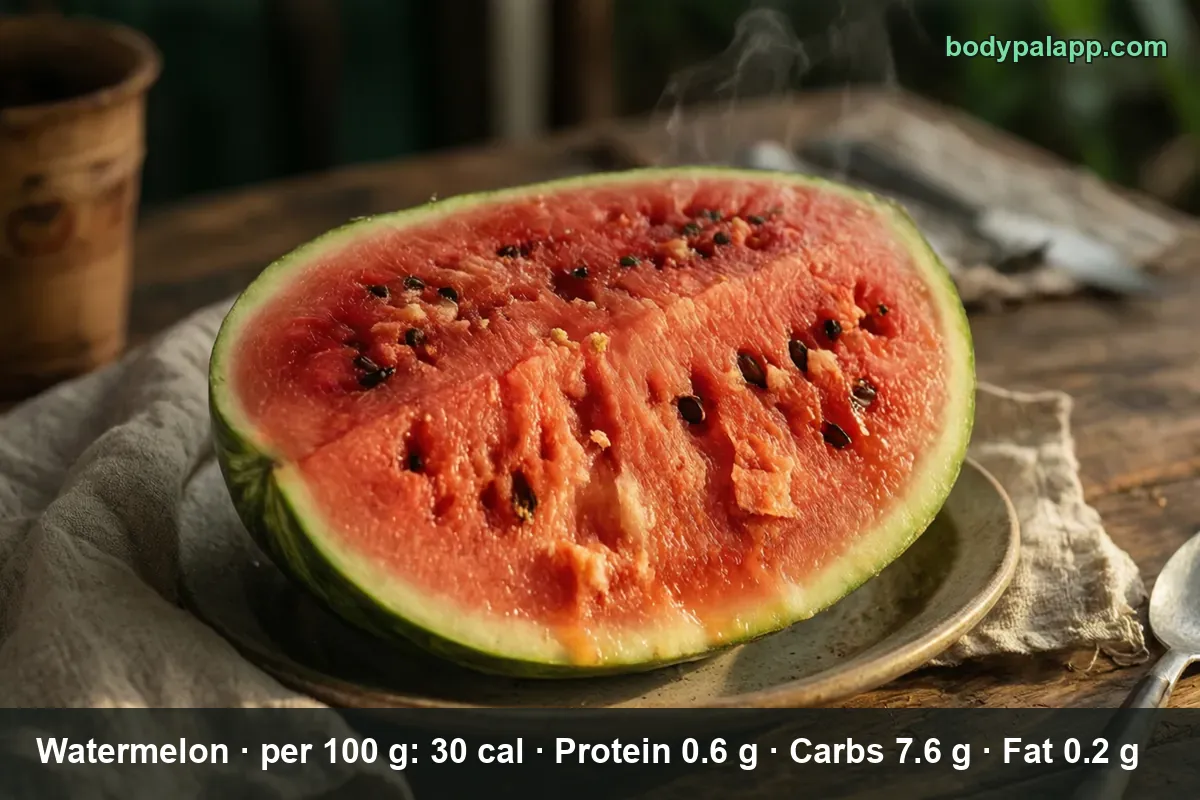
A cup of diced watermelon weighs 152 g and carries 46 calories; per 100 g the fruit is 30 calories. That makes the calories in watermelon about as low as fresh fruit gets. The catch is the serving people actually cut — a wedge sliced 1/16 of the way around a melon weighs 286 g and lands at 86.
On this page
- Watermelon quick facts
- US servings, from one cube to a whole melon
- Juice, wedges, cubes and seeds
- Water, potassium and the sugar question
- How does watermelon compare?
- Most popular watermelon brands
- Watermelon FAQs
Watermelon quick facts
The row behind this page is SR Legacy 167765, "Watermelon, raw". It is the record for the fruit you are holding — cut, seeded or not, straight from the rind — and it is the only watermelon entry that carries the full set of household measures: cup diced, cup balls, wedge and NLEA serving. A newer FNDDS record (2709270) lists identical values per 100 g, because it is a second edition of the same food rather than a different melon; it is useful later for slice weights.
The main column below is a cup of diced fruit, 152 g, because that is how most people log it. Nothing here is rounded up from a bigger number: the per-100 g column is USDA's own.
| Nutrient | Per 100 g | Per 1 cup diced (152 g) | % Daily Value |
|---|---|---|---|
| Calories | 30 | 46 | — |
| Total fat | 0.15 g | 0.2 g | 0% |
| Saturated fat | 0.02 g | 0.0 g | 0% |
| Carbohydrate | 7.55 g | 11.5 g | 4% |
| Dietary fiber | 0.4 g | 0.6 g | 2% |
| Total sugars | 6.2 g | 9.4 g | — |
| Protein | 0.61 g | 0.9 g | 2% |
| Sodium | 1 mg | 2 mg | 0% |
% Daily Value is based on a 2,000-calorie diet.
Verified nutrition data
Numbers on this page come from USDA FoodData Central, the U.S. Department of Agriculture’s food composition database, and from manufacturer labels where a branded product is named. Last verified September 2026. How we verify our data →
There is no added sugars row here: USDA does not publish an added sugars figure for this raw record, and raw fruit has none by definition. Total sugars have no Daily Value on the US label, which is why that cell stays empty. Cholesterol is 0 mg, and potassium comes in at 112 mg per 100 g — 170 mg in a cup, or 4% of the Daily Value set by FDA.
Sodium is the quiet number. One milligram per 100 g is close to nothing; a cup gives you 2 mg, which is a rounding error against the 2,300 mg daily ceiling.
US servings, from one cube to a whole melon
Watermelon is sold in shapes that have nothing to do with each other. A plastic tub of cubes from the deli case, a triangular wedge off a half melon, a whole melon in the trunk of the car — all the same food, wildly different totals.
| Serving | Weight | Calories |
|---|---|---|
| 1 oz | 28.4 g | 9 kcal |
| 1 cup, diced | 152 g | 46 kcal |
| 1 cup, balls | 154 g | 46 kcal |
| 1 NLEA serving | 280 g | 84 kcal |
| 1 wedge, about 1/16 of a melon | 286 g | 86 kcal |
| Per 100 g | 100 g | 30 kcal |
The cup measures, the NLEA serving and the wedge all come from USDA's household list for record 167765. The ounce is our own arithmetic from the USDA 100 g figure, not a USDA serving — useful if you weigh food rather than scoop it.
Two things fall out of that table. First, cubes and balls are the same calories: the balls pack slightly more densely, 154 g to the cup instead of 152 g, and the two round to the same 46. Second, the cup is the smallest household serving on the list and the wedge is nearly double it. If you cut a melon into sixteenths and eat one, log 86, not 46.
A medium whole watermelon weighs roughly 4,518 g. That is 1,355 calories and about 341 g of carbohydrate — 124% of the Daily Value — again our own scaling from the 100 g figure rather than a USDA serving. It is a genuinely hard number to eat by accident, but a hot afternoon and a spoon have managed it.
Juice, wedges, cubes and seeds
| Version | Per 100 g | Typical piece | Calories |
|---|---|---|---|
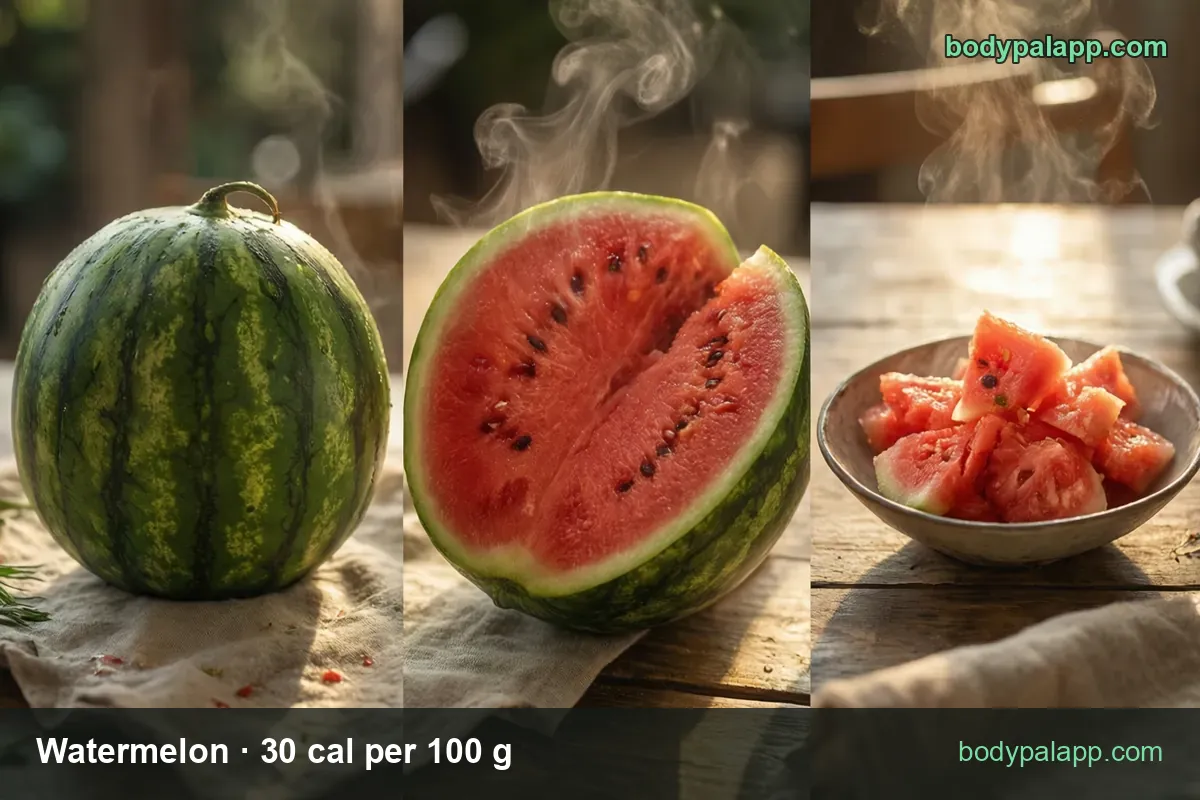
| Watermelon juice, 100% | 30 kcal | 8 fl oz glass, 240 g | 72 kcal |
| Watermelon, raw — medium slice | 30 kcal | one medium wedge, 325 g | 98 kcal |
| Watermelon, raw — single cube | 30 kcal | one cube, 15 g | 5 kcal |
| Watermelon seed kernels, dried | 557 kcal | 1 oz, 28.35 g | 158 kcal |
Juice. USDA models 100% watermelon juice on the fruit itself, so the per-100 g line is identical: 30 calories. What changes is the glass. Eight fluid ounces is 240 g of liquid, which is more melon than most people would chew, and it arrives as 72 calories with the fiber already broken down. The difference between the juice and the cup is portion size, not the source.
Slices. The newer FNDDS record puts a medium slice at 325 g — 98 calories, and one of the few fruit servings that crosses into snack-bar territory. Slice weights are eyeballed by whoever holds the knife, so anywhere from 218 g to 432 g is a normal cut. Weigh one slice off your usual melon once, and you can stop guessing.
Cubes. A single cube is 15 g and 5 calories. That sounds trivial until you count what leaves a party platter; twenty cubes is 300 g, roughly a wedge.
Seeds. Dried watermelon seed kernels are a completely different food: 557 calories per 100 g, driven by 47.37 g of fat and 28.33 g of protein. One ounce is 158 calories, more than three cups of the fruit. These are hulled kernels sold as a snack, not the black seeds you spit into the grass.
Water, potassium and the sugar question
Watermelon is roughly 92% water, and every number on the page follows from that. A cup gives you 0.6 g of fiber — 2% of the 28 g Daily Value — which is why a bowl of it refreshes without doing much for hunger an hour later. Strawberries, at a nearly identical calorie count per gram, deliver noticeably more.
Potassium is the one nutrient that shows up in a useful amount for the calories: 170 mg per cup, 320 mg in a 286 g wedge, about 7% of the Daily Value. Potassium is listed by the NIH Office of Dietary Supplements among the nutrients most Americans fall short on, and watermelon is a cheap way to nudge it without adding sodium — there is essentially none in the fruit.
The sugar looks alarming written down and is not, in context. A cup holds 9.4 g of total sugars, all of it occurring naturally; total sugars have no Daily Value, and the FDA's 50 g added sugars limit does not apply to them. If you are managing carbohydrate rather than calories, though, the wedge is the number to watch: 21.6 g of carbohydrate in one cut, against 11.5 g in a cup. MyPlate puts most adults at about 2 cups of fruit a day; two cups of watermelon is 92 calories, which leaves plenty of room.
How does watermelon compare?
| Fruit | Per 100 g | US serving | Calories |
|---|---|---|---|
| Watermelon | 30 kcal | 1 cup diced, 152 g | 46 kcal |
| Grapefruit, pink and red | 30 kcal | 1 cup sections with juice, 230 g | 69 kcal |
| Carambola (starfruit) | 31 kcal | 1 cup cubes, 132 g | 41 kcal |
| Strawberries | 32 kcal | 1 cup halves, 152 g | 49 kcal |
Our take: per gram, watermelon and grapefruit tie for the lightest of the four at 30 calories per 100 g, and the spread across all four is two calories — at this end of the produce aisle, the fruit you pick matters far less than the size of the bowl. Per cup the order flips, because a cup of starfruit cubes only weighs 132 g and a cup of grapefruit sections comes packed in its own juice at 230 g. For weight management, watermelon and strawberries are close enough to be interchangeable; strawberries win on fiber, watermelon wins on volume for the calorie. For satiety, none of them will carry you to the next meal on their own.
Most popular watermelon brands in the United States
Ranked by how widely each product appears among foods sold in the United States, from the BodyPal food database of over 3.3 million products. Calories are the figures printed on each Nutrition Facts label, checked against USDA FoodData Central.
| Product | Calories (per 100 g) |
|---|---|
| Del Monte Watermelon Chunks | 32 cal |
| Del Monte Premium Seedless Watermelon | 32 cal |
| Wegmans Organic Watermelon Chunks | 32 cal |
| Taylor Farms Watermelon Spears | 36 cal |
| Country Fresh Watermelon Spears | 31 cal |
| Crazy Fresh Watermelon Chunks | 31 cal |
Brand popularity: BodyPal food database. Nutrition: manufacturer labels / USDA FoodData Central.
Watermelon FAQs
How many calories are in a cup of watermelon?
A cup of diced watermelon, 152 g, is 46 calories. A cup of melon balls weighs 154 g and works out to the same 46. That is 4% of the Daily Value for carbohydrate and about 2% of the fiber DV, from a food that is roughly 92% water.
How many calories are in one slice of watermelon?
One wedge cut about 1/16 of the way around a melon weighs 286 g and carries 86 calories. USDA's newer FNDDS record lists a medium slice at 325 g, which comes to 98 calories. Slices are cut by eye, so weigh yours once and you will know which end you are on.
How many calories are in a whole watermelon?
A medium whole watermelon weighs about 4,518 g, which is 1,355 calories - our own arithmetic from the USDA 100 g figure, not a USDA serving. The bigger number is carbohydrate: roughly 341 g, or 124% of the Daily Value. Eating a melon across an afternoon is a full day of carbs.
How much sugar is in watermelon?
A cup of diced watermelon holds 9.4 g of total sugars, and 100 g holds 6.2 g. All of it occurs naturally in the fruit. USDA does not publish an added sugars figure for this raw record, and total sugars carry no Daily Value on the US nutrition label.
How many carbs are in watermelon?
A cup of diced watermelon has 11.5 g of carbohydrate, 4% of the Daily Value, and 0.6 g of that is fiber. Per 100 g the figure is 7.55 g. A 286 g wedge brings 21.6 g of carbohydrate and 1.1 g of fiber, which is nearly double the cup.
Is watermelon good for weight loss?
At 30 calories per 100 g, watermelon is one of the lightest things you can log, and a cup costs only 46. But it brings 0.6 g of fiber, 2% of the Daily Value, so it refreshes more than it fills. If you want it to hold you, pair it with protein.
How much potassium is in watermelon?
A cup of diced watermelon supplies 170 mg of potassium, 4% of the 4,700 mg Daily Value, and 100 g supplies 112 mg. A 286 g wedge brings that to 320 mg, about 7%. It is a modest contributor for the calories rather than a headline potassium source.
Are watermelon seeds high in calories?
Dried watermelon seed kernels run 557 calories per 100 g, so a 1 oz handful is 158 calories - more than three cups of the fruit. They are a separate food from the black seeds in a slice: 47.37 g of fat and 28.33 g of protein per 100 g.
Similar foods
- Arizona Green Tea — 224 cal per tall can, 23 fl oz
- Watermelon Juice — 72 cal per cup
- ICEE — 185 cal per medium
- Slurpee — 101 cal per small
- Sweet tea — 119 cal for 12 fl oz glass
- Cappuccino — 65 cal per cup (8 fl oz)
Count it without the math
Point the camera at the plate and BodyPal counts the wedge for you, rind and all.


How long does it take to burn off watermelon?
A 1-cup (152 g) serving of diced fruit is 46 kcal. Enter your weight and the amount you ate to see how long it takes you to burn that off:
lb
| Activity | Time to burn 46 kcal |
|---|---|
| Walking, brisk | 9 min |
| Cycling, moderate | 6 min |
| Swimming, moderate | 7 min |
| Jogging | 5 min |
| Weight training, moderate | 10 min |
Times are for a 155 lb adult at a steady pace; change the weight to see yours. The amount is set to the portion in the text (152 g); change it to what you actually ate. BodyPal works this out from your steps automatically.
One food is easy to picture; a whole day is harder. See how many calories you need a day and what a deficit actually looks like.