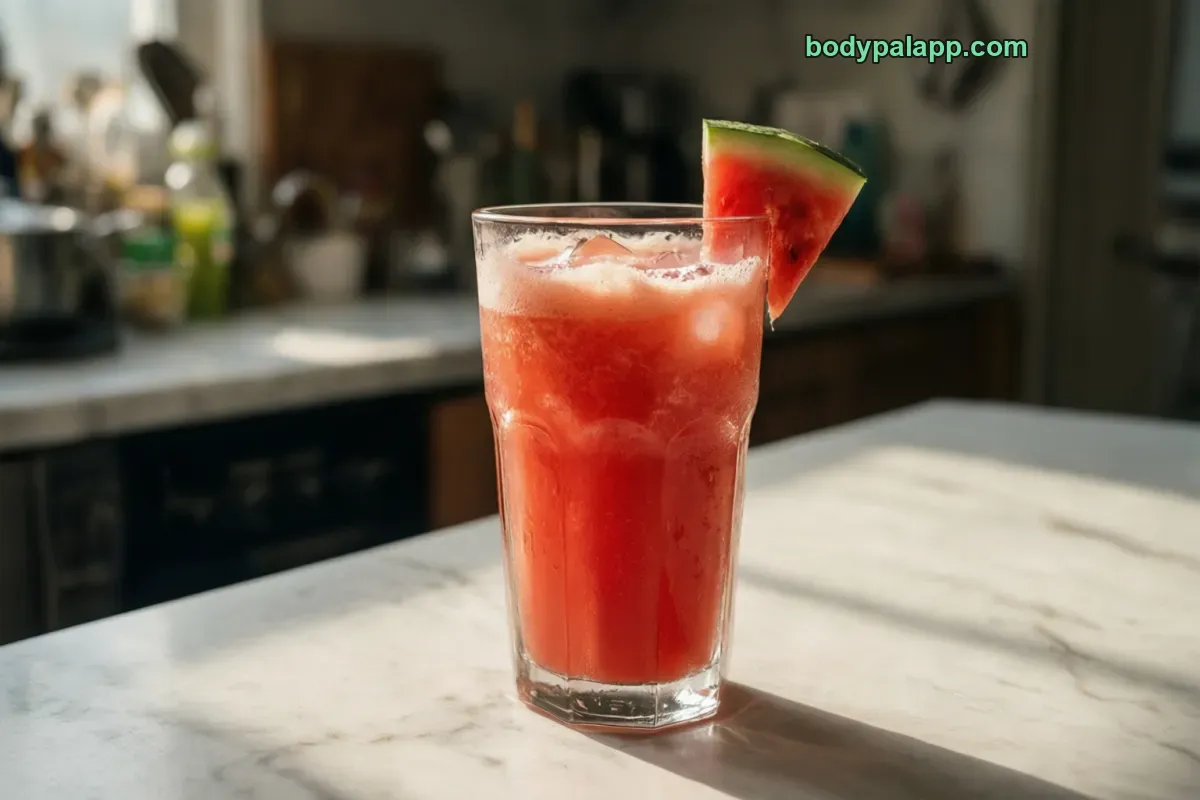
Watermelon juice calories come to 72 for a 1 cup (240 g) serving and 30 per 100 g. Nearly all of that energy is sugar: a cup carries 14.9 g of it, carbs supply 89% of the calories, and protein, fat and sodium barely register. What moves your total is the size of the glass.
72kcal
1 cup · 240 g, 100% juice
7%protein
1.5 gProtein
18 gCarbs
0.4 gFat
How to burn off 72 kcal
—Walking, brisk
—Jogging
—Cycling, moderate
—Swimming
Skip the math. BodyPal counts these calories from your steps and workouts automatically.
Nutrition facts
100% juice · per 240 g
Calories
72 kcal
Protein
1.5 g
Carbohydrate
18.1 g
Fat
0.4 g
Saturated fat
0 g
Cholesterol
0 mg
Sodium
2 mg
Potassium
269 mg
Iron
0.6 mg
Source: USDA FoodData Central
🛡️
Verified nutrition data
Numbers on this page come from USDA FoodData Central, the U.S. Department of Agriculture’s food composition database, and from manufacturer labels where a branded product is named. Last verified September 2026. How we verify our data →
Watermelon juice: calories, protein and sodium by serving
Percent of daily value uses the FDA reference of 2,000 kcal a day.
Serving
kcal
Protein
Carbs
Fat
Sodium
% DV kcal
1 cup (240 g)
72
1.5 g
18.1 g
0.4 g
2 mg
4%
12 oz glass (340 g)
102
2.1 g
25.7 g
0.5 g
3 mg
5%
100 g
30
0.6 g
7.6 g
0.2 g
1 mg
2%
3 × 1 cup (240 g)
216
4.4 g
7 mg
5 × 1 cup (240 g)
360
7.3 g
12 mg
A 12 oz glass is a 102-calorie drink
The standard cup is 240 g and 72 calories, about 4% of the daily value. Most people do not pour a measured cup, though. A 12 oz glass holds 340 g and lands at 102 calories, which is 5% of the daily value. That gap looks small on one glass and adds up fast over a hot afternoon.
Refills are where watermelon juice gets you. Two cups (480 g) come to 144 calories, three cups (720 g) to 216, and five cups, a full 1,200 g pitcher's worth, reach 360. None of that comes with much fiber or protein to slow you down, so it drinks like water while counting like a snack.
If you track intake, log the glass you actually used rather than a default cup. The difference between a 240 g cup and a 340 g glass is 30 calories per pour. Over several pours that is the size of a small piece of fruit, consumed without noticing.
Carbs supply 89% of the calories
The calorie split is lopsided: 89% carbs, 7% protein and 4% fat. Per 100 g that works out to 7.6 g of carbs, 0.6 g of protein and 0.2 g of fat. Most of the carbs are sugar, at 6.2 g per 100 g, with only 0.4 g of fiber.
Protein is too low to matter. A cup gives 1.5 g, which is 3% of the daily value, and even a 12 oz glass only reaches 2.1 g. Fat is a rounding error at 0.4 g per cup and 0 g of saturated fat. Cholesterol is 0 as well.
This profile is typical of 100% juice: the water and sugar of the fruit stay, while the pulp that held most of the fiber is largely gone. That is why the calorie count is modest but the drink does little to keep you full. Treat it as a light source of quick carbs, not as a meal component that carries its own weight.
Sugar is the row to watch, not sodium
A cup of watermelon juice has 14.9 g of sugars, and a 12 oz glass has 21.1 g. Since this is 100% juice per the USDA row, that sugar comes from the fruit itself rather than added syrup. It still counts toward your total carbs: 18.1 g per cup and 25.7 g per glass.
Fiber does not balance it out. A cup gives 1 g against a daily value of 28 g, and a glass gives 1.4 g. If you want the sweetness with more fiber, whole watermelon is the better pick, since the juice leaves most of the pulp behind.
Sodium, by contrast, is a non-issue. A cup has 2 mg and a glass 3 mg, both 0% of the daily value. Even five cups only add up to 12 mg. Potassium is the mineral that shows up, at 112 mg per 100 g. If you watch sodium closely, this is one of the easiest drinks to fit in.
Pair it with protein so it is not just sugar
Because a cup brings 72 calories and almost nothing besides sugar, watermelon juice works best next to food that supplies what it lacks. A breakfast with eggs or yogurt, or a lunch with a protein source, turns the juice into a side rather than a standalone sugar hit. On its own, it is refreshment, not fuel for the next few hours.
Smaller glasses help. Serving it in a 240 g cup instead of a 340 g glass keeps it at the lower end of the range, and mixing it with sparkling water stretches the volume without adding calories. Bottled versions vary, so labels from brands like Simply, Welch's or Blue Monkey are worth a glance; some are juice drinks rather than 100% juice.
To keep refills honest, BodyPal can log the glass from a photo, so the second and third pour end up in your day's total instead of slipping past it.
How does watermelon juice compare?
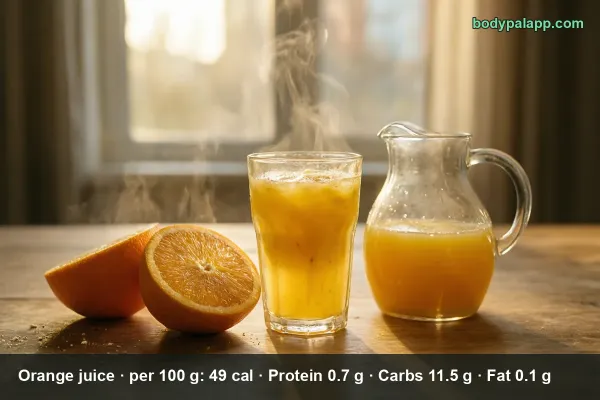
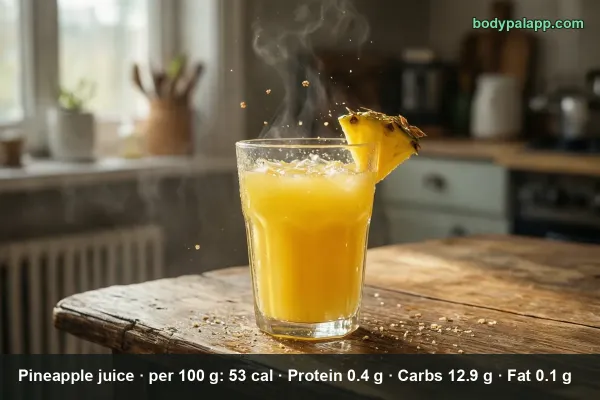
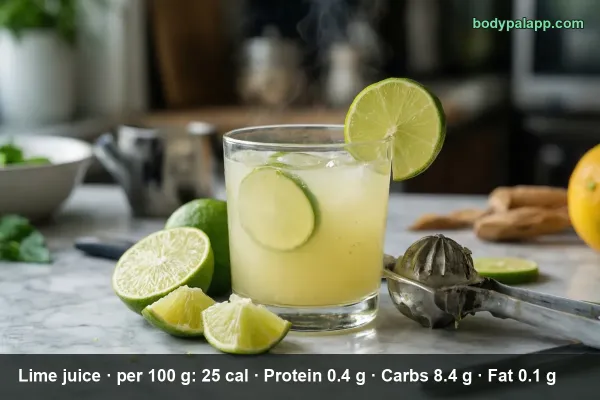
Here is how watermelon juice stacks up against orange, pineapple and lime juice, per 100 g and per usual serving.
Verdict: For the fewest calories by the glass, watermelon juice at 30 per 100 g beats orange juice at 49 and pineapple juice at 53, which runs about 1.8 times higher. Lime juice is lower at 25, but it is a squeeze for flavor, not something you drink by the cup.
Most popular watermelon juice brands in the United States
Ranked by popularity in the BodyPal database
# Productkcal / 100 g
1Everfresh Watermelon Juice8 fl oz · 240 g50 kcal
2Juicy Juice Watermelon Juice8 fl oz · 240 g33 kcal
3Capri Sun Watermelon Juice1 pouch · 177 g51 kcal
4Coco Joy Watermelon Juice1 cup · 250 g32 kcal
5Simply Watermelon Juice Drink8 fl oz · 240 g38 kcal
6Welch's Watermelon Juice From Concentrate8 fl oz · 240 g54 kcal
7Blue Monkey 100% Watermelon Juice250 g32 kcal
Juices from concentrate and watermelon juice drinks often carry added sugar, so several labels read higher than the 30 calories per 100 g of plain 100% juice. Source: manufacturer labels / USDA FoodData Central.
Watermelon juice FAQs
How many calories are in a cup of watermelon juice?
A 1 cup serving (240 g) is 72 calories. That works out to 30 calories per 100 g.
Is watermelon juice good for weight loss?
At 30 calories per 100 g it is one of the lighter fruit juices, and a cup is 72 calories. The same cup still has 14.9 g of sugar and only 1 g of fiber, because juicing leaves most of the flesh behind.
Watermelon juice vs orange juice: which has fewer calories?
Watermelon juice has 30 calories per 100 g against 49 for orange juice, so a cup is 72 calories versus about 118.
How much sugar is in watermelon juice?
6.2 g per 100 g, which is 14.9 g in a 240 g cup. Total carbs are 7.6 g per 100 g, or 18.1 g per cup.
How many calories are in a 12 oz glass of watermelon juice?
A 12 oz glass (340 g) of watermelon juice has 102 calories, about 5% of the daily value. It also carries 21.1 g of sugars and 25.7 g of carbs, with 2.1 g of protein.
How many carbs are in a cup of watermelon juice?
A 1 cup (240 g) serving has 18.1 g of carbs, of which 14.9 g are sugars. Fiber is only 1 g, so nearly all the carbs are quickly absorbed sugar from the fruit.
Does watermelon juice have any protein?
Very little. A cup has 1.5 g of protein, which is 3% of the daily value, and protein supplies just 7% of the drink's calories. Pair it with food if you want something filling.
Is watermelon juice high in sodium?
No. A cup has 2 mg of sodium and a 12 oz glass has 3 mg, both 0% of the daily value. Even five cups come to only 12 mg.
How much fiber is in watermelon juice?
A cup of watermelon juice has 1 g of fiber, against a daily value of 28 g. Per 100 g it is 0.4 g, because juicing leaves most of the fruit's pulp behind.