
How many calories are in a latte?
A standard 8 fl oz cup of latte is 103 calories, and the drink runs 43 calories per 100 g — light for something this filling, because it is mostly milk and water. The number only misbehaves when the cup grows: the 16 ounce size most people actually order is 206 calories.
On this page
- Latte quick facts
- US latte sizes, from 8 ounces to 20
- Nonfat, non-dairy, flavored and iced lattes
- Saturated fat is the row that moves
- How does a latte compare?
- FAQ
Latte quick facts
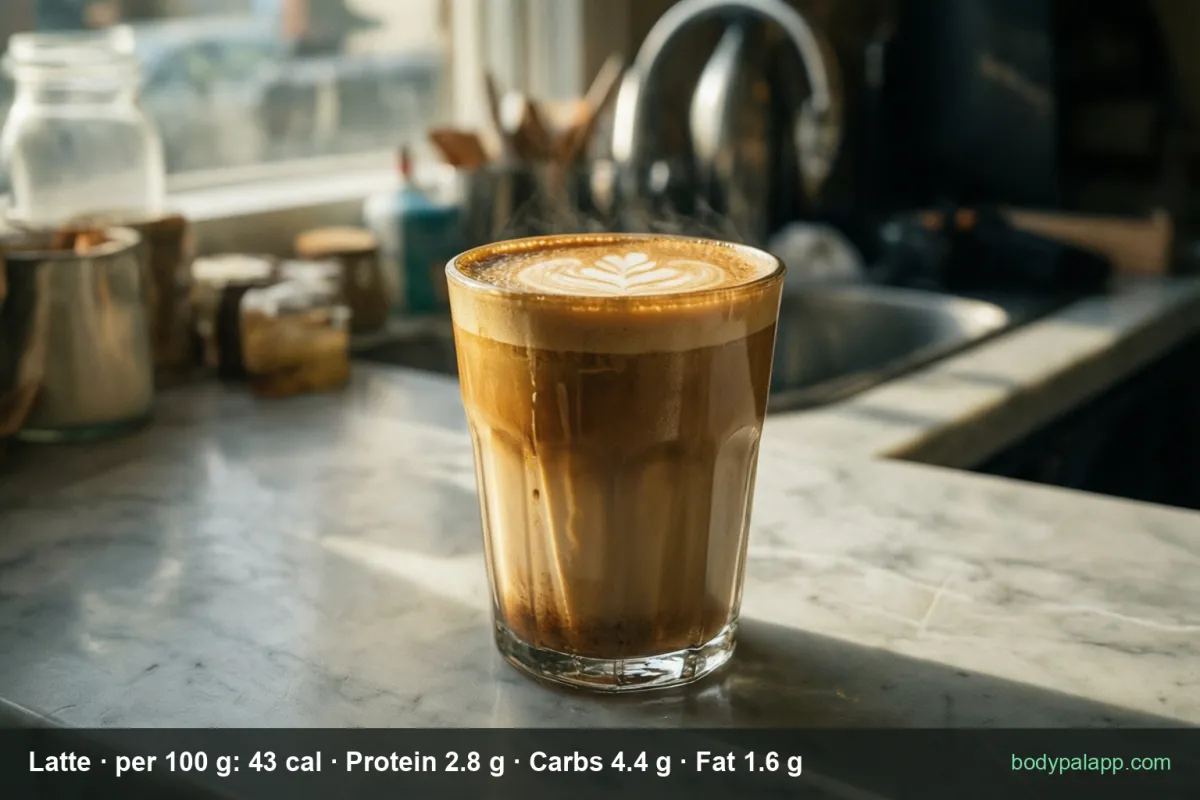
The record behind every number here is FNDDS 2710386, "Coffee, Latte" — espresso and steamed whole milk, nothing added. That is the drink in the cup above and the one a plain latte order gets you at almost any counter. The other USDA lattes on this page are the same beverage prepared differently: skim instead of whole milk, plant milk instead of dairy, syrup stirred in, ice in the cup. Different preparation, same source, so nothing is averaged between them.
| Nutrient | Per 100 g | Per 1 cup (240 g) | % Daily Value |
|---|---|---|---|
| Calories | 43 | 103 | — |
| Total fat | 1.61 g | 3.9 g | 5% |
| Saturated fat | 0.94 g | 2.3 g | 11% |
| Carbohydrate | 4.35 g | 10.4 g | 4% |
| Dietary fiber | 0 g | 0 g | 0% |
| Total sugars | 4.06 g | 9.7 g | — |
| Protein | 2.81 g | 6.7 g | 13% |
| Sodium | 35 mg | 84 mg | 4% |
% Daily Value is based on a 2,000-calorie diet.
Verified nutrition data
Numbers on this page come from USDA FoodData Central, the U.S. Department of Agriculture’s food composition database, and from manufacturer labels where a branded product is named. Last verified September 2026. How we verify our data →
Two rows you would see on a carton are missing here: added sugars and trans fat are not published in this FNDDS release, so they are left off rather than guessed. For a plain latte the distinction barely matters — the 9.7 g of sugar in a cup is lactose from the milk, not syrup. A cup also carries 17 mg of cholesterol (6% DV) and 365 mg of potassium (8% DV), which is more potassium than most people expect from a coffee drink.
One thing this page is not about: bottled ready-to-drink lattes and dry latte powders are separate products with their own labels, and their numbers do not transfer to a barista-made cup.
US latte sizes, from 8 ounces to 20
| Serving | Weight | Calories |
|---|---|---|
| 1 fl oz | 30 g | 13 kcal |
| 1 oz by weight | 28 g | 12 kcal |
| 1 cup, 8 fl oz | 240 g | 103 kcal |
| Small, 12 fl oz | 360 g | 155 kcal |
| Medium, 16 fl oz | 480 g | 206 kcal |
| Large, 20 fl oz | 600 g | 258 kcal |
| Per 100 g | 100 g | 43 kcal |
The 1-cup line is the USDA household measure. The weight-ounce line and the 12, 16 and 20 ounce lines are our own arithmetic from the USDA 100 g figure, not USDA servings — a latte weighs almost exactly 30 g per fluid ounce, so the math is clean.
Note the two ounce rows, because this is where food diaries go wrong. A fluid ounce of latte is 30 g and 13 calories; an ounce by weight is 28 g and 12 calories. Log a 16 ounce drink as 16 weight-ounces and you undercount by roughly 13 calories, which is small. Log a 20 ounce cup as "1 cup" and you undercount by 155.
That is the real headline. The recipe never changes between an 8 ounce cup and a 20 ounce cup — only the volume does — yet the calories go from 103 to 258, two and a half times as many. No milk swap on this page saves as much as ordering one size down.
Nonfat, non-dairy, flavored and iced lattes
| Version | Per 100 g | Typical cup | Calories |
|---|---|---|---|
| Latte, whole milk | 43 kcal | 1 cup (240 g) | 103 kcal |
| Nonfat, "skinny" | 30 kcal | 1 cup (240 g) | 72 kcal |
| Non-dairy milk | 28 kcal | 1 cup (240 g) | 67 kcal |
| Flavored, vanilla or similar | 55 kcal | 1 cup (248 g) | 136 kcal |
| Decaffeinated | 43 kcal | 1 cup (240 g) | 103 kcal |
| Iced latte | 27 kcal | 1 cup (240 g) | 65 kcal |
| Iced, nonfat | 19 kcal | 1 cup (240 g) | 46 kcal |
Nonfat takes a cup from 103 to 72. Protein holds at about 6.9 g, since skim milk loses the fat and keeps the rest, so a skinny latte is the one swap that costs you nothing nutritionally.
Non-dairy milk lands at 67 a cup, slightly under nonfat. This USDA row covers plant milks as a group rather than oat specifically, so read it as a ballpark for almond, soy and oat alike. Protein is the trade: about 2.3 g a cup instead of 6.7 g.
Flavored is the direction that costs. At 55 calories per 100 g, a flavored cup is 136, and sugars go from 9.7 g to roughly 17.9 g — our arithmetic from the 100 g figure. USDA does not publish added sugars for this record, but the extra 8 g is syrup, not milk. A 12 fl oz vanilla latte works out to about 205 calories on the same arithmetic, just under a plain 16 ounce cup at 206. Syrup adds more than skim milk takes away.
Decaf is 43 per 100 g and 103 a cup, identical to the caffeinated record within rounding. Only the caffeine leaves.
Iced looks like a diet drink and is not one. At 65 calories a cup it beats the hot version by more than a third, but the ice is doing the work — cubes occupy part of the volume, so the same cup holds less milk. Order iced in a 16 ounce cup and you are back to about 130 calories. Iced nonfat, at 46 a cup, is the lightest drink on this page.
Saturated fat is the row that moves
Calories are the least interesting number on a large latte. A 16 fl oz whole-milk latte is 206 calories and 7.7 g of total fat, 10% of the FDA Daily Value — but 4.5 g of saturated fat, which is 23% of the 20 g Daily Value, all before lunch. The Dietary Guidelines for Americans put the ceiling at under 10% of daily calories from saturated fat, and a daily large latte spends most of a morning's allowance on a drink.
Switch that same 16 ounce cup to skim and calories fall to about 144, while saturated fat drops to roughly 0.3 g, close to 1% of the Daily Value. The calorie saving is 30%; the saturated fat saving is near total. If your doctor has flagged cholesterol rather than weight, that is the swap that matters, and it is the one most people skip in favor of a smaller size.
The upside stays either way. A cup delivers 6.7 g of protein and 365 mg of potassium, and MyPlate counts the milk in a latte toward the dairy group — a large one is close to a full cup-equivalent of milk. As coffee-shop drinks go, this is the one that behaves like food.
How does a latte compare?
| Drink | Per 100 g | US serving | Calories |
|---|---|---|---|
| Latte | 43 kcal | 1 cup (240 g) | 103 kcal |
| Cafe con leche | 40 kcal | 1 cup (240 g) | 96 kcal |
| Macchiato, sweetened | 40 kcal | 1 cup (240 g) | 96 kcal |
| Iced cafe mocha, nonfat | 43 kcal | 1 cup (240 g) | 103 kcal |
The per-serving figures for the three neighbors are our own arithmetic from their USDA 100 g values, scaled to the same 240 g cup so the comparison is fair.
Our take: at cup-for-cup parity these four drinks are within 7 calories of each other, which means the drink you pick is close to irrelevant and the size you pick is everything. The one worth a second look is the nonfat iced mocha — it matches a plain latte at 103 a cup, but it gets there with 8.96 g of carbohydrate per 100 g against the latte's 4.35 g, so it is a sweeter drink with less milk protein behind it. For satiety, order the plain latte. For the smallest number, order a nonfat iced latte at 46 a cup and stop worrying about the rest.
Latte FAQs
How many calories are in a latte?
A standard 8 fl oz cup of latte is 103 calories, or 43 calories per 100 g. That is whole milk and espresso with nothing added. Coffee shop cups are rarely 8 ounces, though: the 16 ounce size most people order doubles it to 206 calories.
How many calories in a 16 oz latte?
A 16 fl oz latte weighs about 480 g and carries 206 calories, our own arithmetic from the USDA 100 g figure rather than a listed serving. It also brings 4.5 g of saturated fat, 23% of the FDA Daily Value, which climbs faster than the calorie count does.
How many calories in an iced latte?
An iced latte is 65 calories per cup, against 103 for the hot version. The recipe is not lighter; the ice is. Cubes take up part of the cup, so 240 g of iced latte holds less milk. Order it in a 16 ounce cup and it is about 130.
Does a skinny latte have fewer calories?
Yes: a nonfat latte is 72 calories per cup against 103, a saving of 31. The bigger change is saturated fat, which falls from 2.3 g to about 0.1 g per cup. Protein barely moves, staying near 6.9 g, because skim milk drops the fat and keeps the rest.
How many calories in an oat milk latte?
A latte made with non-dairy milk is 67 calories per cup. The USDA row covers plant milks as a group — oat, almond and soy together — so treat it as a ballpark rather than an oat-specific figure. Protein drops hardest, from 6.7 g to about 2.3 g a cup.
Does a vanilla latte have added sugar?
A flavored latte runs 55 calories per 100 g against 43, so a cup is 136 calories. Sugars climb from 9.7 g to about 17.9 g a cup. USDA does not publish added sugars for this record, but the extra 8 g comes from syrup rather than from the milk.
How much protein is in a latte?
A cup of latte carries 6.7 g of protein, 13% of the Daily Value on the FDA label. Milk supplies nearly all of it; espresso contributes almost none. A 16 fl oz cup works out to about 13.5 g, which is why a latte holds you better than black coffee mid-morning.
Is a decaf latte lower in calories?
No. A decaf latte is 43 calories per 100 g and 103 per cup, matching the caffeinated record within rounding. Only the caffeine changes; fat, sugar and protein are the same. If you are cutting calories, the milk and the cup size are the levers, not the beans.
Similar foods
- Caffe Latte — 206 cal per medium latte
- Red Bull — 111 cal per can (8.4 fl oz)
- Coke 500 Ml — 210 cal per 500 ml bottle
- Coke — 258 cal per bottle (20 fl oz)
- Pepsi — 149 cal per can (12 fl oz)
- Soda — 156 cal per can, 12 fl oz
Count it without the math
Point the camera at the cup and BodyPal logs the latte for you, size and milk included.


How long does it take to burn off a latte?
A 1-cup (240 g) serving is 103 kcal. Enter your weight and the amount you ate to see how long it takes you to burn that off:
lb
| Activity | Time to burn 103 kcal |
|---|---|
| Walking, brisk | 21 min |
| Cycling, moderate | 13 min |
| Swimming, moderate | 15 min |
| Jogging | 12 min |
| Weight training, moderate | 23 min |
Times are for a 155 lb adult at a steady pace; change the weight to see yours. The amount is set to the portion in the text (240 g); change it to what you actually ate. BodyPal works this out from your steps automatically.
This table assumes you know your daily total. If you do not, the daily calorie calculator works it out from five numbers.