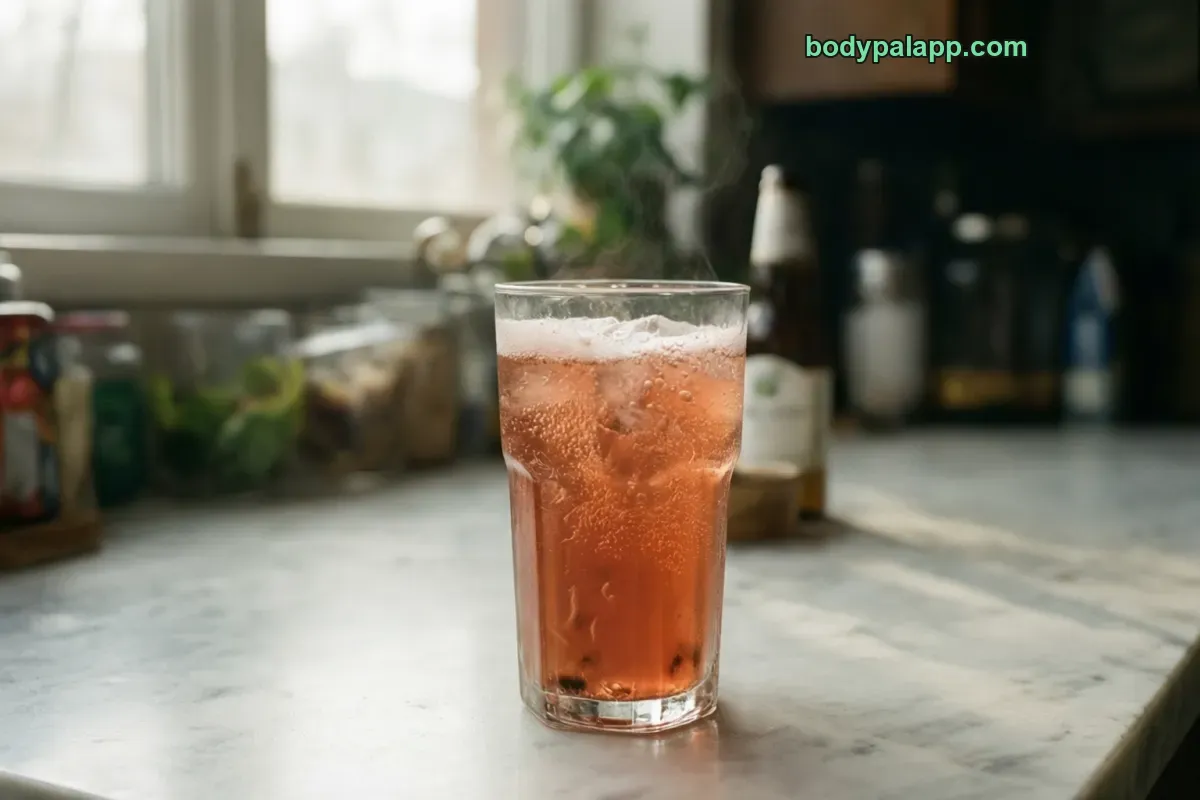
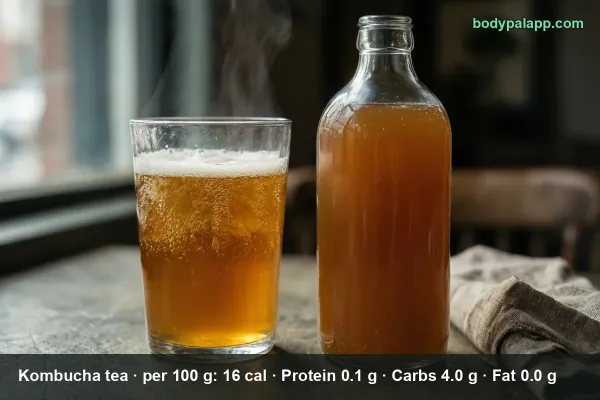
Kombucha calories come to 60 for one 372 g bottle and 16 per 100 g. The number to notice is sugar: a bottle carries 14.8 g of it, which is nearly all of the carbohydrate and nearly all of the energy. Fat, protein and sodium barely register, so the size of your pour decides the total.
60kcal
1 12 fl oz bottle · 372 g, bottled, ready to drink
2%protein
0.4 gProtein
15 gCarbs
0 gFat
How to burn off 60 kcal
—Walking, brisk
—Jogging
—Cycling, moderate
—Swimming
Skip the math. BodyPal counts these calories from your steps and workouts automatically.
Nutrition facts
Bottled, ready to drink · per 372 g
Calories
60 kcal
Protein
0.4 g
Carbohydrate
14.8 g
Fat
0 g
Saturated fat
0 g
Cholesterol
0 mg
Sodium
7 mg
Potassium
15 mg
Iron
0 mg
Source: USDA FoodData Central
🛡️
Verified nutrition data
Numbers on this page come from USDA FoodData Central, the U.S. Department of Agriculture’s food composition database, and from manufacturer labels where a branded product is named. Last verified September 2026. How we verify our data →
Kombucha: calories, protein and sodium by serving
Percent of daily value uses the FDA reference of 2,000 kcal a day.
Serving
kcal
Protein
Carbs
Fat
Sodium
% DV kcal
1 bottle (372 g)
60
0.4 g
14.8 g
0 g
7 mg
3%
8 oz glass (227 g)
36
0.2 g
9 g
0 g
5 mg
2%
100 g
16
0.1 g
4 g
0 g
2 mg
1%
3 × 1 bottle (372 g)
179
1.1 g
22 mg
5 × 1 bottle (372 g)
298
1.9 g
37 mg
A full bottle is a 60-calorie drink
Bottled kombucha usually comes in a 372 g bottle, and finishing it gives you 60 calories, about 3% of a 2000-calorie daily value. Pour an 8 oz glass instead and you drink 227 g for 36 calories. The real question is whether you finish the bottle in one sitting or split it.
Totals climb slowly because the drink is so dilute. Two bottles add up to 744 g and 119 calories. Three bottles reach 179 calories, and even five bottles, a full 1,860 g of liquid, land at 298 calories. Few people drink that much in a day, but the math shows kombucha rarely decides a calorie budget on its own.
Where it starts to matter is habit. A bottle with lunch every day is a small, steady line item, not a free one. If you track intake, log the size you actually drank, because a glass and a whole bottle sit in noticeably different places on the label. A half-finished bottle saved for later is easy to forget and easy to count twice.
Nearly every calorie comes from sugar
The calorie split is lopsided: 97% of kombucha's energy comes from carbohydrate, 2% from protein and 1% from fat. Per 100 g that works out to 4 g of carbs, 0.1 g of protein and 0 g of fat. In this USDA entry, listed as tea, kombucha, all 4 g of those carbs are sugars.
Scale that to a serving and the picture is clear. A 372 g bottle holds 14.8 g of carbs and 14.8 g of sugars, while the 8 oz glass carries 9 g of carbs and 9.1 g of sugars. There is 0 g of fiber to go with it, and the 0.4 g of protein in a bottle is too little to count as a protein source at all.
Against a carb daily value of 275 g, a bottle is a modest share. Still, think of kombucha as a lightly sweet drink rather than a flavored water. That sugar is the whole calorie story, and it is the one number worth reading on any label you pick up.
Sodium, fat and cholesterol barely register
Kombucha is close to empty on the rows people usually watch. Per 100 g it lists 2 mg of sodium, 0 g of fat, 0 g of saturated fat and 0 mg of cholesterol. A full bottle has 7 mg of sodium, which shows up as 0% of the 2300 mg daily value. The 8 oz glass has just 5 mg.
Even heavy drinking does not move these rows much. Five bottles add only 37 mg of sodium and 1.9 g of protein. Potassium is minor too, at 4 mg per 100 g against a 4700 mg daily value, so do not count on kombucha for minerals. It is a drink you choose for taste, not for what it adds to the label.
The practical reading is simple. If you watch sodium or saturated fat, kombucha gives you nothing to worry about. If you watch sugar, that is the only row that deserves attention. It also sits easily next to a salty meal, where a sports drink with more sodium per 100 g would add to the day's total.
Treat it as a sweet drink, not a free one
Kombucha works best as a swap. If it replaces a higher-calorie drink, the switch saves calories. If it lands on top of your usual coffee, juice or soda, it simply adds 36 to 60 calories depending on the pour.
Because it has almost no protein or fat, a bottle will not keep you full for long. Pair it with a meal that brings protein and fiber, such as eggs, beans, chicken or a salad with nuts, rather than sipping it alone as a snack. The drink then rides along with food that does the filling.
Recipes vary from label to label, and the page lists brands such as Brew Dr. Kombucha, Buchi Kombucha and Karma Kombucha Origins. Check the sugar line whenever you switch brands or flavors. BodyPal can log a bottle from a photo, so tracking a daily habit takes seconds.
How does kombucha compare?
Here is how kombucha stacks up against kombucha tea, espresso and Gatorade, per 100 g and per usual serving.
Verdict: For the fewest calories, espresso wins at 3 per shot and 9 per 100 g, while kombucha tea matches kombucha exactly at 16 per 100 g. If you want a sweet drink to sip, a 60-calorie bottle of kombucha beats a 158-calorie bottle of Gatorade, which also brings 39 mg of sodium per 100 g.
Most popular kombucha brands in the United States
Ranked by popularity in the BodyPal database
# Productkcal / 100 g
1Sky Kombucha12 fl oz · 355 g17 kcal
2Buchi Kombucha180 g19 kcal
3House Kombucha8 fl oz · 236 g8 kcal
4Brew Dr. Kombucha7 fl oz · 207 g14 kcal
5Katalyst Kombucha Jasmine8 fl oz · 236 g13 kcal
6Lake State Kombucha Original12 fl oz · 353 g10 kcal
7Karma Kombucha Origins8 fl oz · 246 g18 kcal
8Kombucha Dog Raw Organic8 fl oz · 240 g19 kcal
Bottled brands run from 8 to 19 calories per 100 g depending on how much sugar is left after fermentation, so a label can sit either side of the 16 above. Source: manufacturer labels / USDA FoodData Central.
Kombucha FAQs
How many calories are in a bottle of kombucha?
A 12 fl oz bottle (372 g) is about 60 calories. An 8 oz glass is 36 calories, and 100 g has 16.
Is kombucha good for weight loss?
At 16 calories per 100 g it is one of the lighter bottled drinks, but a full 12 fl oz bottle still adds 60 calories, almost all of it from 14.8 g of sugars.
Kombucha vs espresso: which has fewer calories?
Espresso is lower at 9 calories per 100 g against 16 for kombucha, though espresso is poured in much smaller amounts.
How much sugar is in kombucha?
About 4 g of sugars per 100 g, which works out to 14.8 g in a 12 fl oz bottle and 9 g in an 8 oz glass.
How many kcal is kombucha per 100 g?
Kombucha has 16 kcal per 100 g. About 97% of that energy comes from carbohydrate, and all 4 g of those carbs are sugars, with 0.1 g of protein and 0 g of fat.
How many calories are in an 8 oz glass of kombucha?
An 8 oz glass of kombucha (227 g) has 36 calories. It carries 9.1 g of sugars and 5 mg of sodium, a lighter pour than the full 372 g bottle at 60 calories.
What is the full nutrition breakdown of kombucha?
Per 100 g, kombucha has 16 calories, 4 g of carbs, 4 g of sugars, 0.1 g of protein, 0 g of fat, 0 g of fiber, 2 mg of sodium and 4 mg of potassium. In calorie terms it is almost entirely sugar.
How many calories are in two bottles of kombucha?
Two 372 g bottles of kombucha come to 119 calories across 744 g of drink. Three bottles reach 179 calories, so the total climbs slowly even if you drink several in a day.