Espresso calories come to 3 for one 30 g shot and 9 per 100 g, brewed and unsweetened. Notice how little that number moves. A double shot is 5 calories, and even five shots stop at 14. Milk, syrup and sugar decide what your cup really costs. The espresso hardly counts.
3kcal
1 shot · 30 g, brewed, unsweetened
5%protein
0 gProtein
1 gCarbs
0.1 gFat
How to burn off 3 kcal
—Walking, brisk
—Jogging
—Cycling, moderate
—Swimming
Skip the math. BodyPal counts these calories from your steps and workouts automatically.
Nutrition facts
Brewed, unsweetened · per 30 g
Calories
3 kcal
Protein
0 g
Carbohydrate
0.5 g
Fat
0.1 g
Saturated fat
0 g
Cholesterol
0 mg
Sodium
4 mg
Potassium
35 mg
Iron
0 mg
Source: USDA FoodData Central
🛡️
Verified nutrition data
Numbers on this page come from USDA FoodData Central, the U.S. Department of Agriculture’s food composition database, and from manufacturer labels where a branded product is named. Last verified September 2026. How we verify our data →
Espresso: calories, protein and sodium by serving
Percent of daily value uses the FDA reference of 2,000 kcal a day.
Serving
kcal
Protein
Carbs
Fat
Sodium
% DV kcal
1 shot (30 g)
3
0 g
0.5 g
0.1 g
4 mg
0%
Double shot (60 g)
5
0.1 g
1 g
0.1 g
8 mg
0%
100 g
9
0.1 g
1.7 g
0.2 g
14 mg
0%
3 × 1 shot (30 g)
8
0.1 g
13 mg
5 × 1 shot (30 g)
14
0.2 g
21 mg
A double shot is a 5-calorie drink
One 30 g shot carries 3 calories, 0.5 g of carbs and 0.1 g of fat. A double shot (60 g) comes to 5 calories, 1 g of carbs and 0.1 g of protein. That is the order most coffee bars pour by default, so for many people 5 is the realistic baseline.
Adding shots barely changes the total. Three shots (90 g) come to 8 calories and 13 mg of sodium. Five shots (150 g) reach 14 calories and 21 mg of sodium. Each figure is rounded from the per-100 g value, so logging two singles can look a touch different from logging one double. The difference is too small to matter.
Count the shots for caffeine, not for calories. The calorie number that moves your day sits in whatever surrounds the espresso, so give that part your attention when you log a latte or a mocha.
Carbs are three quarters of a very small total
On paper the calorie split looks lopsided: 76% from carbs, 18% from fat and 5% from protein. Those shares describe a tiny pie. Per 100 g, espresso has 1.7 g of carbs, 0.2 g of fat and 0.1 g of protein, which adds up to 9 calories.
None of those carbs are sugar. The card lists 0 g of sugars and 0 g of fiber, so the carbohydrate comes from dissolved coffee solids, not from anything sweet. Saturated fat sits at 0.1 g per 100 g and cholesterol at 0.
Potassium is the one mineral with a visible number, at 115 mg per 100 g. Against a daily value of 4700 mg that is a small contribution, so treat espresso as a drink, not as a source of nutrients. If you are tracking macros, a shot or two will not shift your carb or fat targets in any meaningful way.
Sodium and sugar both stay near zero
If you watch sodium, espresso is easy to fit in. One shot has 4 mg and a double has 8 mg, both 0% of the 2300 mg daily value. Even 100 g, with 14 mg, registers as only 1%.
Sugar is a flat 0 g for every serving on the card, from a single shot to 100 g. That holds only for espresso as brewed. Once sugar, flavored syrup or a sweetened creamer goes in, the sugar row and the calorie row climb together, and the numbers on this page no longer describe your cup.
The practical takeaway is simple. Plain espresso is close to a free entry in a food log, while the extras are what need measuring. If you take your shot with a sugar packet or a splash of milk, log those as separate items so the totals stay honest.
What you add matters more than the shot
Straight espresso fits almost any eating plan because it contributes so little. The choices around it are where the calories hide: milk volume, the type of milk, sweeteners and whipped toppings. A drink built on a double shot starts at 5 calories and can end far higher, depending entirely on those extras.
If you want a lower-calorie routine, keep the espresso and trim the add-ins. An americano or a plain shot keeps the total near the figures on this page. If you want something that feels more like a snack, a milk drink does that job, but count it as one.
Pairing espresso with food is a separate decision. A shot next to a pastry is mostly the pastry in calorie terms, so log the food first and the coffee second. BodyPal can log espresso and whatever is next to it from a photo, which keeps both entries in one place.
How does espresso compare?
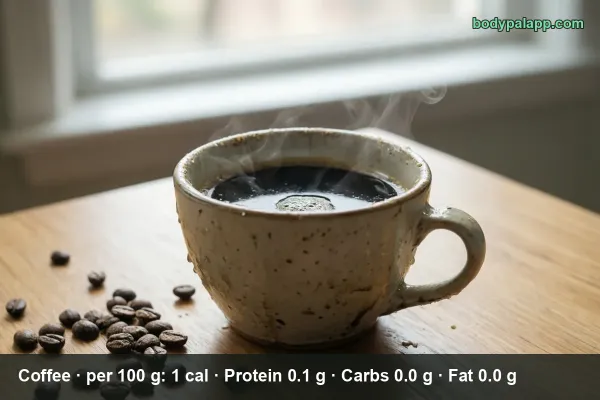
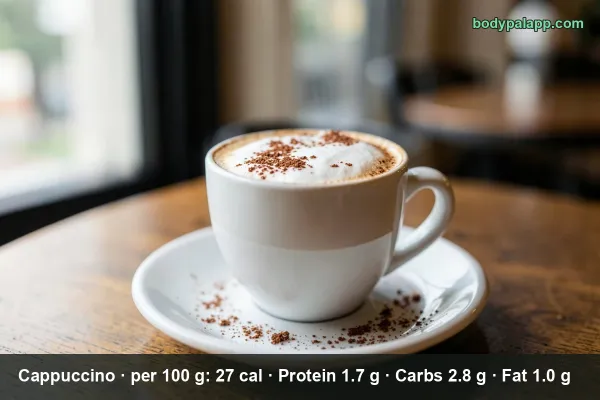
Here is espresso next to coffee, black coffee and cappuccino, compared per 100 g and per usual serving.
Verdict: For the fewest calories per sip, black coffee wins at 2 per 100 g, though its 248 g cup still lands at 5, the same as a double espresso. Cappuccino runs about 3 times espresso at 27 per 100 g because of the milk, so choose it when you want something more filling and stick with straight espresso when you are counting.
Espresso FAQs
How many calories are in a shot of espresso?
A single 1 fl oz shot (30 g) has about 3 calories. A double shot (60 g) has about 5 calories.
Is espresso good for weight loss?
Plain espresso is 9 calories per 100 g, so a double shot adds only about 5 calories to the day. Milk, sugar and syrup are what push the number up.
Espresso vs coffee: which has more calories?
Espresso is 9 calories per 100 g and brewed coffee about 1, but espresso is served in 30 g shots, so one shot is roughly 3 calories.
How many carbs are in espresso?
Espresso has 1.7 g of carbs per 100 g, which works out to about 0.5 g in a single 30 g shot, with 0 g sugar and 0.1 g protein.
How many calories are in a double shot of espresso?
A double shot of espresso (60 g) has 5 calories. It also carries 1 g of carbs, 0.1 g of protein, 0.1 g of fat and 8 mg of sodium, with 0 g of sugar when brewed and unsweetened.
Are two shots of espresso the same as a double?
Yes, two 30 g shots equal one 60 g double, which comes to 5 calories. Logging two singles at 3 each can look slightly higher because of rounding, but the real difference is negligible.
How many calories are in 3 shots of espresso?
Three shots of espresso (90 g) have about 8 calories and 13 mg of sodium. Protein stays at 0.1 g, so even a triple adds almost nothing to your daily total unless you add milk or sugar.
How many kcal does espresso have per 100 g?
Espresso has 9 kcal per 100 g. That breaks down to 1.7 g of carbs, 0.2 g of fat and 0.1 g of protein, with 0 g of sugar and 14 mg of sodium.