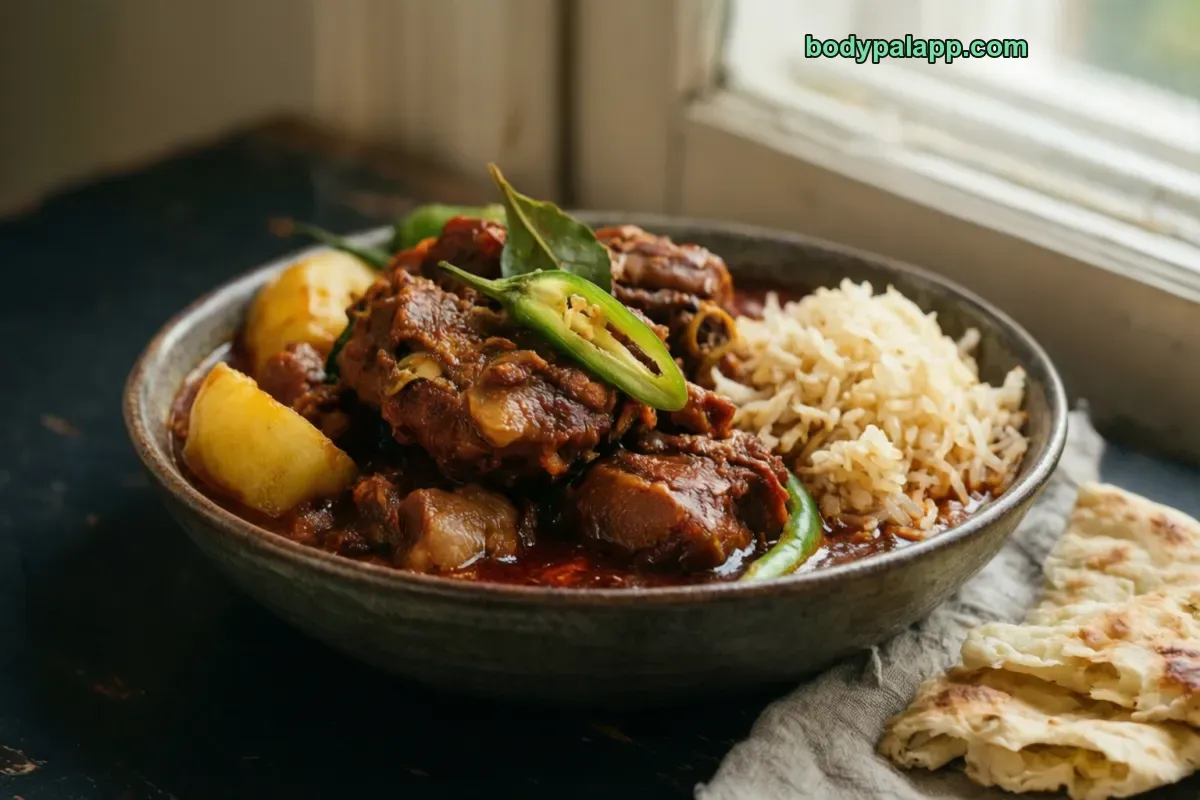
Lamb vindaloo calories come to 210 for a 5 oz serving (142 g) and 148 per 100 g, based on a packaged label. The number to notice is protein: it supplies 60% of the calories, so one tray gives you 18 g of protein for a modest calorie cost. Rice is what moves the total.
210kcal
1 5 oz serving · 142 g, packaged, per label
60%protein
18 gProtein
10 gCarbs
1 gFat
How to burn off 210 kcal
—Walking, brisk
—Jogging
—Cycling, moderate
—Swimming
Skip the math. BodyPal counts these calories from your steps and workouts automatically.
Nutrition facts
Packaged, per label · per 142 g
Calories
210 kcal
Protein
18 g
Carbohydrate
10 g
Fat
1 g
Saturated fat
3 g
Cholesterol
50 mg
Sodium
220 mg
Potassium
400 mg
Source: USDA FoodData Central
🛡️
Verified nutrition data
Numbers on this page come from USDA FoodData Central, the U.S. Department of Agriculture’s food composition database, and from manufacturer labels where a branded product is named. Last verified September 2026. How we verify our data →
Lamb vindaloo: calories, protein and sodium by serving
Percent of daily value uses the FDA reference of 2,000 kcal a day.
Serving
kcal
Protein
Carbs
Fat
Sodium
% DV kcal
5 oz serving (142 g)
210
18 g
10 g
1 g
220 mg
11%
With basmati rice (312 g)
340
19 g
45 g
10 g
690 mg
17%
100 g
148
12.7 g
7 g
0.7 g
155 mg
7%
3 × 5 oz serving (142 g)
630
54 g
660 mg
5 × 5 oz serving (142 g)
1,051
90 g
1,101 mg
One 5 oz tray is a 210-calorie main
The default serving here is a 5 oz portion of 142 g, the size of a single packaged tray. It lands at 210 calories, 18 g of protein and 220 mg of sodium. Against the daily values on this page, that is 11% of calories, 36% of protein and 10% of sodium. For a hot, saucy curry, those are restrained numbers.
Portions scale in a straight line, and they climb faster than you might expect at the table. Two servings (284 g) reach 420 calories with 36 g of protein. Three servings (426 g) come to 630 calories and 660 mg of sodium. A five-tray batch for a family, 710 g in total, adds up to 1,051 calories and 1,101 mg of sodium.
The practical move is to decide on the portion before you serve. A takeout container or a generous home ladle can easily hold two trays' worth of curry. If you weigh it once, you will know what a normal scoop looks like next time, and the calorie count stays honest.
Protein carries most of the calories
The calorie split is unusual for a curry. Protein brings 60% of the energy, carbs 33% and fat only 7%. Per 100 g, that works out to 12.7 g of protein, 7 g of carbs and 0.7 g of fat. Most of what you are eating is lean lamb in a tomato and vinegar based sauce.
The carbs come from the sauce itself, with 2.1 g of sugars and 1.4 g of fiber per 100 g. That is a small load. The meat does the heavy lifting, which is why a single tray can cover more than a third of the daily protein value of 50 g.
Keep in mind where these figures come from: a packaged product, measured per label. A curry house vindaloo cooked with more oil or fattier cuts of lamb can look quite different, with fat taking a much bigger share. If you order out, treat this page as the lean end of the range rather than a promise about every bowl.
Rice takes the meal from 210 to 340
Vindaloo rarely arrives alone. Served with basmati rice, a 312 g plate comes to 340 calories, 45 g of carbs and 10 g of fat. Protein barely moves, from 18 g to 19 g, because rice adds starch rather than protein. The share of daily calories rises from 11% to 17%.
Sodium is the bigger shift. The curry on its own carries 220 mg, but the rice plate lists 690 mg, which is 30% of the daily value. That figure comes from a separate product entry, so the seasoning of the rice and sauce together pushes it up. If you watch sodium, this is the line to check on any frozen meal label.
Fiber improves a little with rice, reaching 4.1 g on the plate versus 2 g for the curry alone. Still, both sit well below the 28 g daily value. Rice makes the meal more filling, but it is mostly extra starch, so the portion of rice decides how far the total climbs.
Build the plate around vegetables
Because the curry is already high in protein and low in fat, the gap on the plate is fiber and volume. A side of cooked spinach, cauliflower, cucumber salad or lentils adds bulk without crowding out the lamb. That approach keeps the meal closer to the 210-calorie tray than the 340-calorie rice plate.
If you like rice, a half scoop is a fair compromise. You keep the familiar pairing, you get some of the starch that tames the chili heat, and you avoid stacking a full plate of rice on top of a large curry portion. Naan and fried sides add up fast, so count them separately.
Potassium is a quiet plus here, at 282 mg per 100 g, and cholesterol sits at 35 mg per 100 g against a 300 mg daily value. To keep track of a whole curry night, BodyPal can log the dish from a photo, so the curry, rice and sides each get their own line.
How does lamb vindaloo compare?
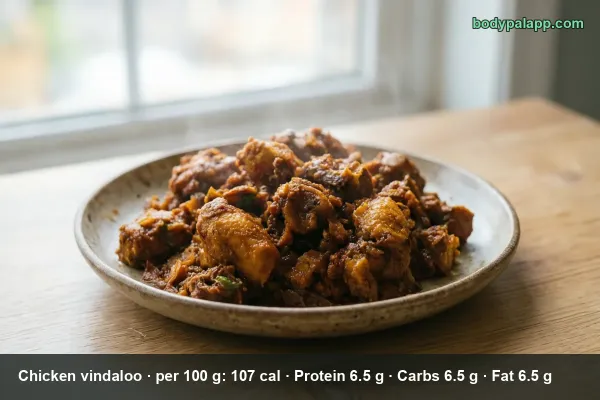
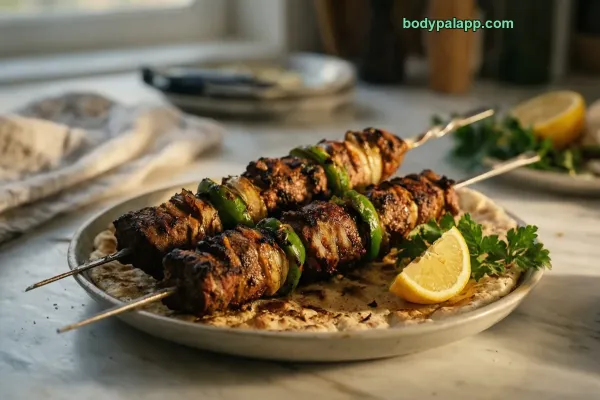
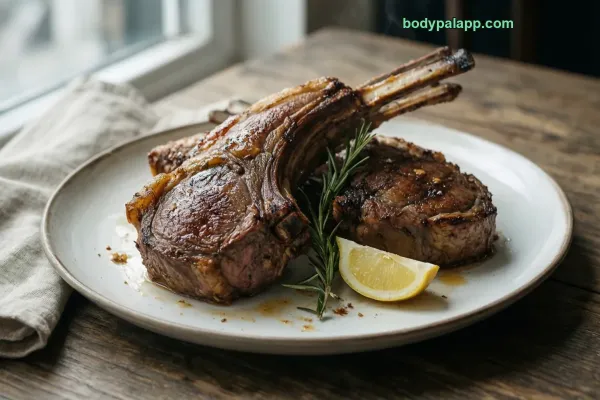
Here is how lamb vindaloo stacks up against chicken vindaloo, lamb kebab and lamb chop, per 100 g and per usual serving.
Verdict: For the fewest calories pick chicken vindaloo at 107 per 100 g, but lamb vindaloo gives nearly twice the protein (12.7 g vs 6.5 g) with less sodium (155 mg vs 376 mg), so it is the better curry for staying full. Lamb kebab at 283 and lamb chop at 264 per 100 g pack more protein but almost double the calories, which makes the vindaloo the leaner way to eat lamb.
Most popular lamb vindaloo brands in the United States
Ranked by popularity in the BodyPal database
# Productkcal / 100 g
1Bombay Kitchen Lamb Vindaloo5 oz · 142 g148 kcal
2Saffron Road Lamb Vindaloo With Basmati Rice11 oz · 312 g109 kcal
3Deep Indian Kitchen Lamb Vindaloo With Turmeric Rice1 tray · 269 g130 kcal
Trays that include basmati or turmeric rice read lower per 100 g, because the rice adds weight to the same amount of curry. Source: manufacturer labels / USDA FoodData Central.
Lamb vindaloo FAQs
How many calories are in lamb vindaloo?
A 5 oz serving (142 g) is 210 calories, and 100 g is 148 calories.
Is lamb vindaloo good for weight loss?
A 5 oz serving is 210 calories with 18 g protein and 1 g fat. The same curry served over basmati rice comes to 340 calories in an 11 oz tray.
Lamb vindaloo or chicken vindaloo: which has fewer calories?
Chicken vindaloo is 107 calories per 100 g against 148 for lamb vindaloo, a gap of 41 calories per 100 g.
How much protein is in lamb vindaloo?
12.7 g per 100 g, so a 5 oz serving (142 g) has about 18 g of protein alongside 10 g of carbs.
Is lamb vindaloo healthy?
A 5 oz serving has 210 calories and 18 g of protein, with 60% of its calories from protein and only 0.7 g of fat per 100 g. Sodium is moderate at 220 mg, which is 10% of the daily value.
How many calories are in lamb vindaloo with rice?
A 312 g plate of lamb vindaloo with basmati rice has 340 calories, 19 g of protein and 45 g of carbs. Sodium rises to 690 mg, or 30% of the daily value, compared with 220 mg for the curry alone.
What does lamb vindaloo nutrition look like per 100 g?
Per 100 g you get 148 calories, 12.7 g of protein, 7 g of carbs, 0.7 g of fat, 1.4 g of fiber and 155 mg of sodium. That is 25% of the daily protein value.
How many calories are in a double portion of vindaloo?
Two 5 oz servings of lamb vindaloo (284 g) come to 420 calories, with 36 g of protein and 440 mg of sodium. Three servings reach 630 calories.
How much sodium is in lamb vindaloo?
A 5 oz serving has 220 mg of sodium, 10% of the daily value, and 100 g has 155 mg. Served with basmati rice, the plate climbs to 690 mg.