
How many calories are in a Lindt truffle?
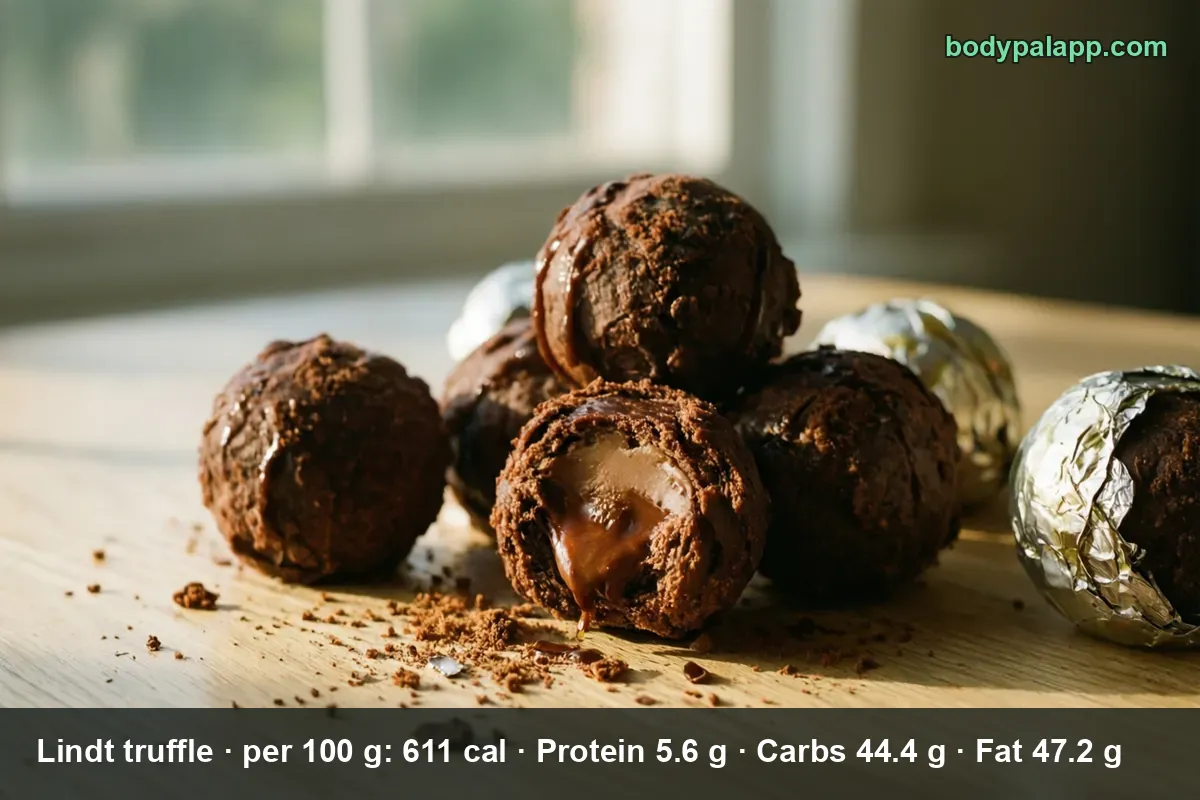
Three LINDOR balls, the serving printed on the bag, weigh 36 g and carry 220 calories. Per 100 g the truffles run 611 calories, which puts them near the top of the candy aisle, because a soft center is mostly cocoa butter. One ball on its own is 12 g and 73 calories.
On this page
- Lindt truffle quick facts
- US servings, from one ball to a dozen
- Milk, dark, caramel and truffle eggs
- Saturated fat is the row that decides
- How do Lindt truffles compare?
- Most popular lindt truffle brands
- Lindt truffle FAQs
Lindt truffle quick facts
The record below is the Lindt & Sprungli label for MILK CHOCOLATE TRUFFLES, fdc_id 2559972, matched by GTIN 0009542015206. Classic milk LINDOR is the ball most people are actually holding when they go looking for a number, and it is the version whose label carries a full panel, added sugars included.
USDA's generic databases do not help here. Foundation, SR Legacy and FNDDS have no entry for a filled truffle with a soft center, so a generic "chocolate candy" row would flatten exactly the thing that makes these different: the shell is thin and the middle is a cocoa-butter melt. The Branded record keeps that intact.
| Nutrient | Per 100 g | Per 3 balls (36 g) | % Daily Value |
|---|---|---|---|
| Calories | 611 | 220 | — |
| Total fat | 47.22 g | 17.0 g | 22% |
| Saturated fat | 36.11 g | 13.0 g | 65% |
| Carbohydrate | 44.44 g | 16.0 g | 6% |
| Dietary fiber | 2.8 g | 1.0 g | 4% |
| Total sugars | 38.89 g | 14.0 g | — |
| Added sugars | 33.3 g | 12.0 g | 24% |
| Protein | 5.56 g | 2.0 g | 4% |
| Sodium | 69 mg | 25 mg | 1% |
% Daily Value is based on a 2,000-calorie diet.
Verified nutrition data
Numbers on this page come from USDA FoodData Central, the U.S. Department of Agriculture’s food composition database, and from manufacturer labels where a branded product is named. Last verified September 2026. How we verify our data →
Nothing had to be dropped from this panel: the label also lists trans fat at 0 g, cholesterol at 14 mg per 100 g (5 mg per three balls, 2% DV) and potassium at 167 mg per 100 g (60 mg per serving, 1% DV). Total sugars get a dash because the FDA sets no Daily Value for them; only added sugars have one, and here they are almost the whole sugar figure.
One gap is worth naming. White chocolate LINDOR has no clean US Branded record in the index, so it gets no row on this page rather than a borrowed number from a look-alike product.
US servings, from one ball to a dozen
| Serving | Weight | Calories |
|---|---|---|
| 1 ball | 12 g | 73 kcal |
| 3 balls, the label serving | 36 g | 220 kcal |
| 1 oz | 28.4 g | 173 kcal |
| 5 balls | 60 g | 367 kcal |
| 6 balls | 72 g | 440 kcal |
| Per 100 g | 100 g | 611 kcal |
Only the 36 g row is a USDA serving; it is the three-ball measure Lindt prints on the bag. The single ball, the ounce, the five and the six are our own arithmetic from the USDA 100 g figure, not USDA servings.
This is where the ball size matters. Twelve grams is small — smaller than a nut cluster, smaller than most bagged candy pieces — so the count climbs faster than the weight suggests. Just over eight balls make 100 g. A handful of five is already 367 calories, and six, which is what a share-size bag disappears into over an evening, is 440.
Bag totals are the one number this page will not print. USDA lists the label serving, not the net weight of every pouch or box, and those change between formats. Multiply 73 by the count in front of you instead; that is the honest way to it.
Milk, dark, caramel and truffle eggs
| Version | Per 100 g | Label serving | Calories |
|---|---|---|---|
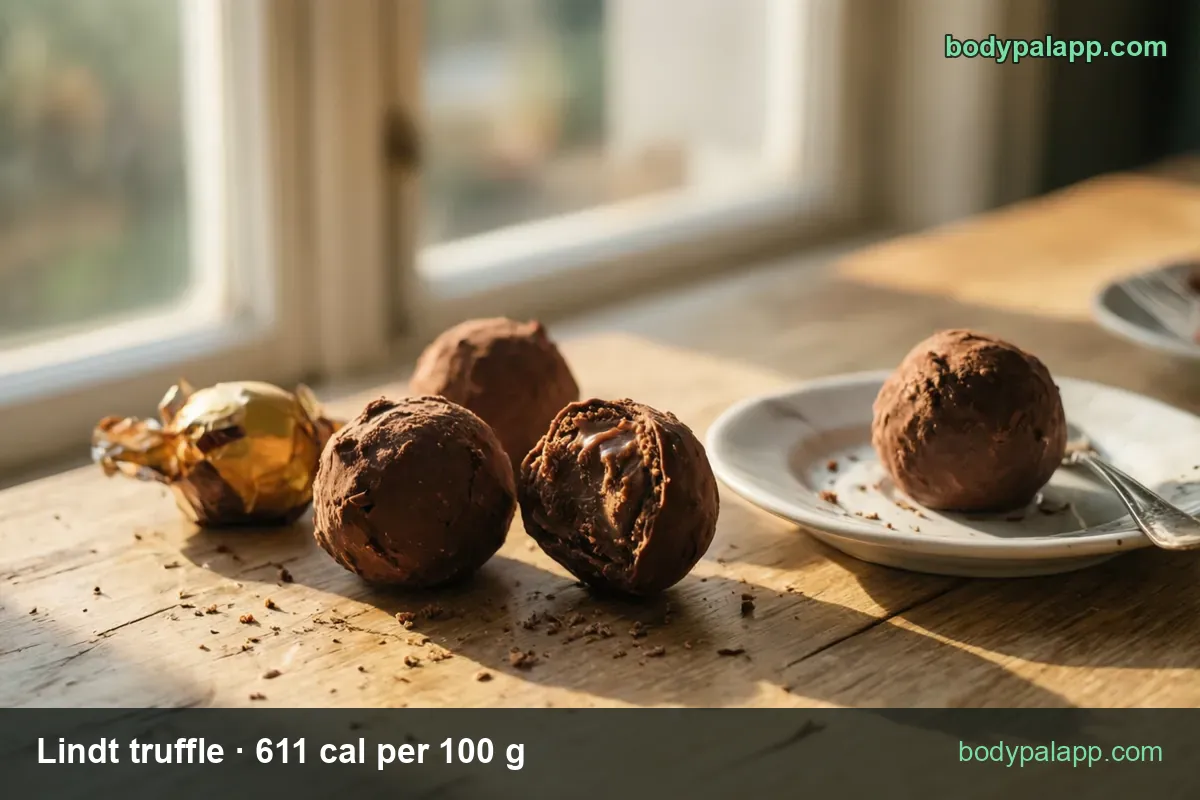
| Milk chocolate (LINDOR) | 611 kcal | 3 balls (36 g) | 220 kcal |
| Dark chocolate | 625 kcal | 2 balls (24 g) | 150 kcal |
| Extra dark chocolate | 611 kcal | 3 balls (36 g) | 220 kcal |
| Assorted | 639 kcal | 3 balls (36 g) | 230 kcal |
| Caramel with sea salt | 667 kcal | 3 balls (36 g) | 240 kcal |
| Milk chocolate truffle eggs | 571 kcal | 1 egg (28 g) | 160 kcal |
The headline here is that dark is not the light option. Per 100 g the dark truffles come in at 625 against milk's 611, and extra dark lands level with milk at 611. Dark only looks lighter on the shelf because its label serving is two balls, 24 g, instead of three. Compare like for like — scaling both 100 g figures down to a 12 g ball ourselves — and a dark ball is 75 calories to a milk ball's 73.
What dark actually buys you is composition, not calories: 4.2 g of fiber per 100 g against 2.8 g, and 33.33 g of sugar against 38.89 g. If sugar is what you are managing, that is a real difference. If calories are, it is a wash.
Caramel with sea salt is the heaviest of the set at 667 per 100 g and 240 per three balls, and it is the saltiest of the set: 111 mg of sodium per 100 g, about 40 mg per serving by our arithmetic, against 25 mg for milk. Its fiber is listed at 0.0 g, so the caramel center displaces the little cocoa fiber the others have.
The truffle eggs are the outlier in the other direction. At 571 per 100 g they are the only version in this table under 600, and one 28 g egg is 160 calories — more than two milk balls, less than three. Across the popular US Lindt labels the spread runs from the eggs at 571 to caramel with sea salt at 667, with assorted at 639 sitting between the milk and the caramel.
Saturated fat is the row that decides
Calories are not the interesting line on this label. Saturated fat is. Three balls carry 13.0 g of it, which is 65% of the Daily Value the FDA sets on the Nutrition Facts label — 20 g for a 2,000-calorie day. Two servings, six small balls, put you past the whole day's mark before dinner. One ball alone is 4.3 g by our own arithmetic from the 36.11 g per 100 g figure, so even the "just one" is over a fifth of the day.
Added sugars run second. Twelve grams per serving is 24% DV, and the Dietary Guidelines for Americans ask for less than 10% of daily calories from added sugars, which is where that 50 g Daily Value comes from. Notice how close the added figure sits to total sugars, 12.0 g of 14.0 g: almost none of the sweetness here is coming along for the ride from milk or cocoa.
Protein and fiber are rounding errors, 2.0 g and 1.0 g per serving, 4% DV each. Nobody is eating these for either, but it is worth knowing that a truffle does nothing for fullness. If you want the chocolate to hold you, pair it with something that has protein rather than expecting the candy to do the work.
How do Lindt truffles compare?
| Truffle | Per 100 g | US serving | Calories |
|---|---|---|---|
| Milk chocolate LINDOR | 611 kcal | 3 balls, 36 g | 220 kcal |
| Assorted chocolate truffles | 639 kcal | 3 balls, 36 g | 230 kcal |
| Chocolate truffles, 2-ball pack | 560 kcal | 2 balls, 25 g | 140 kcal |
| Milk chocolate truffle eggs | 571 kcal | 1 egg, 28 g | 160 kcal |
Our take: for weight loss, the two-ball pack is the only format here that solves the actual problem, because at 560 per 100 g and 140 per pack it ends by itself — the portion is the packaging. For pure enjoyment per calorie, the single milk ball at 73 is hard to beat and easy to stop at if you take one and put the bag away. What we would not do is switch to dark or to assorted expecting a saving; assorted is 639 per 100 g and dark is 625, both above plain milk. The number that changes your day is the count, not the flavor.
Across the wider US Lindt lineup the label servings themselves are a tell: milk, extra dark, assorted and caramel all print three balls at 36 g, dark prints two at 24 g, and the eggs print one at 28 g. Read the serving before you read the calories, or you will compare 24 g against 36 g and reach the wrong conclusion.
Most popular lindt truffle brands in the United States
Ranked by how widely each product appears among foods sold in the United States, from the BodyPal food database of over 3.3 million products. Calories are the figures printed on each Nutrition Facts label, checked against USDA FoodData Central.
| Product | Calories (per 100 g) |
|---|---|
| Lindt LINDOR Assorted Chocolate Truffles | 639 cal |
| Lindt LINDOR Dark Chocolate Truffles | 625 cal |
| Lindt LINDOR Extra Dark Chocolate Truffles | 611 cal |
| Lindt LINDOR Caramel with Sea Salt Dark Truffles | 667 cal |
| Lindt LINDOR Milk Chocolate Truffles | 611 cal |
| Lindt LINDOR Milk Chocolate Truffle Eggs | 571 cal |
Brand popularity: BodyPal food database. Nutrition: manufacturer labels / USDA FoodData Central.
Lindt truffle FAQs
How many calories are in one Lindt truffle?
One milk chocolate LINDOR ball is 73 calories at 12 g, worked out from the USDA figure of 611 calories per 100 g. That is our own arithmetic, not a USDA serving — the label serving is three balls. Dark works out to 75 calories a ball, essentially the same.
How many calories are in 3 Lindt Lindor truffles?
Three milk chocolate LINDOR balls are 220 calories. That is the serving Lindt prints on the bag, 36 g in total, and it also brings 17.0 g of fat, 13.0 g of saturated fat and 12.0 g of added sugars. Assorted at the same weight is 230 calories.
How much does one Lindor truffle weigh?
A standard LINDOR ball weighs 12 g, taken from the USDA label serving of three balls at 36 g. Just over eight of them make 100 g. The truffle eggs are a different format at 28 g each, and the two-ball packs run 25 g for the pair.
Are dark Lindt truffles lower in calories than milk?
No, dark LINDOR is 625 calories per 100 g against 611 for milk, so ball for ball dark is slightly higher, 75 against 73. Its label serving is two balls instead of three, which makes it look lighter. Dark does give more fiber, 4.2 g per 100 g against 2.8 g.
How much saturated fat is in a Lindt truffle?
Three balls carry 13.0 g of saturated fat, 65% of the FDA Daily Value of 20 g. One ball is about 4.3 g by our arithmetic from the 36.11 g per 100 g figure. Six balls take you past a full day's allowance, which is the sharpest limit on this label.
How much sugar is in a Lindor truffle?
A serving of three balls has 14.0 g of total sugars, of which 12.0 g are added sugars — 24% of the Daily Value. One ball works out to roughly 4.7 g of sugar. Dark truffles are lower, 33.33 g per 100 g against 38.89 g for milk chocolate.
How many calories are in 100 g of Lindt truffles?
Milk chocolate LINDOR is 611 calories per 100 g, which is just over eight balls. Caramel with sea salt is the densest at 667, assorted is 639, dark is 625, and the milk chocolate truffle eggs are the lightest of the set at 571 calories per 100 g.
Do Lindt truffles have protein or fiber?
Barely: three balls give 2.0 g of protein and 1.0 g of fiber, 4% of the Daily Value each. There is also 5 mg of cholesterol and 60 mg of potassium per serving. Treat these as a dessert, not as something that will keep you full until the next meal.
Similar foods
- Movie Popcorn — 1128 cal per large order
- Movie Theater Popcorn — 862 cal per medium order
- Peanuts — 164 cal per ounce
- Ferrero Rocher — 220 cal for 3 pieces
- Lay'S Potato Chips — 160 cal per oz
- Cheese Puffs — 159 cal per serving
Count it without the math
Point the camera at the dish and BodyPal counts the truffles for you, wrappers and all.


How long does it take to burn off Lindt truffles?
Three balls (36 g) is 220 kcal. Enter your weight and the amount you ate to see how long it takes you to burn that off:
lb
| Activity | Time to burn 220 kcal |
|---|---|
| Walking, brisk | 44 min |
| Cycling, moderate | 28 min |
| Swimming, moderate | 31 min |
| Jogging | 26 min |
| Weight training, moderate | 49 min |
Times are for a 155 lb adult at a steady pace; change the weight to see yours. The amount is set to the portion in the text (36 g); change it to what you actually ate. BodyPal works this out from your steps automatically.
Want the bigger picture? Calculate your daily calorie needs — your maintenance figure, a target for losing or gaining, and the date you get there.