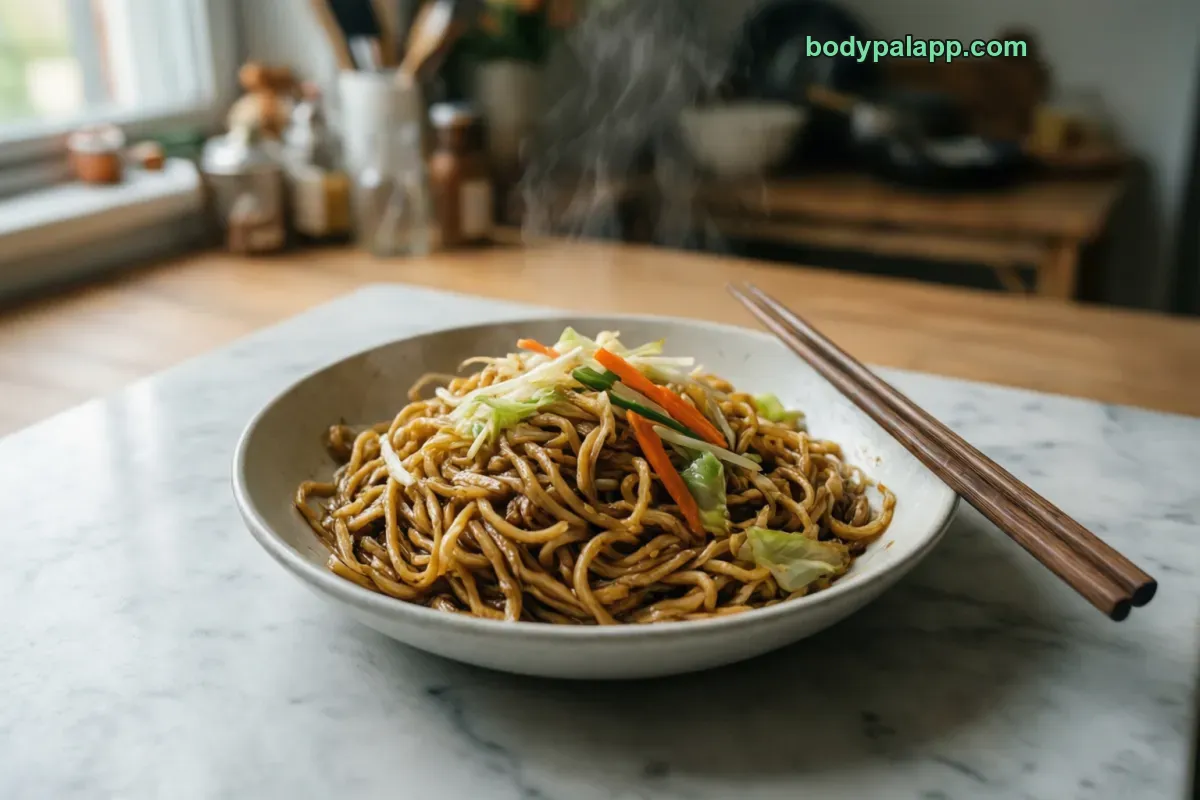
Lo mein calories come to 242 for a 1 cup (200 g) serving and 121 per 100 g. Carbs supply 67% of those calories, and the same cup carries 860 mg of sodium, 37% of the daily value. Portion size moves both numbers fast, and takeout plates rarely stop at a single cup.
242kcal
1 cup · 200 g, noodles, no meat specified
16%protein
9.5 gProtein
40 gCarbs
4.7 gFat
How to burn off 242 kcal
—Walking, brisk
—Jogging
—Cycling, moderate
—Swimming
Skip the math. BodyPal counts these calories from your steps and workouts automatically.
Nutrition facts
Noodles, no meat specified · per 200 g
Calories
242 kcal
Protein
9.5 g
Carbohydrate
40 g
Fat
4.7 g
Saturated fat
0.9 g
Cholesterol
0 mg
Sodium
860 mg
Potassium
210 mg
Iron
2.1 mg
Source: USDA FoodData Central
🛡️
Verified nutrition data
Numbers on this page come from USDA FoodData Central, the U.S. Department of Agriculture’s food composition database, and from manufacturer labels where a branded product is named. Last verified October 2026. How we verify our data →
Lo mein: calories, protein and sodium by serving
Percent of daily value uses the FDA reference of 2,000 kcal a day.
Serving
kcal
Protein
Carbs
Fat
Sodium
% DV kcal
1 cup (200 g)
242
9.5 g
40.3 g
4.7 g
860 mg
12%
Chicken, 1 cup (200 g)
260
18.3 g
32.3 g
6.3 g
826 mg
13%
100 g
121
4.8 g
20.2 g
2.4 g
430 mg
6%
3 × 1 cup (200 g)
726
28.6 g
2,580 mg
5 × 1 cup (200 g)
1,210
47.7 g
4,300 mg
Every cup of lo mein adds 242 calories
A 1 cup (200 g) serving of lo mein holds 242 calories, 9.5 g of protein and 40.3 g of carbs. That is 12% of the daily calorie value, which sounds modest for a filling plate of noodles. The 100 g reference sits at 121 calories, so the math stays simple: every 100 g you add puts about 121 calories on the plate.
The catch is that lo mein rarely arrives as one neat cup. Two cups (400 g) come to 484 calories, and three cups (600 g) reach 726. A full 1,000 g of noodles totals 1,210 calories with only 47.7 g of protein, which is a lot of energy for a fairly small protein return.
If you track what you eat, measure a cup once at home so you know what it looks like in a bowl. After that, eyeballing a takeout portion gets much easier, and you can split a large order into two meals before you start eating. BodyPal can also log the dish from a photo, which saves typing when the plate is already in front of you.
Carbs supply two thirds of the calories
The calorie split is 67% carbs, 17% fat and 16% protein. Per 100 g that works out to 20.2 g of carbs, 2.4 g of fat and 4.8 g of protein. Fat is modest for a stir-fried noodle dish, and saturated fat is only 0.5 g per 100 g.
Fiber is low at 1.3 g per 100 g, or 2.6 g per cup. Sugar is small too: 2.6 g per 100 g and 5.3 g per cup. So the bulk of the energy is plain starch from the noodles, which goes down easily and does not slow you much at the table.
Protein is the weak spot. A cup gives 9.5 g, which is 19% of the daily value, so plain lo mein works better as a base than as a whole meal. Cholesterol is listed at 0 for this USDA row, which describes the noodles with no meat specified. Add a protein and the picture changes, as the chicken version shows below.
Sodium is the row to watch
Per 100 g, lo mein carries 430 mg of sodium, 19% of the daily value. A single cup doubles that to 860 mg, or 37%. Next to calories at 12% of the daily value, sodium is clearly the number that climbs fastest on this page.
Portions push it further. Two cups come to 1,720 mg, and three cups reach 2,580 mg, which is more than the full daily value from one dish. A 1,000 g order holds 4,300 mg. Calories at that size look forgiving by comparison, so sodium is the reason to keep the portion in check even when the calorie budget has room.
If you watch sodium, keep the serving to about a cup, fill the rest of the plate with unsalted steamed vegetables, and go easy on extra soy sauce at the table. Potassium is low at 105 mg per 100 g, so the noodles themselves do little to balance the salt. Drinking water with the meal will not change the numbers, but a smaller scoop will.
Chicken lo mein adds protein, not many calories
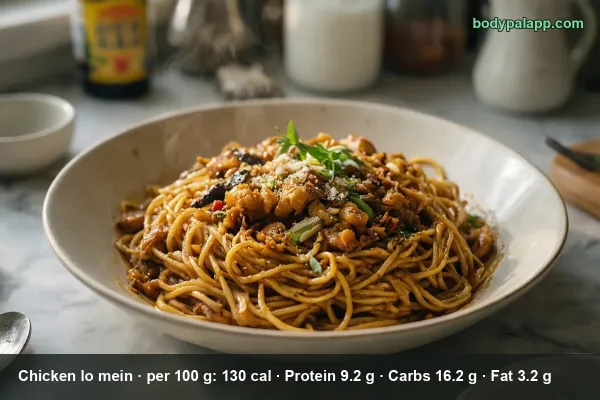
The USDA chicken lo mein row comes to 260 calories per 1 cup (200 g), only slightly more than the plain version. Protein almost doubles, from 9.5 g to 18.3 g, and that cup covers 37% of the daily protein value against 19% for plain noodles.
Carbs drop to 32.3 g and fat rises a little to 6.3 g. Sodium barely moves at 826 mg, or 36% of the daily value. Fiber sits at 2 g and sugar at 4.2 g, close to the plain cup. In short, the meat swaps some noodles for protein without changing the overall size of the meal much.
For a more filling plate, chicken is the better order: more protein for about the same calories. Pair a cup of either version with a side of steamed vegetables or a plain salad to add volume and fiber without much energy. Shrimp is another lean option with a lighter sodium row, covered in the comparison below.
How does lo mein compare?
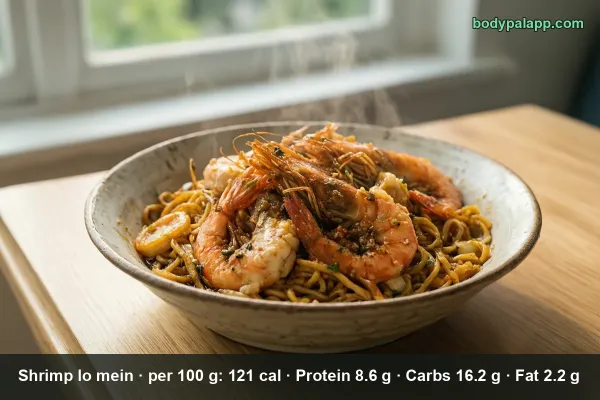
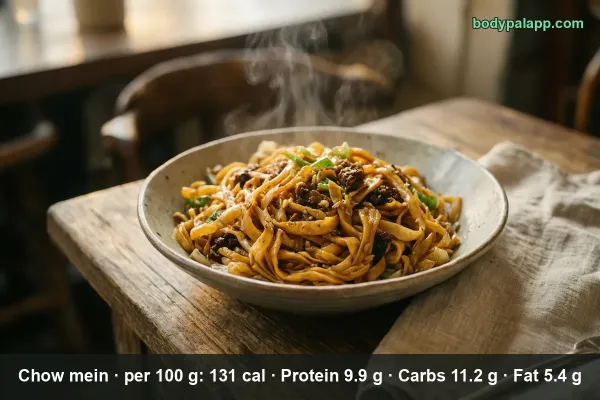
Here is how plain lo mein stacks up against shrimp lo mein, chicken lo mein and chow mein, per 100 g and per usual serving.
Verdict: For weight loss, plain lo mein and shrimp lo mein tie at 121 calories per 100 g, but shrimp brings 8.6 g of protein and less sodium at 363 mg, so shrimp is the smarter pick. For staying full, chow mein leads with 9.9 g of protein per 100 g, though its 5.4 g of fat makes it the richest of the four at 131 calories.
3Tasty Bite Mushroom Lo Mein1/2 pack · 125 g152 kcal
4Simply Asia Chinese Style Lo Mein Noodles2 oz · 56 g339 kcal
5Shung's Mushroom Lo Mein1/2 package · 128 g148 kcal
6Wel-Pac Lo Mein Egg Noodles1 bundle · 94 g340 kcal
7Chung's Vegetable Basil Lo Mein1/2 package · 128 g117 kcal
Dry noodle packs are labeled per uncooked weight, so they read far higher than the cooked dish above. Source: manufacturer labels / USDA FoodData Central.
Lo mein FAQs
How many calories are in a cup of lo mein?
One cup (200 g) of lo mein has about 242 calories, which is 121 per 100 g.
Is lo mein good for weight loss?
A 200 g cup has 242 calories, 9.5 g protein and 40.3 g carbs, so the portion size drives most of the total. The same cup also carries 860 mg of sodium.
Lo mein vs shrimp lo mein: which has fewer calories?
Both have 121 calories per 100 g, or 242 per cup. Shrimp lo mein has more protein: 17.1 g per cup against 9.5 g.
How many carbs are in lo mein?
One cup has 40.3 g of carbs, including 2.6 g of fiber and 5.3 g of sugars.
How many calories are in shrimp lo mein?
Shrimp lo mein has 121 calories per 100 g, the same as plain lo mein. It brings more protein, 8.6 g versus 4.8 g, and fewer carbs at 16.2 g per 100 g.
Is shrimp lo mein fattening?
Shrimp lo mein has 2.2 g of fat and 121 calories per 100 g, so it is not a high-fat dish. The total depends on portion size, just as plain lo mein reaches 484 calories at two cups.
What is the nutrition breakdown of shrimp lo mein?
Per 100 g, shrimp lo mein has 121 calories, 8.6 g of protein, 16.2 g of carbs, 2.2 g of fat and 363 mg of sodium. That is less sodium than plain lo mein at 430 mg.
How many calories are in takeout lo mein?
Based on the USDA row, lo mein has 242 calories per cup (200 g). If your takeout portion fills two cups, that is 484 calories; three cups come to 726 calories and 2,580 mg of sodium.