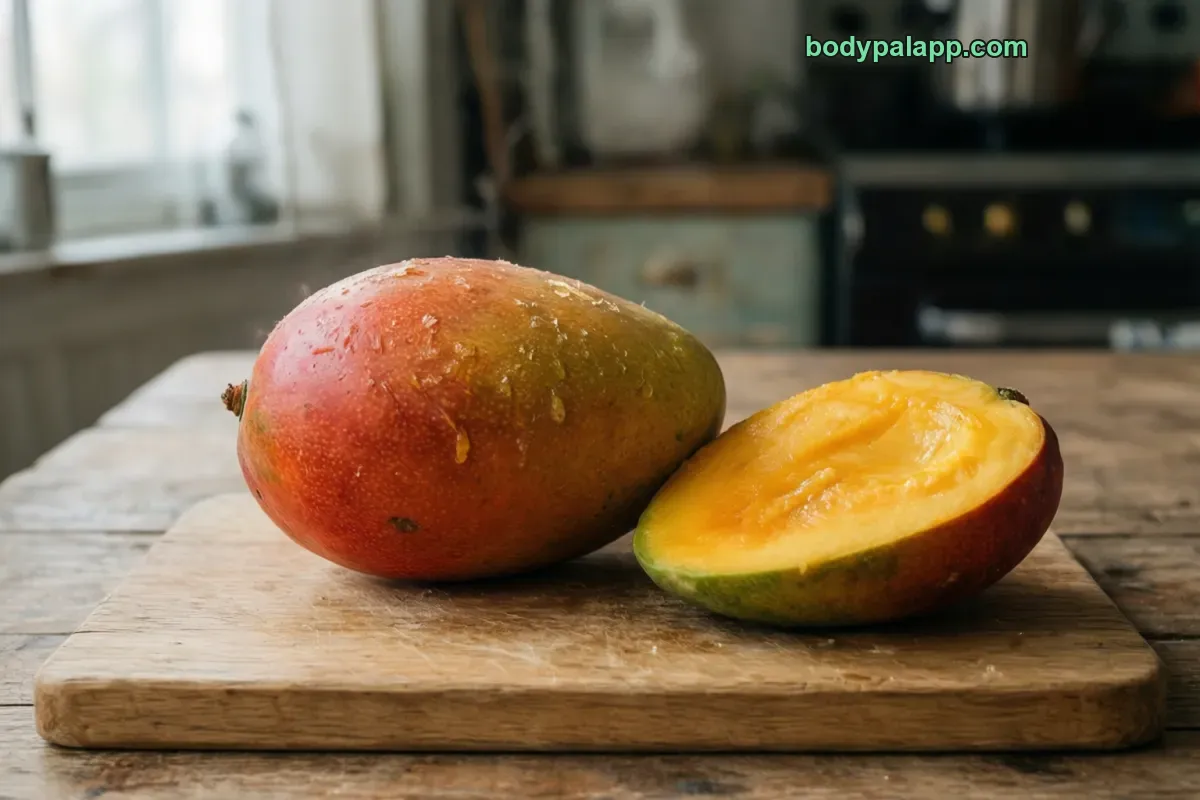
Mango with skin calories come to 202 for one whole mango (336 g), or 60 per 100 g. The number to notice is how carb-heavy the fruit is: 90% of its calories come from carbohydrate, and 45.9 g of a whole mango's 50.3 g of carbs is sugar. Fat and protein barely register.
202kcal
1 whole mango · 336 g, raw, whole fruit
5%protein
2.8 gProtein
50 gCarbs
1.3 gFat
How to burn off 202 kcal
—Walking, brisk
—Jogging
—Cycling, moderate
—Swimming
Skip the math. BodyPal counts these calories from your steps and workouts automatically.
Nutrition facts
Raw, whole fruit · per 336 g
Calories
202 kcal
Protein
2.8 g
Carbohydrate
50 g
Fat
1.3 g
Saturated fat
0.3 g
Cholesterol
0 mg
Sodium
3 mg
Potassium
564 mg
Iron
0.5 mg
Source: USDA FoodData Central
🛡️
Verified nutrition data
Numbers on this page come from USDA FoodData Central, the U.S. Department of Agriculture’s food composition database, and from manufacturer labels where a branded product is named. Last verified September 2026. How we verify our data →
Mango with skin: calories, protein and sodium by serving
Percent of daily value uses the FDA reference of 2,000 kcal a day.
Serving
kcal
Protein
Carbs
Fat
Sodium
% DV kcal
1 mango (336 g)
202
2.8 g
50.3 g
1.3 g
3 mg
10%
1 cup pieces (165 g)
99
1.4 g
24.7 g
0.6 g
2 mg
5%
Small mango (210 g)
126
1.7 g
31.5 g
0.8 g
2 mg
6%
100 g
60
0.8 g
15 g
0.4 g
1 mg
3%
3 × 1 mango (336 g)
605
8.3 g
10 mg
5 × 1 mango (336 g)
1,008
13.8 g
17 mg
A whole mango is 202 calories, a cup is 99
Mango is easy to undercount because the fruit is big. One whole mango of 336 g carries 202 calories, which is 10% of a 2,000-calorie daily value. A cup of pieces (165 g) lands at 99 calories, or 5% of the day. That cup is roughly half the fruit, so the way you serve it decides the total more than anything else.
Size matters too. A small mango of 210 g comes in at 126 calories and 6% of the daily value. If the mangoes at your store run small, logging every fruit as a full 336 g mango will overstate your intake by a fair margin. Weighing one once gives you a reference you can reuse.
The numbers climb fast when mango is the main event. Two whole mangoes total 403 calories, three reach 605, and five add up to 1,008. That last figure is a lot of fruit, but smoothie bowls and fruit platters can hide two or three mangoes without anyone noticing. Count the fruit that went into the blender, not the glass.
Carbs supply 90% of the calories
The calorie split is lopsided: 90% carbohydrate, 5% protein and 5% fat. Per 100 g, mango has 15 g of carbs, 0.8 g of protein and 0.4 g of fat. In practice, nearly every calorie you log from a mango is carbohydrate, and most of that carbohydrate is sugar.
Sugar makes up 13.7 g of those 15 g of carbs per 100 g. A whole mango delivers 45.9 g of sugar, a cup of pieces 22.5 g and a small mango 28.7 g. This is the fruit's own sugar, not added sugar, but it still counts toward your carb total if you track carbs closely.
Fiber softens the picture a little. A whole mango has 5.4 g of fiber, a cup has 2.6 g and 100 g has 1.6 g. Against a daily value of 28 g, one whole mango covers a useful slice of the target. Saturated fat sits at 0.1 g per 100 g and cholesterol at 0, so neither row needs attention.
Sodium is a non-issue, potassium is modest
If you watch sodium, mango is close to invisible. A whole mango has 3 mg, a cup 2 mg and 100 g just 1 mg. Every serving on this page rounds to 0% of the 2,300 mg daily value. Even five whole mangoes total only 17 mg, so the fruit will not move your sodium count in any realistic portion.
Potassium is present but not standout. Mango has 168 mg per 100 g, measured against a daily value of 4,700 mg. A whole fruit adds a meaningful amount over the day, yet it is not the reason to pick mango over other fruit.
So the row to watch is sugar, not salt. If your goal is keeping carbs in check, the cup portion with 22.5 g of sugar is the easier one to fit. If you are not tracking carbs, mango is a low-fat, near-zero-sodium sweet option that sits comfortably in most days of eating.
Mango needs a protein partner
A whole mango gives you only 2.8 g of protein, 6% of the 50 g daily value. A cup gives 1.4 g. On its own, mango is a sweet, quick-energy snack rather than something that holds you until the next meal. That is not a flaw; it just tells you what to pair it with.
Combine a cup of mango with a protein source such as yogurt, cottage cheese or a handful of nuts and the snack becomes more balanced. At 99 calories the cup leaves room for the partner food. A whole mango at 202 calories works better as a dessert after a protein-rich meal than as a standalone snack.
In salsas, salads and smoothies, mango is usually one ingredient among several, so estimate the portion you actually ate. BodyPal can log mango from a photo, which helps when it shows up as cubes in a bowl rather than a whole fruit on the counter.
How does mango with skin compare?
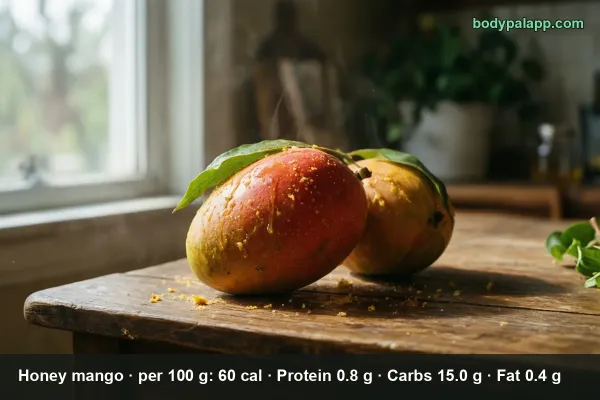
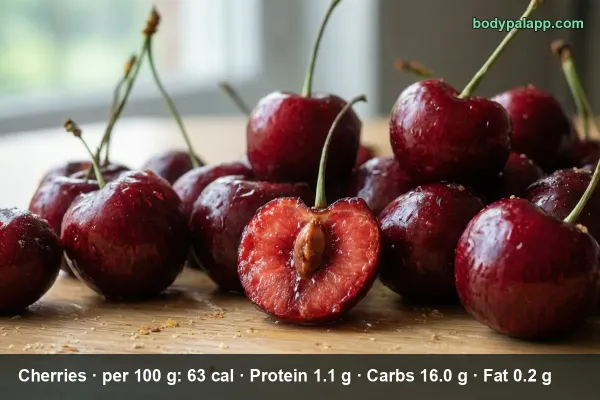
Here is how mango stacks up against honey mango, kiwi with skin and cherries with pit, per 100 g and per usual serving.
Verdict: Per 100 g these fruits are nearly tied, with mango and honey mango at 60 calories, kiwi at 61 and cherries at 63, so pick by taste rather than by calories. For the smallest portable snack, a kiwi at 42 calories per fruit beats a whole mango at 202.
Mango with skin FAQs
How many calories are in one mango with skin?
About 202 calories for a whole raw mango (336 g), or 126 for a smaller 210 g mango.
Is mango good for weight loss?
Mango has 60 calories and 1.6 g of fiber per 100 g, so a cup of pieces (165 g) comes to 99 calories.
Mango vs kiwi: which has fewer calories?
They are almost equal: mango has 60 calories per 100 g and kiwi with skin has 61.
How much sugar is in a mango?
A whole mango (336 g) has about 45.9 g of sugar and 50.3 g of carbs, or 13.66 g of sugar per 100 g.
How many calories are in a cup of mango?
A cup of mango pieces (165 g) has 99 calories. It also brings 24.7 g of carbs, 22.5 g of sugar and 2.6 g of fiber, which makes it about half the calories of a whole fruit.
How many calories are in a small mango?
A small mango of 210 g has 126 calories, about 6% of a 2,000-calorie daily value. It carries 31.5 g of carbs, 28.7 g of sugar and 3.4 g of fiber.
How many carbs are in a whole mango?
One whole mango (336 g) has 50.3 g of carbs, of which 45.9 g is sugar. Per 100 g that is 15 g of carbs, and carbs supply 90% of the fruit's calories.
How much fiber does a mango have?
A whole mango has 5.4 g of fiber, measured against a daily value of 28 g. A cup of pieces has 2.6 g, and 100 g of mango has 1.6 g.
Does mango have much protein?
No. A whole mango has 2.8 g of protein, 6% of the 50 g daily value, and protein makes up only 5% of its calories. Pair it with yogurt or nuts if you want a more filling snack.