
How many calories are in a honey mango?
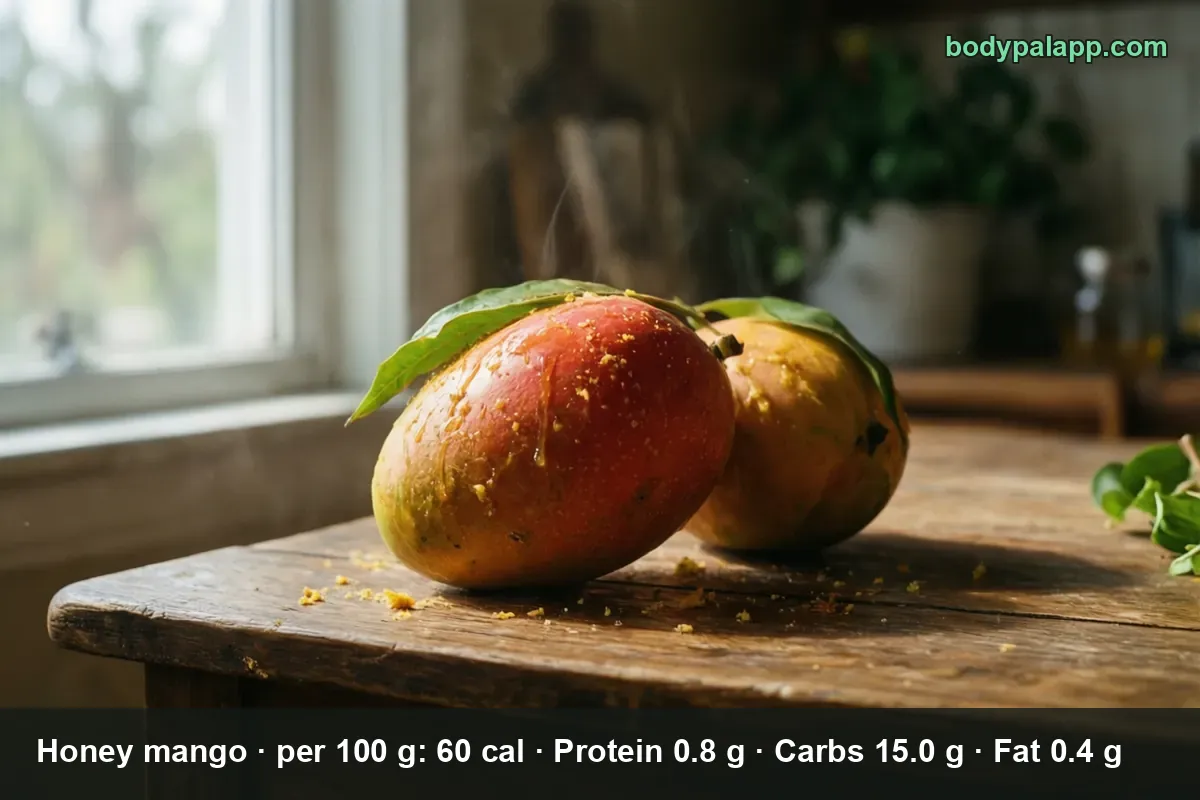
A 1-cup serving of honey mango pieces weighs 165 g and carries 99 calories. Raw mango runs 60 calories per 100 g, so almost everything about the number comes down to how much fruit you cut. A whole mango, skin and pit removed, is 336 g and 202 calories — a little over double the cup.
On this page
- Honey mango quick facts
- US servings from one ounce to a whole mango
- Ataulfo and Tommy Atkins versus the generic row
- What happens when mango is frozen dried or canned
- What the fiber and sugar rows actually mean
- How does honey mango compare?
- FAQ
Honey mango quick facts
Honey mango is the Ataulfo cultivar of Mangifera indica — the small yellow one with the flat pit, sold in a five-pack at most US grocery stores. The record used for the panel below is SR Legacy 169910, "Mangos, raw", because it pairs a full nutrient panel with USDA household measures, including the 1-cup and whole-fruit weights people actually eat.
There is a Foundation record for peeled Ataulfo flesh specifically, and it reads higher. It also has no sugar figure, no saturated fat and no serving weights at all, so it belongs in the variant table further down rather than in the headline panel. Never split the difference between two USDA records; pick the one that matches the fruit in your hand and say which it is.
| Nutrient | Per 100 g | Per 1 cup pieces (165 g) | % Daily Value |
|---|---|---|---|
| Calories | 60 | 99 | — |
| Total fat | 0.38 g | 0.6 g | 1% |
| Saturated fat | 0.09 g | 0.1 g | 1% |
| Carbohydrate | 14.98 g | 24.7 g | 9% |
| Dietary fiber | 1.6 g | 2.6 g | 9% |
| Total sugars | 13.66 g | 22.5 g | — |
| Protein | 0.82 g | 1.4 g | 3% |
| Sodium | 1 mg | 2 mg | 0% |
% Daily Value is based on a 2,000-calorie diet.
Verified nutrition data
Numbers on this page come from USDA FoodData Central, the U.S. Department of Agriculture’s food composition database, and from manufacturer labels where a branded product is named. Last verified September 2026. How we verify our data →
Two rows you would see on a package are missing here on purpose. Added sugars are not published for this record — raw fruit has none, and the SR Legacy edition does not carry the field — so the row is gone rather than guessed. Cholesterol is a flat 0 mg, as it is in every plant food. Potassium is worth naming: 168 mg per 100 g, or 277 mg in the cup, which is 6% of the Daily Value.
US servings from one ounce to a whole mango
| Serving | Weight | Calories |
|---|---|---|
| 1 oz | 28.4 g | 17 kcal |
| Half a cup, pieces | 82.5 g | 50 kcal |
| 1 cup, pieces | 165 g | 99 kcal |
| One whole mango, no skin or pit | 336 g | 202 kcal |
| Per 100 g | 100 g | 60 kcal |
The 1-cup (165 g) and whole-fruit (336 g) weights are USDA household measures attached to the record itself. The half cup and the ounce are our own arithmetic from the USDA 100 g figure, not USDA servings, which is why they land on odd gram weights.
Here is the trap. A whole mango weighs 336 g of edible flesh, a little more than two cups of pieces at 330 g, so "one mango" is not one serving in any practical sense — it is 202 calories against the 99 most people picture when they log a cup. If you cut the fruit over a bowl and eat what is in the bowl, log the whole thing. If you cut a cup and put the rest in the fridge, log the cup.
Ataulfo and Tommy Atkins versus the generic row
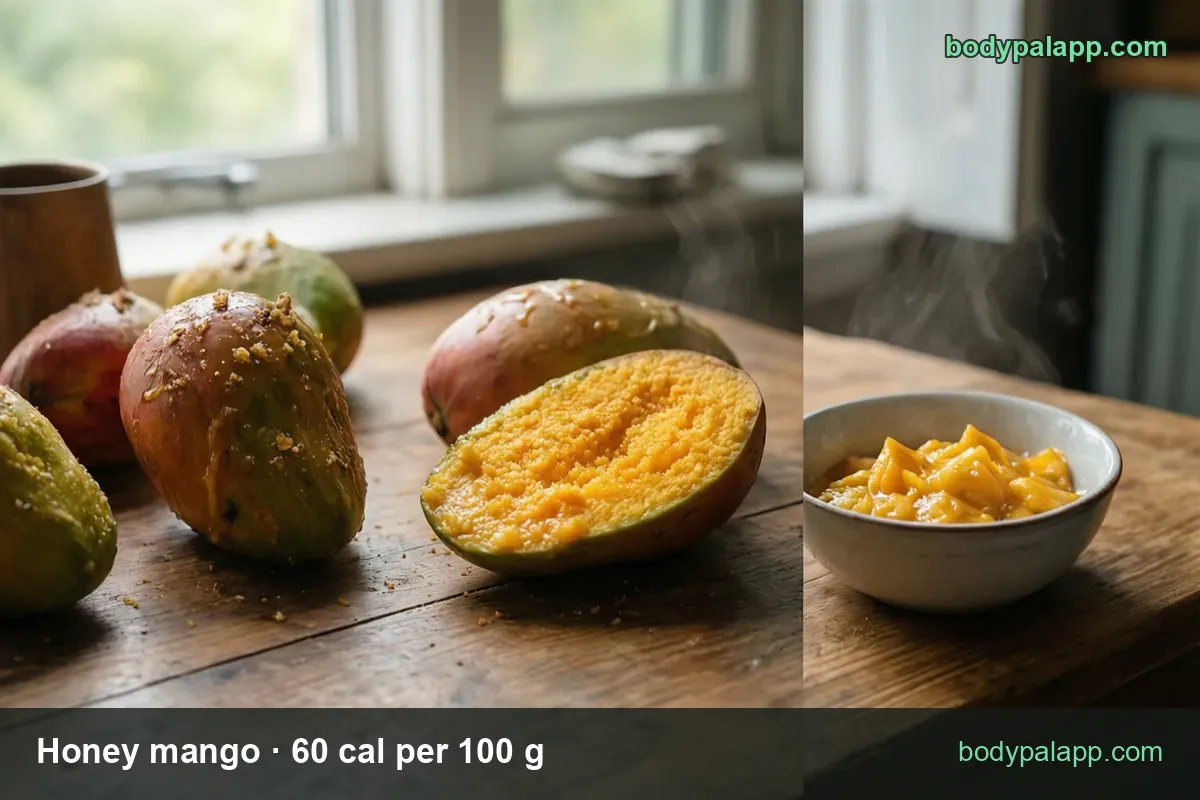
USDA has separate Foundation records for two named cultivars, and both were measured as peeled flesh — no skin, no pit, nothing but what you would eat. That is why they sit above the generic row: the generic entry averages a fruit as usually sold, the Foundation entries weigh only the dense part.
| Version | Per 100 g | Typical serving | Calories |
|---|---|---|---|
| Mango, raw (the main row) | 60 kcal | 1 cup pieces, 165 g | 99 kcal |
| Honey mango (Ataulfo), peeled | 78.5 kcal | 1 cup pieces, 165 g | 129 kcal |
| Tommy Atkins, peeled | 68.5 kcal | 1 cup pieces, 165 g | 113 kcal |
Both cup figures are our own arithmetic from those 100 g values, since neither Foundation record ships a serving weight. The gap is real but small in practice: 30 calories a cup between the honey mango record and the generic one, which is roughly the difference between a level cup and a heaped one.
One note on what you are looking at in the produce aisle. The big red-green mango most stores stack in a pile is Tommy Atkins, the lighter of the two at 68.5 calories per 100 g. The little yellow one sold as honey mango or champagne mango is Ataulfo. If you want a single number for both, the generic 60-per-100-g row is the honest middle, and it is the one this page uses.
What happens when mango is frozen dried or canned
| Version | Per 100 g | Typical serving | Calories |
|---|---|---|---|
| Frozen mango, unsweetened | 60 kcal | 1 cup, 165 g | 99 kcal |
| Canned mango | 65 kcal | 1 cup, 250 g | 163 kcal |
| Dried sweetened mango | 319 kcal | 1 oz, 28.4 g | 90 kcal |
| Mango nectar, canned | 51 kcal | 1 cup, 251 g | 128 kcal |
Frozen is the surprise: unsweetened frozen mango matches raw exactly, 60 calories per 100 g, same carbs, same fiber. The frozen cup and the dried ounce in that table are our own arithmetic from the 100 g figures; the canned and nectar cups are USDA measures. Nothing is added and nothing is cooked out, so a smoothie made with frozen chunks costs the same as one made with fresh fruit.
Canned climbs to 65 per 100 g because of the packing syrup, and the sugars go from 13.66 g to 15.24 g per 100 g. The bigger issue is the cup: a canned cup is 250 g including syrup, not 165 g of fruit, which is how a "cup of mango" becomes 163 calories.
Dried sweetened mango is the one worth measuring. At 319 calories per 100 g it is more than five times fresh mango by weight, so a 1 oz handful is 90 calories where an ounce of fresh is 17. It is also the only mango row here with real sodium — 162 mg per 100 g against 1 mg in the fresh fruit.
Nectar goes the other way and still loses. A cup is 128 calories, more than the 99 in a cup of actual fruit, with 0.8 g of fiber instead of 2.6 g. You pay more calories for less of the thing that makes fruit filling.
What the fiber and sugar rows actually mean
A cup of mango pieces carries 2.6 g of fiber, 9% of the FDA Daily Value of 28 g. A whole mango carries 5.4 g, close to a fifth of the day, which is a lot for something that tastes like candy. Potassium runs the same direction: 277 mg in the cup, 6% of the 4,700 mg Daily Value.
The sugar row is the one people misread. A cup shows 22.5 g of total sugars and no %DV, and that blank is not an oversight. Daily Values on the label exist only for added sugars, capped at 50 g, and raw mango has none — every gram of that 22.5 comes with the fiber, water and potassium attached. Comparing fruit sugar to the added-sugar limit is comparing two different measurements.
Where mango does ask for attention is volume. One cup counts as one cup-equivalent toward the fruit group in MyPlate, and it is easy to eat two of them off a cutting board without noticing. If you're watching calories, the fix is not skipping the mango; it is cutting one cup and leaving the rest wrapped.
How does honey mango compare?
| Fruit | Per 100 g | US serving | Calories |
|---|---|---|---|
| Mango, raw | 60 kcal | 1 cup pieces, 165 g | 99 kcal |
| Pineapple, canned in juice, drained | 60 kcal | 1 oz, 28.4 g | 17 kcal |
| Longans, raw | 60 kcal | 1 oz, 28.4 g | 17 kcal |
| Java-plum (jambolan), raw | 60 kcal | 1 oz, 28.4 g | 17 kcal |
Our take: all four rows land on exactly 60 calories per 100 g, so by weight this is a four-way tie and picking between them on calories alone is pointless. USDA lists only an ounce for the other three, which is why their serving column looks so small — an ounce of mango is also 17 calories. What separates them is what a real portion looks like: mango gives you a full 165 g cup of soft fruit with 2.6 g of fiber for 99 calories, while drained canned pineapple arrives pre-portioned and stops you sooner. For a dessert substitute, cut the mango. For a snack you want to stretch across an afternoon, the canned fruit does the job with less to weigh.
Honey mango FAQs
How many calories are in a honey mango?
A 1-cup serving of pieces is 99 calories at 165 g, and a whole mango with the skin and pit removed is 336 g and 202 calories. Raw mango is 60 calories per 100 g in USDA's SR Legacy record, so the weight you cut decides the total.
How many calories in one cup of mango?
99 calories for one cup of pieces, 165 g on the scale. That cup brings 24.7 g of carbohydrate, 2.6 g of fiber and 1.4 g of protein. Half a cup, 82.5 g by our own arithmetic from the 100 g figure, comes to 50 calories.
Is honey mango higher in calories than regular mango?
Slightly. USDA's Foundation record for peeled Ataulfo flesh reads about 78.5 calories per 100 g against 60 for the generic raw mango row, and peeled Tommy Atkins reads 68.5. Peeled flesh is denser than the generic entry, so a cup of Ataulfo pieces works out to 129 calories.
How much sugar is in a honey mango?
22.5 g of total sugars in a 1-cup serving, and 45.9 g in a whole 336 g mango, all of it naturally occurring. Total sugars carry no Daily Value on the label, because the FDA's 50 g limit applies to added sugars, and raw fruit contains none.
How many carbs are in a mango?
24.7 g of carbohydrate in a cup of pieces, 9% of the Daily Value, from 14.98 g per 100 g. A whole 336 g mango comes to 50.3 g. Fiber is 2.6 g of the cup's total, and sugars account for 22.5 g of it.
How much fiber is in a cup of mango?
2.6 g per cup, which is 9% of the 28 g Daily Value, scaled from 1.6 g per 100 g. A whole mango carries 5.4 g, close to a fifth of the day's fiber. That is high for a fruit this sweet, and it is the reason a cup holds you longer than juice.
Are dried mangoes higher in calories than fresh mango?
Much higher: dried sweetened mango is 319 calories per 100 g against 60 for fresh, so a 1 oz handful of 28.4 g is 90 calories where an ounce of fresh mango is 17. Drying removes the water and the sweetened rows add sugar, concentrating both.
Is mango good for weight loss?
At 60 calories per 100 g, mango is cheap by weight for something this sweet: a full cup of pieces costs 99 calories and brings 2.6 g of fiber. If you're watching calories, cut one cup rather than working through the whole 336 g fruit, which is 202.
Similar foods
- Mango — 99 cal per cup pieces
- Fruit cup — 89 cal per cup
- Kiwi — 42 cal per medium kiwi
- Bartlett Pear — 112 cal per medium pear
- Bing Cherries — 97 cal per cup without pits
- Gala Apple — 98 cal per medium apple
Count it without the math
Point the camera at the cutting board and BodyPal counts the mango for you, cup or whole fruit.


How long does it take to burn off honey mango?
A 1-cup (165 g) serving is 99 kcal. Enter your weight and the amount you ate to see how long it takes you to burn that off:
lb
| Activity | Time to burn 99 kcal |
|---|---|
| Walking, brisk | 20 min |
| Cycling, moderate | 12 min |
| Swimming, moderate | 14 min |
| Jogging | 12 min |
| Weight training, moderate | 22 min |
Times are for a 155 lb adult at a steady pace; change the weight to see yours. The amount is set to the portion in the text (165 g); change it to what you actually ate. BodyPal works this out from your steps automatically.
One food is easy to picture; a whole day is harder. See how many calories you need a day and what a deficit actually looks like.