
How many calories are in a mango?
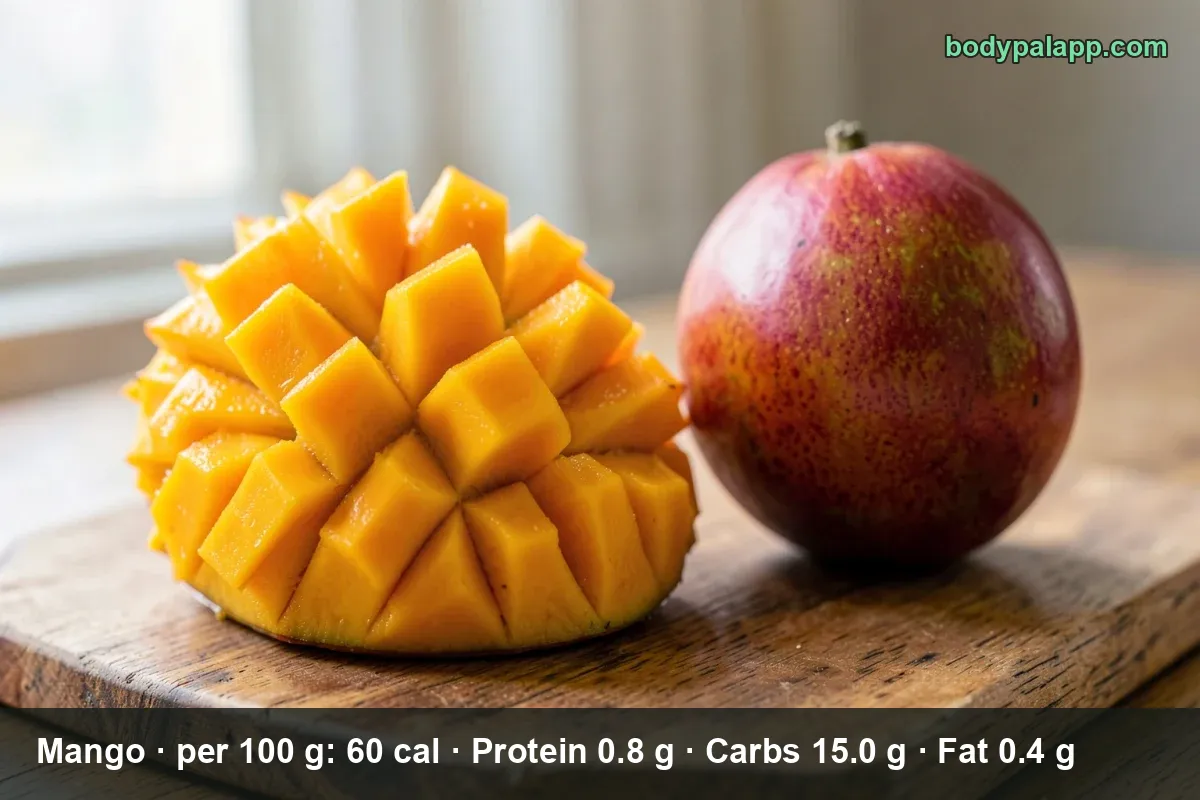
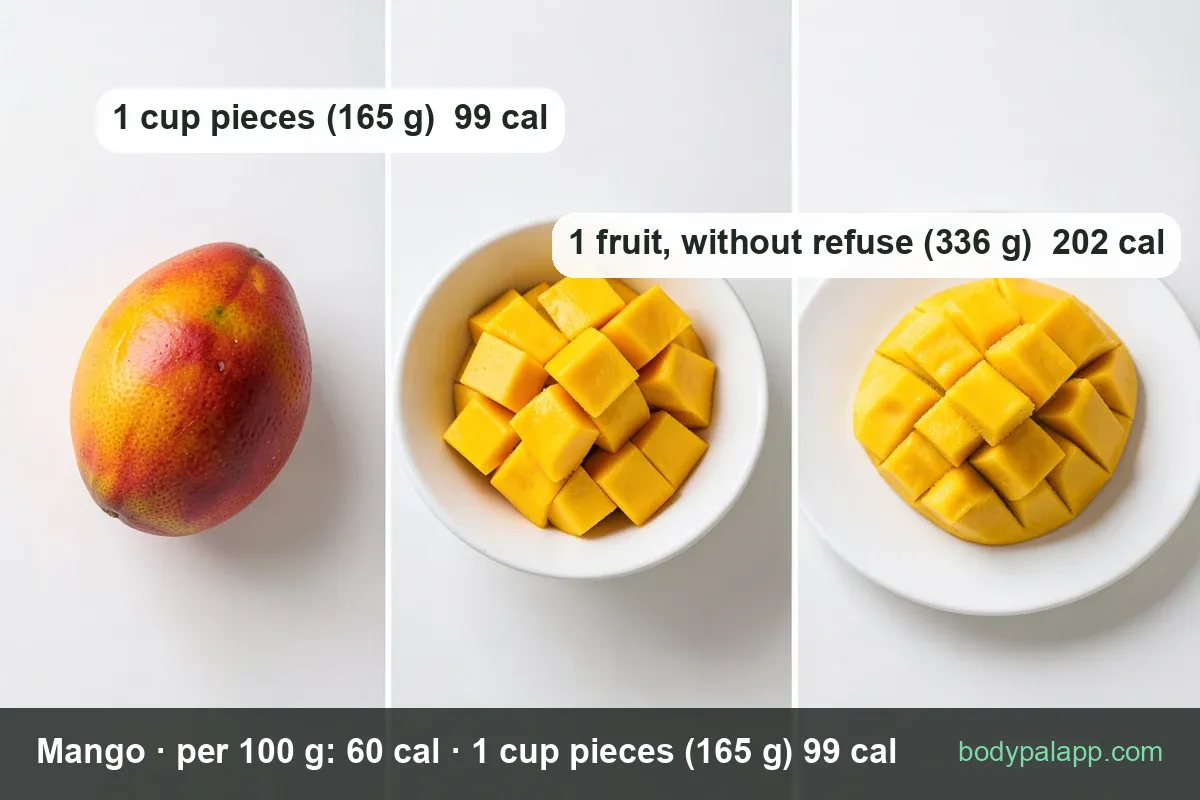
A 1-cup serving of fresh mango pieces weighs 165 g and carries 99 calories. Per 100 g raw mango is 60 calories, and almost all of that is the fruit's own sugar. Log a whole mango instead and that entry is 202 calories, because a mango without skin and pit runs 336 g.
On this page
- Mango quick facts
- US servings, from one ounce to a whole fruit
- Frozen, canned, dried and nectar
- Ataulfo vs Tommy Atkins
- Sugar is the row people worry about
- How does mango compare?
- Most popular mango brands
- Mango FAQs
Mango quick facts
The row that matches the fruit in your hand is SR Legacy 169910, "Mangos, raw". It is the only raw-mango record that carries the full set a label needs - sugars, saturated fat, sodium and potassium - and the only one with household measures attached, which is why the cup and the whole-fruit weights below are USDA's own and not a guess.
Two newer Foundation records exist for specific cultivars, peeled. They report energy by the Atwater calculation and skip sugars and saturated fat entirely, so they belong in the variety section further down rather than in the main table.
| Nutrient | Per 100 g | Per 1 cup pieces (165 g) | % Daily Value |
|---|---|---|---|
| Calories | 60 | 99 | — |
| Total fat | 0.38 g | 0.6 g | 1% |
| Saturated fat | 0.09 g | 0.1 g | 1% |
| Carbohydrate | 14.98 g | 24.7 g | 9% |
| Dietary fiber | 1.6 g | 2.6 g | 9% |
| Total sugars | 13.66 g | 22.5 g | — |
| Protein | 0.82 g | 1.4 g | 3% |
| Sodium | 1 mg | 2 mg | 0% |
% Daily Value is based on a 2,000-calorie diet.
Verified nutrition data
Numbers on this page come from USDA FoodData Central, the U.S. Department of Agriculture’s food composition database, and from manufacturer labels where a branded product is named. Last verified September 2026. How we verify our data →
There is no added-sugars row here on purpose: the SR Legacy edition has no field for it, and raw fruit has none to report. Cholesterol is 0 mg. Potassium is the quiet win at 168 mg per 100 g, which works out to 277 mg in a cup, or 6% of the FDA Daily Value of 4,700 mg.
US servings, from one ounce to a whole fruit
| Serving | Weight | Calories |
|---|---|---|
| 1 oz | 28 g | 17 kcal |
| 1/2 cup pieces | 83 g | 50 kcal |
| 1 cup pieces | 165 g | 99 kcal |
| 1 fruit, without refuse | 336 g | 202 kcal |
| Per 100 g | 100 g | 60 kcal |
Two of those weights come straight from USDA: the 165 g cup of pieces and the 336 g whole fruit. The half cup and the ounce are our own arithmetic from the USDA 100 g figure, not USDA servings.
That 336 g figure trips people up, so read it carefully. "Without refuse" means the flesh only, after the skin and the pit are gone - the fruit you carry home from the store is heavier than 336 g before you cut it. It also describes a generous mango. A small one you eat over the sink is closer to the cup entry than to the whole-fruit entry, and if you log the whole fruit by habit you are booking 202 calories for something that may have been 99.
This is the single biggest source of error in a mango entry. Cut, cube, and log the cup. If you would rather not weigh, half a large mango is a fair stand-in for one cup.
Frozen, canned, dried and nectar
| Version | Per 100 g | Typical serving | Calories |
|---|---|---|---|
| Raw mango | 60 kcal | 1 cup pieces (165 g) | 99 kcal |
| Frozen mango | 60 kcal | 1 cup pieces (165 g) | 99 kcal |
| Canned mango | 65 kcal | 1 cup (250 g) | 163 kcal |
| Dried sweetened mango | 319 kcal | 1 oz (28 g) | 90 kcal |
| Mango nectar | 51 kcal | 1 cup (251 g) | 128 kcal |
Frozen is the easy one. USDA's frozen mango record repeats the raw numbers line for line - 60 calories, 13.66 g of sugars, 1.6 g of fiber per 100 g - because freezing plain fruit adds nothing. The bag in your freezer is the same food as the fruit on the counter, and the cup weight we used for it is our arithmetic from the 100 g figure rather than a USDA household measure.
Canned mango sits a little higher at 65 calories per 100 g, with more sugar and less fiber than the raw fruit, since the packing syrup or juice comes along for the ride. A full cup weighs more than a cup of cut fruit too, so 163 calories is the honest number.
Dried sweetened mango is the one worth watching. At 319 calories per 100 g it is more than five times the raw fruit by weight, and a single ounce - roughly three or four strips, our own arithmetic from the 100 g figure rather than a USDA serving - lands at 90 calories, just short of a whole cup of fresh mango. That is water removed and sugar added, not a mango turned magically dense. The sodium moves too: 162 mg per 100 g against 1 mg raw.
Mango nectar behaves like a drink rather than a fruit. At 51 calories per 100 g it looks light, but a cup is 251 g and 128 calories, and the fiber collapses from 1.6 g per 100 g to 0.3 g. If mango shows up in your day as a bottled drink, that is the row to use.
Most mango products in USDA's branded database are drinks, in fact - juice cocktails, energy cans and blends, ranging from about 29 to 61 calories per 100 ml. There is no clean retail record for bagged frozen chunks or dried strips, which is why the generic USDA rows above do the work here.
Ataulfo vs Tommy Atkins
USDA measured two named cultivars separately, peeled and raw, and the gap is bigger than most people expect from the same fruit.
| Variety | Per 100 g | Serving | Calories |
|---|---|---|---|
| Ataulfo (honey) mango, peeled | 78.4665 kcal | 100 g | 78 kcal |
| Tommy Atkins mango, peeled | 68.4625 kcal | 100 g | 68 kcal |
Tommy Atkins is the big red-and-green oval that fills most US produce bins; Ataulfo is the small flat yellow one sold as honey or champagne mango. Both read higher than the 60 calories of the generic raw record, partly because they are peeled flesh only and partly because their energy is calculated by the Atwater factors rather than measured. Neither record reports sugars or saturated fat, so we cannot fill those rows for them and have not tried.
For everyday logging, stay with the 60 per 100 g figure. If you eat honey mangoes almost exclusively and want to be conservative, 78 per 100 g is the defensible ceiling - about 129 calories for a 165 g cup by our own arithmetic.
Sugar is the row people worry about
A cup of mango carries 22.5 g of total sugars. That is a real number and it is why mango gets called a sugar bomb, but the label rule matters: total sugars have no Daily Value, and the 50 g Daily Value you may have seen applies to added sugars only. Raw mango has none. Nothing in a cup of cut mango counts against that 50 g.
What the cup does deliver: 2.6 g of fiber, 9% of the 28 g Daily Value, alongside 277 mg of potassium at 6% and 2 mg of sodium at 0%. MyPlate counts one cup of cut fruit as one cup-equivalent toward the fruit group, so a mango cup is a full serving by that measure, not a partial one.
The comparison that actually changes a day is fresh against dried and against nectar. Same fruit, same shelf, three very different entries: 99 calories with 2.6 g of fiber, 90 calories from one ounce of dried strips, or 128 calories from a cup of nectar with almost no fiber left. If you are watching sugar and want to stay full, the fresh cup is the pick, and it is not close.
How does mango compare?
| Fruit | Per 100 g | US serving | Calories |
|---|---|---|---|
| Mango, raw | 60 kcal | 1 oz (28 g) | 17 kcal |
| Longans, raw | 60 kcal | 1 oz (28 g) | 17 kcal |
| Java-plum (jambolan), raw | 60 kcal | 1 oz (28 g) | 17 kcal |
| Pineapple, canned in juice, drained | 60 kcal | 1 oz (28 g) | 17 kcal |
Our take: all four of these land on exactly 60 calories per 100 g, which is the useful surprise here - mango is not the calorie outlier its reputation suggests, and canned pineapple drained of its juice matches it gram for gram. Since density is a tie, the only thing that separates them in your log is volume, and mango loses that contest because a cup of cubes is a big 165 g scoop. Eat mango for the fiber and the potassium, and control the portion with a measuring cup rather than by eye. Compare it with dried mango, not with other fresh fruit, if you want the number that actually moves your day.
Most popular mango brands in the United States
Ranked by how widely each product appears among foods sold in the United States, from the BodyPal food database of over 3.3 million products. Calories are the figures printed on each Nutrition Facts label, checked against USDA FoodData Central.
| Product | Calories (per 100 g) |
|---|---|
| Arizona Mucho Mango Drink | 42 cal |
| Monster Mango Loco Juice | 51 cal |
| Snapple Mango Madness Juice Drink | 42 cal |
| Arizona Mucho Mango Energy Drink | 29 cal |
| Naked Mighty Mango Blend of 5 Juices | 61 cal |
| Arizona Mucho Mango Fruit Juice Cocktail | 35 cal |
Brand popularity: BodyPal food database. Nutrition: manufacturer labels / USDA FoodData Central.
Mango FAQs
How many calories are in one whole mango?
202 calories for one mango without refuse, which USDA weighs at 336 g of flesh after the skin and pit are removed. That is a large fruit. Raw mango is 60 calories per 100 g, so a smaller mango yielding one cup of cubes is 99 calories instead - a difference worth weighing once.
How many calories in a cup of mango?
99 calories in one cup of mango pieces, which USDA weighs at 165 g. Half a cup is about 50 calories by our own arithmetic from the 100 g figure. The cup brings 24.7 g of carbohydrate, 2.6 g of fiber and 1.4 g of protein, with just 2 mg of sodium.
Is mango high in sugar?
Mango has 13.66 g of total sugars per 100 g, or 22.5 g in a 165 g cup. All of it is the fruit's own sugar; raw mango has no added sugars, and the 50 g Daily Value for added sugars does not apply to it. Dried sweetened mango is the version where added sugar appears.
How many carbs are in mango?
14.98 g of carbohydrate per 100 g of raw mango, which is 24.7 g in a 165 g cup, or 9% of the Daily Value. Fiber accounts for 2.6 g of that cup. A whole 336 g fruit works out to roughly 50 g of carbohydrate by our own arithmetic from the 100 g figure.
Does dried mango have more calories than fresh?
Yes, and by a lot: dried sweetened mango is 319 calories per 100 g against 60 for raw. One ounce, about 28 g, is 90 calories - nearly the same as a whole 165 g cup of fresh mango at 99. Water is removed and sugar is added, so weight is a poor guide here.
Is frozen mango as healthy as fresh mango?
Nutritionally it is identical, at 60 calories per 100 g either way. USDA's frozen mango record repeats the raw numbers exactly: 14.98 g of carbohydrate, 13.66 g of sugars and 1.6 g of fiber per 100 g. Plain frozen fruit has nothing added. Log a cup of frozen chunks the same way you log fresh, at 99 calories.
How much fiber is in a mango?
1.6 g of fiber per 100 g, which is 2.6 g in a 165 g cup and 9% of the 28 g Daily Value. A whole 336 g fruit gives about 5.4 g by our own arithmetic from the 100 g figure. Mango nectar keeps almost none of it, at 0.3 g per 100 g.
Is mango good for weight loss?
At 60 calories per 100 g it is one of the cheaper sweet things you can eat, and a 99-calorie cup brings 2.6 g of fiber and 277 mg of potassium. The catch is volume, not density: cups of cubes go down fast. Measure the cup, and skip the nectar at 128 calories.
Similar foods
- Fruit cup — 89 cal per cup
- Kiwi — 42 cal per medium kiwi
- Bartlett Pear — 112 cal per medium pear
- Bing Cherries — 97 cal per cup without pits
- Gala Apple — 98 cal per medium apple
- Pear — 101 cal per medium pear
Count it without the math
Point the camera at the plate and BodyPal counts the mango for you, cup or whole fruit.


How long does it take to burn off mango?
A 1-cup (165 g) serving is 99 kcal. Enter your weight and the amount you ate to see how long it takes you to burn that off:
lb
| Activity | Time to burn 99 kcal |
|---|---|
| Walking, brisk | 20 min |
| Cycling, moderate | 12 min |
| Swimming, moderate | 14 min |
| Jogging | 12 min |
| Weight training, moderate | 22 min |
Times are for a 155 lb adult at a steady pace; change the weight to see yours. The amount is set to the portion in the text (165 g); change it to what you actually ate. BodyPal works this out from your steps automatically.
Want the bigger picture? Calculate your daily calorie needs — your maintenance figure, a target for losing or gaining, and the date you get there.