
How many calories in a fruit cup?
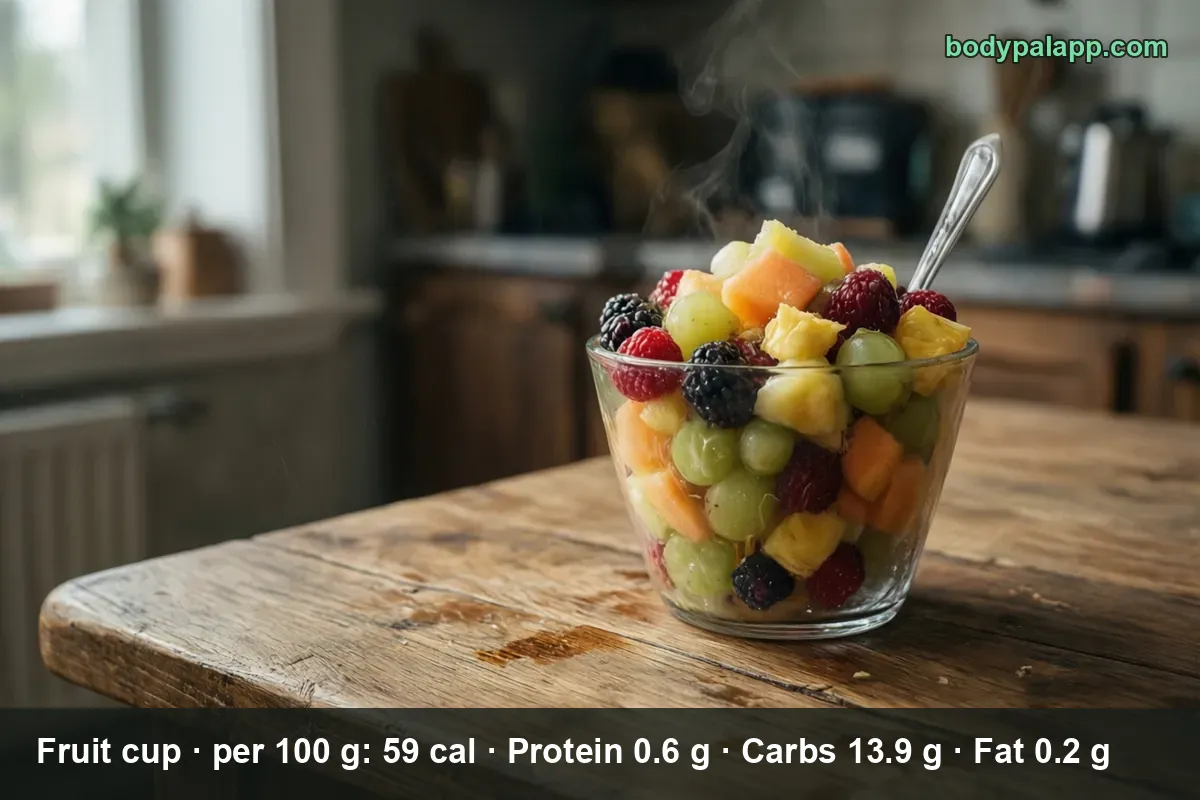
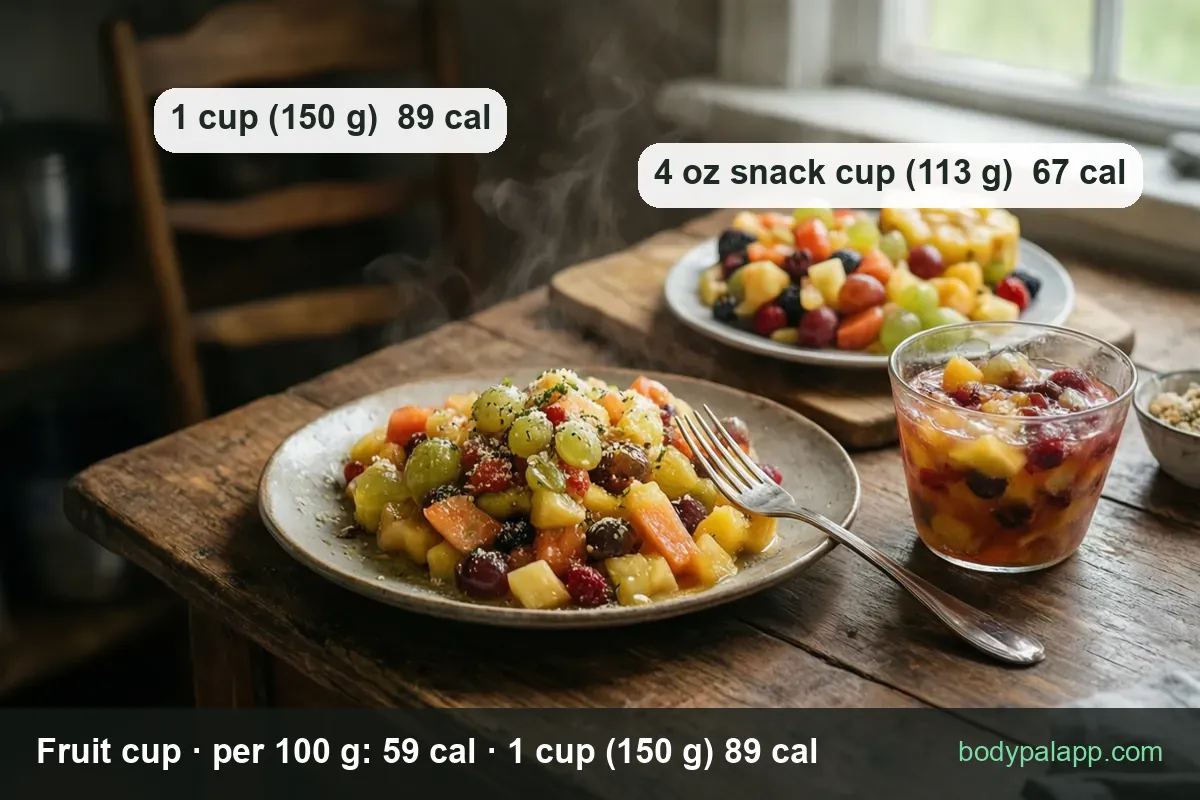
A 1-cup serving of fresh fruit cup, 150 g of cut melon, pineapple, grapes and berries, is 89 calories. Per 100 g it is 59. The grab-and-go snack cup out of the cooler is a smaller object, 4 oz or 113 g, and comes to 67. A cup of tropical fruit canned in heavy syrup is 221.
On this page
- Fruit cup quick facts
- USDA has no record called a fruit cup
- US serving sizes, cup by cup
- The cup that weighs 249 grams
- Fresh, in juice, in syrup
- What whipped cream does to the number
- What 89 calories of fruit buys you
- How does a fruit cup compare?
- Most popular fruit cup brands
- FAQ
Fruit cup quick facts
The reference is the deli-counter version: fresh cut fruit, nothing poured over it, no citrus in the mix. Melon, pineapple, grapes, berries. The thing in the clear plastic cup by the register.
| Nutrient | Per 100 g | Per 1 cup (150 g) | % Daily Value |
|---|---|---|---|
| Calories | 59 | 89 | — |
| Total fat | 0.21 g | 0.3 g | 0% |
| Saturated fat | 0.04 g | 0.1 g | 0% |
| Carbohydrate | 13.94 g | 20.9 g | 8% |
| Dietary fiber | 1.5 g | 2.3 g | 8% |
| Total sugars | 10.45 g | 15.7 g | — |
| Protein | 0.64 g | 1.0 g | 2% |
| Sodium | 4 mg | 6 mg | 0% |
% Daily Value is based on a 2,000-calorie diet.
Verified nutrition data
Numbers on this page come from USDA FoodData Central, the U.S. Department of Agriculture’s food composition database, and from manufacturer labels where a branded product is named. Last verified September 2026. How we verify our data →
Two rows a packaged label would carry are absent for the same reason: USDA publishes no added sugars figure and no trans fat figure for this record. Cut fruit with nothing added has no added sugar in any practical sense, but writing a zero the source never printed would be inventing it. Total sugars carry no Daily Value on a US label, which is why that cell is empty rather than zero.
Two more numbers sit in the same record without appearing on the label. Cholesterol is 0 mg. Potassium is 190 mg per 100 g, or 285 mg in a cup, about 6% of the 4,700 mg Daily Value.
The two rows worth staring at are fiber and sodium. A cup gives 2.3 g of fiber, 8% of the day, from something that costs 89 calories. It gives 6 mg of sodium, which rounds to nothing. Almost no other prepared item at a deli counter can say both of those things.
USDA has no record called a fruit cup
Search USDA FoodData Central for "fruit cup" and you get nothing. Not a thin result, an empty one. "Fruit cup" is what Americans call it; USDA files it as fruit salad.
The record behind every fresh number on this page is FNDDS 2709287, "Fruit salad, fresh or raw, excluding citrus fruits, no dressing", from the 2021–2023 survey release. That description is the deli cup written out in full. No dressing means no syrup, no cream, no mayonnaise-bound party salad, and the exclusion of citrus matches what actually goes into these cups: melon, pineapple, grapes, berries.
A companion record covers the version with orange or grapefruit in it, at 56 calories per 100 g instead of 59, because citrus is mostly water. Three calories is not a difference you can taste or usefully log. It matters only so that a chart quoting 56 and a chart quoting 59 do not look like a contradiction. Both are correct.
The canned cups sit in a different USDA collection, SR Legacy, and they are a genuinely different food. That section is further down.
US serving sizes, cup by cup
| Serving | Weight | Calories |
|---|---|---|
| 1 oz | 28 g | 17 |
| ½ cup | 75 g | 44 |
| 4 oz snack cup | 113 g | 67 |
| 100 g | 100 g | 59 |
| 1 cup | 150 g | 89 |
USDA's household measure for this record is a cup at 150 g, and that is the figure most calorie charts print. Every other row in that table is our own scaling of the 59 calories per 100 g, because USDA publishes no ounce or snack-cup portion for this food. The 150 g cup is also not the cup most people are holding.
The grab-and-go snack cup is sold by fluid ounces, not by USDA cups. Four ounces of fruit is 113 g, and 113 g of cut fruit is 67 calories. Log it as "1 cup" because that is the button in the app and you have written down 89. The overcount is 22 calories, which is a third more than the thing actually contained.
The error runs in a friendly direction here. It matters because it is the same mistake people make with yogurt, salad and cereal, where the gap is not 22 calories.
The half-cup row is the one to memorize if you build your own: 75 g of cut fruit is 44 calories.
The cup that weighs 249 grams
Here is the trap that makes canned fruit look like a bargain and a rip-off at the same time, depending on which column you read.
Fresh fruit cup is 59 calories per 100 g. Canned in 100% juice it is 50. Lower. Obviously lower, and every per-100 g chart on the internet will tell you so.
Now weigh the cup. USDA's cup of fresh cut fruit is 150 g, because fruit is chunky and a cup of chunks holds air. USDA's cup of canned fruit in juice is 249 g, because the juice fills every gap and gets counted, drunk or not. In water it is 245 g; in heavy syrup, 257 g.
So the same word, cup, describes two objects that differ by two thirds of their weight. Run the arithmetic and the ranking flips:
- Fresh fruit cup, 1 cup, 150 g: 89 calories
- Canned in 100% juice, 1 cup, 249 g: 125 calories
Forty percent more calories from the food with fewer calories per gram. The liquid did that.
Drain the juice and you land somewhere between the two, but there is no honest figure for it: USDA weighs solids and liquids together and publishes no drained line. If you drain, weigh what is left and use the per-100 g number. That is the only version of the sum that is not a guess.
Fresh, in juice, in syrup
To compare packing liquids fairly, the weight has to be held still. Every row below is our own scaling to the same 4 oz cup, 113 g, not a USDA portion, so the only thing changing is what the fruit is sitting in.
| Version | Per 100 g | 4 oz cup (113 g) |
|---|---|---|
| Canned in water, no sugar added | 30 | 34 |
| Canned in 100% juice | 50 | 57 |
| Fresh, with citrus | 56 | 63 |
| Canned in light syrup | 58 | 66 |
| Fresh, no citrus | 59 | 67 |
| Tropical, canned in heavy syrup | 86 | 97 |
| Canned in extra heavy syrup | 88 | 99 |
Top to bottom the spread is 30 to 88 calories per 100 g, near enough a tripling, and the fruit inside barely moves across those rows. Peach, pear, apricot, pineapple, cherry: the same five in the water pack and the extra-heavy-syrup pack. What changes is the liquid.
The row that surprises people is light syrup at 58, sitting one calorie under fresh fruit at 59. Light syrup is not a health claim, it just is not very concentrated, and fresh fruit is not calorie-free. They land in the same place.
Water pack is the outlier worth acting on. At 30 calories per 100 g it is half of fresh, because peaches canned in water give up some of their own sugar to the can. A whole 245 g cup is 74 calories, less than a 150 g cup of fresh cut fruit, and it keeps in a cupboard.
The tropical cup is the one to watch. Pineapple, papaya, banana and guava in heavy syrup runs 86 calories per 100 g and a full 257 g cup is 221 calories, which is three times the water pack for something that reads as fruit either way. That is the SR Legacy tropical record; the juice-pack record is the one behind the 50 and the 125.
What whipped cream does to the number
Fruit is a rounding error next to what people put on top of it.
| Fruit cup with… | Per 100 g | Per 1 cup |
|---|---|---|
| Nothing (fresh) | 59 | 89 (150 g) |
| Pudding | 133 | 242 (182 g) |
| Nondairy whipped topping | 148 | — |
| Whipped cream | 158 | 288 (182 g) |
| Marshmallows | 244 | 417 (171 g) |
A cup of fruit with whipped cream is 288 calories against 89 for the same fruit bare. The topping is not an addition, it is the meal: fat goes from 0.21 g per 100 g to 10.37 g, and saturated fat from 0.04 g to 2.94 g.
Sodium says it more bluntly. Plain fresh fruit cup is 4 mg per 100 g; with marshmallows it is 122 mg, thirty times as much, and 244 calories per 100 g puts an ambrosia salad closer to ice cream than to fruit. The version bound with salad dressing or mayonnaise reaches 240 calories and 124 mg of sodium per 100 g, which is why this page does not treat it as a fruit cup at all.
Nondairy topping is not the saving it looks like: 148 calories per 100 g against 158 for real cream. USDA lists no cup weight for that record, so there is only the density to print.
The position, rather than the table: eat the fruit plain, or accept that you ordered a dessert. There is no middle version where a fruit cup with cream is still a fruit cup.
What 89 calories of fruit buys you
Per cup, against the FDA Daily Values printed on every US label:
- Dietary fiber 2.3 g — 8% of the day
- Carbohydrate 20.9 g — 8%
- Protein 1.0 g — 2%
- Sodium 6 mg — 0%
- Total fat 0.3 g — 0%
Fiber and carbohydrate land on the same 8%, which is the honest summary of this food: carbohydrate and water with a useful amount of fiber attached, and almost nothing else. One gram of protein per cup will not hold anyone until the next meal.
That is a job description, not a criticism. MyPlate counts cut fruit toward the daily fruit target cup for cup, and a fruit cup is the easiest way there is to hit it away from a kitchen. Pair it with something carrying protein and it is a good snack; eat it alone at eleven and you will be hungry at noon.
The 15.7 g of sugar in a cup looks large and needs one sentence of context. All of it was already in the melon and the grapes, which is why no added sugars figure exists for this record. Sugar in whole cut fruit arrives with fiber and water attached, the entire distinction the Dietary Guidelines for Americans draw between fruit and candy.
How does a fruit cup compare?
| Version | Per 100 g | One cup | Calories | Protein | Carbs |
|---|---|---|---|---|---|
| Fresh fruit cup | 59 | 150 g | 89 | 1.0 g | 20.9 g |
| Canned in water | 30 | 245 g | 74 | 0.9 g | 19.3 g |
| Canned in 100% juice | 50 | 249 g | 125 | 1.3 g | 32.5 g |
| Tropical, heavy syrup | 86 | 257 g | 221 | 1.1 g | 57.5 g |
| With whipped cream | 158 | 182 g | 288 | 3.8 g | 26.6 g |
Our take: if you are counting, the water-pack can wins outright at 74 calories for a full 245 g cup, and it is the only row here that gives you more food for fewer calories than fresh. Fresh cut fruit is second at 89 and worth the small premium for texture. The juice pack is the row to be careful with, because 125 calories a cup is more than fresh despite the lower density, and the tropical syrup cup at 221 is a dessert wearing fruit's name.
Most popular fruit cup brands in the United States
Ranked by how widely each product appears among foods sold in the United States, from the BodyPal food database of over 3.3 million products. Calories are the figures printed on each Nutrition Facts label, checked against USDA FoodData Central.
| Product | Calories (per 100 g) |
|---|---|
| Del Monte Diced Peaches in 100% Juice Fruit Cup Snacks | 53 cal |
| Del Monte Tropical Fruit Cup | 49 cal |
| Del Monte Mixed Fruit Cup | 40 cal |
| Del Monte Fruit Cups, Diced Mangos | 38 cal |
| Crunch Pak Orange Fruit Cups | 71 cal |
| Zee Zees Fruit Cup, Peaches, Diced, 4.5 oz | 55 cal |
Brand popularity: BodyPal food database. Nutrition: manufacturer labels / USDA FoodData Central.
Fruit cup FAQs
How many calories in a fruit cup?
89 calories in a 1-cup (150 g) serving of fresh cut fruit, at 59 calories per 100 g. The 4 oz grab-and-go snack cup weighs 113 g and comes to 67. A half-cup, 75 g, is 44 calories.
How many calories in a fruit cup with syrup?
66 calories for a 4 oz cup in light syrup, 97 for tropical fruit in heavy syrup and 99 in extra heavy syrup. A full 257 g cup of the tropical heavy-syrup version is 221 calories, against 89 for a cup of fresh cut fruit.
How many carbs in a fruit cup?
20.9 g in a 1-cup (150 g) serving, which is 8% of the Daily Value, and 13.94 g per 100 g. A cup of fruit canned in 100% juice carries 32.5 g, because the cup weighs 249 g once the juice is counted.
Is a fruit cup healthy?
A cup gives 2.3 g of fiber, 8% of the Daily Value, for 89 calories and 6 mg of sodium, which is 0% of the day. Protein is 1.0 g, so it works as a snack rather than a meal. Syrup packs and whipped-cream versions change that picture entirely.
How many calories in a Del Monte fruit cup?
Del Monte's fruit cup snacks run between 38 and 53 calories per 100 g depending on the fruit. The diced peaches in 100% juice cup is 53 per 100 g, or 60 calories for the 113 g cup, and the mixed fruit cup is 45 for the same size.
Is canned fruit lower in calories than fresh?
Per 100 g, canned in juice is lower: 50 against 59 for fresh. Per cup it is higher, 125 against 89, because a cup of canned fruit weighs 249 g with the juice and a cup of fresh cut fruit weighs 150 g. Only the water pack wins both ways at 30 per 100 g and 74 a cup.
How many calories in a fruit cup with whipped cream?
288 calories for a 1-cup (182 g) serving, at 158 per 100 g. That is more than three times the 89 calories in a plain cup of fresh fruit. Fat rises from 0.21 g per 100 g to 10.37 g, and nondairy whipped topping saves almost nothing at 148.
How much sugar is in a fruit cup?
15.7 g in a 1-cup (150 g) serving, or 10.45 g per 100 g. All of it is the sugar already in the melon, pineapple, grapes and berries. USDA publishes no added sugars figure for this record, and total sugars carry no Daily Value on a US label.
Similar foods
- Red Delicious Apple — 125 cal per medium apple
- Honey Mango — 99 cal per cup pieces
- Honeycrisp Apple — 109 cal per medium apple
- Mango — 99 cal per cup pieces
- Blueberries — 84 cal per cup
- Gala Apple — 98 cal per medium apple
Count it without the math
Point the camera at the cup and BodyPal works out whether it is the 150 g one or the 113 g one before you log it.


How long does it take to burn off a fruit cup?
A 1-cup (150 g) serving is 89 kcal. Enter your weight and the amount you ate to see how long it takes you to burn that off:
lb
| Activity | Time to burn 89 kcal |
|---|---|
| Walking, brisk | 18 min |
| Cycling, moderate | 11 min |
| Swimming, moderate | 13 min |
| Jogging | 10 min |
| Weight training, moderate | 20 min |
Times are for a 155 lb adult at a steady pace; change the weight to see yours. The amount is set to the portion in the text (150 g); change it to what you actually ate. BodyPal works this out from your steps automatically.
Burning it off is one side of it. The other is knowing your number: work out how many calories you need a day, with macros and a goal date.